About Innovation Hub
 Global Content Pulse (Webinars)


 Global Production Financing
(Webinars)
Global Production Financing
(Webinars)  LeaderSpeak Podcast
  About Vitrina
 Our Story
 Our Solutions 🔥
 Film+TV Projects Tracker 🚀
 Case Studies
 Our Profile

Gap financing in 2026 isn’t just a “safety net” anymore—it’s the engine driving the independent film supply chain. It’s a debt facility secured against unsold international territories, typically covering 10-35% of an indie film’s budget. By leveraging sales forecasts instead of hard collateral, producers can greenlight projects that traditional banks won’t touch.
Look, the market’s shifted. Streamers aren’t handing out “cost-plus” deals like candy anymore. If you’re an independent producer today, you’ve got to be part CFO, part strategist. You’re dealing with a landscape where gap financing has become the new equity—it’s often safer, cheaper, and more predictable than finding high-net-worth individuals to take a first-loss position.
Table of Contents
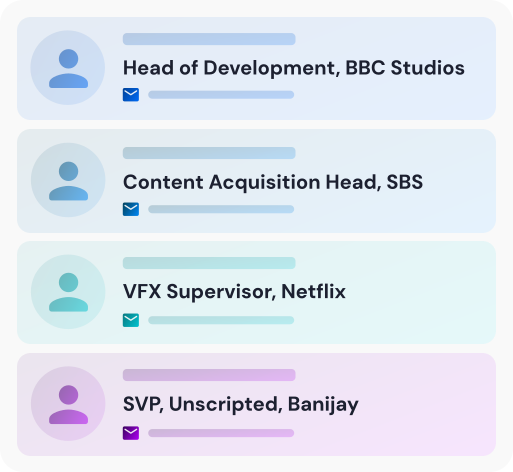
Stop Guessing Who’s Financing. Get Targeted Outreach.
Stop searching and start getting funded. We identify the exact decision-makers currently backing projects like yours, turning raw data into risk-aligned capital partnerships.
Major Studios
Scouting early stage projects, IP, and Regional partners for global studio pipelines.
IP Owners & Leads
Connecting creative leads with qualified financiers and major streaming platforms.
Streamers
Securing high-value pre-buy content and discovering early-stage global IP for platforms.
Indie Producers
Bridging the gap for indie filmmakers to reach executive production partners and capital.
Global Financing Ecosystems
Mapping complex markets and pairing projects with disciplined, risk-aligned capital across global territories worldwide.
The Mechanics of Gap Loans in 2026
In 2026, the “Big Crunch” is real. Capital flows toward projects that are “de-risked” from day one. Gap loans work because they rely on the *estimated* value of unsold territories. If you’ve sold the US and UK but have Germany, Japan, and France still on the table, a gap lender looks at those “holes” and lends you money against them.
Here’s the rule of thumb: lenders typically won’t lend more than 50-65% of the sales agent’s *low* estimate. This is known as the 60% rule. If your agent says Japan is worth $100k, don’t expect a lender to give you more than $60k against it.
“The independent film landscape has shifted dramatically. You’re not just selling a movie; you’re selling a financial instrument that happens to be a story.” — Phil Hunt, CEO of Head Gear Films.
Expert Insight: Phil Hunt on the current finance landscape:

5 Ways to Raise Gap Financing Now
Raising gap isn’t just about calling a bank. It’s about packaging. In today’s market, there are 5 proven ways to raise gap financing for an indie feature. You might start with a specialist media lender, or you might find a sales agent who provides “in-house” gap.
- The Pure-Play Media Banks: Institutions that understand “soft money” and pre-sales.
- Boutique Gap Funds: Private capital that takes higher risks for 12-18% interest.
- Sales Agent Advances: Selling the rights early to get the cash you need to start.
- Hybrid Mezzanine-Gap: Blending middle-tier debt with gap for projects over $10M.
- Sovereign Hub Backstops: Using locations like Saudi Arabia or South Korea to secure the final 20% of the budget.
Producers who want to move fast often use Vitrina’s VIQI AI to research which lenders are currently active in specific genres—it saves weeks of manual outreach.
The Vitrina Capital Stack Optimizer™
How do you structure your 2026 project for maximum “bankability”? Use this framework to check your readiness before hitting the markets.
*Optimizing this stack reduces your IRR requirements for equity partners, making the project easier to close.
Gap vs. Mezzanine vs. Senior Debt
Understanding the “waterfall” is crucial. If you don’t know who gets paid first, you’re going to lose your shirt in the negotiation. Gap loans differ from senior debt primarily in their collateral. Senior debt is usually backed by *guaranteed* money—like a government tax credit or a signed Netflix license.
But what about that middle tier? Gap vs. Mezzanine financing is a common debate. Mezzanine sits between gap and equity. It’s usually unsecured and carries a much higher interest rate because if the movie flops, the Mezzanine lender is the last one to see a dime before the equity guys. For a deep dive, check out our guide to mezzanine financing in 2026.
While banks are being cautious, senior debt for indies remains active if you have your completion bonds in order. Don’t even walk into a bank without a bond commitment. It’s a non-starter.
Find the Financiers Backing Your Genre
Stop searching and start getting funded. We identify the exact decision-makers currently backing projects like yours, turning raw data into risk-aligned capital partnerships.
Negotiating Pre-Sales and Platform Deals
The “Ask and Take” negotiation is an art form. You’re trying to sell rights before production begins to prove to the gap lender that the market actually wants your film.
But don’t just take the first offer. Pricing your pre-sales strategically means holding back some territories. If you sell everything upfront, you have no “gap” to borrow against. It’s a delicate balance: sell enough to satisfy the bank, keep enough to pay for the gap.
Protecting the Margin: Financial Controls
You’ve secured the gap. You’ve got the greenlight. Now don’t blow it. Managing production cost overruns is the fastest way to lose the trust of your lenders. If your gap lender sees your “hot costs” spiraling, they might freeze the next draw.
Smart productions use real-time hot cost templates to monitor spending daily. In 2026, lenders don’t want a weekly report—they want a dashboard. If you can’t show them the numbers by 8 PM every night, you’re not playing at the pro level.
Frequently Asked Questions
Can I get gap financing for a first-time director?
It’s much harder, but possible if the package is “bulletproof.” You’ll likely need a very experienced line producer and a sales agent with a massive track record. Expect the gap lender to charge a higher interest rate—usually 2-3 points higher than an established director would pay.
What is the typical interest rate for gap loans in 2026?
We’re seeing rates between 8% and 15% per annum. However, you also have to factor in legal fees, which can run $15k-$30k per lender, and origination fees (usually 1-2%). All-in, your effective rate is often closer to 18% if the loan is only for a 6-month period.
Does gap financing cover post-production?
Yes, usually gap is part of the “production” loan, but it can be specifically used to bridge the gap into the delivery stage. Just be careful: if you spend your gap money on the shoot and hit an overrun, you won’t have enough to finish the VFX. That’s why monitoring sets is so vital.
Is mezzanine financing safer than gap?
No, quite the opposite. Mezzanine is riskier for the lender and more expensive for the producer. Gap is secured against specific territory estimates; mezzanine is often secured against the “back end” or residuals, which are much harder to predict.
How Vitrina Helps with Gap Financing
Finding the right financial partner shouldn’t be a game of “who you know.” It should be about who is active and interested in your genre.
- Research: Use VIQI to ask specific questions about lender requirements and deal structures.
- Discovery: Sign up for free to explore our database of 600,000+ verified supply chain companies, including 150+ specialist film lenders.
- Expert Support: Need a direct connection? Our Concierge Service matches your project with vetted lenders within 48 hours.
The Bottom Line
Gap financing in 2026 is the bridge between a dream and a delivery. It’s complex, it’s expensive, but it’s the most powerful tool in the independent producer’s kit. By mastering sales forecasts, understanding the stack, and maintaining iron-clad financial controls, you can keep your project—and your profit margin—on track.
Find Film+TV Projects, Partners, and Deals – Fast.
VIQI matches you with the right financiers, producers, streamers, and buyers – globally.
Producers Seeking Financing, Co-Pros, or Pre-Buys?
Vitrina Concierge helps producers reach the right financiers, commissioners, distributors, and co-production partners — with precision outreach, not cold pitching.
Join Industry Briefings Trusted by Leaders

Format Adaptations: Global Trends
Where formats are traveling, which adaptations are breaking out, and how streamers are backing remakes in 2025–2026.

Books, Novels & Comics Adaptations: Global Trends
Books, webtoons, and manga driving the next global screen hits. Discover how in this webinar.

Micro-Dramas & Mobile-First Storytelling
Micro-dramas are building real audiences and revenue. Understand the platforms, buyers, and economics behind the growth.

Navigating Global Content Licensing Trends
How global content licensing is shifting beyond flat fees to flexible, deal-driven models.