About Innovation Hub
 Global Content Pulse (Webinars)


 Global Production Financing
(Webinars)
Global Production Financing
(Webinars)  LeaderSpeak Podcast
  About Vitrina
 Our Story
 Our Solutions 🔥
 Film+TV Projects Tracker 🚀
 Case Studies
 Our Profile
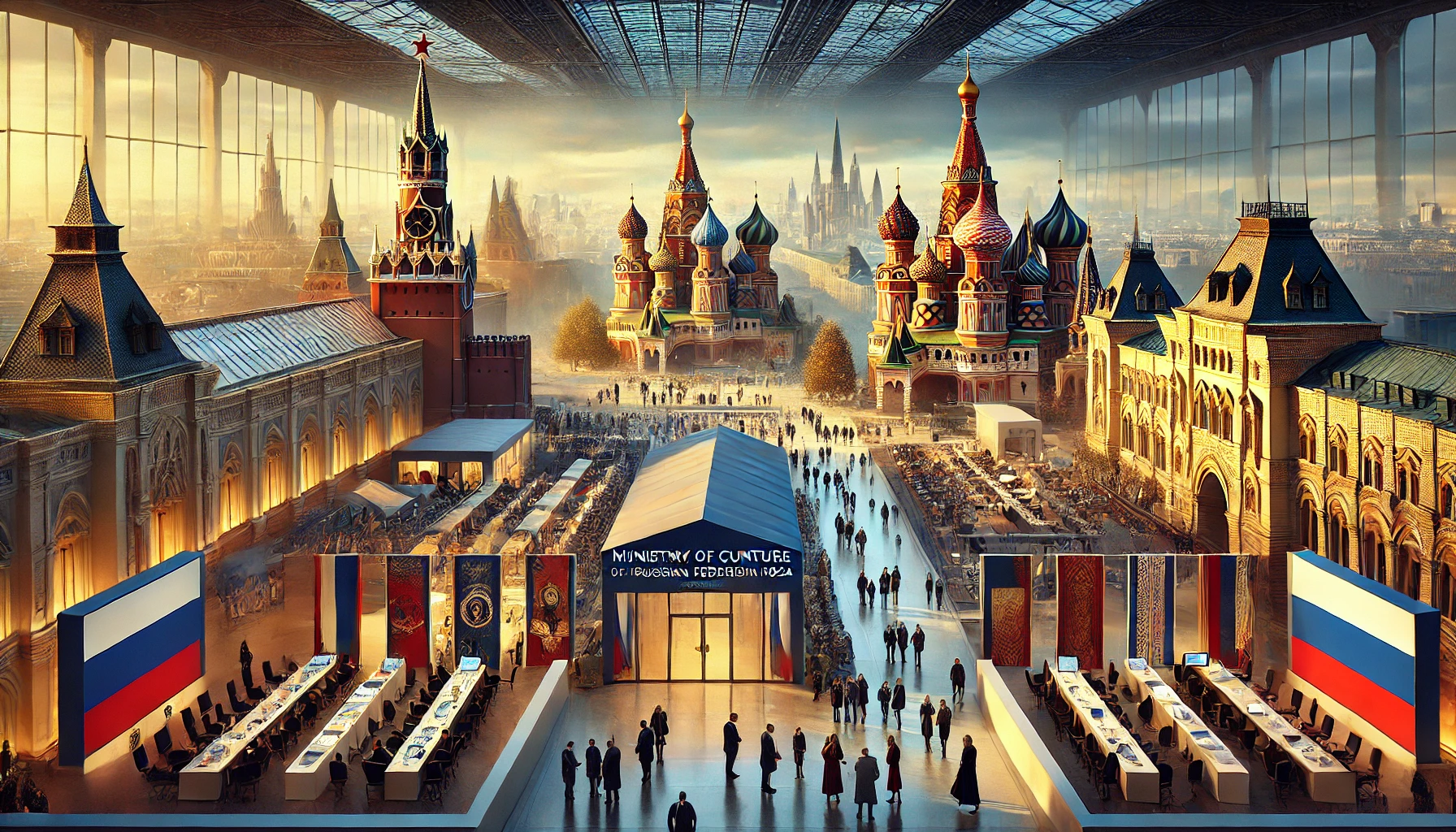
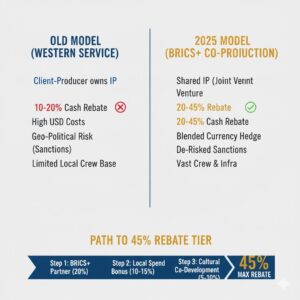 Table of Contents
-
-
- The Great Pivot: Russia’s 2025 Production Landscape
- Federal Rebate Mechanics: The 30% to 45% Tiers
- The Moscow Film Cluster: Infrastructure as a Subsidy
- Risk Mitigation: Navigating the Ministry of Culture Expert Board
- Beyond Moscow: Primorsky and Kaliningrad Incentives
- The Vitrina Advantage: Sourcing Verified Partners
-
Strategic Executive Insights
| Topic | Strategic Insight |
|---|---|
| Effective Rebate Cap | Maximum support hits 45% (30% cash rebate + 15% in-kind logistics/infrastructure support). |
| Minimum Local Spend | Typically requires a minimum of 15 million RUB (~$165,000 USD) spent within the Russian territory. |
| Co-Production Requirement | Rebates are not direct-to-foreign-entity; they must be managed via a registered local service company. |
| Vitrina Intelligence | Vitrina maps 2,200+ active Russian production entities, identifying those with recent co-pro success. |
1. The Great Pivot: Russia’s 2025 Production Landscape
According to the latest 2024-2025 market reports, Filming in Russia has entered a phase of aggressive infrastructure-led growth. Following the exit of Hollywood majors, the domestic industry—supported by the Ministry of Culture—has shifted its gaze toward BRICS+ partnerships. The volume of state funding for cinema reached record levels in late 2024, with over 150 feature films and series currently receiving some form of federal subsidy.
The “Insider’s” view reveals that while the political climate remains complex, the business of production is being streamlined. The government is actively positioning Russia as a “post-production and VFX powerhouse” for Asian and Middle Eastern markets, offering world-class talent at a significant currency discount. For the international executive, the priority is no longer just finding a location, but securing a partner who can guarantee liquidity through the rebate system.
2. Federal Rebate Mechanics: The 30% to 45% Tiers
The federal rebate for international cinema production is managed through the Russian Export Center (REC). While the baseline rebate is a 30% cash return on qualifying local spend, the 2025 updates introduced “uplift” categories that make the territory uniquely competitive on the global stage.
-
-
- Base Rebate (30%): Covers cast/crew salaries, location rentals, and equipment hire.
- Infrastructure Uplift (+10%): Triggered when utilizing the new Moscow Film Cluster facilities for at least 60% of the production schedule.
- Post-Production Bonus (+5%): Awarded to projects that utilize Russian VFX houses for their entire post-production pipeline.
-
The “catch” for international producers is the auditing process. All expenses must be meticulously documented by the local service provider. This is why vetting the financial reputation of your Russian partner is more critical than their creative reel.
3. The Moscow Film Cluster: Infrastructure as a Subsidy
When discussing Filming in Russia, the conversation invariably centers on the “Moscow Film Cluster” (MFC). This initiative, spearheaded by the Moscow Mayor’s Office, functions as a vertical integration of production support. The MFC includes the Moskino Film Park, one of the largest outdoor backlots globally, and the METMET Film Factory, which focuses on virtual production.
The “Insider” insight here is that the MFC acts as a soft-subsidy. By filming within the cluster, producers gain access to free permits for major city landmarks, discounted rates on state-owned equipment, and a dedicated liaison to the Ministry of Internal Affairs for complex logistics. This “one-stop-shop” model is designed to mirror the efficiency of established hubs like Prague or Toronto.
4. Risk Mitigation: Navigating the Ministry of Culture Expert Board
The approval of rebates is not automatic; it is selective. Every project is reviewed by an “Expert Board” within the Ministry of Culture. This board evaluates projects on two primary axes: Economic Benefit (local spend/jobs) and Cultural Diplomacy.
To mitigate risk, international executives should focus on the “Service Plus” model. Rather than just a pure service hire, forming a minority co-production with a Russian studio often smooths the regulatory path. These local studios have the “Expert Board” relationships necessary to shepherd a project from application to final disbursement.
Projects that align with economic impact and cultural diplomacy benchmarks are more likely to secure approvals when routed through structured platforms for submitting production proposals, rather than relying on informal or ad-hoc submissions.
5. Beyond Moscow: Primorsky and Kaliningrad Incentives
While Moscow provides the infrastructure, regional commissions in territories like Kaliningrad and the Primorsky Territory (Vladivostok) offer localized “cash-back” programs. In Kaliningrad, for example, regional rebates can reach 40% for specific types of content, particularly those that highlight the region’s unique European-style architecture.
The Primorsky Territory is increasingly favored by Chinese and Indian productions due to its proximity and specialized “Eastern Gateway” visa regime. These regions operate with their own budgets and evaluation criteria, often providing a faster (though smaller-scale) approval cycle than the federal ministry in Moscow.
6. The Vitrina Advantage: Sourcing Verified Partners
The greatest friction in Filming in Russia is the search for a trustworthy local anchor. Vitrina’s global database removes this opacity by mapping 150,000+ companies, including over 2,200 entities within Russia. By analyzing “Hero Projects”—such as Yash Raj Films’ Pathaan or high-budget domestic epics—producers can identify which vendors have the institutional capacity to deliver on complex rebate audits.
Through Vitrina, executives can access verified contact details for CXOs at major studios like Central Partnership, Art Pictures Studio, and others who are actively seeking international collaborations. This data-driven approach transforms a high-risk gamble into a strategic, de-risked expansion into a high-rebate territory. For international executives evaluating multiple territories, access to a verified film commission directory alongside studio and vendor intelligence significantly reduces entry risk and accelerates production decision-making.
Frequently Asked Questions
What is the maximum possible rebate for filming in Russia in 2025?
The total effective support can reach 45%, comprising a 30% cash rebate on federal spend, with potential uplifts of 10% for using the Moscow Film Cluster and 5% for post-production work done locally. Executives should use Vitrina to verify which local partners are currently certified to handle these high-tier applications.
Do foreign production companies receive the rebate directly?
No. Rebates are paid to the registered Russian service provider or co-production partner. This entity must have a clean tax record and must have filed all necessary production reports to the Russian Export Center (REC) or the Ministry of Culture.
What are the minimum spend requirements for the Moscow rebate?
The minimum threshold for the Moscow-specific grant is generally around 15 million RUB (~$165,000 USD). However, regional incentives in places like Kaliningrad may have lower entry points for smaller indie projects or documentaries.
How long does the rebate disbursement process take?
The evaluation by the Expert Board takes roughly 30-45 days. The final disbursement of funds occurs after the project has been completed, the audit is verified, and the film has secured its distribution or exhibition certificate in Russia.