About Innovation Hub
 Global Content Pulse (Webinars)


 Global Production Financing
(Webinars)
Global Production Financing
(Webinars)  LeaderSpeak Podcast
  About Vitrina
 Our Story
 Our Solutions 🔥
 Film+TV Projects Tracker 🚀
 Case Studies
 Our Profile

| Strategic Pillar | Executive Insight |
|---|---|
| The 30% Cash Reimbursement | Applicable to Qualifying Production Expenditure (QPE) in India for features, series, and animation with a cap of INR 300 million per project. |
| The 5% Content Bonus | An additional 5% bonus is available for projects that demonstrate “Significant Indian Content” or employ a high percentage of Indian crew. |
| Single Window Clearance | The FFO (Film Facilitation Office) serves as the centralized gateway for all permits, effectively reducing bureaucratic lead times by 60%. |
| Vitrina Relevance | Access verified profiles of Indian Line Producers who have successfully managed audits for major international streamers. |
Strategic Roadmap
The Incentive Architecture: Decoding the 30% Rebate
The centerpiece of Filming in India is the Audio-Visual Co-production and Foreign Production Incentive Scheme. For foreign productions—ranging from live-action features to high-end digital animation—the government offers a 30% cash reimbursement of Qualifying Production Expenditure (QPE). According to data from the Ministry of Information and Broadcasting, this incentive was significantly enhanced at Cannes 2024 to attract large-scale global projects that previously bypassed India due to fiscal caps.
The cap is the critical metric: a project can now claim up to INR 30 Crore (~USD $3.6 million). To qualify, a production must meet a minimum expenditure floor of INR 2.5 Crore (~USD $300,000) within the territory. This makes India not just a destination for indie darlings, but a viable hub for studio tentpoles. The QPE includes local labor, rental services, transportation, and post-production, provided these services are procured through registered Indian entities.
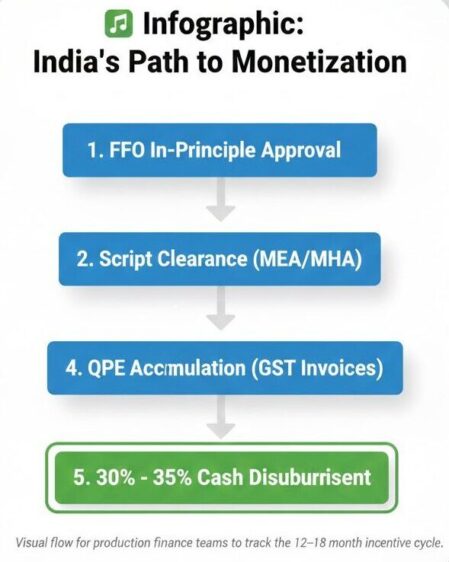
The bottom line for financiers is the Audit Trail. The rebate is a post-production disbursement. To ensure a smooth exit, every invoice must be GST-compliant and mapped to the “In-Principle” approval granted by the FFO. Why does this matter? Because any deviation in the QPE from the initial budget submitted can trigger a “Verification Hold” during the final audit phase.
Navigating the FFO: The Single-Window Permit Strategy
Historically, the “India permit” was a fragmented process involving dozens of local authorities. Today, the Film Facilitation Office (FFO), managed under the aegis of the National Film Development Corporation (NFDC), serves as the Single Window gateway. This office doesn’t just issue permits; it acts as the primary interface for the incentive application.
According to Invest India, the FFO has reduced permit turnaround times from months to a standard 3-4 week window for most scripts. For productions involving sensitive areas or defense assets, the lead time remains longer, but the centralized web portal allows for real-time tracking of applications.
The strategy for international producers is to engage a local Production Service Company (PSC) that is SIRECINE-equivalent. These PSCs manage the script clearance with the Ministry of External Affairs and the Ministry of Home Affairs, which is a mandatory prerequisite for the FFO permit.
Bonus Multipliers: Maximizing the 5% Content Top-Up
India offers a unique fiscal “Top-Up.” In addition to the base 30% reimbursement, productions can unlock an additional 5% bonus, bringing the total potential rebate to 35%. This bonus is triggered by two specific criteria: Significant Indian Content (SIC) or the employment of a significant Indian workforce.
The SIC criteria are measured through a points-based system that assesses the cultural relevance of the project—locations, characters, and storylines that highlight India’s heritage or contemporary society. Alternatively, employing a crew where at least 15% of the HODs (Heads of Department) are Indian nationals serves as an equivalent qualifier for the bonus.
Stacking Incentives: Federal vs. State-Level Benefits
Strategic producers do not stop at the federal rebate. Several Indian states offer their own localized incentives that can be “stacked” on top of the 30% federal credit. Uttar Pradesh, Madhya Pradesh, and Uttarakhand are currently the most aggressive in this space, often providing cash subsidies for projects that spend a specific number of shooting days within the state.
For instance, a production shooting a significant portion in Uttar Pradesh can claim state-level subsidies ranging from INR 1 Crore to INR 3 Crore, provided they utilize a certain percentage of local cast and crew. This layering of incentives effectively lowers the net local spend by nearly 40% in some cases, making India one of the most cost-efficient hubs in Asia for large-scale production.
Vitrina Briefing: Sourcing Vetted Indian Partners
The success of a 30% rebate application rests entirely on the quality of your local production partner. Vitrina de-risks the India greenlight by mapping the verified track records of Indian PSCs who have successfully cleared FFO audits for global platforms like Netflix, Amazon, and Disney+.
Accelerate Your India Discovery
Strategic Conclusion
India’s 30% incentive is a structural shift that demands a new approach to regional production finance. It is no longer a territory to be “managed” through external HODs alone; it requires a deep integration with the FFO ecosystem and a rigorous commitment to GST-compliant accounting. The potential for a 35% net rebate, when combined with some of the lowest BTL (Below-The-Line) costs globally, positions India as a primary competitor to traditional Eastern European and Southeast Asian hubs.
The path forward for studio executives is to transition from speculative scouting to data-driven selection. By utilizing Vitrina’s verified project and collaborator data, you can identify the exact local partners who can bridge the gap between a complex script and a clean financial exit. The India greenlight is now as much a fiscal decision as it is a creative one.
Strategic FAQ
What is the minimum spend required for the 30% India incentive?
To qualify for the federal incentive, a foreign production must incur a minimum local expenditure of INR 2.5 Crore (approximately USD $300,000) within the territory of India.
How is the 5% Content Bonus calculated?
The bonus is awarded if the project meets “Significant Indian Content” criteria (points-based for cultural relevance) or if the Indian workforce constitutes a significant portion of the crew HODs.
Is post-production and animation spend eligible for the rebate?
Yes, expenditure on post-production, VFX, and animation services performed by registered Indian entities is considered Qualifying Production Expenditure (QPE) under the scheme.
Can state subsidies be stacked with the federal 30% rebate?
Yes, many Indian states allow their localized subsidies to be claimed alongside the federal rebate, provided the project meets the specific filming and employment criteria of that state.