About Innovation Hub
 Global Content Pulse (Webinars)


 Global Production Financing
(Webinars)
Global Production Financing
(Webinars)  LeaderSpeak Podcast
  About Vitrina
 Our Story
 Our Solutions 🔥
 Film+TV Projects Tracker 🚀
 Case Studies
 Our Profile
“regional content investment
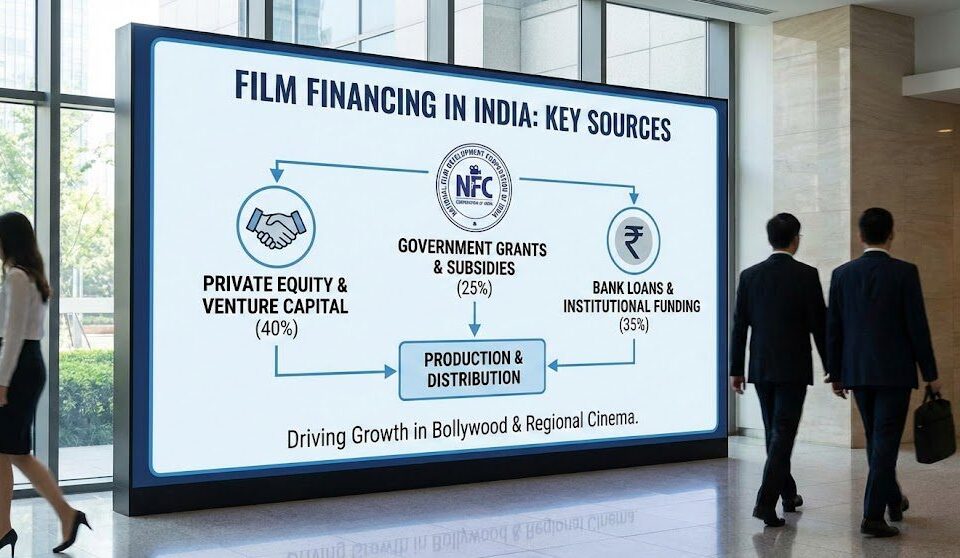
Film financing in India is a multi-layered process of securing capital through institutional lenders, private equity, government incentives, and emerging digital licensing models.
This involves orchestrating a mix of equity, debt, and soft-money incentives to mitigate production risk and ensure project completion.According to recent industry analysis, India’s media and entertainment sector is projected to reach $30 billion by 2026, driven by a 25% increase in regional content investment.
In this guide, you’ll learn actionable strategies for IPR securitization, navigating NFDC schemes, and leveraging supply chain intelligence to identify active financiers.
While traditional resources focus on high-level lists of financiers, they often fail to address the technical nuances of modern deal structuring or the impact of global distribution shifts on local funding.
This comprehensive guide addresses those gaps by providing technical depth on innovative funding mechanisms and a step-by-step roadmap for securing institutional backing in today’s fragmented market.
Table of Contents

Your AI Assistant, Agent, and Analyst for the Business of Entertainment
VIQI AI helps you plan content acquisitions, raise production financing, and find and connect with the right partners worldwide.
- Find active co-producers and financiers for scripted projects
- Find equity and gap financing companies in North America
- Find top film financiers in Europe
- Find production houses that can co-produce or finance unscripted series
- I am looking for production partners for a YA drama set in Brazil
- I am looking for producers with proven track record in mid-budget features
- I am looking for Turkish distributors with successful international sales
- I am looking for OTT platforms actively acquiring finished series for the LATAM region
- I am seeking localization companies offer subtitling services in multiple Asian languages
- I am seeking partners in animation production for children's content
- I am seeking USA based post-production companies with sound facilities
- I am seeking VFX partners to composite background images and AI generated content
- Show me recent drama projects available for pre-buy
- Show me Japanese Anime Distributors
- Show me true-crime buyers from Asia
- Show me documentary pre-buyers
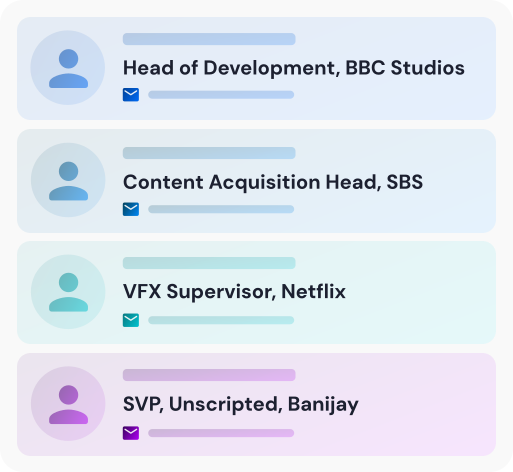
- List the top commissioners at the BBC
- List the post-production and VFX decision-makers at Netflix
- List the development leaders at Sony Pictures
- List the scripted programming heads at HBO
- Who is backing animation projects in Europe right now
- Who is Netflix’s top production partners for Sports Docs
- Who is Commissioning factual content in the NORDICS
- Who is acquiring unscripted formats for the North American market
Key Takeaways for Producers
-
Intellectual Property Focus: Securitizing IPR allows producers to raise capital against future revenue streams without diluting creative ownership or project equity.
-
Incentive Optimization: Leveraging NFDC schemes can provide up to 30% reimbursement on production costs, significantly reducing the initial funding requirement for regional projects.
-
Data-Driven Sourcing: Using supply chain intelligence platforms like Vitrina helps identify active financiers and co-production partners 70% faster than traditional networking.
-
Digital Window Strategy: Structuring deals with a mix of SVoD and FAST channel licensing ensures rotational revenue windows post-theatrical release.
What is Modern Film Financing in India?
Modern film financing in India has evolved from a closed network of private financiers to a sophisticated marketplace involving corporate studios, venture capital, and institutional debt. This transformation is driven by the industry’s need for transparency and the rapid globalization of Indian content. Producers now utilize a “stack” approach, combining multiple sources to cover the budget.
The core of this evolution is the transition from individual relationship-based lending to a data-powered framework. This shift allows for more predictable ROI calculations and broader access for independent creators. For acquisition leads, understanding this stack is crucial for evaluating project health and rights availability.
Find film financiers and production partners in India:
How Does IPR Securitization Work in Indian Cinema?
IPR (Intellectual Property Rights) securitization is an innovative financing method where a filmmaker leverages the anticipated future cash flows of a project’s rights as collateral for an immediate loan. In the Indian context, this typically involves packaging theatrical, digital, and satellite rights to secure institutional funding. It is a powerful tool for high-concept projects with strong franchise potential.
To succeed with IPR securitization, producers must have a robust chain of title and verified valuation metrics. Industry leaders use supply chain data to demonstrate market demand for specific genres or talent attachments, providing lenders with the “data trust” needed to approve significant capital outlays.
Analyze recent film licensing deals in the Indian market:
Industry Expert Perspective: Incentive Scheme For Production Of Foreign Films In India
This briefing from NFDC leadership provides a foundational understanding of how global financing standards are being integrated into the Indian production ecosystem through official co-production treaties.
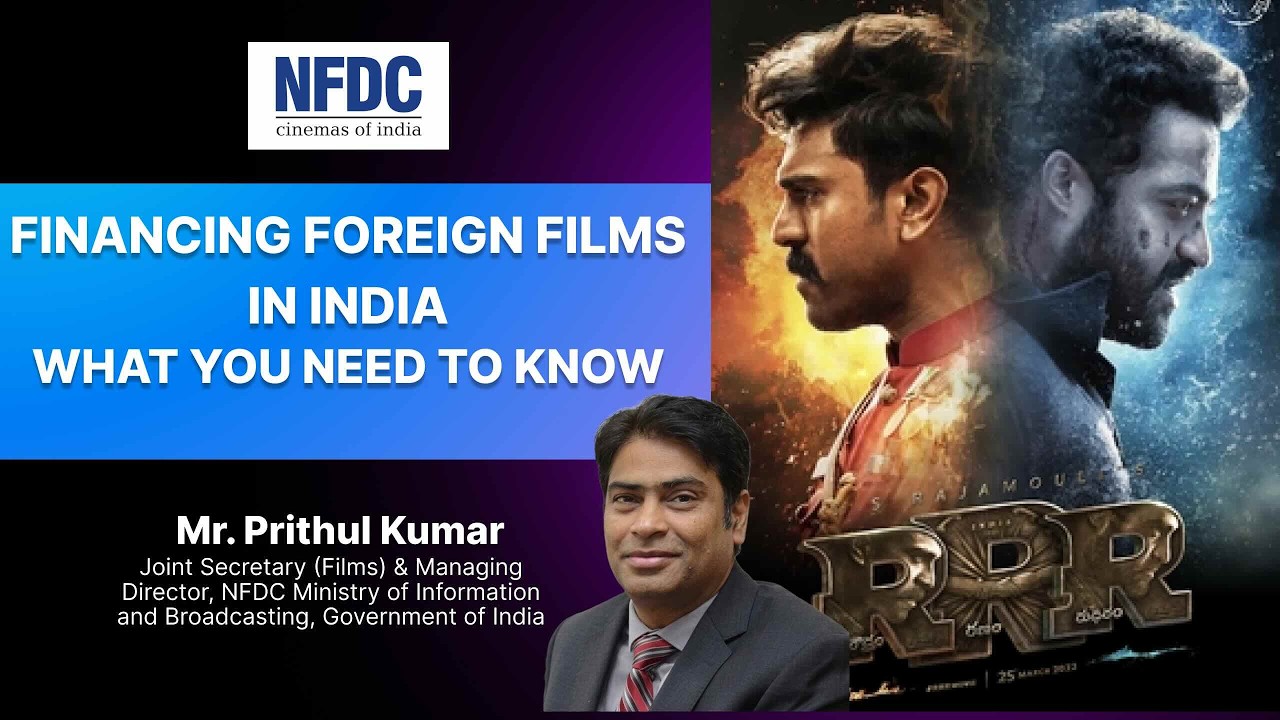
Mr. Prithul Kumar (Joint Secretary, Films) discusses initiatives by the Ministry of Information and Broadcasting to aid international film production and official co-productions under bilateral agreements. These schemes are critical for producers looking to de-risk their financing through official state support.
Crowdfunding in Indian Cinema: Strategy vs. Success Stories
Crowdfunding has emerged as a viable “gap-filler” for independent Indian cinema, particularly for projects that don’t fit the traditional commercial mold. Platforms like Kickstarter and Wishberry have hosted successful campaigns for films like Lucia and Manthan (re-release funding), proving that a passionate community can replace a corporate financier.
However, the strategy is less about the “money” and more about “audience building.” A successful crowdfunding campaign acts as a proof-of-concept for larger distributors. By tracking these grassroots movements through project trackers, acquisition leads can identify high-demand indie IP before it reaches the festival circuit.
Discover trending independent projects in India:
How Do Government Film Incentives Work (NFDC)?
The National Film Development Corporation (NFDC) offers several schemes aimed at promoting Indian cinema, including production incentives for regional films and grants for international co-productions. These incentives are designed to lower the barrier to entry for quality storytelling. Typically, these involve a reimbursement of qualified production expenditure (QPE) incurred within India.
Maximizing these incentives requires early-stage planning and adherence to strict reporting standards. Producers must ensure their projects qualify as “officially sanctioned” co-productions to unlock the highest tiers of support. Supply chain intelligence helps verify the track record of co-production partners to ensure eligibility and compliance.
Find verified co-production partners in India:
The Impact of Streaming Platforms on Financing Strategies
The arrival of global SVoD giants has fundamentally changed the financing risk profile for Indian films. Pre-licensing deals—where a platform acquires streaming rights before production is complete—provide essential “gap financing” that can make or break a project. This model has expanded beyond Hindi cinema into the “Big Four” South Indian markets, creating a boom in regional production.
However, as the market matures into “Weaponized Distribution,” platforms are more selective. Strategic producers now track commissioning editor movements and platform acquisition preferences in real-time. This intelligence allows them to tailor their pitches to the exact needs of buyers, increasing the likelihood of securing high-value pre-sales.
Analyze platform acquisition trends in India:
Frequently Asked Questions
Quick answers to common queries about the Indian film financing landscape.
How can I secure film financing in India as an independent producer?
What are the best government schemes for filmmakers in India?
Is crowdfunding a reliable source for film finance in India?
How do streaming platforms like Netflix affect film funding?
What is IPR securitization in the film industry?
Do Indian banks provide loans for film production?
How does Vitrina AI help in film financing?
Can foreign producers get funding in India?
Moving Forward
The film financing landscape in India has shifted from opaque, relationship-driven networks to a transparent, data-powered ecosystem. This transformation addresses critical gaps in access for independent creators and provides a structured framework for institutional investment. By leveraging innovative methods like IPR securitization and government schemes, producers can navigate the complexities of a fragmented market with greater confidence.
Whether you are an independent producer looking to secure pre-sales financing, or an acquisition lead trying to identify the next breakout regional hit, the principle remains: actionable intelligence drives deal velocity. Understanding the interplay between local incentives and global platform appetite transforms financing from speculation to strategy.
Outlook: Over the next 12-18 months, expect a surge in “Authorized Data” deals and co-production treaties, as India positions itself as a global hub for cost-effective, high-quality content production.
About the Author
Expert in Entertainment Supply Chain Content Architecture with over a decade of experience in SEO-optimized content strategy for global media markets. Specialist in navigating the intersection of technology and creativity to drive business growth. Connect on Vitrina.
Find Film+TV Projects, Partners, and Deals – Fast.
VIQI matches you with the right financiers, producers, streamers, and buyers – globally.
Producers Seeking Financing, Co-Pros, or Pre-Buys?
Vitrina Concierge helps producers reach the right financiers, commissioners, distributors, and co-production partners — with precision outreach, not cold pitching.
Join Industry Briefings Trusted by Leaders
Streamers – Netflix vs. Amazon – The 2026 Strategy
How Netflix and Amazon’s content and revenue strategies are diverging ahead of 2026.

Format Adaptations: Global Trends
Where formats are traveling, which adaptations are breaking out, and how streamers are backing remakes in 2025–2026.

Books, Novels & Comics Adaptations: Global Trends
Books, webtoons, and manga driving the next global screen hits. Discover how in this webinar.

Micro-Dramas & Mobile-First Storytelling
Micro-dramas are building real audiences and revenue. Understand the platforms, buyers, and economics behind the growth.