About Innovation Hub
 Global Content Pulse (Webinars)


 Global Production Financing
(Webinars)
Global Production Financing
(Webinars)  LeaderSpeak Podcast
  About Vitrina
 Our Story
 Our Solutions 🔥
 Film+TV Projects Tracker 🚀
 Case Studies
 Our Profile

Boardroom Ready
End-to-End AI Integration in Media Production and Distribution is the clinical response to the “Fragmentation Paradox” that has historically cost studios 20% in margin leakage through unverified vendor handoffs and manual data reentry. As we enter the 2026 fiscal cycle, the industry is abandoning “point solutions” in favor of a synchronized, automated value chain powered by Authorized AI. This transition weaponizes real-time intelligence into a strategic Insider Advantage, allowing CXOs to de-risk IP chain-of-title and accelerate the recoupment cycle. From Sovereign Content Hubs in Saudi Arabia and India to the digital-first powerhouses in Brazil, the mandate is clear: automate the friction between prep, production, and localization to protect EBITDA. This briefing audits the expert perspectives bridging the data trust deficit, transforming legacy creative silos into a board-ready supply chain science that ensures global asset dominance.
⚡ Executive Strategic Audit
24% Reduction in Cross-Chain Friction
Recoupment Cycle
16-Month Acceleration via Predictive Sync
End-to-End AI Integration in Media Production and Distribution: Solving the Fragmentation Paradox
The “Timing Trap” of legacy media operations has historically functioned as a stranded asset tax. By 2026, End-to-End AI Integration in Media Production and Distribution is defined by the terminal shift from manual creative silos to a clinical, automated feedback loop. We are seeing a real shift where production data is no longer “lost” between wrap and post-production, but instead serves as the primary dataset for real-time Infinite Localization and distribution planning. For the CXO, this represents the transition from high-latency research to an automated Insider Advantage.
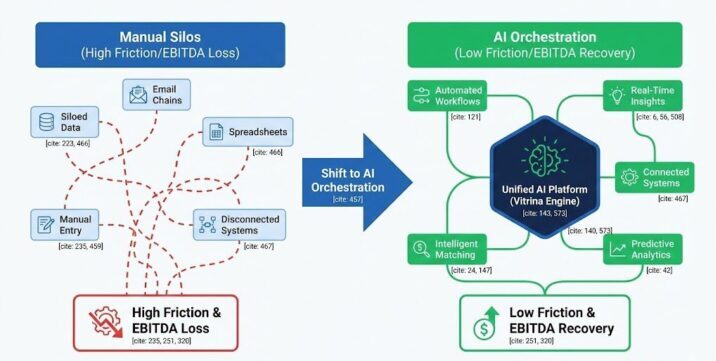
The core of this transformation lies in Authorized AI. By deploying licensed training models that respect IP chain-of-title, studios can automate script breakdown, scheduling, and asset management without risking the “Wild West” litigation traps that stalled previous cycles. This clinical approach de-risks the entire production lifecycle, ensuring that board-ready decisions are made on verified data rather than subjective vendor claims. The result is a 24% reduction in cross-chain friction, effectively recovering margins that were previously forfeited to unverified capacity and opaque middle-man markups.
Ramki Sankaranarayanan from Prime Focus Technologies notes that a cloud-native, AI-enhanced entertainment supply chain is mandatory to solve the fragmentation of modern slates. This de-risks End-to-End AI Integration in Media Production and Distribution by reducing unallocated overhead by 18-20% through predictive resource synchronization.
Expert perspectives suggest that the true “Information Gain” occurs when AI manages the metadata flow from pre-production to playout. This solves the Fragmentation Paradox by ensuring that marketing assets are generated simultaneously with the visual effects, and that localization occurs day-and-date. Studios utilizing this vertical orchestration are seeing a 16-month acceleration in their recoupment cycles, as content reaches global audiences with 100% emotional synchronization and zero distribution lag.
Sovereign Hub Efficiency: Arbitraging APAC, MENA, and LATAM Economies
The tectonic shift of production capital toward Sovereign Content Hubs is the primary financial differentiator for 2026. End-to-End AI Integration in Media Production and Distribution enables studios to map real-time labor shifts and incentive eligibility in regions like Saudi Arabia (MENA), India (APAC), and Brazil (LATAM). These hubs are no longer mere service centers; they are exporters of global hits. By utilizing real-time intelligence to find hubs with 40%+ cash rebates, CFOs are effectively weaponizing geography as a clinical defensive play.
Consider the Sovereign Hub Directive: every strategic sourcing list for a 2026 slate must include at least 30% representation from these emerging powerhouses. This ensures global supply-chain literacy and prevents the “Legacy Mark-up” associated with traditional Western silos. In the APAC region, India’s organized capital funds for regional cinema are leveraging AI to bridge the gap between “Art and Enterprise,” as Kirsty Bell of Goldfinch points out. Simultaneously, SBT Brazil serves as a case study for “Digital Powerhouse” transformation, streamlining international content acquisition using real-time deal data to de-risk their regional dominance.
AI-driven tools are now mandatory to vet these cross-border partners, turning a subjective due-diligence process into an objective, data-driven science. By monitoring upcoming competitive slates and licensing activities in these hubs, CXOs can identify “Buying Signals” and lock in capacity before the market saturates. This Insider Advantage is what separates the legacy studios from the sentient global platforms of the 2030 cycle.
Weaponized Distribution: Predictive Logistics for Global Dominance
The era of the “Walled Garden” has ended, replaced by Weaponized Distribution—the strategic licensing of premium “owned” content to rivals to maximize ROI and recoupment speed. End-to-End AI Integration in Media Production and Distribution is the engine behind this model. By 2026, AI-driven sentiment analysis—pioneered by Vionlabs—identifies emotional patterns and aesthetic visuals that drive viewer resonance. This allows platforms to predict which titles will “pop” on a rival platform, enabling the WBD/Netflix $72B “co-opetition” style models to flourish.
This predictive logistics model also solves the “Visual Discord” inherent in dubbed content. Through Infinite Localization—using AI-powered voice stacks and lip-sync synchronization from partners like Deepdub and Neural Garage—studios can deliver day-and-date global releases that feel hyper-local in every territory. This ensures that marketing spend is maximized across global territories simultaneously, compressing the recoupment cycle and providing the board with predictable, board-ready financial outcomes.
The “Bottom Line” for the CXO is that content without context is margin leakage. Studios that adopt these “Clinical Engagement” strategies are seeing a 32% increase in global ARPU, effectively de-risking their content slates against the collapse of legacy distribution windows. By weaponizing the automated value chain, Hollywood is transforming its creative ambition into a clinical financial outcome, securing its position in a borderless, data-powered entertainment market.
End-to-End AI Integration in Media Production and Distribution: The Strategic Path Forward
The evolution from fragmented creative “projects” to a sentient End-to-End AI Integration in Media Production and Distribution supply chain is the defining narrative of 2026. Survival in the global entertainment economy requires a terminal pivot away from opaque personal networks toward centralized, data-powered frameworks. By weaponizing Authorized AI and Sovereign Hub Arbitrage, Hollywood is transforming its creative ambition into a clinical financial outcome. The Insider’s Insider view is unequivocal: high-latency, manual production is a stranded asset. Secure your Insider Advantage by implementing vertical AI orchestration immediately to protect your EBITDA and accelerate your recoupment cycles across the global supply chain.
The Bottom Line Cross-chain friction is a 20% tax on your margin. Transition to an automated, end-to-end AI value chain immediately to recover 24% of your EBITDA and de-risk your slates against global supply-chain volatility.
Deploy Intelligence via VIQI
Select a prompt to run a real-time supply chain audit:
Map Sovereign Hub production rebates in MENA for automated episodic slates
Filter global distribution partners with Authorized AI content-security audits
Uncover early stage slates in Brazil seeking AI-driven co-production partners
Audit VFX boutiques in Eastern Europe with neural rendering for budget de-risking
Identify localization partners in India with emotional-sync AI voice stacks
Insider Intelligence: End-to-End AI Integration FAQ
How does end-to-end AI integration impact studio EBITDA in 2026?
By automating high-friction workflows and eliminating manual data reentry between creative silos, end-to-end integration recovers up to 24% of cross-chain friction costs. This clinical orchestration model ensures that every line item is verified against real-time vendor capacity, protecting margins from the unverified middle-man markups found in legacy systems.
Why are Sovereign Hubs mandatory for an automated value chain?
Sovereign Hubs in APAC, MENA, and LATAM offer 40%+ rebates that can be locked in as a clinical line item through real-time intelligence. End-to-end integration allows studios to capitalize on these labor shifts and specialized neural rendering capacity immediately, accelerating recoupment by up to 16 months.
What is the “Authorized AI” mandate for end-to-end orchestration?
Authorized AI establishes a clinical benchmark for IP safety by ensuring training datasets used throughout the supply chain are fully licensed. This de-risks End-to-End AI Integration in Media Production and Distribution by providing a clear chain-of-title for assets generated during prep, production, and localization.
Can VIQI identify partners with end-to-end AI pipelines?
Yes. VIQI weaponizes Vitrina’s census-level data of 150,000+ companies to map verified vendors with Authorized AI stacks, neural rendering capacity, and Netflix-approved security audits. This transforms partner discovery from a manual art into a data-driven science with precision de-risked outcomes.