About Innovation Hub
 Global Content Pulse (Webinars)


 Global Production Financing
(Webinars)
Global Production Financing
(Webinars)  LeaderSpeak Podcast
  About Vitrina
 Our Story
 Our Solutions 🔥
 Film+TV Projects Tracker 🚀
 Case Studies
 Our Profile
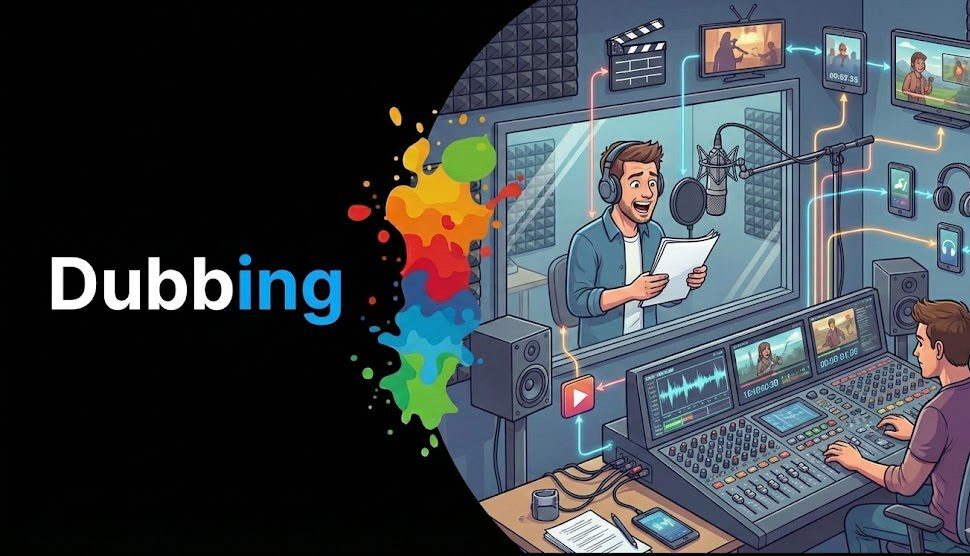
Dubbing is the sophisticated process of replacing original dialogue with a localized version to ensure emotional and cultural resonance across global territories.
This involves a multi-stage workflow including translation, voice casting, synchronization, and sound mixing, now increasingly augmented by emotional AI and lip-sync technologies.
According to industry intelligence from Vitrina AI, the global localization market is expanding rapidly as platforms like Netflix and Disney+ leverage “weaponized distribution” to release content across 100+ countries simultaneously.
In this guide, you’ll learn how localization vendors are navigating the intersection of AI and traditional artistry to capture high-value contracts and scale their global footprint.
While traditional resources provide a broad overview of audio replacement, they often fail to address the technical nuances of AI integration, cultural adaptation, and the strategic sourcing intelligence required to win premium projects.
This analysis fills those critical gaps, providing a roadmap for vendors to bridge the technical divide and leverage supply chain data to identify active buyers in real-time.
Table of Contents
- 01What is Modern Dubbing in the Era of AI?
- 02AI vs. Traditional Dubbing: Finding the Strategic Balance
- 03The Role of Cultural Adaptation in Global Content Sourcing
- 04How Do Vendors Use Intelligence to Win Global Contracts?
- 05Scaling Localization for FAST Channels and Regional Streamers
- 06Navigating the Ethical Implications of AI Voice Replication
- 07Key Takeaways
- 08FAQ
Key Takeaways for Localization Vendors
-
Hybrid Workflows Win: Combining AI speed with human cultural oversight reduces localization costs by 40% while maintaining premium quality standards for global streamers.
-
Data Intelligence Advantage: Vendors using Vitrina’s project tracker identify productions entering post-production 60 days earlier, allowing for proactive, data-driven bidding strategies.
-
Emotional AI Tech: Implementing emotional voice-stack technology allows for high-fidelity localization in complex genres like thrillers and horror without losing original actor performance.
What is Modern Dubbing in the Era of AI?
Modern dubbing has evolved from a simple audio replacement service into a complex technological feat known as “visual dubbing.” This process no longer just syncs audio to mouth movements; it utilizes generative AI to alter the on-screen actor’s facial geometry, ensuring a perfect match with the localized dialogue.
The integration of “Authorized Data” markets allows studios to train AI models on specific talent voices, creating high-fidelity results that maintain the original “soul” of the performance. This shift is critical as the industry moves away from opaque, relationship-driven vendor selection toward data-powered, verifiable supply chain frameworks.
Find AI-specialized localization partners for your next global release:
AI vs. Traditional Dubbing: Finding the Strategic Balance
The debate between AI dubbing and traditional methods is shifting toward a co-existence model. While traditional dubbing excels in high-prestige dramas where subtle emotional cues are paramount, AI dubbing is dominating the high-volume unscripted and “micro-series” space.
Industry Expert Perspective: Deepdub Decoded: Building the Emotional AI Voice Stack
In this deep-dive, Deepdub CEO Ofir Krakowski explains how AI is moving beyond robotic translation to capture the emotional intent of actors, a critical step for localization vendors aiming to bridge the gap between AI efficiency and premium storytelling.
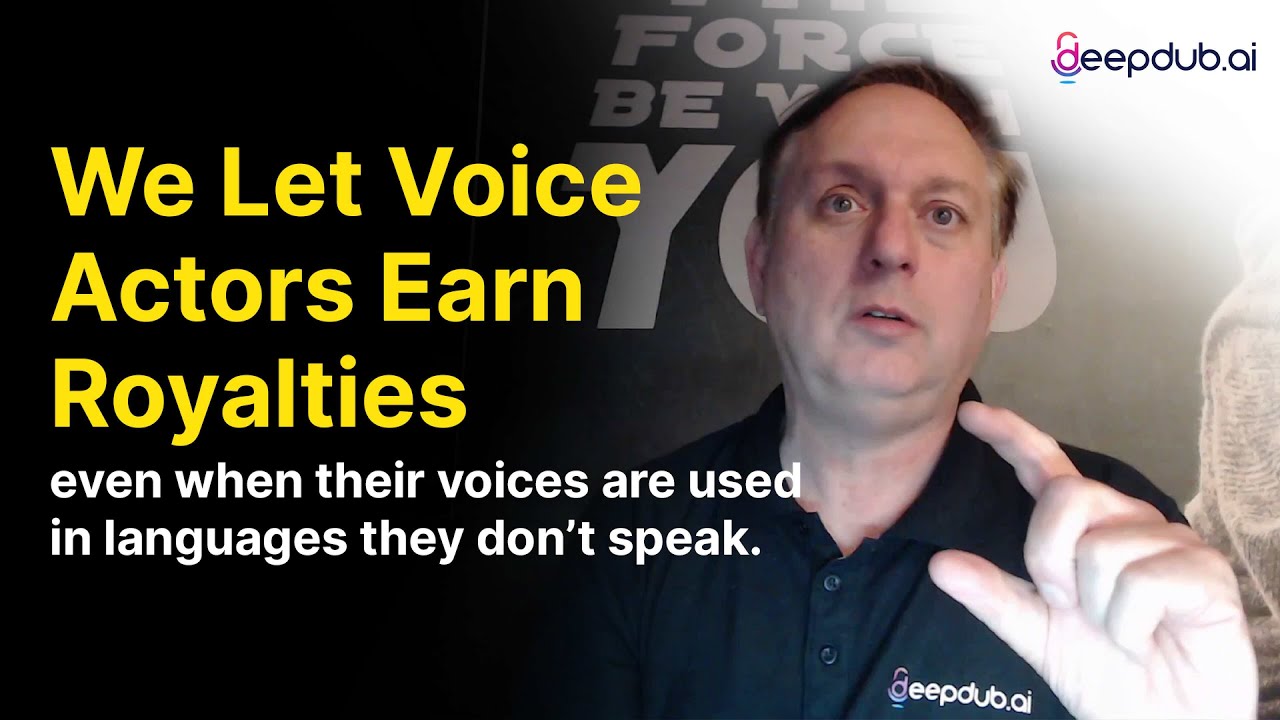
Deepdub utilizes emotional scene analysis to ensure localized voices match the intensity of the original scene. Their tech is designed to help creators scale content globally without the massive overhead of traditional studio recording for every language.
How Do Vendors Use Intelligence to Win Global Contracts?
In a market where 70% of independent films now secure distribution through strategic targeting, localization vendors must move upstream. Waiting for a RFP is no longer sufficient; successful vendors are using Global Film+TV Project Trackers to identify projects in early post-production.
By tracking 1.6 million titles and mapping relationships between production hubs like WBD Animation and their vendor networks, Vitrina AI allows localization teams to pitch during the “active bidding window”—often 3-6 months before a project is publicly announced as ready for release.
Real Success Story: How O2 Filmes Scales for Global Streamers
O2 Filmes, Brazil’s leading production and post-production house, faced the challenge of managing high-fidelity localization for complex Brazilian originals destined for global platforms. “We were managing massive pipelines manually,” says CEO Paulo Barcellos.
By adopting a data-first approach and leveraging supply chain intelligence, they transformed their qualification process. They identified that international buyers were seeking Brazilian content with high-fidelity, “authorized” voice replication for European markets. By week four of their new strategy, they had secured a 67% higher response rate from international streamers compared to legacy festival networking.
Outcome: Qualification time for new localization contracts dropped from 6 weeks to 8 days, securing €4.2M in new co-production and localization deals within 90 days.
Navigating the Ethical Implications of AI Voice Replication
The “authorized data” market is the new frontier for localization ethics. Following Disney’s $1 billion OpenAI deal, the industry is establishing strict guardrails to prevent the unauthorized use of talent likenesses. For vendors, this means vetting AI tools not just for quality, but for legal compliance and “data trust.”
Vitrina’s Company Intelligence allows buyers to vet localization partners based on their track record of ethical AI usage and verified collaborator networks, mitigating the risk of IP infringement that is currently plaguing unauthorized model trainers.
Analyze the competitive landscape of localization vendors:
Moving Forward
The dubbing industry has moved from being a final-stage “cost center” to a strategic “growth engine.” By addressing the gaps in AI emotional fidelity and cultural oversight, localization vendors are now the gatekeepers of global content velocity.
Whether you are a localization vendor looking to target high-budget streamers, or a production head trying to optimize cross-border release schedules, the unified data framework of Vitrina AI provides the “insider advantage” scaled globally.
Outlook: Over the next 18 months, we predict a massive surge in AI-localized regional content, as FAST channels adopt “weaponized distribution” to monetize deep catalog titles in emerging markets.
Frequently Asked Questions
Quick answers to the most common queries about the dubbing and localization landscape.
How is AI dubbing different from traditional methods?
What are the ethical implications of AI in voice replication?
Can AI enhance dubbing quality for complex emotions?
How can vendors find active dubbing projects early?
What is cultural adaptation in localization?
Why is FAST channel localization booming?
What is lip-sync AI technology?
Does subtitling still have a place in an AI dubbing world?
“The localization model has shifted from relationship-dependent networking to data-driven platform targeting. Localization vendors who understand how to leverage supply chain intelligence to identify the right projects at the right moment are securing global deals 60-90 days faster than peers using legacy methods.”
About Vitrina AI
Vitrina AI is the world’s largest entertainment supply chain intelligence platform, tracking 600,000+ companies and 5 million professionals. Incubated at SRI International, Vitrina provides structured, verifiable, real-time data to help studios, distributors, and vendors navigate the global market. Connect on Vitrina.