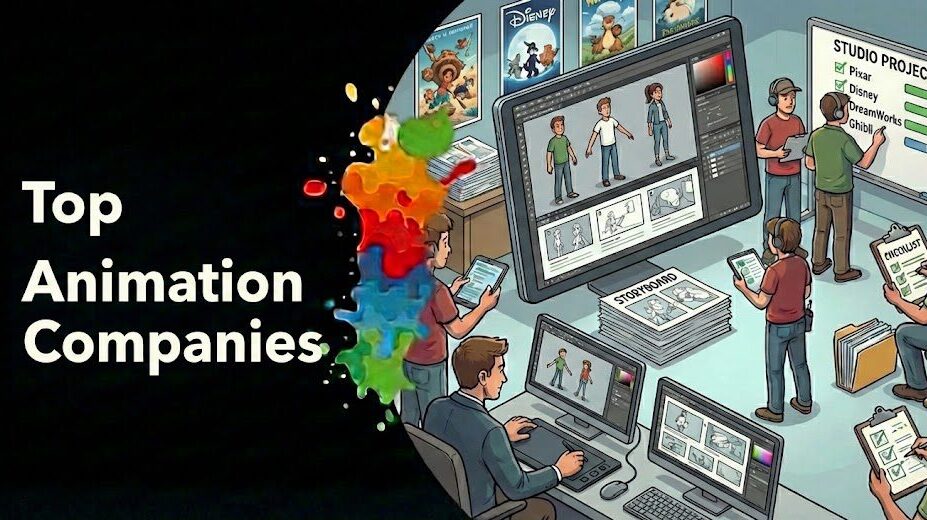
15 Top Animation Companies Driving the Global Content Boom in 2026

Share
Animation
Share
Top Animation Companies

QUICK ANSWER

The biggest animation companies in the world are Walt Disney Animation Studios, Pixar, DreamWorks Animation, Illumination, and Sony Pictures Animation in North America; Studio Ghibli, Toei Animation, and MAPPA in Japan; Aardman Animations and Cartoon Saloon in Europe; and CJ ENM in South Korea. By revenue, Disney dominates — its studio entertainment segment generates over $10 billion annually. By output volume, Toei Animation produces more episodes than any other studio globally.

By Sandeep Nikanke, Head of Intelligence — Film & TV Distribution, Vitrina AI | Last Updated: May 2026 | Tracked against Vitrina’s live database of 1.6M+ titles, 140,000+ entertainment companies, and animation deal flow across 100+ markets.

The global animation industry has grown far beyond Saturday morning cartoons. When you combine theatrical box office, streaming commissions, broadcast licensing, consumer products, and merchandise, the total animation ecosystem is estimated at approximately $462 billion globally in 2025 (Precedence Research). That figure isn’t a projection — it reflects the compounding economic layers built on top of animated IP, from a Pixar film that earns $1.7 billion at the box office to the plush toys still selling at airports fifteen years after a franchise launch.

For producers, buyers, and studio executives, the challenge isn’t finding animation studios. It’s finding the right ones. Over 6,000 animation studios and production companies operate globally, according to Vitrina platform data. The vast majority are boutique service shops or early-stage IP developers that never appear in trades. The handful of famous names — Disney, Pixar, DreamWorks, Ghibli — represent a tiny fraction of the production capacity actually available for co-production, service work, and content licensing. The intelligence gap between what’s visible and what’s actually operating is enormous.

This guide maps the full landscape: the biggest studios by revenue and output, the 3D animation specialists, the Japanese anime powerhouses reshaping global content consumption, the European co-production ecosystem with its incentive stacking opportunities, and Asia’s fast-growing content hubs. Whether you’re a student trying to understand who makes what, or an executive sourcing animation capacity for a 52-episode kids’ series, this is the reference that gets you oriented fast.

KEY TAKEAWAYS

  • Disney dominates by revenue, but Toei Animation leads globally by episode output — two completely different definitions of “biggest.”
  • The global anime market hit $25 billion in 2024, with overseas revenue exceeding domestic for the first time (Association of Japanese Animations).
  • Over 6,000 animation studios operate globally — most are invisible to producers who rely only on trades and festivals.
  • AI-assisted workflows are already cutting pre-production timelines by 30-40% at major studios, changing cost models for co-production.
  • European co-production incentive stacking (France + Ireland treaties, UK HETV relief) remains the most underused tool in animation financing.

GLOBAL ANIMATION INDUSTRY — KEY STATISTICS 2025-2026

  • ~$462 billion — total global animation market value in 2025 including theatrical, streaming, broadcast, licensing, and merchandise revenue (Precedence Research, 2025)
  • Ne Zha 2 grossed $2.2 billion worldwide in 2025 — the first animated film in history to cross $2 billion at the global box office (Variety / Box Office Mojo)
  • Zootopia 2 grossed $1.85 billion globally in 2025, the highest-grossing Hollywood animated film ever made, crossing $1 billion in just 17 days (Disney press release / Box Office Mojo)
  • Inside Out 2 grossed $1.699 billion in 2024 — the highest-grossing Pixar film ever at time of release (Deadline / Box Office Mojo)
  • $25.25 billion — global anime market in 2024, with overseas revenue at 56% of total ($14.27 billion) — exceeding domestic Japan for the first time in the industry’s history (Association of Japanese Animations)
  • 6,000+ animation studios and production companies operate globally — the vast majority are small-to-mid-size service or IP-development studios invisible to trade press (Vitrina platform data)
  • AI-assisted workflows are compressing animation pre-production timelines by 30–40% at studios that have integrated them; episodic cost reductions of 20–35% already realized in practice (CJ ENM investor reports, 2024–2025)

The Biggest Animation Studios in the World — North America

North America houses the highest-revenue animation studios on the planet. Disney’s studio entertainment segment alone generates over $10 billion annually (The Walt Disney Company annual report, 2024), and that figure doesn’t capture the licensing and consumer products revenue that animated franchises generate downstream. The studios below aren’t just content producers — they’re franchise platforms, distribution networks, and global brand engines that shape what animation looks and sounds like everywhere else.

Citation Capsule: North America’s animation majors collectively represent the largest concentration of franchise IP in entertainment. Disney’s studio entertainment segment exceeded $10 billion in annual revenue in fiscal 2024 (The Walt Disney Company Annual Report, 2024), a figure that excludes Parks and Experiences revenue driven by animated IP like Frozen, Toy Story, and Moana.

Walt Disney Animation Studios and Pixar

Disney Animation and Pixar together constitute the most commercially successful animation operation in history. Inside Out 2 grossed $1.699 billion globally in 2024, the highest-grossing Pixar film ever at time of release (Box Office Mojo, 2024). Moana 2 followed with $1.059 billion worldwide. These aren’t outliers — they reflect a consistent ability to engineer theatrical events at a scale no other studio matches.

Pixar’s position within the Disney ecosystem is more complex than it looks from outside. The studio pioneered computer-generated feature filmmaking with Toy Story in 1995 and has been responsible for some of the most technically innovative films ever made. Its RenderMan rendering software underpins production pipelines at studios well beyond Pixar’s own walls. But several Pixar theatrical releases shifted to Disney+ during the pandemic streaming pivot, creating internal friction about theatrical windowing that’s still being resolved.

For buyers and distributors, the Disney-Pixar pipeline means extremely structured licensing windows. Theatrical rights lead, followed by PVOD, then streaming exclusivity on Disney+, then selective free-TV licensing in certain markets. Regional dubbing and local distribution deals are typically managed through Disney’s direct regional offices rather than through third-party distributors. The downstream licensing opportunity — consumer products, theme park integration, publishing — is significant and commercially distinct from content licensing.

What’s worth watching in 2025-2026: Disney is actively managing the tension between theatrical animation (which it needs for brand-building and the theatrical ecosystem) and Disney+ content strategy. The studio has several features in various stages of development, and its theatrical animation pipeline remains the clearest signal of where the franchise IP calendar is heading. Producers looking to service Disney animation directly will find a largely self-contained operation, but regional co-production opportunities do exist in select territories.

From tracking Disney animation deal flow across Vitrina’s platform, the most active licensing and distribution activity happens in the 12-18 months following a major theatrical release, with regional free-TV rights and co-production for ancillary content flowing through multiple territory-specific arrangements rather than a single global deal.

DreamWorks Animation (NBCUniversal / Peacock)

DreamWorks Animation is experiencing a genuine creative resurgence after years of franchise fatigue. Puss in Boots: The Last Wish earned $484 million globally and received near-universal critical acclaim — a rare combination for a franchise sequel (Box Office Mojo, 2023). The Wild Robot followed in 2024 with $308 million worldwide and significant awards attention, signaling that DreamWorks is competing seriously for prestige alongside commercial success.

The studio’s relationship with Peacock, NBCUniversal’s streaming platform, shapes its content strategy significantly. DreamWorks Animation Television produces substantial episodic content for Netflix under a legacy deal, while new IP development is increasingly oriented toward the Peacock ecosystem. This dual-track operation means the studio has more content slots to fill than many of its peers, which creates genuine co-production and licensing opportunities for international partners.

DreamWorks’ international licensing appetite is real and well-documented. The studio has historically been more open to regional co-production arrangements than Disney, particularly for episodic and kids’ content. Buyers in EMEA and APAC markets should note that the DreamWorks Animation Television division specifically has a track record of working with non-US production partners on series that carry the DreamWorks brand in exchange for territory rights bundles.

Illumination (Universal Pictures)

Illumination is arguably the most capital-efficient major animation studio operating today. Where Disney and Pixar typically spend $150-200 million to produce a theatrical animated feature, Illumination routinely produces comparable films for $80-100 million (industry production estimates, Deadline). The result is an unusually favorable risk-return profile: Despicable Me 4 earned $969 million globally in 2024 on a relatively modest production budget, making it one of the highest-return animated releases of the year.

The Minions franchise alone has generated over $5 billion in cumulative global box office across its theatrical releases — a figure that rivals the GDP of small nations and underscores the franchise machinery Illumination operates (Box Office Mojo, cumulative to 2024). The studio’s Paris-based production arm, Illumination Mac Guff, handles the actual animation work, which means the creative and production operation is genuinely European even though distribution runs through Universal Pictures worldwide.

For producers and buyers, Illumination’s focus is almost entirely on its own franchise IP. It doesn’t extensively co-produce with external partners on theatrical films, but its distribution relationship with Universal creates downstream licensing opportunities across Universal’s international distribution network. Studios looking to understand the “low-budget, high-return” model in theatrical animation use Illumination as the primary benchmark.

Sony Pictures Animation

Sony Pictures Animation has earned a reputation as the most visually innovative major American animation studio, largely through the Spider-Verse franchise. Spider-Man: Across the Spider-Verse grossed $690 million globally in 2023 and won the Academy Award for Best Animated Feature, while simultaneously being cited by animators and critics as genuinely advancing what animated filmmaking can look like (Academy of Motion Picture Arts and Sciences, 2024). Spider-Man: Beyond the Spider-Verse is among the most anticipated animated features in recent memory.

The studio’s 2D/3D hybrid visual approach — layering hand-drawn aesthetic sensibilities over computer-generated foundations — has influenced production conversations at studios globally. It’s not just stylistic: it’s a technical pipeline question, and several animation service companies in South Korea, France, and India have reported direct inquiries from producers asking them to replicate or build on Spider-Verse’s visual methodology.

Sony’s animation operation is more receptive to co-production and third-party IP development than its theatrical results suggest. The studio has worked with external IP holders and international co-production partners on non-theatrical content. For producers with strong visual concepts or existing IP, Sony Pictures Animation is a more accessible major than Disney or Illumination.

Warner Bros. Animation and Cartoon Network Studios

Warner Bros. Animation manages one of the deepest animation IP libraries in the industry. Looney Tunes, DC Animation, Adult Swim originals, Hanna-Barbera properties, and Cartoon Network’s original franchises all sit within the same corporate roof under WBD. The breadth creates flexibility — the studio can produce prestige adult animation for Max, franchise action content for DC fans, and legacy property revivals simultaneously.

Max (formerly HBO Max) has become a serious commissioning platform for adult animation. Harley Quinn, which has run for four seasons on Max, represents the kind of prestige adult animated series that would have been unimaginable on a major studio’s slate fifteen years ago. The adult animation category has grown faster than any other animation segment on streaming platforms, and WBD has positioned itself to capture that growth through both original commissions and library depth.

For international buyers and producers, the WB Animation catalog represents significant licensing opportunity — particularly in markets where Looney Tunes and Scooby-Doo have decades of audience familiarity. Co-production opportunities tend to arise around specific IP revival projects and episodic extensions of existing franchises rather than original theatrical features.

Nickelodeon Animation (Paramount Global)

Nickelodeon Animation holds some of the most durable IP in children’s entertainment. SpongeBob SquarePants has been in continuous production since 1999 and shows no signs of franchise fatigue — the property now spans multiple series, specials, theatrical features, and a theme park universe. Teenage Mutant Ninja Turtles was successfully relaunched with Mutant Mayhem in 2023, earning $180 million globally and establishing a new visual direction for the franchise (Box Office Mojo, 2023).

The Avatar franchise represents Nickelodeon Animation’s most ambitious IP story. Avatar: The Last Airbender remains one of the highest-rated animated series ever made, with a live-action Netflix adaptation driving renewed interest in the original animated property. Paramount+ is the primary streaming home for Nickelodeon content, which shapes the studio’s commissioning priorities toward content that works within that ecosystem.

Regional co-production and licensing for Nickelodeon properties is managed through Paramount’s international licensing infrastructure, which operates in most major markets. Producers in emerging markets with strong kids’ content track records may find Nickelodeon Animation’s international licensing arm more accessible than the larger theatrical studios.


Are These the Top 3D Animation Companies Defining the Medium?

3D computer-generated animation is now the default format for theatrical animated features globally, but the companies that define its craft extend well beyond the famous studios. According to production industry surveys, over 70% of theatrical animated features released since 2010 have used CG as their primary technique (Animation Magazine, industry survey 2023). The companies below have either pioneered the tools, perfected the workflows, or developed the outsourcing infrastructure that makes modern CG animation possible at scale.

Citation Capsule: Pixar’s RenderMan rendering software, first commercially released in 1988, remains the industry-standard rendering technology used by studios producing the majority of VFX-heavy and fully animated theatrical features globally. It won a Technical Achievement Academy Award and has been credited on over 30 films that won or were nominated for Best Visual Effects (Academy of Motion Picture Arts and Sciences, technical awards database).

Pixar Animation Studios — The Pioneer

Pixar didn’t just make the first computer-generated feature film. It built the software, the workflow, and the storytelling philosophy that defines the industry. RenderMan, Pixar’s proprietary rendering software, is still licensed to and used by studios across the globe for both animation and live-action VFX work. The studio’s internal technical research — on cloth simulation, fur rendering, subsurface scattering in skin — has become standard practice everywhere CG animation is produced.

Inside Out 2’s $1.699 billion global gross in 2024 confirmed that Pixar’s storytelling brand still commands premium theatrical performance when the studio gets both the creative execution and the release strategy right. The studio has approximately 1,200 employees and operates on a slate of roughly one theatrical feature every 12-18 months, supplemented by Disney+ short-form content and series extensions of theatrical IP.

DreamWorks Animation — Shaping Modern CG Character Animation

When Shrek was released in 2001, it established a visual and tonal grammar for CG animated features that studios are still responding to or reacting against today. DreamWorks’ character rigging and facial animation techniques evolved significantly with each franchise installment, and by the time Puss in Boots: The Last Wish arrived, the studio had developed a distinctive approach that blends CG geometry with hand-drawn animation principles — a technique widely praised in technical animation circles (SIGGRAPH 2023 presentations).

DNEG Animation — Global Service and Feature Film Infrastructure

DNEG Animation operates across London, Montreal, Mumbai, and Vancouver, making it one of the most geographically distributed animation production companies in the world. The studio produced The Bad Guys (2022, DreamWorks) and has a substantial feature film service pipeline alongside its independent productions. DNEG’s multi-territory pipeline structure makes it particularly attractive for producers who need to navigate co-production treaty requirements across multiple jurisdictions simultaneously.

For producers structuring European or Canadian co-productions, DNEG’s presence in multiple treaty-eligible territories is a genuine operational advantage. The studio’s ability to split production work across territories while maintaining a unified creative pipeline addresses one of the core logistical challenges in international animation co-production.

Animal Logic — Now Amazon-Owned

Animal Logic is the Australian studio that produced The LEGO Movie (2014, $469 million global) and its sequels, establishing itself as one of the most technically capable animation facilities outside the United States. Amazon acquired Animal Logic in 2022, giving the studio a direct pipeline to Prime Video’s content commissioning and a financier with effectively unlimited capital appetite for content. The studio’s Sydney and Vancouver operations give it treaty access in both Australia and Canada.

What Amazon’s acquisition means in practice is that Animal Logic’s considerable technical capability — it built the production pipeline for The LEGO Movie’s distinctive “stop-motion-CGI” hybrid aesthetic — is now available for Amazon’s animation ambitions. The studio is actively developing original IP for Prime Video alongside continuing service work.

Framestore — Paddington and Premium CG Animation

Framestore, based in London with offices in New York, Montreal, and Bangalore, is best known as a VFX house but has produced landmark animation work — most notably the Paddington films, where the bear’s integration into live-action environments remains a benchmark for photorealistic character animation. Paddington in Peru (2024) demonstrated that the studio’s character animation capabilities remain state-of-the-art more than a decade after the first film. Framestore’s animation division works alongside its VFX operation, which gives it access to technical resources that purely animation-focused studios can’t match.

Laika Studios — Stop-Motion Innovation With CG Enhancement

Laika occupies a unique position in the 3D animation landscape. Technically, it’s a stop-motion studio — but its use of 3D printing for facial replacement animation, combined with CG environmental work, makes it as technically sophisticated as any fully digital operation. Coraline (2009), ParaNorman (2012), The Boxtrolls (2014), Kubo and the Two Strings (2016), and Missing Link (2019) each pushed the boundaries of what physical fabrication combined with digital enhancement can achieve. The studio is Nike-founder Phil Knight’s personal creative project, which means it operates without the commercial pressure that would otherwise force it toward safer creative choices.

Blue Sky Studios — The Cautionary Archive

Blue Sky Studios’ story is an important cautionary case for anyone studying the animation industry’s corporate consolidation dynamics. The studio produced the Ice Age franchise — which cumulatively earned over $3.2 billion globally across five films (Box Office Mojo, cumulative) — and Rio, before being acquired by Disney as part of the Fox acquisition in 2019. Disney closed Blue Sky in 2021, eliminating approximately 450 jobs and shelving several productions in development. The closure wasn’t a creative failure — it was a strategic decision to consolidate animation production capacity and eliminate internal competition. The Ice Age library now sits in Disney’s content portfolio.

Weta FX — Independent CG Powerhouse

Weta FX, following the separation from WetaFX’s original combined structure with Peter Jackson’s operations, now operates as an independent company after Unity Software’s acquisition and subsequent restructuring. Based in Wellington, New Zealand, Weta FX has VFX and animation credits across the most technically demanding productions in cinema history, including Avatar, The Lord of the Rings, and Planet of the Apes. Its animation capabilities — particularly in CG creature performance and environments — are relevant to any producer considering large-scale CG animation with photorealistic elements.


Which Japanese Animation Studios Are Anime’s Global Powerhouses?

Anime has completed its transition from niche subculture to mainstream global entertainment. The global anime market reached $25 billion in 2024, and for the first time in the industry’s modern history, overseas revenue exceeded domestic Japanese revenue at 56% of total (Association of Japanese Animations, 2024). Demon Slayer: Infinity Castle grossed $802.6 million worldwide in 2025, becoming the highest-grossing Japanese film ever — a result that would have seemed implausible to Western theatrical executives just a decade ago (Variety, 2025).

Citation Capsule: The global anime market reached $25 billion in 2024, with overseas revenue comprising 56% of total — the first time international markets have exceeded Japan’s domestic anime economy. Demon Slayer: Infinity Castle’s $802.6 million worldwide theatrical gross in 2025 set a new record as the highest-grossing Japanese film in history (Association of Japanese Animations, 2024; Variety, 2025).

Studio Ghibli — The Gold Standard of Artistic Animation

Studio Ghibli’s position in animation history is unique: it’s both the most artistically revered animation studio in Japan and one of the most commercially successful specialty animation operations globally. The Boy and the Heron won the Academy Award for Best Animated Feature in 2024, earning $182 million globally — an extraordinary theatrical result for a film with no franchise precedent, no sequel hook, and no marketing budget comparable to American studio releases (Box Office Mojo, 2024). It was Hayao Miyazaki’s return to feature directing after a declared retirement, and it performed as though audiences had been waiting for exactly that.

Nippon TV’s acquisition of Studio Ghibli in 2023 brought institutional stability to a studio that had been creatively dependent on Miyazaki’s personal involvement for most of its existence. The acquisition also clarified the catalog licensing situation — Ghibli’s films, now available on Netflix outside Japan and on Max in North America, have demonstrated some of the strongest long-tail streaming performance of any animation catalog in the market.

For buyers and distributors, Studio Ghibli’s catalog represents a licensing opportunity with unusual durability. My Neighbor Totoro, released in 1988, still generates streaming viewership and merchandise revenue comparable to recent releases. The Totoro character is one of the most recognized in Japan and has cult status globally. Ghibli’s approach to licensing is conservative — it maintains strict quality control over merchandise and co-branding — which preserves brand value but limits the volume of licensing arrangements available.

Toei Animation — The Largest Animation Output in the World

Toei Animation produces more animation episodes than any other studio on the planet. One Piece has been in continuous production since 1999 — that’s over 1,100 episodes and counting, making it one of the longest-running animated series in history. Dragon Ball Super, Sailor Moon, Digimon, and Precure are among Toei’s other major franchises, each spanning decades of continuous production and multiple series iterations. No other studio manages active production pipelines across this many long-running properties simultaneously.

Toei’s 2024 announcement of the Eterna brand signals an intent to develop premium animation content targeted specifically at global streaming platforms — a deliberate strategic move to complement its episodic volume business with higher-budget, internationally positioned projects. This is significant for producers and streaming platforms considering Japanese content partnerships: Toei is signaling that it wants co-production and co-development relationships with non-Japanese partners for specific project categories.

The studio’s catalog depth is its most underappreciated asset in licensing conversations. Sailor Moon’s global licensing revenue alone — from apparel, collectibles, and new media adaptations — has been estimated at over $13 billion cumulatively since the property’s 1992 launch (industry estimates). Toei’s ability to monetize catalog across fashion, gaming, and streaming simultaneously is a capability that most Western studios are still building toward.

MAPPA — The Fastest-Growing Major Anime Studio

MAPPA has executed one of the most aggressive studio buildouts in anime history over the past five years. The studio produced the globally acclaimed Attack on Titan final season, Jujutsu Kaisen (one of the highest-grossing anime of the 2020s), and Chainsaw Man simultaneously — a production load that would have strained any studio and reportedly did challenge MAPPA’s workforce significantly. Despite intense industry scrutiny of its labor practices, MAPPA’s output quality has remained consistently high, and it has attracted major projects that would previously have gone to older, more established studios.

MAPPA’s aggressive talent acquisition strategy — hiring directors, animators, and creative staff from competing studios at above-market rates — has both accelerated its growth and created friction across the Japanese animation industry. The studio is now considered a Tier 1 anime production house capable of delivering theatrical-quality animation on episodic timelines, which is exactly what streaming platforms need from Japanese content partners.

For international buyers, MAPPA’s willingness to engage with streaming platforms directly — rather than exclusively through traditional production committee structures — makes it somewhat more accessible than many of its Japanese peers. Its track record on Netflix and Crunchyroll releases demonstrates an understanding of international audience expectations that older studios are still developing.

Bones — Quality Over Quantity

Bones operates on a very different philosophy than MAPPA or Toei. The studio produces a relatively small number of series per year, but maintains a reputation for above-average production quality and creative ambition. My Hero Academia, Fullmetal Alchemist: Brotherhood (consistently rated among the greatest anime series ever made), Cowboy Bebop, and Mob Psycho 100 are among its major titles. Fullmetal Alchemist: Brotherhood in particular has a 9.1 rating on MyAnimeList — a metric that matters for streaming acquisition because it predicts strong completion rates and subscriber retention.

For buyers assessing content quality rather than volume, Bones is one of the more reliable signals in anime production. Its catalog titles consistently perform well in international streaming contexts because they were built with character depth and narrative coherence that translates across cultural contexts better than many franchise-driven series.

Science Saru — Auteur Animation for Global Streaming

Science Saru, founded by director Masaaki Yuasa, represents a different kind of anime studio: small, auteur-driven, and explicitly oriented toward international partnerships. Inu-Oh (2022) demonstrated the studio’s commitment to visual experimentation that goes far beyond conventional anime aesthetics. Scott Pilgrim Takes Off (2023) for Netflix showed that Science Saru could work within English-language IP frameworks and deliver to international streaming expectations. It’s a rare combination in Japanese animation.

For streaming platforms and international producers interested in anime that’s genuinely distinctive rather than franchised, Science Saru is one of the most interesting conversation partners in Tokyo. The studio’s Netflix relationship and Yuasa’s international reputation make the communication barrier lower than at most Japanese studios.

A-1 Pictures and Aniplex — Inside the Sony Anime Infrastructure

A-1 Pictures is the production studio; Aniplex is the Sony Music-owned production and distribution subsidiary that finances and manages a significant portion of Japan’s biggest anime franchises. The relationship between the two is fundamental to understanding how major anime gets made and distributed. Sword Art Online, Kaguya-sama: Love Is War, and the Demon Slayer production committee arrangement all flow through Aniplex’s financial and distribution infrastructure.

Aniplex’s position as a Sony subsidiary gives it distribution capabilities that independent anime studios can’t replicate. Sony Pictures Entertainment’s global theatrical distribution network was instrumental in Demon Slayer: Infinity Castle’s 2025 international release performance. For international buyers, engaging with Aniplex is the most direct route to many of Japan’s highest-profile anime properties — but it’s also the most structured and contractually complex engagement in the anime licensing landscape.

Vitrina platform tracking shows that Aniplex and Toei together account for a disproportionate share of anime international licensing deal flow volume — both studios process significantly more international territory requests than the anime market average, reflecting the global demand concentration around franchise-dominant IP.


What Makes European Animation Companies Different — Co-Production Models and Incentives

European animation operates on a fundamentally different economic model than North American or Japanese studios. The European co-production ecosystem is built around public funding bodies, treaty-based co-production structures, and national tax incentive frameworks that can be stacked across multiple jurisdictions to significantly reduce net production costs. A France-Ireland co-production on an animated kids’ series can access the 25% French production rebate, Ireland’s Section 481 tax credit, and potentially Creative Europe support simultaneously — a combination that can cover 35-45% of qualifying production costs (Creative Europe Programme data, European Audiovisual Observatory).

Citation Capsule: European animation co-productions that stack national tax incentives can access combined rebates covering 35-45% of qualifying production costs. A France-Ireland co-production can combine France’s 25% production rebate with Ireland’s Section 481 tax credit, while the UK’s 40% HETV animation tax relief represents one of the highest single-territory animation incentive rates globally (Creative Europe Programme; UK HMRC animation tax relief guidance, 2024).

Aardman Animations (UK) — The World’s Most Beloved Stop-Motion Studio

Aardman Animations is one of the very few animation studios in the world that is immediately recognizable by its visual style alone. Wallace and Gromit are cultural institutions in the UK and have significant international recognition — the characters’ return in Vengeance Most Fowl for Netflix in early 2025 was one of the most anticipated British animation events in years. Based in Bristol, Aardman operates with the 40% High-End TV animation tax relief that makes UK animation attractive for international co-production, combined with one of the strongest brand identities in the craft animation space.

The Chicken Run: Dawn of the Nugget Netflix release (2023) demonstrated that Aardman can deliver high-quality CG-enhanced stop-motion at a scale that works for global streaming platform audiences, not just theatrical specialists. The studio has been building its Netflix relationship carefully, using it to reach audiences that couldn’t access its theatrical or broadcast content historically.

For co-production partners, Aardman is a genuinely active conversation participant. The studio has a track record of working with Canadian, French, and US partners, and its distinctive aesthetic is seen as a commercial differentiator rather than a liability in international sales discussions. The studio is employee-owned, which means its decision-making process is consensus-driven and slower than a corporate studio — but the creative commitment it brings to projects is correspondingly deeper.

Cartoon Saloon (Ireland) — Academy Award-Nominated on a European Budget

Cartoon Saloon has achieved what almost no small studio anywhere in the world has done: received multiple Academy Award nominations for Best Animated Feature with budgets a fraction of what American studios spend. The Secret of Kells (2009), Song of the Sea (2014), The Breadwinner (2017), and Wolfwalkers (2020) form a body of work that is routinely cited by animation critics and filmmakers as among the most artistically significant of the streaming era. Apple TV+ became Cartoon Saloon’s primary distribution partner with Wolfwalkers, giving the studio global reach it couldn’t achieve through theatrical distribution alone.

Ireland’s Section 481 tax credit offers a 32% rebate on qualifying Irish production expenditure, and Cartoon Saloon has become the most visible proof point for what that incentive can produce. The studio regularly co-produces with French, Canadian, and Luxembourg partners — demonstrating the multi-territory treaty stacking that European animation co-production enables at its best.

For producers looking to make prestige animated features on non-Hollywood budgets, Cartoon Saloon’s production model is the most studied template in Europe. The studio’s willingness to develop original IP with international partners — rather than requiring franchise IP as a condition of engagement — makes it unusually accessible to creative producers with strong concepts but limited development capital.

Mediawan Kids and Family (France) — Scale European Production

Mediawan, backed by private equity and with significant French media group support, operates one of the highest-volume animation production operations in Europe. Its Kids and Family division produces over 400 hours of animation annually, with output distributed across broadcast, streaming, and SVOD platforms globally. France’s 25% production rebate (TRIP) applies to qualifying animation expenditure, making Mediawan a cost-competitive option for international co-production relative to studios based in higher-cost territories.

For buyers looking for volume — broadcasters needing 52-episode series, streamers building out animated kids’ catalogs — Mediawan Kids and Family has the production infrastructure to deliver at scale. Its relationships with major European broadcasters and streaming platforms mean it understands the commissioning requirements of the buyers most animation producers are targeting.

Blue Zoo Animation (UK) — BAFTA-Winning Kids’ Content

Blue Zoo has built a reputation as one of the UK’s most reliable quality animation production houses for children’s content. The studio has won multiple BAFTA awards, has done production work on Bluey (one of the highest-rated children’s series in streaming history), and operates with the UK animation tax credit structure that makes it competitive for international co-productions. Its approach — combining strong technical production capability with genuine creative flexibility — has made it the go-to UK animation partner for several international broadcasters.

Illumination Mac Guff (France) — The Most Capital-Efficient CG Operation

Illumination Mac Guff is the Paris-based production arm that actually creates the animation for Illumination’s theatrical releases distributed by Universal. Its role in the Despicable Me, Minions, The Super Mario Bros. Movie ($1.36 billion global, 2023), and related franchise productions makes it one of the most commercially important animation studios in the world, even though it operates with virtually no public profile compared to its American creative executives. The studio’s ability to produce theatrical-quality CG animation at budgets 30-40% below comparable American operations is the central competitive advantage of the Illumination model.


Asia’s Rising Animation Production Companies — The New Co-Production Geography

Asia’s animation production landscape beyond Japan is growing faster than any other regional market. Netflix committed $2.5 billion to Korean content over multiple years, KOFIC’s 25% production rebate makes South Korea cost-competitive with Canada, and India’s animation market is projected to grow from $2.5 billion to $4 billion by 2029 (FICCI-EY Media and Entertainment Report, 2024). These aren’t emerging markets in any patronizing sense — they’re production markets with genuine creative and technical capability that many Western producers haven’t systematically mapped.

Citation Capsule: India’s animation industry is projected to grow from approximately $2.5 billion in 2024 to $4 billion by 2029, driven by domestic OTT platform demand, international service work, and original IP development (FICCI-EY Media and Entertainment Report, 2024). South Korea’s KOFIC production rebate of 25% on qualifying expenditure positions it as one of the most cost-competitive animation production territories in Asia for international co-production structures.

CJ ENM (South Korea) — The Strategic Powerhouse

CJ ENM is the Korean media conglomerate that most global animation producers haven’t fully mapped yet. It operates Mnet (music), tvN (drama and entertainment), and has an animation and IP division that benefits from both Korea’s 25% KOFIC production rebate and Netflix’s sustained $2.5 billion Korean content investment commitment. The company has publicly announced targets for AI-assisted production workflows that would reduce episodic animation costs by 20-35% — an ambition that, if realized, would significantly shift the cost calculus for Korean animation co-production.

CJ ENM’s content infrastructure in Korea is deeply embedded in the production ecosystem that generated Squid Game, Parasite, and a decade of Korean Wave content. The company understands international content positioning better than almost any other Asian media group, and its animation ambitions are backed by the institutional relationships and capital allocation that can actually execute at scale.

For producers interested in Korean co-production, CJ ENM’s position at the intersection of Netflix investment, government incentives, and AI production ambition makes it a company worth understanding in detail. Its co-production appetite for animation is genuine, and its distribution capability — through Korea and across APAC — gives international partners something concrete in return for a Korean production commitment.

Toonz Media Group (India) — 4,000+ Minutes of Annual Production

Toonz Media Group, headquartered in Thiruvananthapuram, Kerala, is one of India’s largest animation production companies and one of the world’s most prolific by output volume. The studio produces over 4,000 minutes of animation annually across service work and original IP, with clients including major European broadcasters, Netflix, and entertainment companies across APAC. Toonz’s global network — with offices in India, the Middle East, and distribution partnerships across 150+ markets — gives it a reach that exceeds what most producers expect from an Indian animation studio.

India’s animation industry benefits from significant cost advantages relative to North American and European production, with Indian animation production costs running approximately 40-60% below comparable UK or French operations for equivalent output volume. This isn’t just a wage arbitrage story — India has built genuine technical capability in rigging, compositing, and CG character animation over three decades of service work for global studios.

The growing domestic OTT market — Hotstar, Amazon Prime Video India, Netflix India — is creating demand for original Indian animated IP alongside the service work pipeline. Toonz has been developing original IP specifically for Indian audiences while maintaining its international service business, a dual-track approach that mirrors the strategy successfully executed by Korean studios over the previous decade.

Triggerfish (South Africa) — African IP for Global Streaming

Triggerfish, based in Cape Town, is the production company that put African animation on the global streaming map. Kizazi Moto: Generation Fire (2022, Disney+) was an anthology of African science fiction and fantasy animation from creators across the continent, produced and executive-produced by Triggerfish and Pan-African creator Tendai Huchu. The project demonstrated that African narrative perspectives in animation have genuine international appeal — and that Triggerfish has the production capability to deliver them to streaming platform standards.

The studio’s earlier work on Khumba and Seal Team established its CG feature animation capability, while the Disney+ relationship opened international commissioning relationships that create ongoing content development opportunities. For producers looking for African co-production partners — a category that has become increasingly significant for streaming platforms seeking content diversity mandates — Triggerfish is the most visible and track-record-proven option on the continent.

Manga Productions (Saudi Arabia) — Sovereign Content Capital at Scale

Manga Productions is the most significant animation company operating within Saudi Arabia’s Vision 2030 cultural transformation program. The studio, backed by the King Abdulaziz Center for World Culture, produced The Journey (2021) — the first fully Saudi-produced animated theatrical feature, developed over several years with international co-production partners. Saudi Arabia’s 40% cash rebate for qualifying production expenditure is one of the highest in the world, and the government’s cultural investment mandate means Manga Productions has access to capital allocation that private-sector studios can’t match.

The strategic context matters for international producers evaluating Saudi co-production. Vision 2030 is explicitly designed to build a domestic content industry, which means international co-production partners who bring creative and technical capability can access significant public financing in exchange for genuine production partnerships. The 40% cash rebate alone makes Saudi Arabia worth modeling in any major animation financing plan.


How to Find and Work With Animation Companies — The Professional’s Guide

Finding an animation studio is easy. Finding the right one — with available capacity, the right track record for your specific content category, a financial structure that works for your co-production model, and a creative team that can actually deliver — is a fundamentally different task. In our experience tracking animation deal flow across 100+ markets, the gap between a studio’s public profile and its actual operational reality is wider in animation than in almost any other segment of the content industry. A studio’s showreel shows you what it’s done. It tells you almost nothing about whether it can deliver your project on your timeline.

Working with Vitrina’s live company database, we’ve observed that animation co-production deals that fall apart most commonly do so not because of creative misalignment but because of capacity misrepresentation — studios that committed to production timelines they couldn’t honor because they hadn’t been transparent about their existing production load.

What to look for beyond the showreel: delivery track record is the single most predictive factor for a successful animation co-production. Ask for references from recent clients, not the studio’s marketing team. Look for evidence of on-time delivery to broadcast standards across multiple projects, not just one flagship title. Financial health matters too — animation production requires significant capital advance, and studios that are cash-flow constrained during production create risks that surface at the worst possible moments. Current production load is the third factor: a studio at 95% capacity when you’re pitching will be 110% when you’re in production.

Co-production incentive stacking is the most underused tool in animation financing, and it’s also the most complex to structure correctly. The France-Ireland treaty allows a co-production between a French company and an Irish company to access both the 25% French rebate and the 32% Section 481 Irish credit on their respective national expenditures. Add a Canadian co-producer and the Canada Media Fund, and you’ve potentially covered 30-40% of total production cost before a single broadcaster or streamer commitment. The UK-Canada co-production treaty works similarly, and the UK’s 40% HETV animation relief is among the highest single-territory animation incentive rates globally (UK HMRC animation tax relief guidance, 2024).

The fragmentation challenge is real and systematic. Over 6,000 animation studios operate globally, according to Vitrina platform data. The ones that appear in Variety, Hollywood Reporter, and festival press represent fewer than 1% of the total. The production capacity that matters for most co-production structures — mid-size studios with 50-300 staff, proven episodic delivery, and treaty-eligible jurisdictions — is largely invisible unless you have a systematic way to find it. Festival pitching sessions, trade fair meetings, and personal networks reach some of it. They don’t reach most of it.

VIQI — Vitrina Intelligence

Which animation companies are actively co-producing in your genre and territory right now?

VIQI searches Vitrina’s live database of 140,000+ entertainment companies and 400,000+ active projects — returning current commissioning mandates, co-production appetite, and verified contact data for animation studios in any territory.

Search Animation Studios Free →


The animation industry in 2026 looks structurally different from even three years ago. AI tools, shifting streaming economics, anime’s global crossover moment, FAST channel proliferation, and sovereign content investment are simultaneously changing what gets made, where it gets made, and what it costs. Producers and buyers who are still working from 2022 assumptions about the market are already operating with outdated models.

1. AI-Assisted Production Is Compressing Timelines and Changing Cost Models

AI tools are already compressing animation pre-production timelines by 30-40% at studios that have integrated them systematically, and episodic cost reductions of 20-35% are being realized in practice at studios including CJ ENM (CJ ENM investor presentations; industry reports, 2024-2025). This isn’t speculative — it’s observable in production budgets and delivery schedules across the studios that have moved earliest. The primary applications are in storyboarding automation, background generation, lip-sync processing, and in-betweening — exactly the labor-intensive processes that have historically made animation expensive relative to live-action.

The cost implications for co-production financing are significant. If a Korean or Indian animation studio can deliver episodic animation at 25-35% below its 2022 cost base, the incentive stacking calculations for co-production change materially. Studios that can demonstrate AI-assisted cost efficiency are already seeing stronger interest from international co-production partners who are modeling new finance structures.

What hasn’t changed: the creative and artistic judgment that determines whether animation is worth watching. AI tools can generate backgrounds and process in-betweens, but the character performance, story structure, and emotional intelligence that make animation resonate still require human creative labor. Studios that understand AI as a production efficiency tool rather than a creative replacement are executing this transition better than those that treat it as a cost-cutting exercise.

2. Adult Animation Is Streaming’s Fastest-Growing Animation Segment

Adult animation has grown from a niche scheduling consideration to one of the most actively commissioned animation categories on streaming platforms. Netflix, Max, Hulu, and Prime Video all have dedicated adult animation development slates, and the category’s engagement metrics on streaming platforms are consistently above the animation average because adult animation audiences are highly loyal and highly engaged. Harley Quinn (Max), Big Mouth (Netflix), Invincible (Prime Video), and Arcane (Netflix, 2021-2024) have demonstrated that adult animation can achieve both critical acclaim and genuine mainstream viewership simultaneously.

Arcane in particular reset expectations for what adult animation could achieve commercially and critically. The League of Legends adaptation won multiple Emmy Awards and demonstrated that premium-budget animated content aimed at adult audiences could outperform most live-action drama in engagement and subscriber acquisition metrics. Its production, led by Fortiche Productions in France, also demonstrated a European animation studio’s capacity to deliver at Hollywood premium-drama standards.

3. Anime’s Global Crossover Is Creating Overflow Production Demand

Anime’s overseas revenue exceeding domestic Japanese revenue for the first time in 2024 (Association of Japanese Animations) isn’t just a milestone — it’s a structural shift that changes how Japanese studios negotiate with international partners. When a studio’s primary revenue growth is coming from overseas markets, the economics of international co-production and licensing look very different than when domestic was dominant. Japanese studios that were cautious about international co-production structures five years ago are actively seeking international content partnerships today.

The overflow effect matters for non-Japanese producers: major Japanese studios are at or near capacity on domestic franchise commitments, which means international demand is driving them to consider production partnerships with Korean, Indian, and Southeast Asian animation studios. This is creating a secondary market for high-quality Asian animation service work that benefits studios across the region.

4. FAST Channels Are Opening a New Window for Animation Backlists

Free Ad-Supported Streaming TV (FAST) channels have created a new monetization window for animation catalog that studios were previously struggling to extract value from. Animation backlists — older seasons of kids’ series, completed anime runs, classic franchise entries — perform well on FAST platforms because animation ages better than live-action, characters are recognizable across decades, and animation content’s visual style doesn’t date the way real-world settings do. Pluto TV, Tubi, Peacock’s free tier, and Samsung TV Plus all carry dedicated animation channels that generate advertising revenue on content that is fully amortized.

For studios and distributors sitting on animation catalogs that aren’t generating meaningful SVOD licensing revenue, FAST represents a genuine incremental revenue source. The CPM rates are lower than SVOD licensing fees, but the content requirement is zero — these are fully produced episodes with no incremental cost. Studios like Toei Animation and DreamWorks Animation Television are particularly well positioned given the depth of their completed episode libraries.

5. Sovereign Content Hubs Are Changing Co-Production Economics

Saudi Arabia, South Korea, and India have all deployed government capital at a scale that fundamentally changes the economics of co-production in their territories. Saudi’s 40% cash rebate, Korea’s KOFIC 25% rebate alongside Netflix’s $2.5 billion commitment, and India’s projected animation market growth to $4 billion by 2029 — these aren’t market trends driven by private capital. They’re deliberate sovereign investments in building domestic content industries, and they create co-production opportunities with government-backed economics that private-market studios can’t match.

The practical implication for international producers is that a Saudi, Korean, or Indian co-production partner brings not just production capability but a publicly backed financial incentive that reduces the co-production’s total net cost. Studios and producers who build systematic knowledge of these incentive structures — and who have the relationship infrastructure to access them — have a financing advantage over those who don’t. This is one of the clearest cases where market intelligence translates directly into financial outcome.


Frequently Asked Questions About Animation Companies

What are the biggest animation studios in the world?

The biggest animation studios by revenue are Walt Disney Animation Studios and Pixar (Disney’s studio entertainment segment exceeds $10 billion annually), followed by Illumination (Universal), DreamWorks Animation (NBCUniversal), and Sony Pictures Animation in North America. In Japan, Toei Animation leads by output volume, with MAPPA and Studio Ghibli the most globally recognized. Aardman and Cartoon Saloon represent Europe’s most acclaimed operations.

What is the largest animation studio in the world?

By revenue, Walt Disney Animation Studios and Pixar combined under Disney’s studio entertainment division represent the largest animation operation globally — exceeding $10 billion in annual studio revenue (The Walt Disney Company Annual Report, 2024). By episode output volume, Toei Animation in Japan produces more animation episodes per year than any other single studio worldwide, with franchises like One Piece (1,100+ episodes) and Dragon Ball Super in continuous production.

What are the top 3D animation companies?

The leading 3D animation companies are Pixar (which invented the commercial CG animation pipeline), DreamWorks Animation, Illumination Mac Guff, Sony Pictures Animation, Animal Logic (now Amazon-owned, produced The LEGO Movie), DNEG Animation (multi-territory CG production), and Framestore (Paddington franchise). For VFX-integrated CG animation, Weta FX and DNEG are the largest international operations. Each brings distinct technical specializations and cost structures.

Which animation companies are best for co-production?

For European co-production with incentive access, Cartoon Saloon (Ireland, Section 481), Aardman (UK, 40% HETV relief), and Mediawan Kids and Family (France, 25% rebate) are the most active participants. For Asia-Pacific co-productions, CJ ENM (Korea, 25% KOFIC) and Toonz Media Group (India) offer strong infrastructure. DreamWorks Animation Television has a stronger international co-production track record than most North American majors. The optimal partner depends on your genre, budget, and territory targets.

How big is the global animation market?

The global animation market is estimated at approximately $462 billion in 2025 when accounting for all revenue streams: theatrical, streaming, broadcast, consumer products, licensing, and merchandise (Precedence Research, 2025). The global anime market alone reached $25 billion in 2024 (Association of Japanese Animations). Theatrical animated features generated approximately 15% of the $30 billion global theatrical box office in 2024 (Gower Street Analytics), demonstrating that theatrical is a significant but minority revenue stream in the total animation economy.

What is the most successful animation company?

By cumulative box office and franchise IP value, Walt Disney Animation Studios and Pixar are unambiguously the most commercially successful animation operations in history. Disney’s animated IP underlies billions in annual merchandise, theme park, and licensing revenue beyond the box office. Illumination is the most capital-efficient by return-on-investment ratios. By cultural influence on global animation aesthetics, Studio Ghibli and Pixar are most frequently cited by animators worldwide as the studios they study and respect most.

How do I find animation production companies for my project?

Beyond festival pitching and trade fair networking, systematic studio discovery requires a structured approach: define your production requirements (format, budget, territory, incentive eligibility), then research studios with matching capabilities and current capacity. Vitrina’s VIQI platform searches 140,000+ entertainment companies against live commissioning mandates and co-production appetite data — filtering by territory, genre, and production type to surface studios that match your specific project profile, not just studios that are famous.


Vitrina Concierge

Looking for an animation studio that fits your specific project requirements?

Vitrina Concierge makes warm introductions to animation decision-makers actively seeking your type of content — verified in advance so you’re not cold calling. A Korean animation studio was connected to Netflix’s adult animation team in week one. An LA producer reached Netflix UK, Fifth Season, and Fox Entertainment within 48 hours.

→ Request Concierge Introduction


The Animation Industry Is Bigger, More Fragmented, and More Accessible Than Most Producers Realize

A ~$462 billion global market with 6,000+ active studios doesn’t have a single shape. It has Walt Disney and Pixar at one end — billion-dollar franchise machines with structurally controlled distribution and licensing — and small 20-person studios in Bangalore, Warsaw, and Busan at the other, producing work for international clients that never makes it into the trades. Between those poles is an enormous production market that is genuinely accessible to producers who know how to find it, evaluate it, and structure the right engagement.

The strategic implications from this analysis are clear. First, the most commercially important animation development of 2025 isn’t a new Disney IP — it’s the structural shift in anime’s revenue geography, with overseas now exceeding domestic for the first time, and the AI-assisted cost reductions already visible at Korean and Chinese studios. Second, European co-production incentive stacking remains the most underused financing tool in animation, particularly for projects that can genuinely qualify as French-Irish or UK-Canadian co-productions. Third, the sovereign content hubs — Saudi Arabia, South Korea, India — represent co-production economics that private-market studios simply can’t match when government backing meets genuine 25-40% cash rebates.

The professionals who navigate this landscape most effectively aren’t the ones with the most festival contacts or the best taste in animation. They’re the ones with the most systematic, current intelligence about who is actually making what, where capacity exists, and what the real deal terms look like. That intelligence gap is what VIQI and Vitrina Concierge are built to close. The studios are out there — all 6,000+ of them. The question is which 5 are right for your project right now.


Sandeep Nikanke

Head of Intelligence — Film & TV Distribution, Vitrina AI

Sandeep leads market intelligence for film and TV distribution at Vitrina AI, tracking animation studio deal flow across 100+ markets. His analysis draws on Vitrina’s live database of 1.6M+ titles and 140,000+ companies.