About Innovation Hub
 Global Content Pulse (Webinars)


 Global Production Financing
(Webinars)
Global Production Financing
(Webinars)  LeaderSpeak Podcast
  About Vitrina
 Our Story
 Our Solutions 🔥
 Film+TV Projects Tracker 🚀
 Case Studies
 Our Profile

| Strategic Pillar | Executive Insight |
|---|---|
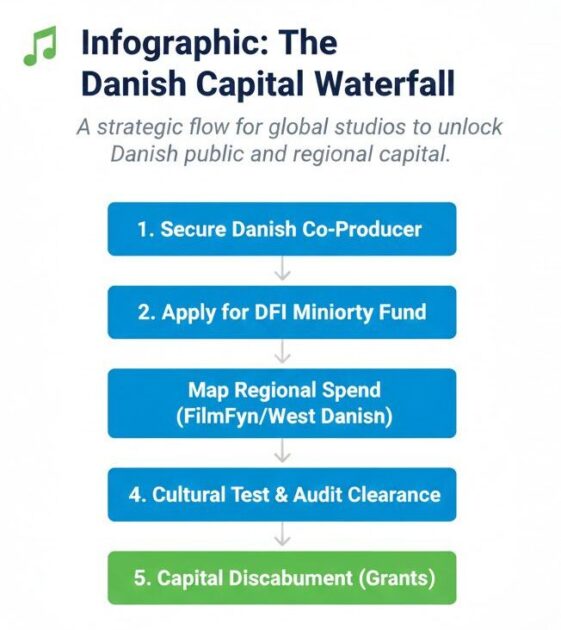
| The DFI Minority Fund | A selective scheme for features and documentaries with significant artistic merit; requires a Danish co-producer and cultural distribution. |
| Regional Multipliers | Funds like Den Vestdanske Filmpulje and FilmFyn provide cash injections for projects shooting outside Copenhagen, often with fewer cultural strings. |
| Public Service Fund | Specifically targets high-end TV drama and documentaries intended for broadcasting/streaming, rewarding high Danish creative participation. |
| Vitrina Relevance | Identify Danish co-production partners with a 100% success rate in DFI audit exits via the project tracker. |
Table of Content
The DFI Mechanics: Selective Funding vs. Automatic Rebates
The Denmark’s Production Incentives conversation is anchored by the Danish Film Institute (DFI), which operates under the Ministry of Culture. Unlike territories where a production accountant can calculate a 25% rebate based on a spending spreadsheet, the DFI manages a selective system. According to data from the DFI, approximately 10 to 12 minority co-productions are supported annually, with individual grants typically ranging from DKK 1 million to DKK 4 million.
The bottom line for executives is that DFI funding is not a “right” but an “award.” The selection committee prioritizes projects with high artistic quality and strong Danish creative elements—such as a Danish department head, lead cast, or post-production house. For a project to qualify, it must have secured its primary financing in its home territory and must include a confirmed distribution agreement in Denmark.
Why does this matter? Because the DFI funds act as “equity-like” grants that do not require traditional repayment but do demand a high level of cultural integration. In 2024, the DFI signaled a pivot toward supporting larger-scale international projects that utilize Danish VFX and post-production, recognizing the technical mastery of the local supply chain.
Regional Powerhouses: Unlocking FilmFyn and West Danish Funds
While Copenhagen remains the creative epicenter, the most aggressive Denmark’s Production Incentives are often found in the regions. Regional funds have become the “secret weapon” for international producers who find the DFI’s cultural requirements too stringent.
FilmFyn, located on the island of Funen, is one of the most proactive funds in Scandinavia. With an annual budget of approximately DKK 10 million, FilmFyn provides cash investments to projects that spend a significant portion of their budget on the island. Their investment is “automatic-lite”—it is still discretionary, but the primary metric is local economic impact (crew hire, hotel stays, logistics) rather than artistic merit.
Similarly, Den Vestdanske Filmpulje (The West Danish Film Fund) supports productions in the Aarhus region. According to market intelligence from KFTV, regional funds in Denmark can be “stacked” with DFI minority funding, provided the project meets the geographic requirements of each fund. This allows a savvy producer to cover nearly 30-35% of their Danish spend by geographically distributing their production activities across Fyn and Jutland.
The Public Service Fund: A Strategic Gateway for Streamers
One of the most disruptive elements of Denmark’s Production Incentives for the 2024–2025 cycle is the Public Service Fund (Public Service-puljen). Originally designed for broadcast television, the fund has been adapted to accommodate high-end TV drama and documentaries intended for digital streaming platforms.
Managed by the DFI, this fund supports “high-quality drama” that is developed or produced in Denmark. For international streamers, this is a vital capital source, as it provides subsidies that can reach up to 25% of the total production cost for projects with significant Danish participation.
The strategic play here is the distribution mandate. The fund requires the content to be available to Danish audiences on a platform with significant reach. As global streamers like Netflix and HBO Max have established deep roots in the Nordics, they have become the primary beneficiaries of this scheme, using it to offset the high labor costs associated with Danish crew rates.
Structural Mandates: Navigating the 2025 Co-production Rules
To access Denmark’s Production Incentives, a project must have a registered Danish co-production partner. This partner is the legal applicant for all funds and is responsible for the financial administration and local audit.
Under the current rules, the Danish co-producer’s share must be between 10% and 25% of the total budget for minority co-productions. Furthermore, the “Spend Requirement” is strict: generally, every DKK provided by the DFI must be spent within the Danish territory.
Compliance is managed through a rigorous audit process. Failure to demonstrate that the funds were spent on Danish vendors or crew can lead to the “clawback” of the grant. Executives should prioritize partners who have an SIRECINE-equivalent track record of fiscal transparency and previous successful exits from DFI audits.
How Vitrina Accelerates Your Danish Greenlight
Navigating the selective nature of Denmark’s Production Incentives requires more than a location scout; it requires a verified partner who can secure “Minority Co-production” status. Vitrina de-risks this process by mapping the entire Danish supply chain—from DFI-certified service producers to specialized VFX houses in Aarhus.
Accelerate Your Discovery with VIQI
Strategic Conclusion
Denmark remains a premier destination for high-end content, but its incentive model is a play for quality and integration rather than volume. By mastering the selective architecture of the DFI and stacking it with regional multipliers from FilmFyn or Aarhus, productions can achieve a capital efficiency that rivals the automatic tax credits of Eastern Europe. The key to success is early-stage alignment with a Danish co-producer who can secure the DFI “seal of approval” while managing the geographic spend requirements that unlock regional cash injections.
The path forward for production finance leaders is to move beyond generic location scouting and focus on Partner Discovery. As the Public Service Fund continues to evolve in favor of global streaming platforms, the ability to identify verified partners with a successful DFI exit history is the ultimate competitive advantage. Vitrina provides the real-time data and executive-level connections necessary to transform Denmark’s selective funding promises into tangible production results.
Strategic FAQ
Does Denmark offer an automatic tax rebate for film production?
No, Denmark does not currently have a national automatic tax rebate. It operates a selective funding system through the Danish Film Institute (DFI) and regional funds, which require a Danish co-producer and cultural/economic merit to qualify.
What is the minimum Danish co-production share required?
To qualify for minority co-production funding from the DFI, the Danish partner must generally hold a financial and creative share between 10% and 25% of the total production budget.
Can I stack DFI funding with regional funds like FilmFyn?
Yes, productions can stack national DFI grants with regional investments from FilmFyn or Den Vestdanske Filmpulje, provided the spend is geographically targeted to those specific regions and the Danish co-producer manages both applications.
Is the Public Service Fund available for Netflix or HBO Max projects?
Yes, the Public Service Fund is open to high-end TV drama and documentaries intended for digital streaming, provided they have significant Danish creative participation and meet the reach requirements for the Danish audience.