

 About Innovation Hub
 Global Content Pulse (Webinars)


 Global Production Financing
(Webinars)
Global Production Financing
(Webinars)  LeaderSpeak Podcast
  About Vitrina
 Our Story
 Our Solutions 🔥
 Film+TV Projects Tracker 🚀
 Case Studies
 Our Profile
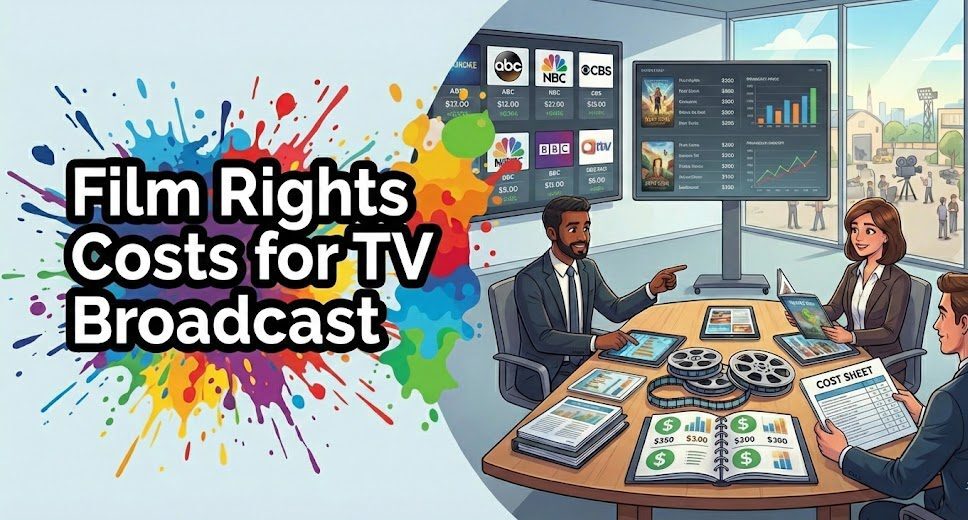
Typical costs involved in acquiring film rights for TV broadcast range from four-figure flat fees for library content to multi-million dollar agreements for premium blockbuster premieres.
These costs are structured through a combination of flat license fees, royalties, and Minimum Guarantees (MG), influenced by territorial reach, broadcast duration, and platform exclusivity.
According to industry data tracked by Vitrina AI, rights valuation for regional documentaries has seen a 15% shift toward revenue-share models as broadcasters seek to mitigate upfront financial risk.
In this guide, you’ll learn the technical nuances of licensing structures, how content type dictates pricing, and the data-driven negotiation strategies used by top acquisition leads to secure favorable terms.
While most industry resources provide surface-level estimates, they often fail to address the technical friction between flat fees and long-term royalty obligations that define modern broadcast deals.
This comprehensive analysis fills those gaps by providing a deep dive into rights valuation—moving beyond generic lists to offer actionable negotiation frameworks for 2025.
Table of Contents
Key Takeaways for Acquisition Leads
-
Multi-Layered Cost Structures: Typical costs involve upfront MGs plus backend royalties, requiring buyers to balance initial capital with long-term revenue obligations.
-
Genre-Driven Valuation: Feature film blockbusters command premium fees for theatrical-to-TV windows, while documentaries often utilize lower flat-fee structures or non-exclusive licenses.
-
Intelligence-Backed Negotiation: Leveraging supply chain data on 140,000+ distributors allows buyers to benchmark fees against real-time market trends and competitor slates.
-
Exclusivity Premiums: Exclusive broadcast rights can increase costs by 50% or more, making non-exclusive “rotational window” strategies a key ROI driver for mid-tier broadcasters.
What are Typical Costs Involved in Acquiring Film Rights for TV Broadcast?
The “typical” cost of film rights is a moving target influenced by the film’s theatrical performance, star power, and the specific rights being granted. For a standard television broadcast, costs are generally divided into three primary tiers: library content, mid-tier independent films, and major studio blockbusters. Library titles may cost as little as $5,000 to $20,000 for a multi-year non-exclusive license in smaller territories, while premium content can command millions for a first-run window.
Beyond the base license fee, broadcasters must account for “hidden” costs such as localization (dubbing and subtitling), technical delivery fees, and marketing obligations. In an era of “Weaponized Distribution,” where content is frequently rotated between platforms to maximize ROI, the cost structure often includes complex windowing clauses that dictate when a film can move from theatrical to SVOD and finally to linear TV.
Find library content matching your budget range:
How Do Content Type and Genre Influence Licensing Fees?
Valuation strategies differ wildly between documentaries and feature films. Documentaries often utilize “educational” or “cultural” broadcast licenses, which typically command lower upfront fees but may include longer tail royalty structures. In contrast, feature films—especially those in the action, thriller, and horror genres—are currently in high demand due to their “low-cost, high-concept” nature, allowing broadcasters to achieve significant viewership without the price tag of a major superhero blockbuster.
According to the Vitrina Brief, companies like Warner Bros. Discovery are strategically utilizing “Weaponized Distribution” to license premium content to rivals like Netflix to maximize ROI. This trend has created a secondary market for broadcasters to acquire “near-premium” titles at a fraction of their original premiere cost, provided they accept non-exclusive or delayed windows.
Explore trending genres with available rights:
Industry Expert Perspective: Inside FilmSharks International: World Sales & Remakes
Understanding rights costs requires a look into the world of sales agents and remake rights. In this session, Guido Rud, CEO of FilmSharks, discusses how international rights are structured across sales, remakes, and production models.
Guido Rud explores the inception and growth of FilmSharks, highlighting the company’s three core business models: world sales, remake distribution, and production mastery in the Ibero-American market.
Navigating Flat Fees, Royalties, and Minimum Guarantees
The financial core of a licensing agreement is typically built on a combination of three elements: the Flat Fee, the Royalty, and the Minimum Guarantee (MG). A Flat Fee is a one-time payment for a fixed license period, common for non-exclusive library content. Conversely, Royalties are ongoing payments based on performance metrics, though these are more common in SVOD/AVOD environments than traditional linear broadcast.
The Minimum Guarantee (MG) serves as a recoupable upfront payment that the broadcaster provides to the distributor. If the film generates royalties beyond the MG, the distributor receives additional payments; if not, the broadcaster is still obligated to pay the full MG. Acquisition leads must carefully model these “recoupment waterfalls” to ensure the project reaches profitability before the license period expires.
Analyze recent licensing trends and fee structures:
The Negotiation Process: Securing Favorable Terms for Broadcasters
Effective negotiation for film rights is built on “comparable analysis.” Successful acquisition leads benchmark requested fees against the film’s theatrical box office (if applicable), similar title performance on their own network, and current market demand for the genre. Key levers in negotiation include the “Grant of Rights” (linear vs. catch-up TV), the number of permitted telecasts, and the “Holdback Period” which prevents the film from appearing on competing platforms during the license term.
Common pitfalls include over-committing to high MGs for unproven indie titles or failing to secure “Right of First Refusal” for sequel or franchise content. By leveraging platform intelligence to track distributor deal histories, buyers can identify when a distributor is under pressure to close a deal—typically toward the end of a fiscal quarter or when a theatrical window has underperformed—providing the buyer with significant leverage.
Leveraging Supply Chain Intelligence for Better Rights Acquisition
In a fragmented market of 600,000+ companies, relying on personal networks for rights discovery is no longer sufficient. Vitrina AI provides the “digital lighthouse” needed to navigate these complexities. With a database of over 1.6 million titles and real-time tracking of unreleased projects, acquisition leads can identify high-value IP while it is still in production—allowing for “pre-sale” negotiations that often yield significantly lower license fees than post-theatrical acquisitions.
Furthermore, Vitrina’s VIQI AI Assistant acts as a virtual Hollywood agent, answering strategic questions about which distributors are currently active in specific genres and territories. This data-driven approach transforms partner due diligence from a subjective process into an objective one, ensuring that broadcasters invest in partners with verified track records and reliable delivery pipelines.
Moving Forward
The shift from opaque networking to data-driven rights acquisition addresses the critical information gaps that have long hampered broadcaster ROI. By mastering the technical nuances of license fees and windowing, acquisition leads can transform rights management from a cost center into a strategic advantage.
Whether you are an acquisition lead at a national broadcaster looking to optimize your prime-time slate, or a digital programmer seeking cost-effective library content, the key remains: actionable intelligence drives deal velocity.
Outlook: Over the next 18 months, we expect a 20% increase in non-exclusive “rotational” licensing deals as platforms prioritize catalog depth over rigid exclusivity.
Frequently Asked Questions
Quick answers to the most common queries about film rights costs and acquisition.
What are typical costs involved in acquiring film rights for TV broadcast?
What is a Minimum Guarantee in film licensing?
How does exclusivity affect rights costs?
What is “Weaponized Distribution”?
How much does it cost to localize film content for TV?
What is a “Holdback Period”?
Can I buy broadcast rights for unreleased films?
How does Vitrina AI help in rights negotiation?
“The industry is moving away from gut-feeling acquisitions toward a data-driven science. Broadcasters who leverage supply chain intelligence to identify undervalued library content or pre-sale opportunities are outperforming competitors by 40% in terms of content ROI.”
About the Author
Senior Content Strategist at Vitrina AI with 15 years of experience in content acquisition and media rights management for major European networks. Specialist in supply chain data analytics. Connect on Vitrina.