About Innovation Hub
 Global Content Pulse (Webinars)


 Global Production Financing
(Webinars)
Global Production Financing
(Webinars)  LeaderSpeak Podcast
  Global Entertainment Digest (Newsletter)
  About Vitrina
 About VIQI
 Our Story
 Our Solutions 🔥
 Film+TV Projects Tracker 🚀
 Case Studies
 Our Profile
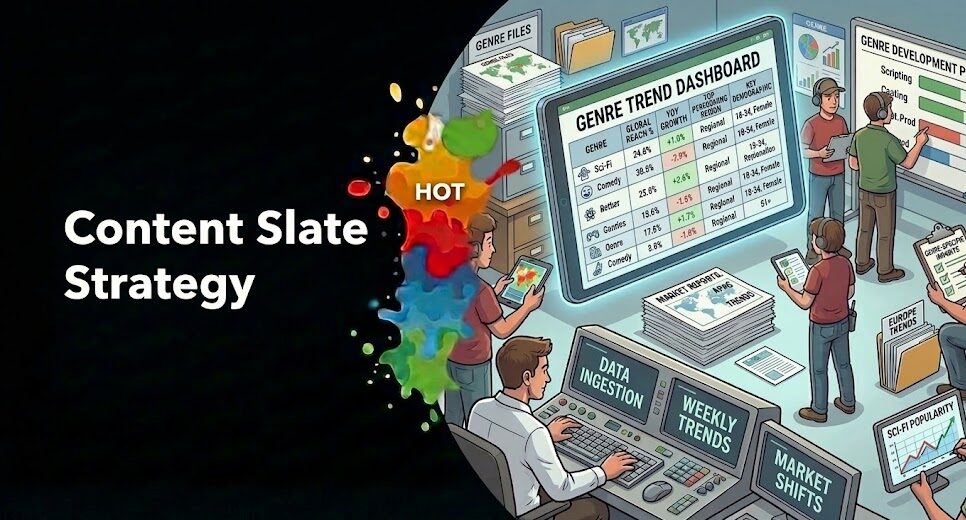
Here’s the honest version of where most independent studios stand right now: they’re making project-by-project bets in a market that rewards portfolio thinking, building financing plans on genre instinct instead of current deal data, and treating co-production treaties as creative relationships rather than capital access mechanisms.
That’s a 2019 operating model being run in a 2026 market — and the gap between those two realities is where most studios are losing deals, losing time, and losing EBITDA margin they can’t recover.
Building a content slate strategy as an independent studio in 2026 requires a fundamentally different framework than what worked five years ago. The streaming gold rush is over. Gap lenders are selective. Pre-sale floors have compressed in every genre except the three where theatrical math still works. And the capital that is moving — patient sovereign capital, institutional equity from fund managers like IPR VC, private lenders like Peachtree Media Partners — is flowing toward studios that demonstrate portfolio discipline, not studios pitching individual projects with no structural logic beneath them.
This guide covers what independent studios getting deals done in 2026 are actually doing differently: how they’re constructing genre portfolios, how they’re building capital stacks before approaching equity, how they’re weaponizing co-production treaties as financing tools, where Sovereign Hub capital creates white-space opportunities, and how real-time deal intelligence is replacing the 3-to-6-month-stale market signals that most studios are still operating on. Vitrina tracks 140,000+ active entertainment companies and 400,000+ projects globally — the patterns you’ll find here come from the deal level, not from trade trends.
In This Guide
- Why Your Slate Is a Portfolio — Not a Project List
- Genre Portfolio Construction: The Three Tiers That Work
- Capital Stack Architecture for Independent Studios
- Co-Production Treaties: Your Best Financing Tool You’re Not Using
- Where Sovereign Hub Capital Opens Doors Equity Can’t
- Building Real-Time Intelligence Into Slate Decisions
- Why Slates Fail: The Patterns That Repeat
- Frequently Asked Questions
Ask VIQI: What Buyers Are Committing MGs to in Your Target Genres Right Now?
VIQI is Vitrina’s AI research assistant trained on 1.6 million titles, 360,000 companies, and 5 million entertainment professionals. Get real-time slate intelligence before you start packaging — not after the deals already closed.
✓ 200 free credits included | ✓ No credit card required
Why Your Slate Is a Portfolio — Not a Project List
Most independent studios think about their slate the way they think about their development list: a collection of projects they’re excited about, at varying stages, competing for the same limited production capital. That framing is the problem.
A slate is a portfolio. And a portfolio has a structure — deliberately designed to balance risk across asset types, optimize capital efficiency across the stack, and generate the cash flow that allows the riskier bets to stay alive long enough to pay off. When Andrea Scarso, Managing Partner at IPR VC, describes how his firm approaches slate financing with partners like A24, MK2, and XYZ Films, he’s describing exactly that logic: “We maximize chances of doing well. We help them strategize over a longer period of time — knowing that, especially nowadays, results are very binary.” IPR VC has been deploying equity into content slates across film, TV, and IP for 12 years, partnering with companies from Helsinki to Los Angeles, and the core of their model is portfolio discipline applied to creative output.
The portfolio framing matters for two concrete reasons. First, it changes how you allocate financing instruments across projects. A commercial genre film at $6-10M should have a fundamentally different capital stack than a prestige drama at the same budget — because their pre-sale potential, gap financing eligibility, equity attraction, and recoupment timelines are all different. Mixing them up, or defaulting to equity for everything, destroys margin across the whole slate. Second, portfolio thinking changes what you greenlight. When you know what roles you need to fill — cash-flow anchor, institutional equity magnet, Sovereign Hub co-production candidate, long-horizon IP development — you select projects strategically rather than reactively.
Scarso frames the upside clearly: “When you hit a successful IP, the upside can be greater than the overall risk you’re taking on a portfolio.” But hitting that upside requires that the rest of the slate is structured to support it — not burn through capital while you wait. That’s the portfolio mindset. And it starts with genre allocation.
Check out how different producer paths map to different financial models — it’s the clearest breakdown of why financing approach needs to match content type from day one.

Your AI Assistant, Agent, and Analyst for the Business of Entertainment
VIQI AI helps you plan content acquisitions, raise production financing, and find and connect with the right partners worldwide.
- Find active co-producers and financiers for scripted projects
- Find equity and gap financing companies in North America
- Find top film financiers in Europe
- Find production houses that can co-produce or finance unscripted series
- I am looking for production partners for a YA drama set in Brazil
- I am looking for producers with proven track record in mid-budget features
- I am looking for Turkish distributors with successful international sales
- I am looking for OTT platforms actively acquiring finished series for the LATAM region
- I am seeking localization companies offer subtitling services in multiple Asian languages
- I am seeking partners in animation production for children's content
- I am seeking USA based post-production companies with sound facilities
- I am seeking VFX partners to composite background images and AI generated content
- Show me recent drama projects available for pre-buy
- Show me Japanese Anime Distributors
- Show me true-crime buyers from Asia
- Show me documentary pre-buyers
- List the top commissioners at the BBC
- List the post-production and VFX decision-makers at Netflix
- List the development leaders at Sony Pictures
- List the scripted programming heads at HBO
- Who is backing animation projects in Europe right now
- Who is Netflix’s top production partners for Sports Docs
- Who is Commissioning factual content in the NORDICS
- Who is acquiring unscripted formats for the North American market
Genre Portfolio Construction: The Three Tiers That Work
Every independent studio slate in 2026 needs to answer one question before it can be financed: which projects on this slate can generate the pre-sale MG floors that unlock gap financing? Not as an aspiration. As a hard structural requirement. Because if more than half your slate can’t clear that bar, you’re running development risk while calling yourself a production company — and that confusion is expensive.
Phil Hunt, founder and CEO of Head Gear Films, has financed over 550 films in nearly 25 years of operation and currently runs 35-40 productions per year — more volume than most Hollywood studios. His read on the independent market has the specificity that only that kind of deal flow produces: “What the market really wants” in the independent pre-sale space right now is action, thriller, and horror. Full stop. Drama “is not really working” at the independent level because its pre-sale value is cast-dependent in ways that compress MGs below what’s needed to support gap structures. Comedy barely travels internationally. But action, thriller, and horror generate the kind of predictable audience behavior that territory buyers will commit minimum guarantees against — and that’s what makes a project financeable.
Joshua Harris, President and Managing Partner of Peachtree Media Partners — which lends against film IP collateral rather than taking equity — confirms this from the lender side: Peachtree’s slate “leans into action movies, thrillers, psychological thrillers, and horror movies” because those are the genres where pre-sale territories generate credible collateral. His emphatic note after attending AFM 2025: “Horror movies overperform” and “the entire base is really seeing the swing back to theatrical being the future of our business.” That’s not a creative opinion. That’s a capital availability signal — theatrical films in commercial genres are what distributors are actively committing to again.
But genre discipline doesn’t mean building an all-action slate. It means operating with three deliberate tiers:
Tier 1: Gap-Financeable Anchors
Commercial genre films — action, thriller, horror — in the $5-15M range with strong packaging (cast, reputable sales agent, completion bond eligible). These projects generate the pre-sale MG floors that make gap loans approvable and create the cash flow that keeps the slate funded between higher-risk projects. You want 2-3 of these per production year, minimum.
Tier 2: Equity-Magnet Prestige
Higher-risk projects — elevated genre, prestige drama, documentary — that can attract institutional equity investors seeking cultural ROI or upside asymmetry. These don’t need to carry the slate financially; that’s not their role. Their role is to attract equity partners, build critical profile, and develop IP that has long-term franchise or library value. One or two per year, structured with equity first — not gap — because their pre-sale floors won’t support debt.
Tier 3: Sovereign Hub Co-Productions
Culturally specific content designed to access government-backed production capital in MENA, APAC, or India. These projects unlock patient capital that doesn’t require the same MG validation as traditional gap financing — and they come with built-in regional distribution access that Western theatrical can’t replicate. We’ll get into the mechanics of this in Section 5. But the point here is that they belong on your slate as a distinct financing category, not as a variation of Tier 1 or Tier 2.
Track Which Genre + Territory Combinations Are Converting Deals Right Now
Trusted by Netflix, Warner Bros, Paramount, and Google TV. Vitrina’s platform maps real-time buyer appetite, active deal flow, and pre-sale territory activity across 140,000+ companies and 400,000+ projects — so your slate reflects today’s market, not last quarter’s.
✓ 200 free credits | ✓ No credit card required | ✓ Full platform access
Capital Stack Architecture for Independent Studios
The biggest financing mistake independent studios make isn’t in which projects they choose — it’s in what order they approach capital sources. Defaulting to equity first, before exhausting soft money and structured debt, is where margin leaks. And in a market where capital is selective, that leak can be fatal to the deal.
Here’s the sequence that works for commercial genre films in the $5-15M range in 2026:
Step 1: Soft money first. Tax incentives and cash rebates can cover 15-50% of your qualified production expenditure — before you’ve raised a dollar of equity. The UK’s Audio-Visual Expenditure Credit hits 34% for high-end TV and film. Georgia’s transferable credit reaches 30%. Japan’s recently launched program goes up to 50% (capped at approximately $6.7M). Canada’s federal program plus provincial stacking gets to 35-40%. Choose your primary production jurisdiction based on total soft money efficiency for your budget range — not just the headline rate. Infrastructure costs, crew availability, and exchange rate dynamics change the real number significantly.
Step 2: Pre-sales to 40-60% coverage. Territory MG presales — structured properly through a reputable sales agent with distributor relationships — should be targeting 40-60% budget coverage for your commercial tier films. That’s the threshold that makes a gap loan application credible. Below it, you’re asking gap lenders to carry too much risk. Above it, you may be leaving backend revenue on the table by selling too many territories upfront. The sweet spot is specific to your project and the current market appetite in your genre — which is why real-time deal intelligence (not six-month-old market reports) is doing actual work here.
Step 3: Gap financing for the remaining 10-30%. Gap loans sit between senior debt and equity in the recoupment waterfall. They’re secured against the unsold territorial rights and carry effective costs of 15-20% annualized. Expensive — but they preserve equity positions for investors who are taking the most risk. Harris’s model at Peachtree goes further than traditional gap: Peachtree will advance against the future value of unsold territories even before distribution agreements are executed, based on credible sales estimates. That’s the flexibility that private capital provides when commercial banks retreat.
Step 4: Equity enters last. Equity carries the highest cost of capital and the furthest recoupment position in the waterfall. It should cover what’s left after soft money, pre-sales, and gap — not substitute for them. For your Tier 2 prestige projects where pre-sale floors are too weak to support gap financing, equity enters differently — structurally, as the primary instrument — but it’s still sized after incentives are fully mapped. The detailed mechanics of how to sequence this are covered in our film capital stack guide.
The ROI impact of this sequencing matters at the slate level. Every dollar of equity you can replace with incentive-stacked soft money or pre-sale-backed debt reduces your cost of capital and improves IRR across the full portfolio. That’s not incremental optimization — it’s the structural difference between a slate that returns capital and one that barely breaks even.
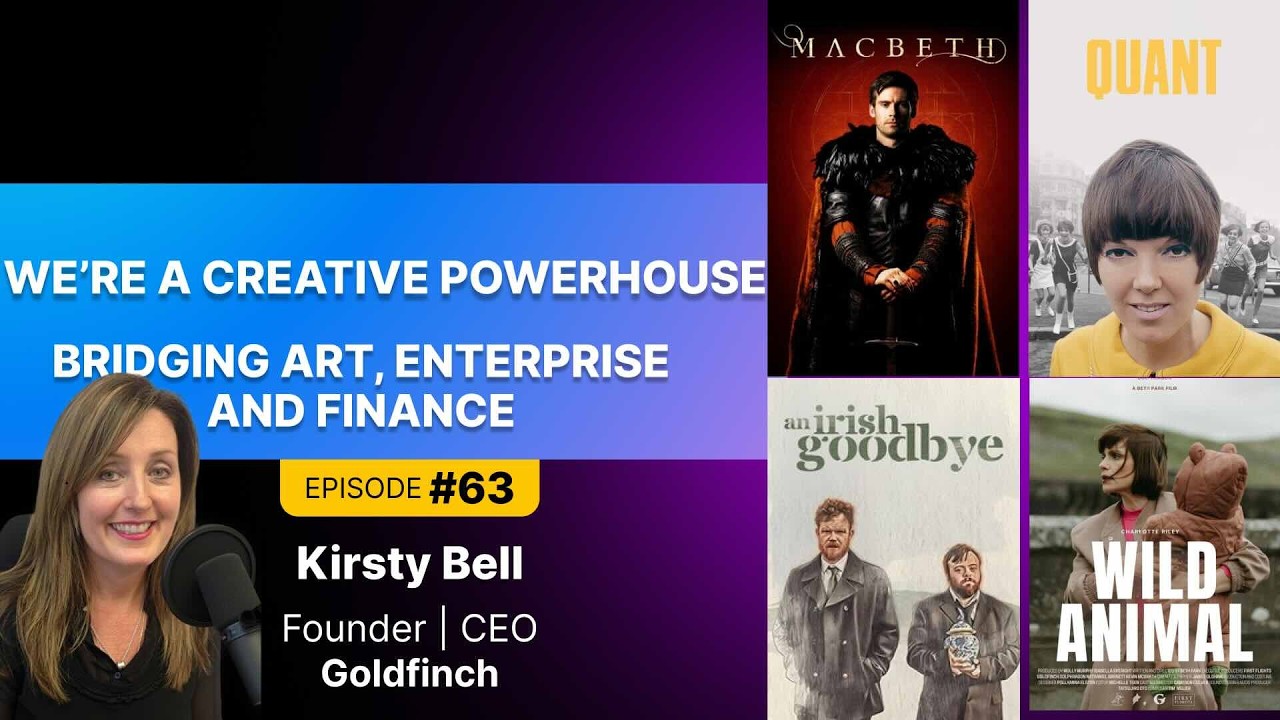
Kirsty Bell (Founder & CEO, Goldfinch) walks through exactly how disciplined business models — not creative ambition alone — create financially sustainable independent studio slates in this Vitrina LeaderSpeak episode:
Co-Production Treaties: Your Best Financing Tool You’re Not Using
Ask most independent studios how they think about co-production treaties and you’ll get a creative answer: they’re about finding the right international partner, sharing storytelling perspectives, accessing a director or actor in another territory. All of that is true. But it misses the structural value that makes co-production treaties one of the most powerful capital stack tools available — and one of the most consistently underused.
When a production qualifies under a bilateral or multilateral treaty, it achieves national film status in each co-producing country simultaneously. That single fact unlocks a cascade of financing advantages. It qualifies for tax incentives in both jurisdictions at once — stacking programs that would otherwise be mutually exclusive. It accesses national film funds in each country. It counts toward local content quotas for broadcasters in both markets, which multiplies your pre-sale buyer universe. And it allows you to pool talent, infrastructure, and distribution relationships across borders without the project being classified as “foreign” in either one.
A Canada-UK co-production under their bilateral treaty, for example, can layer Ontario or BC provincial incentives (an additional 15-20%) on top of Canada’s federal program alongside the UK’s 34% AVEC — potentially achieving 40-50%+ combined soft money coverage against qualified spend. That’s the difference between approaching gap financing at 30% budget coverage and approaching it at 50%+. The gap lender’s risk position is completely different. So is your equity dilution.
The APAC corridor is where the 2026-specific opportunity lives. Japan’s new production incentive program hits up to 50% — introduced specifically to attract international productions. South Korea’s government-backed industry support is mature and proven. Australia enhanced its location incentive post-2024. And the treaty network connecting these markets to European and UK producers is still relatively uncrowded. The international co-production strategy framework for APAC partnerships is genuinely different from the Europe-centric models most studios default to — and the studios building those relationships now are establishing the access that will be competitively harder to replicate once this corridor becomes standard practice.
But co-production partnerships aren’t zero-effort. They require finding partners with verified capacity and active fund relationships — not partners on paper who don’t have the production infrastructure or regulatory standing to actually unlock the incentives you’re counting on. And finding those partners at speed, before your deal timeline collapses, requires intelligence infrastructure that relationship networks alone can’t provide.
Where Sovereign Hub Capital Opens Doors Equity Can’t
The most significant structural shift in independent studio financing over the past three years — bigger than the streaming correction, bigger than the bank retreat from Hollywood — is the emergence of Sovereign Content Hubs™. These are government-backed production centers in Saudi Arabia, UAE, South Korea, and India deploying patient capital at a scale that the traditional independent ecosystem simply cannot match. And most Western independent studios are treating them as location decisions instead of financing decisions.
Saudi Arabia’s commitment to entertainment under Vision 2030 stands at $71.2 billion — with $4+ billion film-specific. The results since 2018 are concrete: from zero to 630+ cinema screens, zero to 65 production companies, 17 operational studios, and $288 million in local production expenditure. The Riviera Content Fund and the Saudi Film Fund represent a combined $200 million actively targeting international co-production — not service work. Genuine creative partnerships that share IP ownership and position content for both regional and global distribution.
What makes Sovereign Hub capital structurally different from traditional financing is its patience. It’s not quarterly-earnings-driven. It doesn’t require the MG validation floor that gap lenders demand. It doesn’t need the cast package that equity investors require. And it comes with built-in distribution infrastructure in markets that have demographics traditional theatrical can barely reach — Saudi Arabia’s population is 60%+ under 30, a cinema-going generation that didn’t exist as a commercial market before 2018.
But — this matters for how you position your Tier 3 projects — Sovereign Hub capital funds cultural authenticity, not cultural tourism. The projects that access this capital aren’t Western productions with a MENA location shot tacked on. They’re genuine co-productions designed to tell regional stories, develop Arabic or South Asian IP, or create content positioned for “local to global” trajectory. As noted by Deadline, international studios entering MENA as genuine creative partners — bringing editorial weight and distribution relationships rather than just a service capacity — are seeing deal structures and fund access that weren’t available two years ago.
For your slate, the practical implication is this: if you’re building one or two culturally specific projects per year into your portfolio specifically designed for MENA or India co-production, you’re unlocking a financing channel that your competitors running purely Western commercial slates can’t access. That’s a structural advantage, not a creative gamble. As Variety has reported, the window for first-mover positioning in Sovereign Hub co-production is still open — but it has a timeline.
Building Real-Time Intelligence Into Slate Decisions
The Fragmentation Paradox™ is most expensive precisely when you can’t see it costing you anything. With 600,000+ companies operating across the global entertainment supply chain, the deal signals that determine whether your slate connects with the market — which territory buyers are actively committing MGs in your genre right now, which co-production partners have verified incentive relationships and current capacity, which Sovereign Hub funds are actively deploying versus stalled in planning — sit buried in closed deal memos and private relationship networks. By the time those signals surface in trade coverage, the deals that generated them closed 3-6 months ago.
Hunt’s operating advantage at Head Gear Films comes directly from volume: processing 35-40 films per year and staying “in the center of the carousel being the marketplace” generates deal-level intelligence that studios with smaller slates simply can’t build organically. They see what’s selling, what’s not, what MG floors are holding and where they’re collapsing — in real time, not in retrospect. That’s the Insider Advantage™ that makes their project selection systematically better than gut feel.
Scarso puts the intelligence problem at the center of what separates good slate investing from bad: “The challenge in the industry right now is not on deal flow — it’s on the quality of investing, it’s on how you structure the investment.” Quality of investment starts with knowing your market at the current deal level, not the historical trend level. And for most independent studios, that means building intelligence infrastructure rather than relying on conference conversations and six-month-old trade reports.
But you don’t have to run 40 films a year to access deal-level market intelligence. You need a platform mapping 140,000+ active companies and 400,000+ projects in real time — tracking which buyers are committing, which genres are converting, which financing structures are getting approved. That intelligence layer transforms slate selection from creative instinct into market-calibrated portfolio construction. It’s the difference between packaging for the market as it is and packaging for the market as you remembered it.
The independent film financing landscape in 2026 rewards the studios that can move on that intelligence faster than their competitors. Not the ones with the best taste — the ones who know what the market wants before it hits the trades.
Why Slates Fail: The Patterns That Repeat
The failure modes in independent studio slate strategy aren’t random. They repeat. And they’re almost always traceable to one of four structural errors that have nothing to do with the quality of the projects involved.
Error 1: Equity-first financing. Going to equity investors before exhausting soft money, incentives, and structured debt. The result is dilution that makes the slate’s financial return inadequate even when projects perform well. The studios that consistently build strong P&L from their slates are the ones that treat equity as the final layer — not the default.
Error 2: Genre incoherence. Building a slate where every project requires equity because none of them generate pre-sale floors strong enough for gap financing. This creates a studio that’s permanently reliant on investors willing to wait in the last recoupment position — and that universe of investors is small, selective, and expensive. A minimum two or three commercial genre anchors per year isn’t a creative compromise. It’s what keeps the lights on while you develop the prestige IP.
Error 3: Single-jurisdiction production thinking. Building every project to qualify for incentives in one territory when treaty structures could unlock two or three programs simultaneously. The soft money available through properly structured co-productions is materially higher than single-jurisdiction approaches — often by 15-20 percentage points of budget. That’s not a marginal improvement. It’s a structural change to your recoupment math. Harris notes that Peachtree regularly encourages producers to diversify their financing collateral precisely because broader collateral coverage means more flexible capital deployment.
Error 4: Stale intelligence. Packaging projects based on market signals from six to twelve months ago — casting decisions made to appeal to territory buyers whose MG appetite has since shifted, genre bets made based on deals that already closed, Sovereign Hub co-production approaches built on program details that have since changed. The cost is invisible until your financing plan stalls in due diligence. The fix is real-time deal intelligence, not more market trips.
Get a Custom Slate Intelligence Briefing from Vitrina’s Expert Team
Netflix UK identified co-production partners in 48 hours using Vitrina’s Concierge service. Our research team maps buyer appetite, verified co-production partners, and Sovereign Hub capital opportunities specific to your studio’s slate targets — by genre, territory, and budget range.
✓ Dedicated research team | ✓ Slate-specific deal intelligence | ✓ No commitment required
Frequently Asked Questions
How many projects should an independent studio carry on its slate in 2026?
There’s no universal answer — it depends on your capitalization and team capacity. But the portfolio logic points toward a minimum of 4-6 active projects at different production stages. The more important variable is the risk balance: you want commercial genre anchors generating gap-financeable pre-sale floors running alongside higher-risk prestige or Sovereign Hub co-productions. Without the anchors, you have no cash flow stability. Without the higher-risk bets, you have no upside that changes your studio’s valuation. Phil Hunt runs 35-40 per year using an institutional volume model; most mid-size studios targeting 6-10 per year can still build the same portfolio logic at smaller scale.
What genres should dominate an independent studio content slate in 2026?
Action, thriller, and horror generate the strongest territory MG pre-sales in the independent market — which is what makes gap financing approvable. These should anchor your commercial tier. But your slate shouldn’t be genre-monotone: build in 1-2 prestige projects for equity attraction and institutional co-financing relationships, and 1-2 culturally specific projects designed for MENA or APAC Sovereign Hub co-production capital. Drama works at the independent level when it’s limited series format with streaming platform interest or when it has the cast packaging to generate foreign MGs — standalone feature drama without either is structurally difficult to finance right now.
What’s the right capital stack sequence for a commercial independent film in 2026?
For a commercial genre film in the $5-15M range, the optimal sequence is: (1) Soft money first — tax incentives covering 15-50% of QPE depending on jurisdiction; (2) Pre-sales targeting 40-60% budget coverage to underwrite gap; (3) Gap financing at 10-30% using unsold territorial rights as collateral; (4) Equity last — covering what’s left and taking the most risk with the highest upside position. The common mistake is going to equity first, before soft money and pre-sales are fully mapped, which drives up cost of capital across the entire slate unnecessarily.
How do co-production treaties improve slate financing efficiency?
When a project qualifies under a bilateral treaty, it achieves national film status in each co-producing country — simultaneously accessing tax incentives, national film funds, and broadcaster pre-sale advantages in both jurisdictions. A Canada-UK co-production can stack provincial incentives alongside Canada’s federal program and the UK’s 34% AVEC — potentially reaching 40-50%+ combined soft money coverage. That’s a fundamentally better starting position for gap financing than single-jurisdiction production. Building 2-3 treaty co-productions per year into your slate pipeline is one of the highest-ROI structural moves available to independent studios in 2026.
What is Sovereign Hub financing and how do independent studios qualify?
Sovereign Content Hubs are government-backed production centers — primarily Saudi Arabia, UAE, South Korea, and India — deploying patient state capital to build domestic film industries. Saudi Arabia’s Vision 2030 has committed $4+ billion film-specific with $200 million in co-production funds open to international partners. Independent studios qualify by bringing genuine co-production partnerships — culturally authentic projects contributing to regional storytelling and audience development — not just location or service deals. The capital doesn’t require MG-validated pre-sales. But it does require genuine creative intent and a track record of market presence, not a single-project opportunistic approach.
How is the theatrical market affecting independent studio slate decisions in 2026?
The theatrical comeback is real and it’s changing the financing calculus. Joshua Harris’s post-AFM 2025 read is that “the entire base is really seeing the swing back to theatrical being the future of our business” — and that includes independent film, not just studio tentpoles. Most distributors are now explicitly looking for films that can play theatrically before going to at-home streaming, which reestablishes the dual-revenue-window model that justified stronger MGs. The sweet spot for independent theatrical in 2026 is the $8-20M commercial genre film — action, thriller, horror — that’s positioned for both theatrical release and immediate streaming follow-through. Above that budget range, the risk/reward math for independents gets difficult. Below it, theatrical distributor interest weakens.
What does the post-COVID financing crunch mean for independent studio slate strategy?
The “Big Crunch” — Phil Hunt’s term for the current production financing contraction — means that the abundant capital of 2021-2022 has largely withdrawn. Gap lenders are more selective. MG floors have compressed outside of proven commercial genres. The bar for bankable packaging — cast attachment, completion bond eligibility, reputable sales agent relationships — is higher than it was when capital was looking for deals to fund. For slate strategy, this translates to three requirements: stronger commercial genre discipline, higher-quality packaging on every project, and real-time market intelligence that keeps you from packaging projects for market conditions that no longer exist. The studios closing deals in this environment are doing all three.
How can Vitrina help independent studios build better content slate strategy?
Vitrina tracks 140,000+ active entertainment companies and 400,000+ projects in real time — giving independent studios the deal-level intelligence to make market-calibrated slate decisions rather than relationship-dependent guesses. Specifically: you can identify which territory buyers are actively committing MGs in your genre and budget range right now, find verified co-production partners with confirmed incentive relationships and current capacity, monitor Sovereign Hub fund deployment activity, and benchmark your financing structure against comparable current projects. VIQI, Vitrina’s AI research assistant trained on 1.6 million titles and 5 million entertainment professionals, lets your development and financing teams ask direct market questions and get answers that static trade databases can’t surface.
The Independent Studio That Survives 2026 Is a Portfolio Manager
The independent studio that’s still operational and scaling three years from now isn’t necessarily the one with the best creative judgment. It’s the one that built a content slate strategy with structural logic beneath every greenlight — where genre portfolio construction feeds capital stack design, co-production treaties stack soft money efficiently before equity is approached, Sovereign Hub relationships open capital channels unavailable to purely Western commercial slates, and real-time intelligence keeps the whole machine calibrated to where the market actually is.
That’s not a more complicated version of how independent studios have always operated. It’s a fundamentally different operating model. And in the post-crunch capital environment of 2026, it’s the one that closes deals.
Key Takeaways:
- Slate = portfolio. Every project needs a defined role — commercial anchor, equity magnet, Sovereign Hub candidate — with financing architecture matched to that role, not defaulted to equity for everything.
- Action/thriller/horror anchor the commercial tier. These generate the pre-sale MG floors that make gap financing approvable. Theatrical is coming back and it’s these genres that are leading the recovery.
- Soft money before equity, always. Tax incentives can cover 15-50% of QPE. Co-production treaty stacking can push that to 40-50%+. Exhaust these layers before equity conversations start.
- Sovereign Hubs are a financing channel, not a location decision. Saudi Arabia’s $4B+ film-specific capital, UAE funds, and South Korea’s government-backed industry support represent patient capital that traditional MG-dependent models can’t access.
- APAC co-production is a 2026 window. Japan’s 50% incentive, Australia’s enhanced rebate, and South Korea’s established programs are combining before competition for this corridor saturates.
- Deal-level intelligence closes deals. Studios operating on real-time buyer signals — not 3-6 month old trade reports — are packaging projects for the market as it is. That’s the Insider Advantage in the current crunch.
Build Your 2026 Slate on Real Deal Intelligence — Not Outdated Reports
Trusted by Netflix, Warner Bros, Paramount, and Google TV. Join 140,000+ entertainment companies using Vitrina to track buyer demand, active deal flow, and Sovereign Hub opportunities in real time — with 200 free credits to start.
✓ 200 free credits | ✓ No credit card required | ✓ Cancel anytime
Need expert help mapping your slate financing architecture? Explore the Concierge Service →
Find Film+TV Projects, Partners, and Deals – Fast.
VIQI matches you with the right financiers, producers, streamers, and buyers – globally.
Producers Seeking Financing, Co-Pros, or Pre-Buys?
Vitrina Concierge helps producers reach the right financiers, commissioners, distributors, and co-production partners — with precision outreach, not cold pitching.
Join Industry Briefings Trusted by Leaders

Format Adaptations: Global Trends
Where formats are traveling, which adaptations are breaking out, and how streamers are backing remakes in 2025–2026.

Books, Novels & Comics Adaptations: Global Trends
Books, webtoons, and manga driving the next global screen hits. Discover how in this webinar.

Micro-Dramas & Mobile-First Storytelling
Micro-dramas are building real audiences and revenue. Understand the platforms, buyers, and economics behind the growth.

Navigating Global Content Licensing Trends
How global content licensing is shifting beyond flat fees to flexible, deal-driven models.