About Innovation Hub
 Global Content Pulse (Webinars)


 Global Production Financing
(Webinars)
Global Production Financing
(Webinars)  LeaderSpeak Podcast
  About Vitrina
 Our Story
 Our Solutions 🔥
 Film+TV Projects Tracker 🚀
 Case Studies
 Our Profile
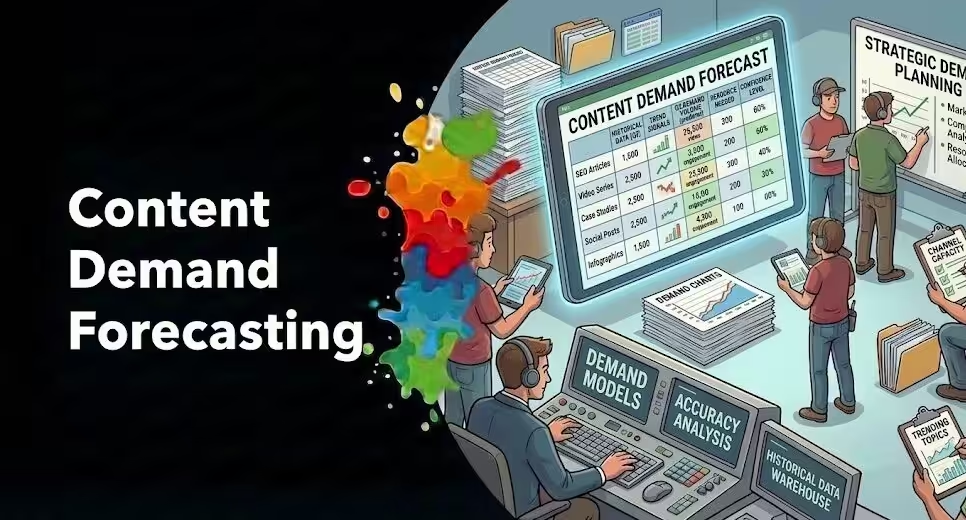
Content demand forecasting is now the deciding factor between a greenlighted series and a development kill. Streamers don’t commission on gut feeling anymore—they never really did, but the data architecture behind those decisions has grown so sophisticated that what used to take 3 months of audience research now runs as a continuous signal layer informing every acquisition meeting, every pitch evaluation, and every renewal decision in real time.
If you’re a producer, acquisition executive, or content strategist trying to understand why certain projects get fast-tracked while better-packaged ones die at pitch, the answer is usually sitting in the platform’s demand data—and you don’t have access to most of it. This guide is about understanding what that data looks like, how streamers use it before a single frame is shot, and what it means for how you position your projects.
Here’s the thing most people get wrong: demand forecasting isn’t just about predicting what audiences will watch. It’s about predicting what they’ll watch on a specific platform, at a specific subscriber acquisition cost, in specific territories—and whether that content will keep them subscribed long enough to justify the content’s ROI. Those are different questions, and the modeling behind them is different too.
Let’s get into the actual mechanics.
Table of Contents
- What Content Demand Forecasting Actually Is (and Isn’t)
- The 5 Data Signals Streamers Use Before Commissioning
- How Major Platforms Run Their Forecasting Models
- Emotion as a Forecasting Variable: What AI Is Doing That Ratings Never Could
- From Forecast to Greenlight: How Data Enters the Commissioning Room
- The Fragmentation Paradox Problem: When More Data Means Less Clarity
- What Demand Forecasting Means for Producers and Sellers
- Where Demand Forecasting Gets It Wrong
- Frequently Asked Questions
- The Bottom Line
See What Platforms Are Actively Commissioning—Before Your Competitors Do
Vitrina tracks real-time commissioning signals across 140,000+ companies and 400,000+ projects. Netflix, Amazon, Apple, OSN—know what they want 6 weeks before the brief hits the market.
Trusted by acquisition executives at Google TV, OSN, and independent production companies across 100+ countries.
Ask VIQI What Streamers Are Buying Now →
No credit card required. 200 free credits to start.
What Content Demand Forecasting Actually Is (and Isn’t)
Content demand forecasting is the practice of using behavioral data, consumption signals, and predictive modeling to estimate audience appetite for specific content types, genres, formats, and subjects before that content is commissioned or acquired. At major streaming platforms, this process runs continuously—a live intelligence layer that shapes every content decision from acquisition pricing to genre prioritization to territorial commissioning windows.
What it isn’t: a magic box that tells you a show will succeed. Every platform that’s invested heavily in demand forecasting has also greenlit expensive failures. The data doesn’t eliminate creative risk. But it does something more valuable—it narrows the range of uncertainty enough to make the ROI math work at scale.
And here’s why that matters to you as a producer or seller: when a streamer’s acquisition team tells you your project “doesn’t fit our current slate priorities,” they’re not being polite. They’re telling you the demand signal for your content type in your proposed territories doesn’t justify the MG they’d need to pay. That’s a data conversation—and knowing the data framework means you can have it properly.
The forecasting models platforms use vary by size and sophistication. But they draw from the same fundamental data categories: what subscribers watch, how long they watch it, what causes them to subscribe or cancel, and what content types cross-pollinate with other subscriber segments. Platforms with 200M+ subscribers—Netflix being the clearest example—have behavioral datasets that no external research firm can replicate. The model runs on first-party data at a scale that competitors with 10M subscribers simply can’t match.

Your AI Assistant, Agent, and Analyst for the Business of Entertainment
VIQI AI helps you plan content acquisitions, raise production financing, and find and connect with the right partners worldwide.
- Find active co-producers and financiers for scripted projects
- Find equity and gap financing companies in North America
- Find top film financiers in Europe
- Find production houses that can co-produce or finance unscripted series
- I am looking for production partners for a YA drama set in Brazil
- I am looking for producers with proven track record in mid-budget features
- I am looking for Turkish distributors with successful international sales
- I am looking for OTT platforms actively acquiring finished series for the LATAM region
- I am seeking localization companies offer subtitling services in multiple Asian languages
- I am seeking partners in animation production for children's content
- I am seeking USA based post-production companies with sound facilities
- I am seeking VFX partners to composite background images and AI generated content
- Show me recent drama projects available for pre-buy
- Show me Japanese Anime Distributors
- Show me true-crime buyers from Asia
- Show me documentary pre-buyers
- List the top commissioners at the BBC
- List the post-production and VFX decision-makers at Netflix
- List the development leaders at Sony Pictures
- List the scripted programming heads at HBO
- Who is backing animation projects in Europe right now
- Who is Netflix’s top production partners for Sports Docs
- Who is Commissioning factual content in the NORDICS
- Who is acquiring unscripted formats for the North American market
The 5 Data Signals Streamers Use Before Commissioning
Not all data signals carry equal weight in a commissioning decision. Here’s how the actual intelligence stack breaks down at most major platforms:
Signal 1: Completion rate and engagement depth. This is the most important single metric at subscription video platforms. Completion rate measures the percentage of subscribers who finish an episode or film—and, for series, what percentage return for subsequent episodes. A show with a 70% series completion rate is generating significantly different subscriber retention value than one where 40% drop after episode two, even if their opening-weekend numbers look identical. Platforms weight completion rate heavily in forecasting because it predicts churn reduction—subscribers who finish a season are far less likely to cancel in the 30 days following.
Signal 2: Search and browse behavior. What subscribers search for before starting content tells platforms what demand exists for topics they’re not yet programming. If search volume for “true crime MENA” is rising on a platform that has zero true crime content from that region, that’s a commissioning signal. Carol Hanley, CEO of Whip Media, has noted how streaming analytics tools now connect browse abandonment data—what subscribers searched for and didn’t find—directly into acquisition priority queues. That gap data is, in effect, a demand brief for the acquisition team.
Signal 3: External demand signals and social sentiment. Platforms don’t operate only on their own first-party data. They monitor search volume trends, social conversation around IP types and storylines, and performance data from comparable content on other platforms (when publicly available). A book that’s driving extraordinary social conversation and search traffic before its adaptation is announced gives the commissioning team a measurable audience that can be attached to projected subscriber acquisition numbers. This is why IP-adjacent projects get prioritized over originals in 2026—the external demand signal exists before production begins.
Signal 4: Subscriber segment overlap and cross-pollination. Advanced platforms model which subscriber segments watch which content types—and, crucially, what content types attract new subscriber segments without cannibalizing existing ones. A platform heavy in Korean drama viewership that’s trying to expand its Latin American subscriber base looks for content that has demonstrated cross-segment appeal in comparable markets. The commissioning decision isn’t just “will our current subscribers watch this”—it’s “will this attract subscribers we don’t have yet.”
Signal 5: Cancellation correlation data. What content types correlate with subscription cancellations? If a platform discovers that subscribers who spend 80%+ of their viewing time in a single genre are more likely to cancel than subscribers with mixed viewing patterns, it starts programming toward genre diversity—not because diverse content performs better individually, but because it creates stickier subscriber behavior at portfolio level. This inverse signal—what to avoid—is as important as the positive demand data in shaping commissioning strategy.
How Major Platforms Run Their Forecasting Models
The same five signals get weighted differently at different platforms—because each platform’s business model and growth priorities are different. Here’s how the four most important buyers in the current market think about it:
Netflix: The Completion Rate Engine
Netflix’s entire content strategy in 2026 runs through one central question: does this content drive completion rates and reduce churn in the 30-day window following a subscriber’s most recent viewing session? Netflix’s published viewership hours metric—which it began releasing publicly in 2023—is only a partial picture of how it actually evaluates content internally. The internal metric that matters most is what Netflix calls “adjusted watch time,” which weights viewing hours by subscriber value score (how likely is this subscriber to cancel in the next 90 days?) and by territory strategic priority.
A show that drives 10M viewing hours from subscribers in high-churn-risk territories—Latin America and Southeast Asia, both high-growth but also high-cancellation regions—gets weighted differently in the model than 10M hours from low-churn subscribers in the US and UK. Content that moves the needle in Brazil, Mexico, India, and South Korea gets greenlit faster than content with identical raw numbers in markets where Netflix already has deep subscriber penetration.
Netflix’s forecasting team also tracks what it calls “title awareness”—the percentage of subscribers who are aware a title exists before they watch it. High awareness with low click-through suggests a thumbnail or marketing problem, not a content problem. Low awareness with high completion rate once discovered suggests a discoverability problem that content investment alone can’t solve. Both signals feed into renewal and commissioning decisions differently.
Amazon Prime Video: Basket Economics
Amazon’s content demand forecasting operates on a fundamentally different economic model than Netflix’s—because a Prime Video subscriber who doesn’t watch a single video is still a paying Amazon customer. The platform’s forecasting model isn’t purely about content ROI—it’s about “basket economics”: how does content investment drive Prime membership retention and incremental spend across the Amazon ecosystem?
This creates anomalies that confuse outside observers. Amazon will spend $250M on The Lord of the Rings: The Rings of Power knowing it won’t recoup that cost purely from streaming. The ROI calculation includes Prime membership upgrades, incremental Amazon shopping activity from newly converted Prime members, and advertising revenue from AVOD tier viewers—none of which appear in a conventional content P&L. Demand forecasting at Amazon has to model all of those variables simultaneously, which is why Amazon’s commissioning decisions sometimes look irrational by streaming-only standards and make complete sense by e-commerce standards.
Apple TV+: Device Attachment Metrics
Apple’s content demand forecasting is the most strategically different of the major platforms—because Apple TV+ isn’t primarily in the entertainment business. It’s in the Apple device business. The commissioning team at Apple uses content as a device attachment driver: content that convinces a household to buy an Apple TV 4K, keep an iPhone subscription active, or upgrade from a free iCloud plan to Apple One creates value that doesn’t flow through the streaming P&L at all.
The demand forecasting signal Apple cares most about is prestige recognition—award nominations, critic consensus, and cultural conversation that creates a “missing out” feeling for non-Apple device owners. That’s why Ted Lasso, Severance, and The Morning Show get the budgets they get: they’re advertising for the Apple ecosystem as much as they’re entertainment products. The commissioning question at Apple isn’t “will this show reach 10M households”—it’s “will this show make our subscribers feel that their Apple relationship is uniquely valuable.” Those are very different forecasting models.
Regional Platforms: OSN, Viu, and the MENA / APAC Reality
Content demand forecasting at regional platforms faces a fundamental data asymmetry. Platforms like OSN, covering 23 countries across MENA and North Africa, and Viu, operating across Southeast Asia and the Middle East, work with much smaller subscriber bases—and far less first-party behavioral data—than Netflix or Amazon. Their commissioning decisions have to rely more heavily on external demand signals and cultural intelligence that the algorithm can’t generate.
Rolla Karam, Senior Vice President of Content Acquisition at OSN, has been direct about what this looks like from the inside: the platform receives over 150 content pitches and proposals weekly, and the selection process is built on a combination of content data from their existing catalog performance and regional cultural knowledge that no external model fully captures. As Karam has noted, the challenge isn’t supply—it’s matching available budget against the content types that will genuinely resonate with a Saudi-centric subscriber base while also serving the broader MENA portfolio.
For regional platforms, demand forecasting is also a localization question. Content that performs on Netflix in Turkey doesn’t automatically translate to OSN’s Lebanese and Saudi audience, even though it’s the same Arabic-subtitled version. The platform’s forecasting model has to account for cultural nuance at a territory-by-territory level that global platforms flatten into regional averages. Building a localized content strategy that accounts for those nuances is the difference between relevant commissioning and expensive catalog clutter.
Emotion as a Forecasting Variable: What AI Is Doing That Ratings Never Could
The most significant development in content demand forecasting over the past 3 years isn’t a new data source—it’s a new way of reading content itself. AI-powered content intelligence tools are now analyzing the emotional texture of video at the scene level, generating data that predicts audience responses with a precision that behavioral data alone couldn’t deliver.
Arash Pendari, founder of Vionlabs, has built a platform that does exactly this—analyzing video content frame by frame to identify emotional patterns, aesthetic signals, and cultural context markers that predict how specific audience segments will respond before those audiences have seen the content. As Pendari has explained in the Vitrina LeaderSpeak series, the core insight is that emotion is data. The emotional signature of a piece of content—the pacing of tension, the distribution of release moments, the visual grammar of the storytelling—predicts engagement and completion rates more reliably than genre labels or marketing copy. This isn’t what a show is about. It’s what a show feels like—and that turns out to be the more powerful forecasting variable.

Arash Pendari (Founder, Vionlabs) on how emotional scene analysis and AI content intelligence are reshaping the way platforms predict audience demand. Via Vitrina LeaderSpeak.
What this means practically: a platform’s acquisition team can now run a Vionlabs-style analysis on a screener before the acquisition meeting and get a data-backed prediction of how its specific subscriber segments will respond—by territory, by demographic cluster, and by genre preference pattern. The tool doesn’t replace the acquisition executive’s judgment. But it arms them with information that makes the conversation with the producer a lot more grounded than “we love the material but it doesn’t fit our current slate.”
And it shifts what producers need to bring to those acquisition conversations. If the platform is going to analyze your screener emotionally before the meeting, the question you should be answering isn’t just “what is this show about” but “what is the emotional experience of watching this show, and who specifically is it built for.” That reframe changes how you construct a pitch deck—and how you make the case that your project’s demand signal matches the platform’s current subscriber acquisition priorities.
From Forecast to Greenlight: How Data Enters the Commissioning Room
Knowing that platforms use sophisticated demand forecasting is one thing. Understanding how that data actually influences a greenlight decision—who presents it, how it’s weighted, where it can be overridden—is a different and more useful piece of intelligence.
At most major streaming platforms, the demand data enters the commissioning process at three points:
Before the pitch. Before your project ever reaches a commissioning executive’s desk, the platform’s data team has already run a preliminary signal check on its content category. Is this genre showing rising, flat, or declining demand on the platform? Is the proposed territory a priority expansion market or a saturated one? Are comparable projects in this format currently over- or under-represented in the catalog? This pre-screening shapes which projects the acquisition team proactively solicits—and which pitches get a fast “no” before they’re properly heard.
During the greenlight process. When a project clears preliminary review and enters formal development or acquisition consideration, the data team builds a formal demand projection: expected viewer reach, completion rate estimate, subscriber acquisition contribution, churn reduction value, and territory-by-territory ROI. This projection gets presented alongside the creative and financial case at the greenlight meeting. At Netflix and Amazon, the data projection isn’t advisory—it’s part of the formal greenlight criteria, with minimum thresholds for projected impact that must be met for the investment to be approved at each budget tier.
Post-premiere, feeding back into future commissioning. The most important thing about streaming demand forecasting is that it’s a closed loop. Every piece of content that goes live becomes new training data for the model. A show that dramatically outperforms its projected completion rate triggers a retrospective analysis: what did the forecast miss, and what signals should we weight differently next time? This feedback loop is what makes platforms’ models get more accurate over time—and what makes the data advantage of a Netflix (which has been running this loop for 10+ years) fundamentally different from a regional platform that’s only been collecting behavioral data for 3.
You can track how content acquisition strategy is being shaped by these intelligence layers across platforms—including how the data feedback loop is changing what types of projects get considered at each commissioning stage.
Position Your Project Against Real Platform Demand—Not Guesswork
Vitrina’s Smart Pairing engine matches your project’s content profile against active acquisition signals from 140,000+ global companies—showing you which platforms have demand for your exact content type right now.
Netflix UK connected with target production partners through Vitrina intelligence within 48 hours. Join producers and acquisition teams doing the same.
No credit card required. Cancel anytime.
The Fragmentation Paradox Problem: When More Data Means Less Clarity
Here’s the uncomfortable reality that doesn’t get discussed enough: the explosion of streaming platforms has created a data fragmentation problem that partially undermines the predictive power of individual platform models.
When there were 3–5 major platforms competing for subscriber attention, behavioral data from one platform gave a reasonably accurate picture of total audience demand. But in 2026, a viewer who watches 4 platforms weekly splits their behavioral signal across 4 datasets that don’t talk to each other. Netflix knows what its subscribers watch on Netflix. It has no visibility into what those same subscribers are watching on Max, Peacock, or Disney+. The model works on a partial picture of the audience’s actual behavior.
This is what Vitrina calls the Fragmentation Paradox—the more the content supply chain fragments, the harder it becomes for any single player to have complete demand intelligence. And the players who get hurt most by this aren’t the giant platforms with 200M+ subscribers. They have enough first-party data to build robust models on their own population. The platforms hurt most are the mid-tier streamers with 10M–50M subscribers, where the model is simultaneously less mature and more dependent on getting the commissioning decisions right because there’s less capital cushion for expensive misses.
For producers and sellers, the Fragmentation Paradox creates opportunity. If no single platform has complete demand intelligence, and if all platforms are working from partial data, then external supply chain intelligence becomes a genuine competitive lever—for both sides of the table. The producer who can demonstrate that their project’s demand signal is validated across multiple platform and audience datasets—not just one platform’s behavioral data—has a stronger commissioning pitch than the producer who only knows their project “should work on Netflix.”
This is exactly where tools like Vitrina’s deal intelligence layer create tangible value: aggregating cross-platform commissioning signals that no individual platform can see from inside its own data silo. Market intelligence that spans the global content supply chain addresses a gap that even the most sophisticated platform models can’t close from first-party data alone.
What Demand Forecasting Means for Producers and Sellers
If platforms are making commissioning decisions based on data forecasts, the logical question is: how do you as a producer or seller engage with that process rather than being subject to it?
Four practical implications worth taking seriously:
Genre specificity matters more than broad appeal. Platforms’ forecasting models are built around specific content categories and subscriber segment overlap—not broad audience appeal. “This show will be loved by everyone” is a terrible pitch in a data-driven commissioning environment. “This project hits the 25–45 female subscriber segment that your platform is underserving in Latin America, based on comparable content performance data” is a much stronger positioning. You’re speaking the model’s language, not fighting against it.
Territorial sequencing is a strategic decision, not an afterthought. The order in which you approach platforms for different territories affects each platform’s demand model. A project with confirmed acquisition in 3 major European territories creates a different signal for an Asian platform than a project with no confirmed distribution. Think of your territorial strategy as demand validation—each confirmed commitment makes the next commissioning conversation easier because it adds external validation to the platform’s internal demand projection.
Data about comparable content is leverage. The platforms know their own comparable content performance—but they don’t always know what’s happening with comparable content on competitive platforms. If you can bring external data on how similar projects have performed in terms of social conversation, search demand growth, and third-party audience metrics, you’re giving the acquisition team information their internal model doesn’t have. That changes the conversation from “trust our creative vision” to “here’s the external demand signal we’ve validated independently.”
Timing your pitch to the platform’s commissioning cycle matters. Demand forecasting models have cadences—quarterly budget cycles, annual content strategy reviews, mid-year recalibrations triggered by subscriber data. A pitch that lands during the platform’s annual genre prioritization review has a different probability of engagement than the same pitch arriving 3 weeks before a fiscal quarter close. Knowing the commissioning calendar—which is part of what deal intelligence platforms track—can be as important as the quality of your pitch deck.
De-Risk Your Next Commissioning Pitch with Live Demand Intelligence
Vitrina Concierge gives you active commissioning priorities by platform, current content demand signals by genre and territory, and comparative project positioning—6 weeks before any of it becomes public.
Used by senior content executives tracking 400,000+ projects globally across Netflix, Amazon, Apple, OSN, and 100+ other platforms.
Where Demand Forecasting Gets It Wrong
Demand forecasting is powerful. But it has well-documented failure modes—and understanding them protects you from both over-relying on the models and from being misled when a platform cites demand data to reject a project that your creative instincts tell you is right.
It systematically undervalues novelty. Every demand forecasting model is trained on historical behavioral data—what subscribers have watched in the past. By definition, it can’t predict demand for content that’s genuinely new. The model had no training data that would have predicted Squid Game‘s global performance. It had no basis for forecasting the true crime documentary format’s transformation from niche to mainstream. Formats and genres that break new ground are structurally disadvantaged in data-driven commissioning environments—which is why the most innovative content often comes from platforms or production companies that deliberately create space for decisions the model can’t support.
It conflates demand with discoverability. A project type that’s generating low platform viewership might be suffering from poor discoverability, not low audience demand. If the platform never properly surfaces a project to the subscriber segments most likely to watch it, the behavioral data is contaminated—it measures algorithmic failure, not audience preference. Demand forecasts built on this data will systematically deprioritize content types that the platform’s own recommendation engine has been failing to serve.
It creates commissioning homogeneity over time. When all platforms are optimizing against similar signals—completion rate, churn reduction, subscriber segment acquisition—they start to converge on similar content strategies. This is visible in the current market: the proliferation of limited true crime series, procedural dramas with franchise potential, and IP-adjacent projects isn’t an accident. It’s the output of multiple platforms’ demand models pointing in similar directions simultaneously. The result is content saturation in overindexed genres and content scarcity in underdiscovered ones—which, again, creates opportunity for producers who are tracking the gaps rather than chasing the signals.
Understanding how streaming platforms’ content preferences are evolving—and where the model-driven consensus is creating blind spots—is one of the most valuable forms of supply chain intelligence available to producers and sellers in 2026.
Frequently Asked Questions About Content Demand Forecasting
What is content demand forecasting in streaming?
Content demand forecasting is the process streaming platforms use to estimate audience appetite for specific content types, genres, and formats before commissioning or acquiring them. It draws on behavioral data—completion rates, search patterns, subscriber segment overlap, cancellation correlations—and uses predictive modeling to project a piece of content’s likely impact on subscriber acquisition and retention. In 2026, this process runs continuously at major platforms and directly shapes which projects get commissioned, at what budget levels, and in which territories.
How does Netflix use data to decide what to commission?
Netflix weights completion rate and churn reduction as its primary commissioning metrics. Internally, the platform adjusts raw viewing hours by subscriber value score and territory strategic priority—meaning 10M hours in high-churn Latin American markets counts differently than 10M hours in low-churn US markets. Netflix also tracks “title awareness” versus click-through rate to distinguish discoverability problems from demand problems. Projects that score well on projected completion rate and churn reduction in priority expansion territories get greenlit faster than content with equivalent raw numbers in saturated markets.
What data signals do streaming platforms use before commissioning content?
The five core signals are: (1) completion rate and engagement depth from existing comparable content; (2) subscriber search and browse behavior, including “browse abandonment” data showing what subscribers searched for and didn’t find; (3) external demand signals including social conversation volume, IP search trends, and third-party audience metrics; (4) subscriber segment overlap modeling showing which content types expand vs. cannibalize existing viewer groups; and (5) cancellation correlation data showing what viewing patterns predict subscriber churn.
What is emotional content intelligence and how does it affect commissioning?
Emotional content intelligence is an AI-driven approach to video analysis that examines the scene-level emotional signature of content—pacing, tension distribution, visual grammar, and cultural context markers—to predict how specific audience segments will respond. Companies like Vionlabs have demonstrated that emotional patterns in content predict completion rates and engagement more reliably than genre labels or marketing descriptions. Platforms are beginning to incorporate this type of analysis into pre-acquisition evaluation, giving them a data point on audience response before any viewers have actually seen the content.
Why do platforms sometimes pass on content that performed well elsewhere?
A project’s performance on one platform doesn’t automatically translate to another because demand forecasts are platform-specific—they’re built around each platform’s subscriber population, territory priorities, and content strategy gaps. A show that excelled on Netflix by filling an unmet demand in its subscriber base may not fill an equivalent gap on Max or Peacock, whose audiences skew differently. Platforms also maintain their own content ROI thresholds: a project may have genuine audience demand but still not meet the specific churn-reduction or subscriber-acquisition contribution required at a given budget level.
What is the Fragmentation Paradox in streaming demand forecasting?
The Fragmentation Paradox is the challenge that arises when the proliferation of streaming platforms splits audience behavioral data across multiple platforms that don’t share data. Each platform sees only its subscribers’ behavior on its own service—a partial picture of total audience demand. This partial visibility reduces the accuracy of any individual platform’s demand model and creates systematic blind spots, particularly for content that appeals to multi-platform viewers whose full behavioral profile no single platform can observe. Mid-tier platforms with 10M–50M subscribers are most vulnerable to this problem.
How can producers use demand forecasting to strengthen their pitches?
Producers can engage with demand forecasting by leading with genre specificity rather than broad appeal, framing projects against a platform’s known subscriber segment gaps rather than general audience size. Bringing external comparable content performance data—social conversation metrics, search demand trends, third-party viewership data from competitive platforms—gives the acquisition team information their internal model doesn’t have. Territorial sequencing is also a strategy: confirmed acquisitions in complementary markets create external demand validation that strengthens commissioning conversations with platforms whose models would otherwise have no comparable data to reference.
Where does content demand forecasting fail or mislead commissioning teams?
Demand forecasting systematically undervalues novelty—since the model is trained on historical data, it can’t accurately predict demand for genuinely new formats or genres. It also conflates discoverability with demand: if a platform’s recommendation algorithm fails to surface content to the right subscribers, the resulting low viewership is misread as low demand rather than algorithmic failure. Long-term, data-driven commissioning creates genre homogeneity—multiple platforms’ models converge on similar signals simultaneously, producing content saturation in overindexed genres while creating blind spots in underserved ones.
The Bottom Line
Content demand forecasting in 2026 is a continuous intelligence operation—not a periodic research exercise. The platforms that do it best don’t just commission better content. They build self-reinforcing data advantages that compound over time, making each successive commissioning decision more accurate than the last.
For producers and sellers, understanding how this process works is no longer optional. Every commissioning conversation you have is, at some level, a data conversation—whether or not the acquisition executive is using that language. The better you can speak it, the stronger your position at the table.
Key points worth keeping front of mind:
- Completion rate and churn reduction—not raw viewing hours—are the primary commissioning metrics at subscription platforms
- Browse abandonment data tells platforms what subscribers want but can’t find—and that gap is a commissioning brief
- Emotional content intelligence now gives platforms predictive data on audience response before any viewers have seen the content
- The Fragmentation Paradox limits every platform’s demand model—external supply chain intelligence fills the gap
- Demand forecasting systematically undervalues novelty and conflates discoverability failures with low demand
- Producers who bring external demand validation—not just creative packaging—win more commissioning conversations in a data-driven market
Get the Demand Intelligence Platforms Are Using—Without Being Inside One
Vitrina aggregates commissioning signals across 140,000+ companies and 400,000+ tracked projects. See what genres, formats, and territories are in active demand—across every major platform simultaneously.
Netflix. Amazon. Apple. OSN. Viu. Know what they’re buying 6 weeks before it hits the market.
No credit card required. Cancel anytime.
Find Film+TV Projects, Partners, and Deals – Fast.
VIQI matches you with the right financiers, producers, streamers, and buyers – globally.
Producers Seeking Financing, Co-Pros, or Pre-Buys?
Vitrina Concierge helps producers reach the right financiers, commissioners, distributors, and co-production partners — with precision outreach, not cold pitching.
Join Industry Briefings Trusted by Leaders
Format Adaptations: Global Trends
Where formats are traveling, which adaptations are breaking out, and how streamers are backing remakes in 2025–2026.

Books, Novels & Comics Adaptations: Global Trends
Books, webtoons, and manga driving the next global screen hits. Discover how in this webinar.

Micro-Dramas & Mobile-First Storytelling
Micro-dramas are building real audiences and revenue. Understand the platforms, buyers, and economics behind the growth.

Navigating Global Content Licensing Trends
How global content licensing is shifting beyond flat fees to flexible, deal-driven models.