About Innovation Hub
 Global Content Pulse (Webinars)


 Global Production Financing
(Webinars)
Global Production Financing
(Webinars)  LeaderSpeak Podcast
  Global Entertainment Digest (Newsletter)
  About Vitrina
 About VIQI
 Our Story
 Our Solutions 🔥
 Film+TV Projects Tracker 🚀
 Case Studies
 Our Profile
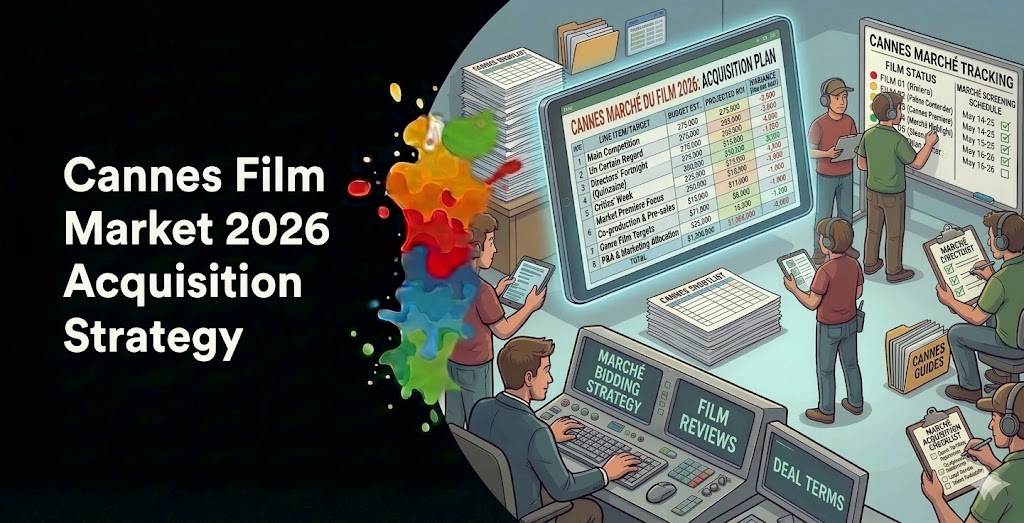
Cannes’ Marché du Film is the single most important deal-making event in the global film calendar. Not because it’s the largest—AFM moves comparable volume—but because the Marché sits inside the world’s most prestigious film festival, which means the room is uniquely concentrated: producers, sales agents, distributors, financiers, streaming buyers, and equity investors all operate within a five-day window on the same stretch of the Croisette. That convergence creates the conditions for the Cannes film market strategy that actually closes deals—provided you know what you’re doing before you land.
Most attendees treat Cannes like a networking event. The ones who move paper treat it like a structured financing and acquisition campaign with a hard deadline. This guide covers both sides of that table—what buyers need to know to source and close effectively, and what sellers must prepare to walk away with MGs signed rather than just meetings taken.
Prep Your Cannes Strategy Before the Croisette Gets Crowded
Trusted by Netflix, Warner Bros, and Paramount. Join 140,000+ companies tracking slates, buyers, and deal flow on Vitrina — before the market opens.
✓ 200 free credits | ✓ No credit card required | ✓ Ask VIQI anything
What Makes the Marché du Film the World’s Most Valuable Film Market
The Marché du Film runs concurrently with the official competition—and that’s the entire point. A documentary screening in Un Certain Regard can generate buyer interest that immediately flows into acquisition negotiations at the Palais. A presale package for an unfinished thriller gets validated or killed by the same conversations happening in festival party circuits and hotel suites.
Scale tells part of the story. The 2025 Marché hosted over 12,000 industry professionals from more than 115 countries, with 4,000+ films in the market screening program. But numbers miss the mechanism. What makes Cannes uniquely powerful is that festival prestige and commercial deal-making happen in simultaneous proximity—a title’s festival performance directly affects its market price in real time.
Here’s the thing: that time compression cuts both ways. It rewards preparation and punishes passivity at the same rate. A buyer without a shortlist is buried under screener requests within 48 hours. A seller without a properly packaged slate—cast attachments confirmed, territory estimates prepared, sales agent engaged—finds themselves competing for meeting slots against producers who arrived ready to close.
The Cannes film market strategy that actually delivers signed deals starts 6-8 weeks before the Palais opens. Not at the hotel bar on opening night. And as the film festival strategic planning framework shows, the groundwork for festival deal-making is structurally identical whether you’re buying or selling—intelligence, timing, and relationship activation are the shared variables.
How the Presale Engine Actually Works at Cannes
Presales are the financial backbone of the Cannes market—and most people’s mental model of how they work is at least partially wrong. A presale is a license agreement where a distributor commits a Minimum Guarantee (MG) for the right to release a film in a specific territory, typically before the film is completed. Those MG contracts then serve as collateral for production loans.
The process runs on a tight pre-market timeline. Sales agents compile slates and send packages to distributor contacts 2-3 weeks before the market opens—sometimes earlier for established relationships. The dealmaking frenzy happens at Cannes, yes, but the evaluations that drive those deals start in April, not May. By the time a buyer sits down for a market meeting, they’ve often already formed a position.
Payment structure matters for both sides. Standard MG terms split 10% on contract signature and 90% on delivery of the completed film. For sellers, this creates the financing gap that gap loans are designed to bridge. For buyers, it means upfront commitment is lower than the headline MG—which affects bidding psychology and cash flow planning simultaneously.
Banks don’t treat all presale contracts equally. Lenders typically advance 70-90% of MG face value, but that discount rate hinges entirely on the distributor’s credit quality. A presale from Pathé in France or Constantin Film in Germany commands top-tier lending terms. An MG from an unknown distributor in a minor territory may not qualify for bank financing at all—which means sellers need to prioritize territory sequencing, not just total MG volume.
The genre signal matters here too. Phil Hunt, Founder and CEO of Head Gear Films—whose company has financed 550+ films—is direct about what the market actually wants: “Action, thriller, horror. Those three kinds of genres specifically are working.” Drama, Hunt notes, isn’t moving in the independent space. Comedy barely travels internationally. Sellers packaging Cannes slates around anything outside that commercial core need significantly stronger cast or director pedigree to compensate.
There used to be a time, Hunt recalls, when a film could be pre-sold off an idea alone—no script, no cast, just a concept and the right conversations at Cannes. Those days are gone. The market now requires a complete package: confirmed cast, reputable director, experienced sales agent, and a budget structure that makes financial sense at each territory’s MG level. The bar has risen considerably since the post-COVID production crunch tightened every lender’s criteria.
Phil Hunt (Founder & CEO, Head Gear Films) breaks down why independent film finance has fundamentally shifted — what genres the market is actually buying, why the window model has collapsed, and what a strong Cannes package looks like in the current environment.

Buyer Strategy: How Acquisition Teams Win at Cannes 2026
Buyers who close at Cannes—not just attend—operate on a different calendar from everyone else. Here’s what separates the teams closing paper from the teams collecting business cards.
Build Your Shortlist in March, Not May
The Marché’s official selection typically circulates 4-6 weeks before the market opens. But serious acquisition teams are tracking production pipelines well before that—monitoring which producers have projects in post, which sales agents are packaging slates, and which territories in their own catalog need filling. Your shortlist should solve real slate problems, not chase Palais buzz.
A workable buyer shortlist at Cannes runs 8-12 titles across tiers. Your tier-one targets (2-3 maximum) get pre-market offers prepared—pricing authority cleared internally, territory scope defined, and a go/no-go framework agreed before the plane lands. Mid-tier targets (4-5 titles) get screener requests made and internal alignment on parameters. The rest are tracked but don’t consume bandwidth. Most acquisition teams get this backwards—too many titles, too little differentiation.
Activate Sales Agent Relationships Before the Market
Sales agents control access to Cannes packages. The agent decides who gets the screener first, who gets the meeting slot that matters, and who hears about a price before it becomes public. Being on the right agent’s pre-screen list is operationally more valuable than any amount of market presence. That relationship is built in the months before Cannes—not at dinner on the Croisette.
Insiders recognize that agent relationship quality is a direct function of deal history. Buyers who’ve closed at prior Cannes or AFM markets—and paid their MGs on time—get preferential access to next year’s slates. It compounds. New buyers entering the market need to be explicit about what they bring: territory reach, platform access, or a track record in adjacent markets that signals commercial credibility.

Your AI Assistant, Agent, and Analyst for the Business of Entertainment
VIQI AI helps you plan content acquisitions, raise production financing, and find and connect with the right partners worldwide.
- Find active co-producers and financiers for scripted projects
- Find equity and gap financing companies in North America
- Find top film financiers in Europe
- Find production houses that can co-produce or finance unscripted series
- I am looking for production partners for a YA drama set in Brazil
- I am looking for producers with proven track record in mid-budget features
- I am looking for Turkish distributors with successful international sales
- I am looking for OTT platforms actively acquiring finished series for the LATAM region
- I am seeking localization companies offer subtitling services in multiple Asian languages
- I am seeking partners in animation production for children's content
- I am seeking USA based post-production companies with sound facilities
- I am seeking VFX partners to composite background images and AI generated content
- Show me recent drama projects available for pre-buy
- Show me Japanese Anime Distributors
- Show me true-crime buyers from Asia
- Show me documentary pre-buyers
- List the top commissioners at the BBC
- List the post-production and VFX decision-makers at Netflix
- List the development leaders at Sony Pictures
- List the scripted programming heads at HBO
- Who is backing animation projects in Europe right now
- Who is Netflix’s top production partners for Sports Docs
- Who is Commissioning factual content in the NORDICS
- Who is acquiring unscripted formats for the North American market
Understand the Streaming Buyer Effect on Territory Pricing
Netflix, Amazon MGM Studios, and Apple TV+ can buy worldwide rights outright—collapsing the territory-by-territory presale model for any title they seriously pursue. That changes the competitive dynamics for every other buyer. When a streamer expresses interest in a package, MG expectations across all territories inflate. When a streamer passes, independent buyers can often close at favorable prices.
But here’s the capital reality: streamers have become more selective post-strike. As Variety reported across the 2025 festival circuit, the era of volume streaming acquisition is over—platforms are prioritizing high-profile packages over breadth. That selectivity creates genuine openings for independent theatrical buyers, regional platforms, and specialty distributors who move fast in the $1-6M MG range on titles the streamers don’t want.
For regional streaming buyers—particularly those covering MENA, APAC, or LATAM—Cannes is the primary window to close deals on Western content before it gets locked up. Rolla Karam, SVP Content Acquisition at OSN, which operates across 23 countries in the Middle East and North Africa, manages exactly this challenge: sourcing Western content that performs across diverse markets while also building out Arabic and Turkish catalog. Regional platforms at Cannes 2026 face compressed deal windows as streamer selectivity frees more content for territory licensing—but only for buyers who move quickly.
Track 400,000+ Projects Before They Hit the Cannes Slate
Netflix UK found their co-production partner in 48 hours. Join 140,000+ companies using Vitrina to track production pipelines, sales agent slates, and acquisition targets before the market opens.
✓ 200 free credits | ✓ No credit card required | ✓ Full platform access
Seller Strategy: Packaging a Cannes Slate That Actually Sells
Sellers—producers and their sales agents—face a different set of problems at Cannes. The market is saturated. Thousands of projects compete for attention from buyers who have already made up their minds about half the titles before they walk through the door. Standing out isn’t about the loudest pitch. It’s about having the right package at the right price for the right territories.
The Capital Stack That Gets Films Off the Ground
A typical commercially viable independent feature entering Cannes presales aims to cover 65-80% of its budget before the market opens. The capital stack usually looks something like this: equity at 20-40%, presales at 30-50%, tax incentives at 15-30%, and gap financing bridging the remainder at 10-15%. The goal of Cannes is to close the presale portion—which then unlocks bank lending against those MG contracts and de-risks the equity position.
Cover 50-70% of your budget through presales and incentives before reaching for gap financing. Sellers who arrive at Cannes with a gap loan already negotiated in principle—and can demonstrate they only need presale contracts to satisfy lender conditions—are in a fundamentally stronger position than those arriving with a wide-open financing plan. The gap closes the stack; the presales activate the gap. Understanding that sequencing is what separates experienced producers from first-timers.
Joshua Harris, President & Managing Partner of Peachtree Media Partners—a film finance lender that advances against distribution agreements and tax incentives—frames what lenders actually evaluate: “The most important aspect that we’re looking at when we pre-screen a project is the team around it. Who are the producers? Who are the sales agents? Who’s the filmmaker and the cast?” Peachtree, which is currently in a $50M raise scaling to $100M, won’t advance without credible management and collateral. Neither will any other serious lender.
As our guide to sales agents in production financing covers in detail, the agent you attach directly signals how banks will assess your presale contracts. A-list agents—Wild Bunch, Protagonist Pictures, Goodfellas—command lending at the top of the 70-90% discount rate. Unknown agents may not qualify for bank financing at all, regardless of the MG amounts on the contracts.
Territory Sequencing: Where to Start Selling
Not all territories are equal as presale targets, and sequence matters enormously. Major markets—Germany, France, UK, Japan, Australia, Italy—carry the highest MG values and provide the best collateral for bank lending. The strategic approach is to close major territories first at Cannes, generating the bank leverage that covers production, then sell remaining territories post-completion, when festival performance data allows you to negotiate from a stronger position.
The classic Cannes execution on a $10M independent feature runs roughly as follows: pre-market conversations activate Germany (via Constantin or equivalent), France (via Wild Bunch or Memento), UK, and one or two APAC major territories. That block of presales—assuming credible cast and commercial genre—can cover $4-5M at realistic MG levels, providing bank collateral for production lending. Mid-tier territories close during or just after the market. Smaller territories get handled at AFM or EFM.
The “Hit Man” model is instructive here. Richard Linklater’s film closed 15 presale contracts before production began—Canada, Italy, Poland, Turkey, the Middle East, and more—with Linklater attached plus Glen Powell as star. Those MGs covered a significant portion of the budget. The film then sold to Netflix for domestic. That’s the ideal presale architecture: major international territories locked before production, domestic window held for a later sale at a post-festival premium.
Co-Production Strategies That Multiply Your Cannes Leverage
Here’s what strategic sellers increasingly weaponize at Cannes: official co-production treaties. An official co-production gives a project national status in both countries—unlocking local incentives, national film fund access, and broadcaster pre-buy obligations in each territory simultaneously. France has 61 bilateral treaties. Canada operates the world’s most extensive treaty network with 60+ partner countries. The UK has treaties covering Australia, Canada, France, Germany, India, and South Africa, among others.
The capital implication is direct. A France-Canada official co-production can stack CNC funding, Telefilm Canada support, Quebec provincial incentives, and Canadian federal tax credits—potentially accessing 40-60% of budget through incentive stacking alone, before a single presale MG is signed. That dramatically changes what a seller needs from Cannes: less total presale volume required, better negotiating position on each individual territory deal.
Andrea Scarso, Managing Director of IPR VC (an equity fund with partners including A24, XYZ Films, and MK2), describes how his team evaluates co-production positioning from an investor perspective: they look for diversification across “different buckets of the market—different in terms of budget size, type of audiences, genre”—because slate diversification and co-production structures reduce single-project risk. That’s the same lens any serious Cannes seller should apply to their own financing architecture before walking into market meetings.
Our multi-territory financing structures guide walks through the specific treaty combinations that work across major Cannes presale territories—useful preparation for any seller building a Cannes financing plan.
Sovereign Content Hubs at Cannes 2026: The New Capital at the Table
The most significant shift in Cannes deal-making over the past three years isn’t streaming—it’s sovereign capital. Government-backed production funds from Sovereign Content Hubs™ have arrived at the Marché with real money and real mandates, changing what buyers and sellers can access and from whom.
Saudi Arabia’s Vision 2030 framework has committed over $4B in film-specific investment, including a 40% cash rebate on qualifying expenditure and the Saudi Film Fund (rebranded as Riviera Content in 2024) at $100M, co-financing with global studios. The UAE offers up to 50% cash rebates in Abu Dhabi alongside zero-tax free zone structures. These aren’t emerging market promises—they’re operational programs with application processes, compliance frameworks, and deployed capital.
For sellers at Cannes, the implication is meaningful: a project structured to qualify for Saudi or UAE incentives can reduce its effective budget by 35-50%, which directly reduces the presale volume required for greenlight. A $10M film produced partly in Saudi Arabia with a 40% rebate on qualifying spend effectively costs $6-7M in net cash. That compression changes every negotiation in the presale market.
For buyers, these Sovereign Content Hubs™ are increasingly sophisticated content originators—not just service providers. Saudi, UAE, and South Korean production companies are arriving at Cannes 2026 with IP they own, backed by sovereign capital that doesn’t need Hollywood validation to greenlight. Buyers who haven’t built relationships with these new supply chain nodes are operating with blind spots that compound each year.
The Fragmentation Paradox™ is most acute precisely here: 600,000+ companies in the global supply chain, with Sovereign Content Hubs adding new production companies, funds, and commissioning entities at a pace that static databases and trade publications simply can’t track. The information asymmetry between buyers with real-time hub intelligence and those relying on six-month-old trade reports translates directly to 15-20% margin leakage on deals that could have been structured better.
How Platform Intelligence Changes Your Cannes Strategy
What separates the buyers and sellers closing deals from those collecting meetings comes down to the quality of intelligence they’re operating on. The real dynamic in 2026 is that the tools available to prepare for Cannes have gotten significantly more powerful—but most teams haven’t updated their workflows to match.
Vitrina’s platform gives buyers and sellers access to 140,000+ companies and 400,000+ projects across the global supply chain—filterable by genre, budget tier, territory, sales agent, production status, and financing type. For a buyer building a Cannes shortlist in March, that means surfacing projects in late-stage post with credible producers and attached agents, weeks before sales slates go out. For a seller building a co-production or presale target list, it means mapping active distributors in specific territories by deal history and acquisition appetite—not guesswork.
VIQI—Vitrina’s AI intelligence layer—answers specific market questions in real time. Which sales agents are most active in the horror/thriller space at Cannes? Which regional distributors have acquisition mandates in Middle Eastern content? What’s the typical MG range for a €5M European drama with no US attachment? These are research tasks that used to take weeks. They don’t anymore.
And for teams that need something beyond the platform—curated package introductions, territory-specific buyer matching, or co-production partner identification—Vitrina’s Concierge Service delivers human expertise against the specific gaps in your Cannes preparation. The acquisition strategy guide for content gatekeepers outlines exactly how modern acquisition teams build intelligence infrastructure—worth reviewing before your market prep begins.
Need a Cannes Strategy Partner, Not Just a Platform?
Vitrina’s Concierge Service works directly with buyers and sellers to build curated Cannes strategies — qualified buyer lists, co-production partner introductions, and territory gap analysis built around your specific slate. No credit card to start.
Cannes Film Market 2026: Frequently Asked Questions
When does the Cannes Marché du Film take place in 2026?
The Cannes Film Festival 2026 runs from approximately May 13-24, with the Marché du Film operating concurrently from around May 14-22. The exact dates are confirmed by the Festival de Cannes organization in early spring. Market accreditation typically opens three months in advance. Sellers should begin outreach to buyers and finalize slate packages at least 6-8 weeks before the market opens—targeting a late March/early April launch for materials distribution.
What’s the difference between the Cannes Film Festival competition and the Marché du Film?
The Festival competition—comprising the Palme d’Or competition, Un Certain Regard, Directors’ Fortnight, and Critics’ Week—is an artistic selection decided by the programming team. The Marché du Film is an open commercial market where any accredited producer or sales agent can screen and sell a project. The two operate simultaneously, and critically, they influence each other: a strong competition premiere generates immediate Marché buying interest, and a project’s presence at the festival (even in market-only screenings) lends credibility to presale conversations.
What genres sell best at the Cannes Marché du Film?
Action, thriller, and horror consistently drive the highest presale volume and the most competitive buyer interest at Cannes. These genres have strong international appeal—buyers in Germany, Italy, Australia, Japan, and MENA all have active appetite for commercial genre films with recognizable cast. Drama can sell at Cannes but requires significantly stronger talent (A-list director or cast) to move at commercial MG levels. Comedy travels poorly in the international territory market—cultural specificity limits its presale value outside the domestic market. Elevated genre—commercially structured films with arthouse credibility—attracts both independent buyer and streamer interest simultaneously, creating the best bidding conditions.
How does gap financing work in the context of a Cannes presale campaign?
Gap financing bridges the difference between the confirmed capital in your stack—equity, presales, and tax incentives—and your total production budget. Typically covering 10-15% of budget (supergap goes to 30%), gap loans are secured against unsold foreign territorial rights and require a reputable sales agent providing credible sales estimates at 1.5-2x the gap amount. Cannes presale contracts, when signed with recognized distributors in major territories, directly improve the gap financing terms you can access—stronger presale coverage means better lender confidence, lower effective cost of gap, and faster greenlight to production.
How important is the sales agent in a Cannes film market strategy?
The sales agent is the single most important variable in a seller’s Cannes strategy—and a critical signal for buyers evaluating packages. The agent creates the territory estimates that determine your collateral value with lenders, manages buyer relationships that control your access to acquisition conversations, and packages your project in ways that optimize MG potential across territories. Banks rate sales agents and adjust their lending terms accordingly—a project represented by Wild Bunch, Goodfellas, or Protagonist Pictures qualifies for different bank terms than one represented by an unknown agent. Engage your sales agent 3-4 months before the market; don’t arrive without one.
Can small production companies compete effectively at the Cannes Marché?
Yes—but with focused strategy. Smaller producers at Cannes don’t need a Palais suite. They need a clear target list of buyers (6-10 specific companies, not everyone), a properly packaged project with confirmed talent attachments, and a sales agent doing the heavy lifting on presale conversations. The Marché runs hundreds of co-production and financing meetings in smaller venues (the Producers Network, national pavilions, hotel suites) where mid-size projects move every year. The mistake small producers make is spreading too thin. Depth of relationship with three qualified buyers beats breadth of meetings with thirty.
How do co-production treaties affect a Cannes presale strategy?
Official co-production treaties give a project national status in each co-producing country, enabling access to local film funds, tax incentives, and broadcaster pre-buy requirements simultaneously. A France-Canada official co-production, for example, can access CNC funding, Telefilm Canada support, provincial incentives, and Canadian federal tax credits—potentially covering 40-60% of budget through incentive stacking before a single presale MG is negotiated. This dramatically reduces the presale volume required from Cannes and strengthens your negotiating position on individual territory deals. France’s 61 bilateral treaties and Canada’s 60+ treaty network make these among the most valuable co-production platforms to structure around for Cannes campaigns.
How does Vitrina help with Cannes film market preparation?
Vitrina provides buyers and sellers with access to 140,000+ companies and 400,000+ projects across the global film and TV supply chain, filterable by territory, genre, budget tier, production status, sales agent, and financing type. For buyers, this means surfacing acquisition targets and mapping sales agent slates weeks before the official market. For sellers, it means identifying qualified buyers by territory appetite and deal history, and connecting with co-production partners by treaty eligibility and infrastructure. VIQI—Vitrina’s AI intelligence layer—answers specific Cannes market research questions in real time. The Concierge service handles curated matching for teams that need human expertise alongside the data.
The Bottom Line: Your Cannes Film Market 2026 Strategy Starts Now
Cannes rewards preparation at every level of the deal. Buyers who’ve built their shortlists, activated sales agent relationships, and cleared internal pricing authority before landing at Nice airport close more deals and pay less for them. Sellers who arrive with confirmed cast, a credible sales agent, a realistic capital stack, and territory estimates that hold up to lender scrutiny move paper. The rest have meetings.
The Fragmentation Paradox™ is most expensive at Cannes—where time compression and information asymmetry interact at maximum intensity. Buyers operating on incomplete intelligence overpay for titles or miss them entirely. Sellers without platform-level market intelligence undervalue territories or mismatch buyers to projects. Both are solvable. But the solution requires starting the intelligence cycle well before May.
And here’s what the traders don’t report: the deals that define a Cannes for an acquisition team or a production company are mostly decided in the six weeks before the festival. The Croisette is where they get signed.
Key Takeaways
- Presale packages ship 2-3 weeks before the market: Buyers who haven’t requested screeners by then are already behind. Sales agent relationships are the access layer—build them before May, not during it.
- Capital stack sequencing determines greenlight: Cover 50-70% through presales and incentives before reaching for gap financing. Cannes is where you close the presale portion; gap financing activates from there.
- Genre is the fastest market signal: Action, thriller, and horror move at Cannes. Drama requires exceptional packaging. Comedy doesn’t travel. Structure your slate around what buyers are actually buying.
- Co-production treaties multiply your financing leverage: Official co-productions access multiple national incentive programs simultaneously, reducing presale volume required and improving per-territory MG negotiating position.
- Sovereign Content Hubs™ are now credible capital sources: Saudi Arabia’s 40% rebate and Vision 2030 film fund, UAE incentives, and South Korea’s infrastructure are not emerging market promises—they’re operational and present at Cannes 2026.
- Platform intelligence compresses the deal cycle: Vitrina’s 140,000+ company and 400,000+ project database surfaces qualified buyers, active sales slates, and co-production partners weeks before the market—turning Cannes from a discovery event into a confirmation one.
Build Your Cannes 2026 Strategy on Real Market Intelligence
Netflix, Warner Bros, and Paramount use Vitrina to track the global entertainment supply chain. Your first 200 credits are free — no credit card, full platform access from day one.
✓ 200 free credits | ✓ No credit card required | ✓ Cancel anytime
Find Film+TV Projects, Partners, and Deals – Fast.
VIQI matches you with the right financiers, producers, streamers, and buyers – globally.
Producers Seeking Financing, Co-Pros, or Pre-Buys?
Vitrina Concierge helps producers reach the right financiers, commissioners, distributors, and co-production partners — with precision outreach, not cold pitching.
Join Industry Briefings Trusted by Leaders

Format Adaptations: Global Trends
Where formats are traveling, which adaptations are breaking out, and how streamers are backing remakes in 2025–2026.

Books, Novels & Comics Adaptations: Global Trends
Books, webtoons, and manga driving the next global screen hits. Discover how in this webinar.

Micro-Dramas & Mobile-First Storytelling
Micro-dramas are building real audiences and revenue. Understand the platforms, buyers, and economics behind the growth.

Navigating Global Content Licensing Trends
How global content licensing is shifting beyond flat fees to flexible, deal-driven models.