About Innovation Hub
 Global Content Pulse (Webinars)


 Global Production Financing
(Webinars)
Global Production Financing
(Webinars)  LeaderSpeak Podcast
  About Vitrina
 Our Story
 Our Solutions 🔥
 Film+TV Projects Tracker 🚀
 Case Studies
 Our Profile
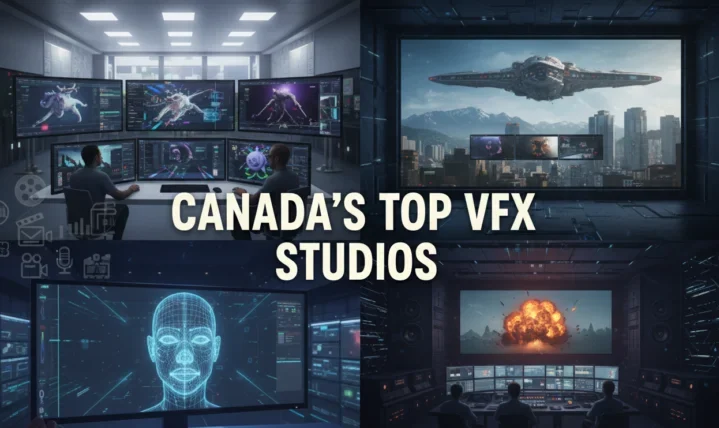
If you’re sourcing VFX studios in Canada and still working off a shortlist you built before 2024, you’re already behind. The landscape moved. Scanline VFX—the Vancouver simulation powerhouse—has been Netflix-owned since 2021 and is now structurally integrated into Netflix original production pipelines. Rodeo FX won back-to-back Academy Awards for Outstanding Visual Effects on Dune: Part One and Dune: Part Two, then immediately acquired Mikros Animation from the collapsed Technicolor Group in March 2025—doubling its animation capabilities overnight. And MARZ in Toronto has built proprietary AI tools (Vanity AI, LipDub AI) that are measurably compressing TV VFX timelines in ways that traditional studios simply can’t replicate.
Here’s what’s actually driving the procurement calculus: Canada’s incentive structure got more competitive, not less. British Columbia increased its Film Incentive BC rate to 40% for productions starting principal photography after December 31, 2024 (up from 35%). Quebec maintains 36–40% for foreign productions—and crucially, it applies to all expenditures, not just labour. Ontario’s OCASE credit delivers 18% on qualified computer animation and special effects labour. Stack those against the federal 25% Canadian Film or Video Production Tax Credit, and Canada’s incentive architecture is genuinely among the deepest on the planet for high-end VFX work.
But incentives only matter if you’re at the right studio. This guide gives you the verified intelligence on Canada’s top VFX studios in 2026—credits, capabilities, ownership structures, and the specific scenario each studio is best suited for.
It’s the Fragmentation Paradox™ in action: 99 VFX studios operate in Canada with somewhere between 6,000 and 20,000 workers across three major hubs. The question isn’t whether Canadian VFX talent is world-class (it is). The question is which studio, which city, and which incentive stack matches your project type.
In This Guide
Vet Canadian VFX Studios in Hours, Not Weeks
Ask VIQI to surface verified Canadian VFX companies by capability, credit history, jurisdiction, and current capacity. Used by production teams at Netflix, Warner Bros, and Paramount to de-risk vendor selection. Join 140,000+ companies on the platform. No credit card required.
Why Canada Leads: The Three-City VFX Ecosystem
Canada’s dominance in global VFX isn’t an accident—it’s a 30-year compounding of tax policy, immigration-friendly talent access, world-class technical schools, and the gravitational pull of major studio output. British Columbia alone accounts for 60% of all film and TV production in Canada, per Creative BC data. And Montreal now houses more than 40 VFX and post-production companies—one of the largest concentrations of post-production infrastructure anywhere on the planet.
But the three cities aren’t interchangeable. They’re distinct ecosystems with different strengths, and the best producers treat them that way.
Vancouver is the large-scale VFX and simulation hub—where Netflix planted Scanline VFX, where Image Engine built its reputation on District 9, and where dozens of international studio outposts (ILM, Wētā FX, Framestore, DNEG, Pixomondo, Sony ImageWorks, Animal Logic, Digital Domain, and more) operate alongside homegrown talent. The BC DAVE tax credit (16% on eligible BC labour) stacks on top of the FIBC base rate—now at 40%—creating a compelling jurisdiction play for North American productions with major simulation or environmental VFX requirements.
Montreal is where Quebec’s incentive structure creates the most powerful cost-efficiency case. The province’s credit applies to all expenditures—not just labour—which is a significant structural advantage for large VFX packages. Rodeo FX, Folks VFX, Pixomondo, Sony ImageWorks, DNEG, Framestore, MPC, Mikros Animation, and Outpost VFX all operate there. It’s also Canada’s European co-production gateway, with French-language treaty access that opens additional financing channels for international productions.
Toronto is the AI and episodic TV innovation hub. MARZ and Rocket Science VFX (RSVFX) have both built major streaming credits here, and the Ontario OCASE credit—18% on qualified animation and special effects labour—specifically targets the premium TV production sweet spot. As we’ve covered in our global VFX companies guide, Toronto’s emergence as an episodic VFX centre has been one of the more significant shifts of the last five years.

Your AI Assistant, Agent, and Analyst for the Business of Entertainment
VIQI AI helps you plan content acquisitions, raise production financing, and find and connect with the right partners worldwide.
- Find active co-producers and financiers for scripted projects
- Find equity and gap financing companies in North America
- Find top film financiers in Europe
- Find production houses that can co-produce or finance unscripted series
- I am looking for production partners for a YA drama set in Brazil
- I am looking for producers with proven track record in mid-budget features
- I am looking for Turkish distributors with successful international sales
- I am looking for OTT platforms actively acquiring finished series for the LATAM region
- I am seeking localization companies offer subtitling services in multiple Asian languages
- I am seeking partners in animation production for children's content
- I am seeking USA based post-production companies with sound facilities
- I am seeking VFX partners to composite background images and AI generated content
- Show me recent drama projects available for pre-buy
- Show me Japanese Anime Distributors
- Show me true-crime buyers from Asia
- Show me documentary pre-buyers
- List the top commissioners at the BBC
- List the post-production and VFX decision-makers at Netflix
- List the development leaders at Sony Pictures
- List the scripted programming heads at HBO
- Who is backing animation projects in Europe right now
- Who is Netflix’s top production partners for Sports Docs
- Who is Commissioning factual content in the NORDICS
- Who is acquiring unscripted formats for the North American market
Canada’s Top 7 VFX Studios for 2026
1. Scanline VFX — Vancouver, BC
Ownership: Netflix (acquired 2021). Revenue: $548.9 million (2025).
Scanline is the large-scale simulation specialist. Full stop. Its proprietary fluid dynamics software Flowline earned a Scientific and Technical Achievement Academy Award in 2008—and it’s still the benchmark for photoreal ocean, weather, and large-scale destruction sequences. The studio was nominated for an Academy Award for its work on Clint Eastwood’s Hereafter; TIME magazine called the tsunami sequence “the most exciting, expertly assembled flood scene in movie history.”
Post-Netflix acquisition, Scanline is effectively the first-call vendor for Netflix originals requiring large-scale environmental VFX. Its hero credits include Zack Snyder’s Justice League, Stranger Things, and Kingdom of the Planet of the Apes. But here’s what matters for procurement decisions: Netflix ownership doesn’t mean Scanline is exclusively unavailable for non-Netflix productions—it means the studio’s pipeline and capacity planning are deeply integrated with Netflix’s commissioning calendar. If you’re not working with Netflix, factor in availability windows carefully. As VFX Voice reports, Scanline maintains both Vancouver and Montreal operations.
Best for: Large-scale fluid simulation, environmental VFX, Netflix original productions. Incentive stack: BC FIBC 40% + DAVE 16% on eligible labour.
2. Rodeo FX — Montreal (HQ), Quebec City, Toronto, Vancouver, Paris, Los Angeles
Founded: 2006 by Sébastien Moreau. Academy Awards: 2 (Dune: Part One, Dune: Part Two — Outstanding Visual Effects).
Rodeo FX is Canada’s most decorated active VFX studio—and the March 2025 acquisition of Mikros Animation (formerly Technicolor) makes it significantly more formidable. The deal brings Mikros’s end-to-end animation capabilities—PAW Patrol: The Mighty Movie, Orion and the Dark, TMNT: Mutant Mayhem—under the same roof as a studio that’s delivered major VFX sequences for Game of Thrones, Stranger Things, The Rings of Power Seasons 1 and 2, Dune: Prophecy, and Expats (three VES nominations in a single cycle). The company currently has major projects in active production for Apple TV+, HBO, and Netflix, per Animation Magazine.
“This is a deeply meaningful moment,” Rodeo FX Founder and CEO Sébastien Moreau said of the Mikros acquisition. “We’re building something that goes beyond business: a creative home where artists can dream bigger.” That’s not marketing language—it reflects a strategic bet that full-service capability (VFX + animation in a single pipeline) is the structural advantage that secures the next decade of major commissions.
Best for: Large-scale feature film VFX, tentpole episodic, emerging animation co-production pipeline. Incentive stack: Quebec 36–40% on all expenditures.
3. Image Engine — Vancouver, BC
Founded: 1995. Group: Cinesite (acquired 2015).
Image Engine is Vancouver’s original prestige VFX studio—founded three decades ago and still delivering top-tier credits. The studio’s reputation was forged on Neill Blomkamp’s District 9 (the only production to beat Avatar in any VES category that year, per Shawn Walsh, who is now Image Engine’s General Manager and Cinesite Group COO VFX). It’s not a studio chasing shot count; it’s a studio focused on complex creature work, photoreal environments, and sequences where technical quality defines the final frame.
Its recent major credits include Game of Thrones, The Mandalorian, 3 Body Problem (Netflix), Lost in Space, Fantastic Beasts: The Secrets of Dumbledore, and Venom: Let There Be Carnage. As part of Cinesite Group, it operates with shared pipeline infrastructure across international facilities—which matters for productions that need to split VFX packages across locations without losing consistency.
Best for: Creature VFX, photoreal environments, premium streaming drama with complex VFX requirements. Incentive stack: BC FIBC 40% + DAVE 16%.
4. MARZ (Monsters Aliens Robots Zombies) — Toronto, ON
Founded: 2018 by Jonathan Bronfman (CEO), Lon Molnar (CCO), Matt Panousis (COO). Team: 300+ employees.
MARZ is the most disruptive studio in the Canadian VFX market—and arguably the most disruptive AI-native VFX studio on the planet right now. The company launched in a Toronto basement in 2018 and has delivered VFX for over 110 TV productions, including Wednesday (Netflix), WandaVision, Moon Knight, Spider-Man: No Way Home, Stranger Things, The Umbrella Academy (all three seasons), Percy Jackson, and The Creator (which won a VES Award for Outstanding Compositing and Lighting in a Feature).
But the credentials aren’t what makes MARZ strategically important in 2026. It’s the technology stack. Vanity AI—its proprietary de-aging and retouching system—automates processes that previously required frame-by-frame manual work. MARZ used it on Peacock’s Dr. Death for de-aging sequences; it’s been deployed on dozens of productions since. LipDub AI is the world’s first fully automated lip-sync technology producing lip movements in under 20 minutes per shot. These tools don’t just save time—they change the unit economics of episodic TV VFX. And they translate directly into budget. As co-founder Lon Molnar explained in a VFX Voice interview, more than 25% of MARZ’s team is focused on R&D, machine learning, and AI—a ratio that looks more like a technology company than a service studio.
Best for: Premium episodic TV with tight schedules and high shot counts, de-aging sequences, AI-enabled pipeline efficiency, streaming drama at Netflix/Disney+/Marvel scale. Incentive stack: Ontario OCASE 18% on qualified labour.
5. Rocket Science VFX (RSVFX) — Toronto, ON
Co-Founder / Production VFX Supervisor: Tom Turnbull.
RSVFX is Toronto’s other major streaming VFX studio—and it’s quietly building an exceptional credit list at the premium end of the market. Tom Turnbull served as Overall Production VFX Supervisor for Wednesday Season 2 (Netflix), delivered 200+ shots for Chief of War (Apple TV+), and provided the VFX for It: Welcome to Derry (HBO). The studio’s film Tuner was selected for Sundance 2026’s Spotlight program—a signal that RSVFX is building festival-level creative credibility alongside its commercial slate.
Production VFX Supervisor Chris Scollard’s feedback on the Chief of War work captures the studio’s operating culture: “The team completely knocked it out of the park. They brought great ideas, explored creative options, and executed with precision.” That’s the kind of partner review that matters more than any awards citation when you’re actually sourcing. Best for: Premium streaming drama (Netflix/HBO/Apple TV+), environment-heavy episodic, battle and action sequences. Incentive stack: Ontario OCASE 18%.
6. Folks VFX — Montreal (HQ), Toronto + 8 Global Offices
Founded: 2012. Group: Pitch Black (FuseFX). Global artists: 900+.
Folks VFX is one of the most internationally scaled studios in Canada—with offices spanning Montreal, Toronto, Bogotá, Saguenay, Mumbai, Los Angeles, New York, Vancouver, Atlanta, and London (900+ artists across the network). That scale matters for productions that need to split large VFX packages across time zones without losing pipeline coherence. The studio won the VES Award for Outstanding Compositing and Lighting in a Feature at the 22nd Annual VES Awards for The Creator—a technically demanding project that required photoreal environment work across multiple complex sequences. Its other credits include Bad Boys: Ride or Die, Quiz Lady (Disney+), and Black Panther: Wakanda Forever.
Best for: High-volume VFX packages requiring multi-office delivery, compositing-heavy productions, international co-productions where Montreal’s Quebec incentive stacks with EU co-production financing. Incentive stack: Quebec 36–40% on all expenditures.
7. DNEG — Vancouver, Toronto, Montreal (Plus Global Network)
Academy Awards: 6 total (more than any other VFX company).
DNEG isn’t a Canadian studio—it’s a global VFX company with deeply entrenched Canadian operations across all three major hubs. But it belongs on any serious shortlist of Canada’s VFX capacity. Its Vancouver, Toronto, and Montreal offices are significant contributors to the pipeline that has delivered six Academy Award wins (including Interstellar, Tenet, Dune: Part One) and credits spanning Spider-Man: No Way Home, 3 Body Problem, Avatar: The Way of Water, and dozens of other major productions. For productions that want to route work through Canadian incentive jurisdictions while accessing DNEG’s global pipeline depth and proprietary technology, the Canadian offices are the entry point. And with our worldwide VFX selection guide covering DNEG’s global operations in detail, this ranking focuses specifically on the Canadian operations context.
Best for: Large-scale feature productions requiring global pipeline capacity, complex multi-department VFX packages. Incentive stack: BC, Ontario, or Quebec credit depending on which office leads the work.
Build Your Canada VFX Vendor Shortlist in 48 Hours
Vitrina tracks 400,000+ film and TV projects and verified profiles for VFX studios across all three Canadian hubs—including capacity data, recent credits, and current production commitments. Get 200 free credits to start vetting studios today. No credit card required.
The Canadian VFX Incentive Stack Explained
Canada’s incentive architecture works at two levels: federal and provincial. The capital reality is that these stack—and when you understand the stacking logic, the headline numbers become materially more compelling than they appear at first glance.
Federal level: The Canadian Film or Video Production Tax Credit (CPTC) provides 25% on qualified labour expenditure. For foreign service productions, the Canadian Film or Video Production Services Tax Credit (PSTC) is the relevant instrument. Both are refundable—meaning you receive the excess over tax owed as cash, not just a reduction in liability.
British Columbia (Vancouver): The Film Incentive BC rate increased to 40% for productions starting principal photography after December 31, 2024. The DAVE (Digital Animation, Visual Effects and Post-Production) credit adds 16% on eligible BC labour costs specifically for VFX work. That’s not a substitute for FIBC—it’s additional. Combined with federal, a production routing significant VFX labour through BC is accessing one of the strongest incentive environments in North America. Creative BC administers all credits; the certification process requires minimum budgets (C$1M for features, C$200K per episode for series).
Quebec (Montreal): Quebec’s credit for foreign productions runs 36–40%—and the crucial structural difference is that it applies to all expenditures, not just labour. For VFX-heavy productions, that distinction changes the effective rate significantly. Montreal International’s data notes that “most clients call and ask for Montreal first because they want that rebate”—a phrase that was said about a decade ago and remains just as true today.
Ontario (Toronto): The OCASE (Ontario Computer Animation and Special Effects) credit delivers 18% on qualifying labour expenditures for eligible computer animation and VFX. It’s specifically designed for the episodic TV and digital media pipeline that studios like MARZ and RSVFX operate within. Our global production incentives guide covers how Canadian credits compare against the UK’s new 29.25% VFX-specific rebate and other competing jurisdictions.
Worth noting: Canadian co-production treaties with more than 50 countries—including the UK, France, Germany, Australia, Ireland, and Israel—mean international productions can access Canadian incentives as part of a larger treaty structure. For a European producer with a Canada-UK or Canada-France co-production, the combined incentive pool is even deeper than any single jurisdiction’s headline rate suggests.
Procurement Logic: Which Studio for Which Project
The real dynamic in Canadian VFX procurement isn’t just about which studio has the best reel. It’s about matching project type to studio capability and incentive jurisdiction—and doing that analysis before you’re in pitch meetings, not during them.
If your project is a Netflix original with major simulation, fluid, or environmental VFX requirements—Scanline VFX is your first conversation, full stop. Netflix ownership means pipeline integration runs deep, turnaround expectations are calibrated to Netflix’s schedule culture, and the studio’s technical toolkit (Flowline for fluid dynamics) is unmatched for certain sequence types.
If you’re producing a tentpole feature or premium streaming drama with complex creature work and large VFX packages—Rodeo FX and Image Engine are the Montreal/Vancouver anchors. Rodeo FX’s Dune track record (two consecutive Academy Award wins is not a coincidence) combined with the new Mikros animation pipeline makes it the most capable full-service provider in Canada right now. Image Engine brings 30 years of photoreal quality for productions that can’t afford VFX that looks like VFX.
If you’re producing a premium TV series with a high shot count and a compressed timeline—MARZ is the AI-native answer. The studio’s entire model—GPU rendering, TV-specific workflows, Vanity AI and LipDub AI tools—was purpose-built for exactly the scenario most episodic producers face in 2026: maximum quality expectations, minimum time, tighter budgets. Its credits on Wednesday, WandaVision, and Spider-Man: No Way Home aren’t just impressive—they’re proof of scale delivery.
And if you need a large VFX package split across time zones with consistent quality—Folks VFX’s 900+ artist global network, anchored by Montreal incentives, is structured for exactly that workload. Their VES win for The Creator is the quality benchmark; their 10-office footprint is the capacity proof.
One thing strategic players understand that others miss: the incentive jurisdiction choice isn’t just a financial decision. It shapes which studios are accessible, which co-production treaties apply, and what your delivery infrastructure looks like. Montreal incentives don’t automatically mean Rodeo FX; BC incentives don’t mean Scanline is your only call. But understanding the jurisdiction calculus before you approach studios puts you in a materially stronger negotiating position. See our US VFX strategic shortlist for comparison if you’re evaluating North American options across the border.
Let Vitrina Concierge Build Your Canada VFX Shortlist
Vitrina’s Concierge team builds targeted VFX vendor shortlists for production executives—by project type, incentive jurisdiction, capacity, and credit history. Used by teams at Netflix, Globo, and WME. No commitment required to enquire.
Frequently Asked Questions
What are the best VFX studios in Canada for 2026?
Canada’s top VFX studios for 2026 include Scanline VFX (Vancouver, Netflix-owned, large-scale simulation), Rodeo FX (Montreal, two Academy Award wins, now with Mikros Animation), Image Engine (Vancouver, photoreal creatures and environments), MARZ (Toronto, AI-native TV VFX), Rocket Science VFX (Toronto, premium streaming drama), Folks VFX (Montreal, 900+ artist global network), and DNEG (Vancouver/Toronto/Montreal operations of the 6-Academy-Award global studio). The best studio depends entirely on project type, timeline, and the incentive jurisdiction most advantageous for your production.
What VFX tax incentives are available in Canada?
Canada offers incentives at both federal and provincial levels. The federal CPTC provides 25% on qualified labour. British Columbia’s Film Incentive BC increased to 40% in 2025, with an additional DAVE credit of 16% for VFX-specific labour. Quebec offers 36–40% for foreign productions on all expenditures. Ontario’s OCASE credit provides 18% on qualified computer animation and special effects labour. These programs stack, making Canada’s combined incentive environment one of the most competitive for VFX work globally.
Is Scanline VFX exclusively available for Netflix productions?
Scanline VFX was acquired by Netflix in 2021 and is deeply integrated into Netflix’s original production pipeline. While the studio does work with non-Netflix productions, its capacity planning and pipeline are heavily oriented around Netflix’s commissioning calendar. Productions not working with Netflix should factor in availability timing carefully. Scanline maintains studios in both Vancouver and Montreal.
What did Rodeo FX acquire in 2025 and why does it matter?
Rodeo FX acquired Mikros Animation from the collapsed Technicolor Group in March 2025, announced by Animation Magazine. Mikros is the end-to-end animation studio behind PAW Patrol: The Mighty Movie, Orion and the Dark (Netflix), and Teenage Mutant Ninja Turtles: Mutant Mayhem. The acquisition gives Rodeo FX a full animation production pipeline alongside its existing VFX capabilities—making it Canada’s most vertically integrated film and TV visual content studio heading into 2026.
What is MARZ’s AI technology and how does it reduce VFX costs?
MARZ has developed two proprietary AI tools. Vanity AI automates the de-aging and retouching process that previously required frame-by-frame manual work—deployed on Dr. Death (Peacock), Wednesday (Netflix), and multiple Marvel productions. LipDub AI is the world’s first fully automated lip-sync system, generating matched lip movements in under 20 minutes per shot for dubbed content. Together, these tools reduce the time and cost of episodic TV VFX significantly—and more than 25% of MARZ’s 300+ person team is focused on continuing this AI R&D work.
Which Canadian city has the most VFX companies?
Vancouver has the largest concentration of major VFX studio operations in Canada—including international outposts of ILM, Wētā FX, Framestore, DNEG, Pixomondo, Sony ImageWorks, Animal Logic, and others, alongside homegrown studios like Scanline VFX and Image Engine. British Columbia accounts for 60% of all Canadian film and TV production. Montreal is notable for having 40+ VFX and post-production companies concentrated in one city—one of the highest densities globally—driven by Quebec’s highly competitive incentive structure. Toronto is emerging as the AI and episodic TV VFX hub.
How does Quebec’s VFX incentive compare to British Columbia’s?
Quebec offers 36–40% for foreign productions on all expenditures—not just labour. British Columbia’s Film Incentive BC is now 40% on resident labour, with an additional 16% DAVE credit for VFX-specific work. For productions with high non-labour VFX costs (equipment, software, facility fees), Quebec’s all-expenditure application can make it more valuable in total. For productions with predominantly labour-driven VFX costs, BC’s stacked credits may be more advantageous. The right answer depends on your specific cost breakdown—and it’s worth modeling both before committing to a jurisdiction.
How do I find and vet Canadian VFX studios for my production?
Vitrina’s platform maps VFX studios across all three major Canadian hubs with verified credit histories, capability filters, capacity indicators, and direct access to decision-makers. You can search by project type, incentive jurisdiction, studio size, and recent credits—and with 200 free credits on signup, it’s the fastest way to build a verified shortlist before approaching studios for bids. Vitrina’s Concierge service also builds custom shortlists for productions with specific requirements.
Key Takeaways
Canada’s VFX ecosystem in 2026 is more capable—and more strategically complex—than most procurement teams realise. The studios at the top aren’t just talented; they’re structurally differentiated by technology investment, incentive positioning, and ownership structures that determine how they fit into your production’s capital stack.
- Incentives got more competitive, not less. BC Film Incentive BC increased to 40% post-December 2024. Quebec’s 36–40% on all expenditures remains the benchmark for large VFX packages. Ontario OCASE at 18% targets the episodic TV sweet spot where MARZ and RSVFX operate.
- Studio ownership matters. Scanline VFX is Netflix-owned and pipeline-integrated. Rodeo FX is independent with deep studio relationships. MARZ is AI-native and venture-backed. Image Engine is Cinesite Group. These structures determine access, availability, and negotiating dynamics—know them before you bid.
- Rodeo FX + Mikros Animation is the major 2025 development. Two Academy Award wins followed by the acquisition of a full end-to-end animation pipeline makes Rodeo FX the most formidable full-service visual content company in Canada heading into 2026.
- MARZ is the AI inflection point. Its Vanity AI and LipDub AI tools are changing the unit economics of episodic TV VFX. For streaming series with high shot counts and compressed schedules, MARZ’s technology advantage is the most significant differentiation in the Toronto market.
- Three cities, three mandates. Vancouver for large-scale simulation and environmental VFX. Montreal for cost-efficient large packages and European co-production access. Toronto for AI-enabled episodic TV delivery. The best productions draw from more than one.
Find Your Canada VFX Partner Today
Vitrina maps 400,000+ productions and 140,000+ companies globally—including verified Canadian VFX studios with credit histories, capability data, and direct contact access. 200 free credits. No credit card required.
Find Film+TV Projects, Partners, and Deals – Fast.
VIQI matches you with the right financiers, producers, streamers, and buyers – globally.
Producers Seeking Financing, Co-Pros, or Pre-Buys?
Vitrina Concierge helps producers reach the right financiers, commissioners, distributors, and co-production partners — with precision outreach, not cold pitching.
Join Industry Briefings Trusted by Leaders

Format Adaptations: Global Trends
Where formats are traveling, which adaptations are breaking out, and how streamers are backing remakes in 2025–2026.

Books, Novels & Comics Adaptations: Global Trends
Books, webtoons, and manga driving the next global screen hits. Discover how in this webinar.

Micro-Dramas & Mobile-First Storytelling
Micro-dramas are building real audiences and revenue. Understand the platforms, buyers, and economics behind the growth.

Navigating Global Content Licensing Trends
How global content licensing is shifting beyond flat fees to flexible, deal-driven models.