About Innovation Hub
 Global Content Pulse (Webinars)


 Global Production Financing
(Webinars)
Global Production Financing
(Webinars)  LeaderSpeak Podcast
  About Vitrina
 Our Story
 Our Solutions 🔥
 Film+TV Projects Tracker 🚀
 Case Studies
 Our Profile
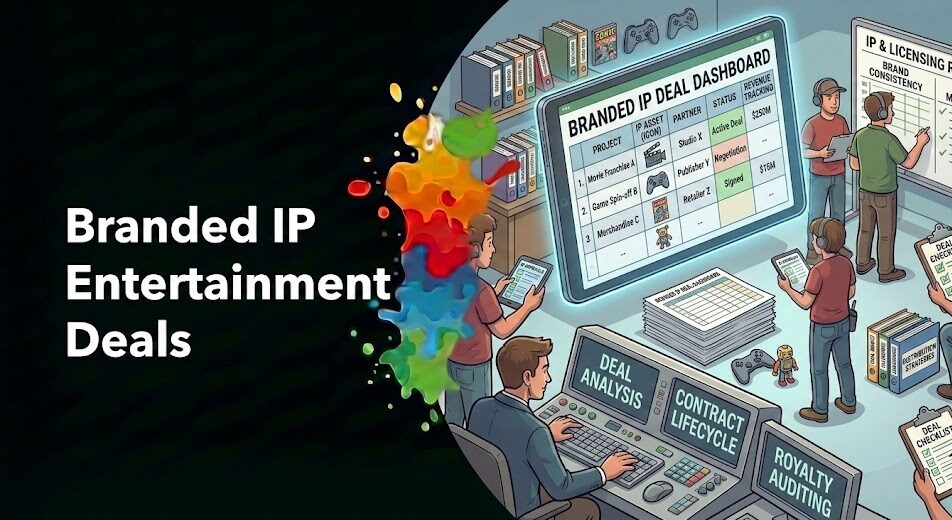
When Mattel‘s Barbie crossed $1.44 billion at the global box office in 2023, it didn’t just sell dolls. It validated a deal structure that every IP-holding toy company, gaming studio, and consumer brand now wants to replicate—and that every studio CFO is quietly trying to figure out how to price correctly.
Branded IP entertainment deals have become one of the most complex, high-stakes transactions in the current content economy, precisely because they blur the line between licensing, production, and merchandising in ways that traditional deal frameworks weren’t built to handle.
Here’s the thing: LEGO and Hasbro didn’t stumble into their entertainment partnerships. They built them methodically—over years, across multiple deal structures, with deliberate control mechanisms baked into every contract. Understanding how those deals actually work gives you a strategic lens that applies far beyond toys. Whether you’re an IP holder with a franchise ready for screen, a producer packaging a branded project, or a studio evaluating what a property is actually worth—this is the intelligence that closes deals faster.
In This Article
- Why Toy Giants Enter Entertainment Deals
- The IP-Out Licensing Model: Core Structure
- Co-Production Arrangements: Sharing Risk and Revenue
- Minimum Guarantees and Royalty Stacks
- Creative Control: What IP Holders Actually Demand
- How Streaming Changed Branded IP Deal Terms
- The Capital Stack in Branded IP Financing
- FAQ: Branded IP Entertainment Deals
- Conclusion & Key Takeaways
Find Branded IP Partners in 48 Hours—Not 6 Months
Vitrina’s Smart Pairing engine maps 140,000+ verified companies—studios, IP owners, and co-production partners—so you can identify the right fit before it hits the trades. Trusted by Netflix, Warner Bros., and Paramount.
200 free credits · No credit card required
Why Toy Giants Enter Entertainment Deals
The economics are almost absurdly compelling—when they work. A successful theatrical release doesn’t just generate box office. It resets the entire consumer products revenue cycle. LEGO’s partnership with Warner Bros. on The LEGO Movie (2014) generated an estimated $468 million at the global box office, but the downstream impact on LEGO set sales was reported to be multiples of that figure. Film content functions, in this model, as the most expensive marketing campaign ever produced.
But don’t mistake that dynamic for passive participation. IP holders like LEGO and Hasbro enter these deals as strategic operators—not licensor-of-last-resort. They’re protecting brand equity built over decades, managing how characters and storylines translate to screen, and—critically—structuring financial participation that captures upside beyond a flat licensing fee. That’s where the deal architecture gets interesting.
The Fragmentation Paradox™ complicates matters here. With over 600,000 companies operating across the global entertainment supply chain, IP holders face genuine opacity when identifying which studios, production companies, or distribution partners are actually positioned—financially and creatively—to deliver on a branded franchise. Relationship-dependent deal-making costs IP holders 15-20% margin through information deficit, and adds 3-6 months to typical deal closure timelines. That’s before cameras roll.
The IP-Out Licensing Model: Core Structure
The simplest—and most commonly misunderstood—structure is the IP-out licensing deal. In this model, the IP holder grants a studio or producer the right to develop and produce content based on the brand, in exchange for a licensing fee and ongoing royalties tied to exploitation revenue.
Here’s what that looks like in practice. The IP holder (say, Hasbro) licenses the Transformers brand to Paramount Pictures. Paramount funds the production, markets the film, and distributes globally. Hasbro receives an upfront licensing fee (which can range from $2 million to $25+ million depending on brand strength and deal scope), plus a royalty calculated on box office gross—typically structured in tiers: 3-5% of first-dollar gross below certain thresholds, escalating as the film outperforms.
The key negotiating variables in an IP-out deal:
- Royalty base definition — gross receipts vs. adjusted gross vs. net (and “net” in Hollywood is famously elastic)
- Territory scope — worldwide vs. defined territories, with different royalty rates per region
- Media scope — theatrical only, theatrical plus streaming, all media including gaming and interactive
- Term length — typically 5-10 years with sequel/franchise options at pre-negotiated rates
- Reversion triggers — what happens if the studio doesn’t greenlight within a defined development window
What’s not visible in the headline deal announcement—and what the trades rarely report—is the merchandising rights carve-out. In virtually every major branded IP deal, the IP holder retains consumer products rights, which they then license separately through a parallel merchandising deal. As we explored in our guide to merchandising deals in entertainment, this revenue stream often dwarfs the licensing fee itself—particularly for family-oriented franchises where toys, apparel, and consumer products generate long-tail returns years after theatrical release.

Your AI Assistant, Agent, and Analyst for the Business of Entertainment
VIQI AI helps you plan content acquisitions, raise production financing, and find and connect with the right partners worldwide.
- Find active co-producers and financiers for scripted projects
- Find equity and gap financing companies in North America
- Find top film financiers in Europe
- Find production houses that can co-produce or finance unscripted series
- I am looking for production partners for a YA drama set in Brazil
- I am looking for producers with proven track record in mid-budget features
- I am looking for Turkish distributors with successful international sales
- I am looking for OTT platforms actively acquiring finished series for the LATAM region
- I am seeking localization companies offer subtitling services in multiple Asian languages
- I am seeking partners in animation production for children's content
- I am seeking USA based post-production companies with sound facilities
- I am seeking VFX partners to composite background images and AI generated content
- Show me recent drama projects available for pre-buy
- Show me Japanese Anime Distributors
- Show me true-crime buyers from Asia
- Show me documentary pre-buyers
- List the top commissioners at the BBC
- List the post-production and VFX decision-makers at Netflix
- List the development leaders at Sony Pictures
- List the scripted programming heads at HBO
- Who is backing animation projects in Europe right now
- Who is Netflix’s top production partners for Sports Docs
- Who is Commissioning factual content in the NORDICS
- Who is acquiring unscripted formats for the North American market
Co-Production Arrangements: Sharing Risk and Revenue
Sophisticated IP holders don’t always license outright. Increasingly, they want equity—and they’re prepared to put capital at risk to get it. The co-production model positions the IP holder as both rights contributor and financial participant, typically alongside a studio or streaming platform that controls distribution.
Hasbro’s acquisition of Entertainment One (eOne) in 2019 for $3.8 billion was the most aggressive expression of this logic: own the production infrastructure entirely, so you capture both creative control and full economic upside. The subsequent divestiture of eOne to Lionsgate in 2023 for $500 million revealed the execution risk in that thesis—production infrastructure is expensive to run, and branded content IP doesn’t automatically translate to an operationally efficient studio. But the underlying instinct—that IP holders should capture more of the value chain—remains very much intact.
In a standard co-production arrangement, the capital stack typically looks like this:
- IP holder equity contribution: 15-35% of production budget (injected as cash or valued IP contribution)
- Studio or streaming platform co-investment: 40-60% of budget, covering P&A and distribution
- Soft money / tax incentives: 10-30% of budget depending on production territory
- Pre-sales or MGs: Against unsold territories, typically handled by a sales agent
The co-production waterfall determines how revenue flows back. IP holders typically negotiate for a preferred return position—recovering their equity contribution before net profit is calculated—plus a back-end percentage proportional to their equity stake. The catch? That back-end is only valuable if the film performs, and the recoupment timeline on a $150M theatrical release can stretch 3-5 years even for a commercially successful title once distribution fees, P&A recoupment, and senior debt repayment are processed.
Track 400,000+ Active Projects—Including Branded IP Deals
Vitrina’s platform surfaces live deal activity across studios, streamers, and independent producers. Join 140,000+ companies who de-risk their content decisions with real-time intelligence.
No credit card required · Cancel anytime
Minimum Guarantees and Royalty Stacks in Branded IP Deals
The minimum guarantee (MG) structure sits at the heart of most branded IP licensing negotiations—and it’s where inexperienced IP holders leave the most money on the table. An MG is the floor payment the licensee commits to, regardless of how the content performs. For IP holders, it’s the only guaranteed cash in the deal. Everything else is contingent.
Royalty stack structures vary considerably by deal type and IP tier:
- Tier 1 IP (franchise brands like Transformers, LEGO): MG of $10M-$30M+ upfront, royalty rates of 5-8% of adjusted gross
- Tier 2 IP (recognized brands, less theatrical history): MG of $1M-$8M, royalty rates of 3-5%
- Tier 3 IP (emerging or niche brands): MG of $250K-$1M, royalty rates of 2-4%
But here’s what the headline deal terms don’t capture: the royalty base calculation is everything. MGs against theatrical gross only capture a fraction of a franchise’s total value in the current windowing environment. LEGO, for instance, has historically negotiated royalties across theatrical, home entertainment, streaming, and interactive rights—recognizing that the long-tail digital revenue on a family franchise often exceeds the theatrical window.
Strategic players understand this distinction and negotiate accordingly. Those who don’t—particularly first-time IP holders without experienced entertainment counsel—typically discover they’ve left substantial upside on the table after a project’s first three-year exploitation cycle.
For a deeper look at how IP rights translate into deal economics, the Vitrina resource on IP rights in the entertainment industry breaks down the full rights landscape across theatrical, streaming, and ancillary windows.
Creative Control: What IP Holders Actually Demand
Behind closed doors, creative control is the negotiation that breaks more branded IP deals than any financial term. Studios want creative latitude. IP holders want brand protection. The two positions aren’t inherently incompatible—but they require contractual precision that generic production deals weren’t designed to provide.
Standard creative control mechanisms in branded IP deals include:
- Brand bible compliance: IP holder provides a style guide and character canon; studio must adhere or seek written approval for deviations
- Script approval rights: IP holder receives script at draft stage with defined approval windows (typically 30-45 days per draft)
- Casting consultation: IP holder consulted on lead casting (rarely has veto, but voice is contractually required)
- Final cut consultation: Not final cut approval (studios rarely cede this), but a formal review and comment process before lock
- Marketing approval: IP holder reviews key art, trailers, and promotional materials—with hard approval rights over anything that depicts core characters
LEGO‘s reported insistence on maintaining brand values—family-appropriate storytelling, humor over darkness, constructive themes—throughout its Warner Bros. partnership is exactly this kind of brand bible compliance in action. It wasn’t creative interference; it was contractual brand management. The results (The LEGO Movie, The LEGO Batman Movie) suggest the constraint produced better creative output, not worse.
The flip side? When brand bible compliance isn’t properly defined, you get disputes. And disputes on major branded productions—where marketing spend is already committed and release dates are calendared—are extraordinarily costly. The real dynamic here is that vague creative control language isn’t flexibility; it’s a litigation risk baked into the contract.
How Streaming Changed Branded IP Deal Terms
The streaming era didn’t just open new distribution windows for branded IP—it fundamentally restructured the economic logic of licensing. And it’s created significant tension in how deals get done.
Traditional theatrical deals gave IP holders royalty visibility through box office reporting. Streaming deals—particularly those structured as flat-fee content licenses—often don’t. Netflix, Amazon Prime Video, and Apple TV+ have historically resisted per-view royalty structures, preferring to license branded IP for a fixed fee (the equivalent of a fully paid-up MG). For IP holders used to theatrical royalty waterfalls, this represents a significant revenue model change.
As Deadline has reported extensively, this is precisely why companies like Mattel and Hasbro have pushed for co-production arrangements with streaming platforms rather than pure licensing—capturing equity upside in lieu of royalty waterfalls. The Netflix/Mattel/Hasbro partnership on K-pop Demon Hunters exemplifies this hybrid structure: Netflix funds production and distribution, while the IP holders retain downstream consumer products rights and negotiate equity participation in the content asset itself.
But streaming has also created opportunity. Series formats—not just features—allow branded IP to generate deeper audience engagement over multiple episodes, which directly drives consumer products cycles. A single 26-episode animated series can sustain toy lines, apparel collections, and gaming products for 3-4 years after initial release. That’s a fundamentally different ROI calculation than a standalone theatrical release with a 12-18 month consumer products window.
Structure Your Branded IP Deal With Concierge Support
Vitrina’s Concierge service connects IP holders with verified studio partners, co-production financiers, and distribution specialists—including the 140,000+ companies mapped across our platform. Netflix, Paramount, and Warner Bros. already use Vitrina to surface supply chain partners.
200 free credits to start · No commitment required
The Capital Stack in Branded IP Entertainment Financing
Not every IP holder has Hasbro’s balance sheet or LEGO Group CEO Niels B. Christiansen‘s ability to fund co-production positions from corporate reserves. For most branded IP holders—gaming companies, comic publishers, consumer brands, entertainment estates—the capital stack question is just as critical as the deal structure question.
What’s actually happening in the current financing environment: lenders and equity investors increasingly view branded IP as superior collateral. Why? Because it enters production with existing consumer demand data—brand recognition, retail sales histories, audience demographic profiles. That’s a materially different risk proposition than an original IP project where demand is entirely speculative.
Phil Hunt, CEO of Head Gear Films—which has financed 550+ movies and runs one of the UK’s highest-volume structured lending operations—notes that deal-structured lending is fundamentally about what the market really wants. Branded IP from recognized consumer franchises consistently passes that market test, which is why gap financing and senior equity positions are more accessible for branded projects than for original content.
The practical implications for IP holders entering production deals:
- IP valuation matters for collateral: A properly valued brand with verifiable retail data can support lending structures that pure creative IP cannot
- Tax incentives reduce your effective equity requirement: UK, Canada, France, and key Sovereign Content Hubs™ like Saudi Arabia (offering rebates up to 40%) can reduce effective budget contribution by 25-35%
- Pre-sales against the IP accelerate the capital stack: Pre-selling territory rights before production—using the brand’s existing market recognition—can compress the gap between greenlight and cash-in-hand by 4-8 weeks
For a comprehensive breakdown of how production deal structures work across different financing models, our detailed resource on production deal structures for studios and financiers covers the full range of arrangements in active use.
FAQ: Branded IP Entertainment Deals
What is a branded IP entertainment deal?
A branded IP entertainment deal is a contractual arrangement in which a brand owner (toy company, gaming studio, consumer brand, or IP estate) grants a studio, streamer, or production company the right to develop content—film, TV series, or digital—based on that brand. These deals typically involve licensing fees, royalty structures, and varying degrees of creative control. They differ from standard IP licensing in that they often include co-production rights, consumer products carve-outs, and sequel options tied to content performance.
How do LEGO and Hasbro structure their studio partnerships differently?
LEGO has historically favored deep creative partnership with a single studio (Warner Bros.) across its theatrical franchise, retaining strong brand bible compliance rights and consumer products exclusivity. Hasbro has taken a more expansive multi-studio approach—Paramount for Transformers, Paramount/eOne for Dungeons & Dragons—while also attempting full vertical integration through its now-divested Entertainment One acquisition. The key structural difference is that LEGO prioritizes brand coherence above financial optimization, while Hasbro has pursued maximum financial participation, with mixed results on the latter.
What is a typical royalty rate in a branded IP licensing deal?
Royalty rates in branded IP entertainment deals typically range from 3-8% of adjusted gross, depending on IP tier and deal scope. Tier 1 franchise brands (with proven box office history) negotiate rates at the top of this range; emerging or niche brands often start at 2-4%. The royalty base—whether calculated on box office gross, adjusted gross, or net receipts—is as important as the rate itself, and experienced IP holders negotiate to define the base as broadly as possible to avoid Hollywood accounting erosion.
How has streaming affected branded IP deal structures?
Streaming platforms have largely replaced per-view royalty structures with flat-fee content licenses, which shifts risk from the platform to the IP holder. In response, sophisticated IP holders like Mattel and Hasbro have negotiated co-production equity positions rather than pure licensing arrangements, ensuring they capture upside proportional to content performance. Series formats have also gained favor because they generate sustained consumer products cycles—a 26-episode animated series can support consumer products revenue for 3-4 years versus a theatrical release’s 12-18 month window.
What creative control rights do IP holders typically retain?
Standard creative control provisions in branded IP deals include brand bible compliance requirements, script approval rights (with defined approval windows of 30-45 days per draft), casting consultation, and marketing approval over key art and trailers. IP holders rarely receive final cut rights—studios typically retain those—but formal review and comment processes are contractually required. The specificity of these provisions matters enormously: vague “creative consultation” language provides little actual protection, while clearly defined approval timelines and escalation procedures create enforceable brand protection.
Can smaller IP holders replicate the LEGO or Hasbro deal model?
Yes—with structural adjustments. Smaller IP holders can access co-production financing by using their brand’s verifiable consumer data as collateral for structured lending. Tax incentives from Sovereign Content Hubs™ like the UK (up to 25% cash rebate), Canada (35%+), and Saudi Arabia (40% rebate) significantly reduce effective equity requirements. The most important step is engaging an experienced entertainment attorney and co-production specialist before approaching studios—undocumented IP ownership or chain-of-title issues will kill deals before they start.
What is a minimum guarantee in a branded IP deal, and how is it negotiated?
A minimum guarantee (MG) is the floor payment committed by the licensee, regardless of content performance. For Tier 1 branded IP, MGs can reach $10M-$30M+ upfront. MG negotiation is driven by the IP’s retail sales history, existing audience recognition, comparable deal precedents in the same franchise tier, and the licensee’s strategic interest in the property. IP holders maximize MGs by creating competitive tension—multiple studios in parallel conversations—before committing to exclusivity. The MG should be non-refundable and non-recoupable against royalties where possible.
How does Vitrina help with branded IP entertainment deal sourcing?
Vitrina’s platform maps 140,000+ verified companies across the global entertainment supply chain, including studios, streamers, production companies, and co-production financiers actively seeking branded IP partnerships. The Smart Pairing engine identifies deal-ready partners based on verified track record, current production slate activity, and territory focus—surfacing opportunities that would otherwise require months of relationship-based outreach. IP holders have used Vitrina to identify studio partners in as little as 48 hours, compared to the industry standard of 3-6 months through traditional network channels.
Conclusion: Structure Is the Strategy
The gap between a licensed branded IP deal that creates generational franchise value and one that delivers a flat fee and a frustrating production experience isn’t talent or luck. It’s deal structure. LEGO and Hasbro didn’t build entertainment empires by accident—they built them by understanding how to deploy IP as a capital asset, protect brand equity through contractual precision, and capture economic upside across the full exploitation lifecycle of their content.
The structures are accessible to any IP holder who approaches them with the right intelligence. Knowing which studios are actively seeking branded partnerships—before it hits the trades—compresses the deal timeline and strengthens your negotiating position. According to Variety, branded IP now represents the single fastest-growing category of content investment among major streaming platforms, with deal volume up significantly in 2024 as platforms de-risk their originals slates. The moment to structure correctly is before you’re in the room, not after.
Key Takeaways
- IP-out licensing vs. co-production: Pure licensing provides predictable MG income; co-production captures equity upside but requires capital commitment and longer recoupment timelines of 3-5 years
- Royalty base is everything: Royalty rate (3-8%) is less important than the base definition—negotiate the broadest possible royalty base across all exploitation windows
- Consumer products rights are the real prize: Always carve these out of any entertainment deal; for family IP, consumer products revenue routinely exceeds licensing fees
- Creative control requires specificity: Vague consultation language is unenforceable; brand bible compliance, defined approval windows, and escalation procedures are the enforceable mechanisms
- Streaming demands equity structures: Flat-fee streaming licenses eliminate royalty waterfalls—co-production equity positions are the structural response for IP holders who want upside participation
Find Your Studio Partner Before It Hits the Trades
Vitrina tracks live deal activity from 140,000+ companies across the global entertainment supply chain. Identify which studios and streamers are actively acquiring branded IP—and connect with verified production partners—starting today.
No credit card required · Trusted by Netflix, Warner Bros., and Paramount
Need a Dedicated Partner for Your IP Deal?
Vitrina’s Concierge team works directly with IP holders to identify, vet, and connect with the right studio or production partners for your specific deal structure—from licensing to full co-production.
Find Film+TV Projects, Partners, and Deals – Fast.
VIQI matches you with the right financiers, producers, streamers, and buyers – globally.
Producers Seeking Financing, Co-Pros, or Pre-Buys?
Vitrina Concierge helps producers reach the right financiers, commissioners, distributors, and co-production partners — with precision outreach, not cold pitching.
Join Industry Briefings Trusted by Leaders
Format Adaptations: Global Trends
Where formats are traveling, which adaptations are breaking out, and how streamers are backing remakes in 2025–2026.

Books, Novels & Comics Adaptations: Global Trends
Books, webtoons, and manga driving the next global screen hits. Discover how in this webinar.

Micro-Dramas & Mobile-First Storytelling
Micro-dramas are building real audiences and revenue. Understand the platforms, buyers, and economics behind the growth.

Navigating Global Content Licensing Trends
How global content licensing is shifting beyond flat fees to flexible, deal-driven models.