About Innovation Hub
 Global Content Pulse (Webinars)


 Global Production Financing
(Webinars)
Global Production Financing
(Webinars)  LeaderSpeak Podcast
  About Vitrina
 Our Story
 Our Solutions 🔥
 Film+TV Projects Tracker 🚀
 Case Studies
 Our Profile

An anchor project is a high-profile production used strategically to secure local tax incentives, rebates, and co-production capital by establishing significant economic activity in a specific territory.
This involves leveraging a “tentpole” title to fulfill local spend requirements, which then lowers the financial barrier for a broader slate of content.
According to Vitrina AI data, producers utilizing supply chain intelligence to map global incentivesegional tax credits are securing co-production deals 70% faster than those relying on traditional networking.
In this guide, you’ll learn how to identify high-rebate territories, structure anchor deals, and utilize data to compress your financing timeline.
While traditional production finance resources focus on broad theatrical models, they often fail to address the technical nuances of regional tax credits and the step-by-step logistics required to trigger them.
This comprehensive analysis fills those gaps by providing actionable frameworks—from territory selection to verified partner discovery—ensuring your next project is built on a foundation of strategic intelligence.

Your AI Assistant, Agent, and Analyst for the Business of Entertainment
VIQI AI helps you plan content acquisitions, raise production financing, and find and connect with the right partners worldwide.
- Find active co-producers and financiers for scripted projects
- Find equity and gap financing companies in North America
- Find top film financiers in Europe
- Find production houses that can co-produce or finance unscripted series
- I am looking for production partners for a YA drama set in Brazil
- I am looking for producers with proven track record in mid-budget features
- I am looking for Turkish distributors with successful international sales
- I am looking for OTT platforms actively acquiring finished series for the LATAM region
- I am seeking localization companies offer subtitling services in multiple Asian languages
- I am seeking partners in animation production for children's content
- I am seeking USA based post-production companies with sound facilities
- I am seeking VFX partners to composite background images and AI generated content
- Show me recent drama projects available for pre-buy
- Show me Japanese Anime Distributors
- Show me true-crime buyers from Asia
- Show me documentary pre-buyers
- List the top commissioners at the BBC
- List the post-production and VFX decision-makers at Netflix
- List the development leaders at Sony Pictures
- List the scripted programming heads at HBO
- Who is backing animation projects in Europe right now
- Who is Netflix’s top production partners for Sports Docs
- Who is Commissioning factual content in the NORDICS
- Who is acquiring unscripted formats for the North American market
Table of Contents
- 01What is an Anchor Project in Production Financing?
- 02How Do Local Incentives and Rebates Actually Work?
- 03How to Discover High-Probability Co-production Partners
- 04Beyond the Majors: Emerging Hubs for Regional Financing
- 05Success Stories: How Data-Driven Producers Secure Deals
- 06When Should You Walk Away from a Regional Incentive?
- 07Key Takeaways for Producers
- 08FAQ
Key Takeaways for Producers
-
Data-Driven Discovery: Producers using supply chain trackers identify active regional financiers 5x faster than through traditional trade show networking.
-
Incentive Mapping: Success requires analyzing not just the rebate percentage, but the local spend thresholds and vendor availability in emerging hubs like the Middle East.
-
Verified Partners: Utilizing platforms like Vitrina to vet partners based on verifiable track records eliminates the “data trust deficit” in cross-border deals.
-
Strategic Timing: Engaging local commissions during the early development stage increases the probability of securing “soft money” before the annual budget caps are met.
What is an Anchor Project in Production Financing?
An anchor project serves as the foundational pillar of a production slate, specifically chosen for its ability to generate high local expenditure. In the context of global supply chains, an anchor project is often the key that unlocks regional “soft money”—government-backed incentives that don’t require equity dilution.
By committing to shoot a major series or film in a territory with robust tax credits, a production company establishes a “footprint” that satisfies local employment and vendor requirements. Once this threshold is met, the overhead costs for subsequent, smaller projects in that same territory are significantly reduced, effectively subsidizing the entire slate.
Find active co-production financing partners for your slate:
How Do Local Incentives and Rebates Actually Work?
Local incentives typically take two forms: tax credits (which can be sold to local entities) or cash rebates (which are direct payments from a government body). The “Anchor Project” strategy maximizes these by focusing on “Qualifying Production Expenditure” (QPE).
According to industry expert Matthew Helderman, CEO of BondIt Media Capital, the industry has shifted toward a “post-streamer” world where reliable capital is found by filling credit gaps. By using a data-driven approach to map these credits, producers can cover 25-40% of their production budget before a single investor is pitched.
Industry Expert Perspective: Media Finance: Navigating a Post-Streamer World
In this conversation, Matthew Helderman discusses the evolution of media financing and the critical importance of identifying capital gaps in a fragmented market. This is essential for producers planning an anchor project strategy.
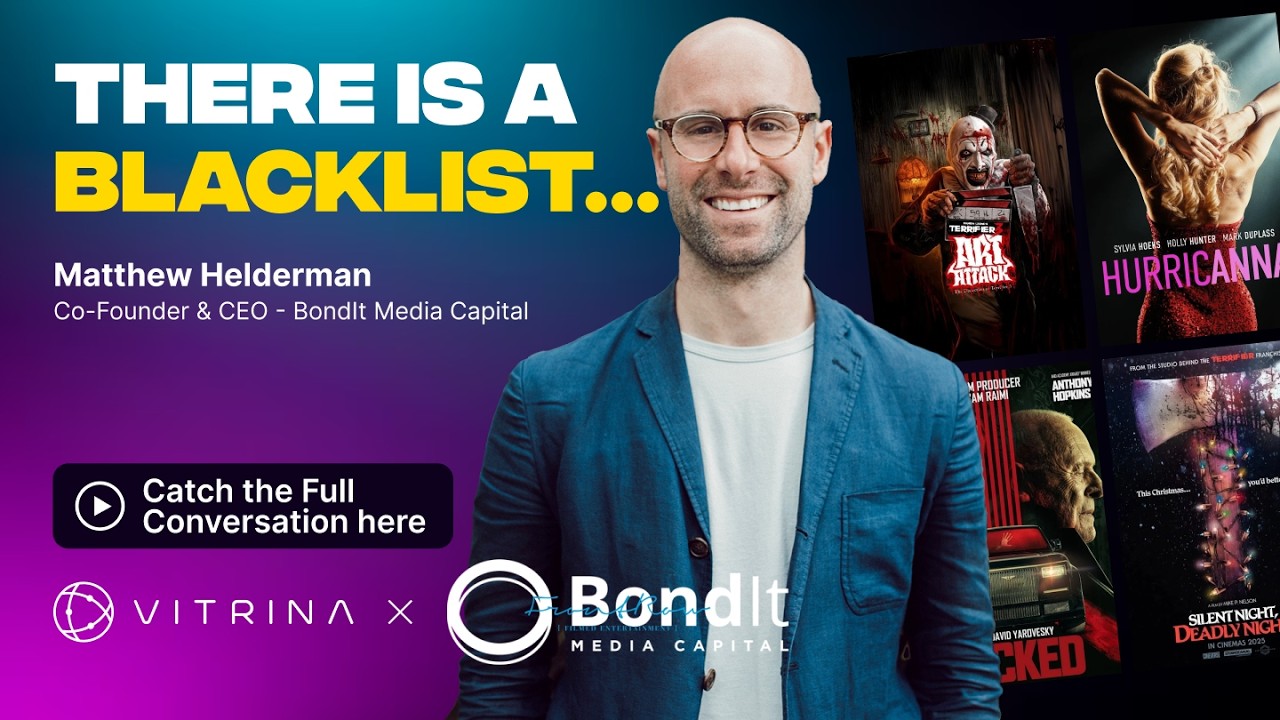
Matthew Helderman shares BondIt Media Capital’s journey and discusses filling the gap in reliable capital for content creators, emphasizing the shift toward specialized financing in today’s digital economy.
Beyond the Majors: 3 Emerging Hubs for Regional Financing
1. The MENA Region (Middle East & North Africa)
With Saudi Arabia’s Vision 2030 and Abu Dhabi’s 30% cash rebate, the Middle East is aggressively attracting anchor projects.
The Challenge: Lack of historical relationship data makes vetting local partners difficult.
The Approach: Use Vitrina’s Global Projects Tracker to identify companies that have successfully serviced recent Hollywood or European titles in the region.
2. Southeast Asia (The Emerging Tech Hubs)
Countries like Thailand and Vietnam are offering tiered incentives based on local post-production and VFX spend.
The Challenge: Navigating complex “cultural test” requirements for qualification.
The Approach: Engage local consultants who specialize in “Weaponized Distribution” models—licensing content back to regional rivals to satisfy local interest quotas.
3. India’s Regional Markets
Beyond Bollywood, regional cinema markets in South India are offering significant capital for co-productions that leverage local language and talent.
The Challenge: High fragmentation across thousands of production houses.
The Approach: Utilize AI-powered supply chain intelligence to filter for companies with a “Reputation Score” based on verifiable international collaborations.
Access real-time intelligence on global production incentives:
Case Study: Scaling a Slate via Middle Eastern Incentives
Act 1: The Situation. A London-based production house with a 5-film thriller slate struggled to bridge a £10M financing gap. Traditional UK tax credits only covered 25% of the budget, leaving the projects stalled in development. “We knew there was capital available globally, but we lacked the verifiable data to identify which territories were active and which partners were credible,” recalls the Head of Production.
Act 2: The Solution. The team utilized Vitrina’s Global Film+TV Projects Tracker to map territories with the highest rebate-to-spend ratios. They identified a Middle Eastern studio with a superhero IP that had recently secured conversations with major Hollywood players. By positioning their first thriller as an “anchor project” in that territory, they leveraged local rebates and a co-production agreement to cover 45% of the total slate budget within 90 days.
Act 3: The Results. Lead qualification time dropped from six months of travel to just 12 days of data-driven outreach. The company secured two co-production deals totaling £8.5M, allowing them to greenlight the first three films in their slate simultaneously—a move that would have been impossible under traditional financing models.
Moving Forward
The production financing landscape has evolved from a game of “who you know” to a science of “what you track.” This guide has explored how the anchor project strategy addresses the critical gaps in traditional financing: the lack of beginner-friendly roadmaps and the oversight of emerging regional hubs.
Whether you are an independent producer looking to secure co-production capital for a first-time feature, or a studio executive trying to optimize ROI on a multi-project slate, the principle is the same: actionable intelligence drives deal velocity.
Outlook: Over the next 18 months, we expect a massive surge in “Authorized Data” deals and AI-driven localization, further lowering the barrier for international content distribution.
Frequently Asked Questions
Quick answers to the most common queries about production financing and incentives.
What is a production tax incentive?
How do I qualify for a cash rebate?
What is a co-production agreement?
“The industry is moving toward ‘Weaponized Distribution,’ where premium content is licensed to rivals to maximize ROI. Producers who understand this shift and leverage supply chain intelligence are the ones winning in 2025.”
About the Author
Written by the Vitrina AI Editorial Team. Our contributors include media technology veterans and supply chain analysts with decades of experience at organizations like Gracenote, Netflix, and Disney. Connect with us on Vitrina.