

 About Innovation Hub
 Global Content Pulse (Webinars)


 Global Production Financing
(Webinars)
Global Production Financing
(Webinars)  LeaderSpeak Podcast
  About Vitrina
 Our Story
 Our Solutions 🔥
 Film+TV Projects Tracker 🚀
 Case Studies
 Our Profile
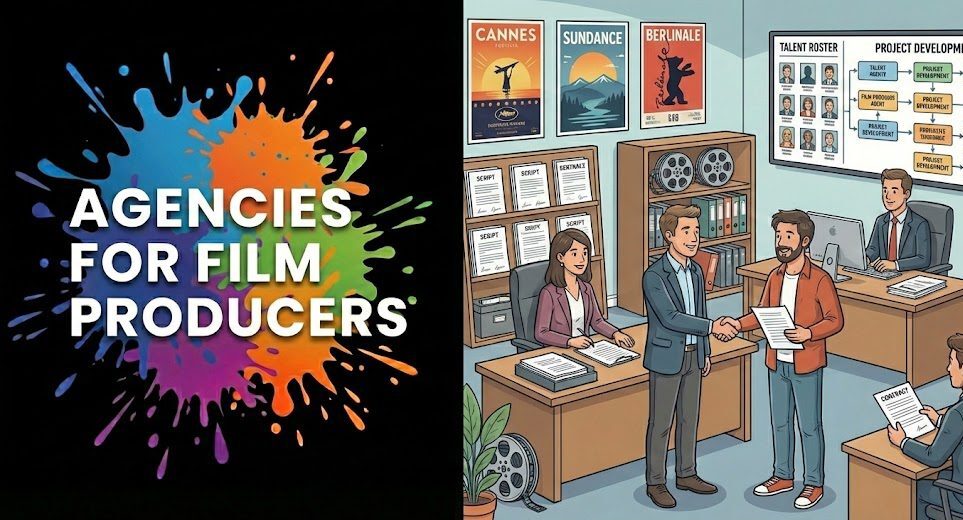
Identifying which agencies represent film producers for collaborations requires moving beyond simple talent lists to finding strategic partners that bridge production and distribution.
Successful producers now leverage supply chain intelligence to target agencies with specific track records in co-financing, international sales, and packaging.
According to industry data, producers using data-driven partner discovery identify viable agency collaborators 70% faster than those relying on traditional networking routes.
In this guide, you will learn a structured framework for agency preparation, specific negotiation strategies, and how to use vertical AI to map the global agency landscape.
While most industry resources offer shallow lists of talent agencies, they fail to provide the “how-to” depth producers need to navigate the actual collaboration process and contractual nuances.
This comprehensive guide addresses these gaps by offering a technical step-by-step framework specifically tailored for film producers seeking professional agency representation and collaborative partnerships.

Your AI Assistant, Agent, and Analyst for the Business of Entertainment
VIQI AI helps you plan content acquisitions, raise production financing, and find and connect with the right partners worldwide.
- Find active co-producers and financiers for scripted projects
- Find equity and gap financing companies in North America
- Find top film financiers in Europe
- Find production houses that can co-produce or finance unscripted series
- I am looking for production partners for a YA drama set in Brazil
- I am looking for producers with proven track record in mid-budget features
- I am looking for Turkish distributors with successful international sales
- I am looking for OTT platforms actively acquiring finished series for the LATAM region
- I am seeking localization companies offer subtitling services in multiple Asian languages
- I am seeking partners in animation production for children's content
- I am seeking USA based post-production companies with sound facilities
- I am seeking VFX partners to composite background images and AI generated content
- Show me recent drama projects available for pre-buy
- Show me Japanese Anime Distributors
- Show me true-crime buyers from Asia
- Show me documentary pre-buyers
- List the top commissioners at the BBC
- List the post-production and VFX decision-makers at Netflix
- List the development leaders at Sony Pictures
- List the scripted programming heads at HBO
- Who is backing animation projects in Europe right now
- Who is Netflix’s top production partners for Sports Docs
- Who is Commissioning factual content in the NORDICS
- Who is acquiring unscripted formats for the North American market
Table of Contents
Key Takeaways for Producers
-
Data-Driven Targeting: Producers using supply chain intelligence identify active financing and sales agencies 70% faster than through general networking.
-
Packaging Power: Agencies don’t just “represent”; they provide technical packaging services that unlock pre-sales and international co-production capital.
-
Vertical AI Advantage: Tools like VIQI allow producers to map agency portfolios and commissioning patterns in real-time, replacing guesswork with verified track records.
What Do Agencies Actually Do for Film Producers?
In the modern entertainment supply chain, agencies serve as the connective tissue between a producer’s creative vision and the market’s capital. While talent agencies traditionally focused on individual representation, the leading global firms now operate as full-service production consultants, sales agents, and financing brokers. For a producer, an agency collaboration isn’t just about finding a manager; it’s about gaining access to a sophisticated infrastructure of deals intelligence and platform relationships.
These agencies facilitate collaborations by “packaging” projects—attaching high-value talent, directors, and even other producers to a script to make it “bankable.” This process significantly lowers the risk for financiers and streamers, as the project comes with pre-vetted creative and commercial elements. Agencies like CAA, WME, and UTA have dedicated global film financing and distribution divisions that track every active buyer from Netflix to regional FAST channels.
Find the right agency for your project genre:
The 4-Step Preparation Framework for Producers
Before approaching an agency, producers must move from “idea mode” to “asset mode.” Agencies are inundated with submissions; what separates a professional inquiry from noise is the technical readiness of the project materials.
1. Audit Your IP and Rights Chain
Ensure you have clear, documented ownership of all rights. Agencies will not collaborate if there is a “chain of title” risk. This includes script options, book adaptation rights, and any underlying life rights agreements.
2. Develop a Comprehensive “Finance Plan” Draft
Show the agency you understand the economics. Your plan should outline tax credits, potential co-production partners, and realistic equity goals. Agencies want to see that you are a business partner, not just a creative dreamer.
3. Identify “Anchor Assets”
Who is already attached? If you have a director or a lead with a “Verified Talent Score,” highlight this. Use supply chain data to show why this combination is currently trending in your target market (e.g., “K-Drama influence in Southeast Asian markets”).
4. Map Agency Portfolios
Don’t cold-query every agent. Use platforms like Vitrina to identify which agents have recently closed deals for similar projects. Mapping these “dealmaking patterns” ensures your outreach is targeted and relevant.
Industry Expert Perspective: Media Finance: Navigating a Post-Streamer World
Understanding the financial mechanics of agency deals requires a deep dive into the broader lending and capital landscape of modern filmmaking.
Matthew Helderman, CEO of BondIt Media Capital, discusses the shift from production to media financing and how creators can bridge the capital gap in an increasingly challenging independent film landscape.
Technical Negotiation Strategies for Agency Terms
Negotiating with a major agency requires a balance of protecting your IP and incentivizing the agent’s time. The traditional “10% of everything” model is often modified in producer-led collaborations where the agency provides technical packaging or financing services.
Tiered Commission Structures: Negotiate commission rates based on the “source of capital.” For example, an agency might take 10% on domestic sales they secure, but only 2.5-5% on “producer-found” financing or pre-existing co-production deals. This ensures the agency is rewarded for genuine “value-add” while protecting your existing equity.
The “Sunsetting” Clause: Ensure that if the agency fails to attach a major asset or secure financing within a set window (e.g., 12 months), the “exclusive representation” rights for that project expire. This prevents your project from becoming “stale” in an agency’s drawer while you are unable to seek other partners.
Access agency deal intelligence:
Global Agency Profiles: Identifying Strategic Partners
Choosing an agency requires a deep understanding of their “sweet spot.” Below are simplified profiles based on current supply chain data:
Creative Artists Agency (CAA)
Strength: Global packaging and financing. Their “CAA Media Finance” group is the gold standard for independent films seeking international co-production.
Best for: Producers with high-budget scripts needing A-list talent and global distribution.
United Talent Agency (UTA)
Strength: Independent film sales and emerging platforms. UTA Independent Film Group excels at finding “niche-to-mass” hits and securing streamers.
Best for: High-concept genre projects (horror, thriller) looking for FAST channel or premium SVOD homes.
Endeavor (WME)
Strength: Intellectual Property and branding. WME’s integration with sports and brand management makes them ideal for “unscripted” or “franchise-led” collaborations.
Best for: Producers working on documentary series or projects with significant “merchandising” or “cross-media” potential.
Find regional agency specialists:
Frequently Asked Questions
Quick answers to help you navigate the producer-agency collaboration landscape.
How do film agencies charge for representation?
Can I approach an agency without a finished script?
What agencies specialize in independent film producers?
How can Vitrina AI help me find an agent?
Moving Forward
The agency landscape has evolved from a simple talent-matching service to a critical component of the entertainment supply chain. By adopting a structured framework—from rights auditing to tiered negotiation—producers can transform agency outreach from a “cold-call” gamble into a strategic business expansion.
Whether you are an independent producer looking to secure your first major packaging deal, or a development executive trying to map the next wave of global platform buyers, data intelligence remains your primary competitive edge.
Outlook: Over the next 18 months, vertical AI will further democratize agency access, allowing boutique producers to use the same “insider intelligence” as major studios to secure financing and distribution.
About the Author
Written by the Vitrina Editorial Team, specializing in supply chain intelligence and market transformation for the global entertainment industry. Connect with us on Vitrina.