IHUB
IHUB
 Private Briefings (Webinars)


 LeaderSpeak Podcast
  Global Entertainment Digest (Newsletter)
  Premium Lists
 Membership Benefits
 About Vitrina
 Our Story
Quick Answer
Film licensing is a contractual grant of rights that allows a third party to exhibit, distribute, or exploit a film within defined parameters — specific territories, platforms, and time windows — in exchange for a fee or revenue share. The global movie licensing market reached USD 5.92 billion in 2025 and is projected to hit USD 10.5 billion by 2035 (Wise Guy Reports). For entertainment professionals, licensing is how a film earns revenue beyond the theatrical window.
Film licensing sits at the intersection of creative ownership and commercial strategy. A single feature film can generate revenue across a dozen platforms, twenty territories, and five or six distinct media types — each governed by a separate licensing agreement with its own term, exclusivity window, and payment structure.
For producers, distributors, and sales agents, the quality of those agreements determines whether a project generates sustained income or earns a single upfront payment and disappears. For commissioners and acquisition executives, understanding the licensing landscape tells you where the real competition lies.
This guide covers every dimension of film licensing that matters for entertainment industry professionals in 2026: deal types, territory strategy, clearance requirements, the rise of FAST channel rights, how TV and series licensing differs from film, and how to avoid the most costly mistakes.
Key Takeaways
- FAST channels added 21% more global channels in 2025 — now 1,850 globally — and represent a USD 14 billion market, making FAST rights commercially material for any back-catalogue title
- Library and Pay-2/3 licensing windows account for roughly two-thirds of total movie streaming value, making back-catalogue licensing more important than new releases for most platforms
- MG values for independent films have declined 30–70% from mid-2010s peaks, shifting negotiating leverage toward agents with verified buyer relationships
- Non-exclusive multi-platform licensing has become the default for mid-budget titles — stacking AVOD and FAST deals alongside a reduced-fee SVOD agreement
- Rights clearance upstream (chain of title, music, underlying rights) determines what can be legally licensed downstream — pre-production legal work is as important as deal execution
- TV series licensing adds mechanics with no film equivalent — stacking rights, catch-up TV, syndication, and format licensing for local adaptation — and unscripted formats are valued primarily on adaptability rather than finished-program appeal
Table of Contents
- What Is Film Licensing?
- Types of Film Licenses
- TV & Series Licensing: How It Differs From Film
- Film Licensing Deal Structures
- Territory-by-Territory Licensing
- Rights Clearance Before You License
- Film Licensing Trends in 2026
- Common Film Licensing Pitfalls
- How to Negotiate a Film License
- How Vitrina Supports Film Licensing Professionals
- FAQ
What Is Film Licensing?
Film licensing is the process by which a rights holder — typically a studio, production company, or sales agent — grants another party the legal authority to exhibit, broadcast, stream, or otherwise exploit a film. Each licence specifies what rights are granted (theatrical, SVOD, free TV), where they apply (territory), for how long (term), and under what financial terms (fee or revenue share).
Licensing is distinct from selling the film outright. The licensor retains underlying ownership of the copyright; the licensee receives a time-limited commercial right. This distinction matters commercially: a well-structured licensing programme can generate revenue from the same title across thirty territories over fifteen years.
The global movie licensing market was valued at USD 5.59 billion in 2024 and reached an estimated USD 5.92 billion in 2025. By 2035, the market is projected to more than double to USD 10.5 billion, growing at a 5.9% CAGR (Wise Guy Reports). Streaming expansion is the primary driver — global streaming subscription revenue hit USD 157.1 billion in 2025, nearly tripling from USD 50 billion in 2020 (Ampere Analysis).
The two commercial sides of film licensing are:
- Rights holders — producers, studios, distributors, sales agents who need to license their content to generate revenue
- Licensees — streamers, broadcasters, distributors, airlines, and educational institutions that acquire rights to build their catalogue or fulfil audience demand
Vitrina tracks 300,000+ verified companies operating across both sides of this market, giving professionals live visibility into who is buying and selling in each territory.
Types of Film Licenses
Film rights are carved up by medium, territory, and exclusivity. Understanding the categories is the first step in structuring a deal that captures maximum value from a title.
Theatrical Rights
Theatrical rights authorise a film to be shown in commercial cinemas. They are typically the first window — the release that drives public awareness and often the benchmark against which downstream licensing values are set.
Global theatrical box office reached USD 32.8 billion in 2025, recovering from the pandemic but still 22% below the pre-COVID peak of USD 42 billion in 2019 (WIPO/Omdia GII 2026). Theatrical performance directly affects the licensing fees a sales agent can command for subsequent windows — a strong box office run lifts SVOD acquisition bids, broadcast interest, and ancillary deals.
Broadcast and Free TV Rights
Free-to-air broadcast rights allow terrestrial and cable channels to air a film, typically in later release windows. These agreements usually include a set number of transmissions over the licence term.
Pay TV and premium broadcast rights (HBO, Canal+, Sky) occupy an earlier window than free TV — often beginning twelve months after theatrical and before SVOD. With streaming commanding higher per-view consumption, traditional broadcast windows have compressed significantly in most territories outside France and Germany.
SVOD, AVOD, and FAST Channel Rights
SVOD (subscription), AVOD (ad-supported), and FAST (free ad-supported streaming TV) rights are now the dominant licensing destination for most titles. Global streaming subscription revenue reached USD 157.1 billion in 2025 (Ampere Analysis), and movies’ share of US streaming platform revenue rose from roughly 27% in 2022 to nearly 50% by 2024 (Parrot Analytics via Hollywood Reporter).
FAST channel rights deserve particular attention. The global FAST market was valued at USD 14.33 billion in 2026 and is projected to reach USD 31.29 billion by 2031 at a 16.91% CAGR (Mordor Intelligence). In the US alone, FAST ad revenue was USD 4.9 billion in 2024 and is forecast to reach USD 9.1 billion by 2029 (PwC Global Entertainment & Media Outlook 2025). Nielsen/Gracenote tracked approximately 1,850 active global FAST channels in 2025 — a 21% increase year-on-year and 76% growth over two years.
What changed: FAST is no longer a graveyard for dated content. More than 70% of FAST programming was produced since 2010 (Nielsen), making FAST licensing a credible revenue stream for recent mid-budget titles, not just decades-old catalogue.
Home Entertainment and Video-on-Demand Rights
Physical media is functionally dead as a commercial priority. US physical media revenue fell below USD 1 billion for the first time in 2024, down 23.4% from 2023 (DEG Q4 2024). The US home video market is now USD 57.2 billion, with SVOD accounting for 91.3% of that total.
Premium VOD (PVOD) and EST (electronic sell-through) retain commercial relevance for event films, particularly when theatrical windows shorten — a trend accelerating since 2020. PVOD windows now begin as early as Day 45 in some territories.
Ancillary Rights
Ancillary rights include airline and hotel in-room entertainment, educational and institutional exhibition, cruise ships, military bases, and non-commercial screenings. While individually modest in value, these rights are almost always non-exclusive and require minimal licensing infrastructure. They add revenue layers without displacing primary platform deals.
Sub-Licensing
A sub-license occurs when a licensee grants part of its licensed rights to a third party — most commonly when an international distributor acquires territorial rights and then sub-licenses to local broadcasters or platforms within that territory. Sub-licensing requires explicit permission in the original agreement; rights holders should require that any sub-licenses are disclosed to them and that sub-license terms don’t exceed the scope of the primary license.
IP and Character Licensing
Separate from the right to exhibit a film, IP and character licensing grants third parties the right to use a title’s characters, brand, or story universe across merchandise, games, theme parks, and other consumer products. This category is commercially significant in its own right: global licensed entertainment character sales reached USD 161.8 billion in 2025, up 8% year-on-year (Licensing International, 2026). For franchise titles, merchandising and brand-extension licensing revenue can exceed the fees generated by distribution rights alone, which is why rights holders increasingly retain IP and character licensing separately from distribution agreements.
Limited vs. Unlimited Licenses
A secondary distinction cuts across all of the license types above: whether access is capped or open-ended within the license term. A limited license restricts the number of views, broadcasts, or downloads permitted; an unlimited license allows unrestricted access within the license period. Flat-fee SVOD and FAST deals are typically unlimited within their term, while some broadcast and educational licenses cap the number of permitted transmissions.
Find Active Buyers for Your Film Rights
Vitrina tracks 300,000+ verified entertainment companies — including streamers, broadcasters, and distributors actively licensing titles in your genre and territory.
TV & Series Licensing: How It Differs From Film
TV content licensing shares the same legal foundations as film licensing but is structured around different units and mechanics. Films are typically licensed as standalone titles; TV content is licensed as individual episodes, full seasons, or entire multi-season series, and several rights concepts specific to episodic content have no real equivalent in film licensing.
Stacking Rights and Catch-Up TV
Stacking rights are the right for a broadcaster or platform to make multiple past episodes — or entire prior seasons — of a current series available on demand, so viewers can catch up or binge before watching new episodes. The scope of stacking rights (a rolling five episodes, the full current season, or all prior seasons) is a key negotiation point in TV licensing deals. Catch-up TV is a related but narrower right, typically covering a shorter window (seven to thirty days) for recently broadcast episodes.
Syndication and Format Rights
After a series’ first-run window, two further licensing avenues open up. Syndication (or second-window licensing) involves licensing older seasons of a successful series to other broadcasters, cable channels, or streaming platforms as library content. Format rights are a distinct and often lucrative category, particularly for unscripted programming: licensing the underlying concept, structure, and production bible of a show so a producer in another territory can create a local adaptation with local talent (for example, “The Office” or “MasterChef” across multiple national versions). Fremantle and Banijay are among the production companies that built substantial international revenue on format licensing specifically.
Scripted vs. Unscripted Licensing
Scripted content (drama, comedy) and unscripted content (reality, game shows, documentaries) are valued and licensed differently. Scripted series generally command higher license fees on the strength of production value, characters, and narrative IP, and strong scripted titles with universal themes travel well internationally as finished, dubbed or subtitled programs. Unscripted content is valued primarily on the strength of its format — how easily the concept and structure can be localized — which makes format licensing, rather than finished-program licensing, the dominant unscripted revenue model internationally.
Documentary and Short Film Licensing
Documentaries and short films sit outside the mainstream film/TV licensing conversation but have their own buyer ecosystems. Documentary buyers include public broadcasters, factual-content channels, SVOD platforms with dedicated factual sections, and educational distributors; valuation hinges on timeliness, access to unique footage or subjects, and award recognition, with educational rights often providing a long revenue tail. Short films are typically licensed to festivals, specialized short-form VOD platforms, airlines, and anthology packages; financial returns per title are modest, and licensing is often as much about exposure and talent discovery as direct revenue.
Content Security and Anti-Piracy
Protecting licensed film and TV content from piracy is a continuous operational requirement that sits alongside the legal terms of any license. Rights holders and licensees typically share responsibility for pre-release screener security, digital rights management (DRM) on streaming platforms, visible or forensic watermarking to trace leaks, and cooperation with industry anti-piracy bodies. Licensing agreements routinely specify minimum DRM and delivery-security standards that a licensee must meet before content is delivered.
Film Licensing Deal Structures
The financial structure of a licensing deal determines how and when a rights holder gets paid. Four primary models dominate the market.
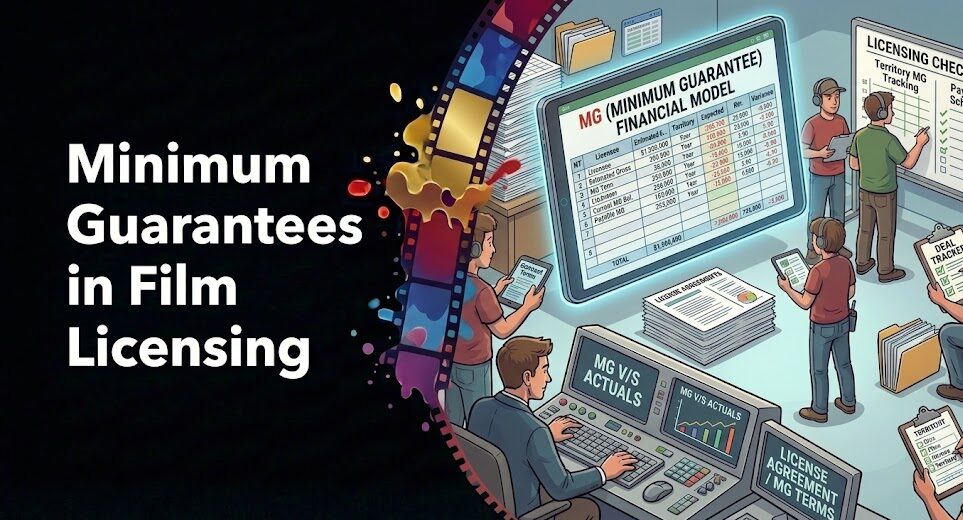
Minimum Guarantee Deals
A minimum guarantee (MG) is an upfront payment made by the licensee against future royalties. The licensee advances money against projected revenues; the licensor keeps the MG regardless of performance and earns additional royalties only after the MG is recouped.
MG values have been under sustained pressure. According to FilmTake’s AFM 2025 analysis, total deal values for independent film territories are down 30–70% from mid-2010s peaks, and the number of territories offering meaningful advances for a given title has fallen from 20–35 a decade ago to roughly 8–18 today. Key surviving MG markets for prestige independent films include France, Benelux, Germany, Australia, and Japan.
Revenue Share Agreements
Revenue share deals — increasingly the default for SVOD and FAST licensing — pay the rights holder a percentage of platform revenues attributable to the title, with no upfront guarantee. They transfer risk to the rights holder while offering theoretical upside in exchange.
For well-performing library titles on high-traffic platforms, revenue share can outperform MG deals over a multi-year licence term. For titles without a known audience, an MG is safer. Library content now drives roughly two-thirds of total movie streaming value (Parrot Analytics), making the back-catalogue revenue share market commercially significant at scale.
Output Deals and First-Look Agreements
Output deals commit a licensee to acquire all or a defined subset of a producer’s slate over a fixed period. They provide production financing certainty but restrict a producer’s ability to shop individual titles to competitive buyers.
First-look agreements give a platform the right to consider — and refuse — a producer’s projects before they go to market. Common in the studio system, they are expanding into the independent sector as platforms seek curated supply pipelines. Both deal types are increasingly accompanied by data requirements: platforms want audience performance data from previous titles before committing.
Non-Exclusive vs. Exclusive Licensing
Exclusivity determines the most important commercial variable in any licensing deal: whether competing platforms can simultaneously hold the same rights.
Exclusive licences command higher fees and are standard in premium SVOD deals. Non-exclusive licensing allows the same title to appear on multiple platforms simultaneously — a model increasingly common for AVOD and FAST rights. The platform fragmentation of 2026 has made non-exclusive windowing strategies viable for titles that cannot command an exclusive MG.
Other Named Deal Structures: Pay-1/Pay-2, Negative Pick-Up, Pre-Sale, and Rent-a-System
Beyond MG, revenue share, and output deals, industry practice recognises several further named structures, each allocating risk and payment timing differently between buyer and seller. A Pay-1 window is the first premium streaming or pay-TV licensing window after a film’s theatrical run; a Pay-2 window follows it. A negative pick-up deal has a distributor pay a fixed price on delivery of a completed film without financing the production itself, letting the producer retain more creative control than in a production-financing-distribution (PFD) deal. A pre-sale is a fixed advance a foreign distributor commits before or during production, limited to one country and term — a financing tool as much as a licensing one. A rent-a-system deal has the producer license through a distributor for a limited term with no advance at all; the distributor takes a low fee and the producer bears the risk.
Real deal example: Netflix and Sony Pictures closed an exclusive global Pay-1 deal on January 15, 2026, reportedly worth more than USD 7 billion — described by trade press as the largest Pay-1 deal ever and the first to consolidate Sony’s post-theatrical streaming rights worldwide under a single buyer. It builds on Sony’s prior US-only Netflix agreement (reported at roughly USD 2.5 billion), which was set to expire at the end of 2026. The deal is a license, not a sale: Sony retains copyright and ownership of its library, while Netflix acquires the time-bound window right to stream new Sony theatrical releases first, worldwide, once their theatrical run ends. The financial terms were not officially confirmed by either company and are attributed to unnamed sources (Deadline, January 2026).
Methodology note: Deal structure comparatives in this guide draw on FilmTake AFM 2025 market analysis, Ampere Analysis streaming revenue data, and Parrot Analytics content demand reports. Vitrina’s own transaction intelligence tracks 300,000+ verified company profiles and associated deal activity. Last reviewed: July 2026.
Territory-by-Territory Licensing
Film licensing is territorial. Rights can be split between Europe, North America, Latin America, APAC, MENA, and Sub-Saharan Africa independently — or consolidated under a single international licensing agreement.
Sales agents typically work by territory cluster. English-language markets (US, UK, Australia, New Zealand, Canada) are often handled separately from continental Europe, which divides between French-speaking, German-speaking, and other territories. Each has distinct regulatory requirements, window structures, and buyer profiles.
Current territory conditions vary sharply:
| Territory | Market Condition 2025–2026 | Best Entry Point |
|---|---|---|
| France | Most stable major market for prestige films; regulated chronologie des médias preserves MG values | Canal+, TF1, France Télévisions, Netflix France |
| UK | Advances compressed 30–60% from peak; strong SVOD competition from Netflix, Apple, Disney+ | BBC iPlayer, Channel 4, Sky Cinema, Netflix UK |
| Germany | 30–60% advance reductions; pay TV window compressed; Netflix DE growing | ARD/ZDF, Sky Germany, MUBI, Netflix DE |
| Japan | Selective but commercially active for genre, animation, and documentary titles | Shochiku, Toho, Amazon Prime JP, Netflix JP |
| China | Virtually closed to foreign independents outside co-production structures | Co-production route or co-commissioned titles only |
| MENA & Sub-Saharan Africa | Early-stage but growing; AI dubbing compressing localisation cost barriers | Shahid, OSN, ShowMax, regional AVOD platforms |
For a producer or sales agent building a territory strategy, the critical input is knowing which distributors and platforms are actively acquiring in each market at a given moment — intelligence that changes quarter by quarter.
Source: Ampere Analysis confirmed global streaming subscription revenue reached USD 157.1 billion in 2025 — up from USD 50 billion in 2020 — with advertising-supported tiers growing from under 5% to 28% of total streaming revenue in the same period. Broadband TV News, March 2026
Annotated Example: Mapping Territory and Window Together
The figures below are an illustrative worked example, not a real deal, built to show how territory and window decisions interact for a single mid-budget title.
A $6M psychological thriller with one recognizable lead is being licensed internationally. Here’s how a sales agent might sequence territory and window for that title:
| Territory | Window | Deal Structure | Why This Sequencing |
|---|---|---|---|
| France | Pay TV first, 12-month exclusive | MG deal, exclusive | Regulated chronologie des médias protects pay TV window value—sequence here first to capture it |
| UK | SVOD day-and-date with France pay TV | Revenue share, non-exclusive | Compressed advances make non-exclusive revenue share lower-risk than chasing a shrinking MG market |
| Germany | 3 months after France pay TV window closes | MG deal, exclusive | Delaying avoids direct window overlap with France while the pay TV window is still earning there |
| Japan | 6 months post-French window, SVOD only | Output deal, exclusive | Genre title with selective but active Japanese appetite; later window avoids cannibalizing earlier MG value |
The logic that matters here: windows aren’t set independently per territory—each one is sequenced against the others to avoid an earlier exclusive window undercutting a later one, while still closing the highest-value MG markets (France, Germany) before moving to revenue-share or output structures where advances are currently compressed.
Territorial Enforcement in the Age of VPNs
Territorial exclusivity depends on technical enforcement, and that enforcement has a tested legal standard. The EU’s top court (CJEU) ruled on July 9, 2026, in Anne Frank Fonds v. Anne Frank Stichting (Case C-788/24), that “state-of-the-art” geo-blocking satisfies a rightsholder’s territorial licensing obligations even though VPNs can be used to circumvent it — classifying VPNs as lawful technical tools and placing liability on the quality of the rightsholder’s blocking implementation, not on the VPN itself. The underlying case concerned differing public-domain copyright terms across EU states rather than a film licensing dispute directly, but the standard it sets is directly applicable to how broadcasters and streamers assess VPN-driven window leakage when a title is licensed territory-by-territory (TorrentFreak, July 2026). For a licensee paying a premium for exclusivity, the practical takeaway is that implementing reasonable, current geo-blocking technology satisfies the territorial obligation even if some VPN leakage still occurs.
Rights Clearance Before You License
A film can only be licensed as cleanly as its rights chain allows. Before a licensing deal can close — and certainly before production wraps — rights holders must clear:
- Chain of title — a documented ownership trail from original source material through every assignment, option, and transfer to the current rights holder
- Music clearances — sync rights for every track used, plus master recording licences where applicable
- Underlying rights — options on books, scripts, life rights, and any other pre-existing intellectual property incorporated in the film
- Footage clearances — archive clips, stock footage, third-party branded content visible on screen
Gaps in any of these can prevent a licensing deal from closing. Platforms routinely conduct chain of title reviews before executing agreements; errors discovered post-deal trigger hold-backs, legal indemnity claims, and occasionally return of the advance.
Rights clearance is not a back-end task. It must run in parallel with development and production. See Vitrina’s guide to film rights acquisition and tracking for the full clearance workflow, including chain of title verification tools and RMIS options.
Verify Buyer Mandates Before You Pitch
Vitrina’s VIQI intelligence tool surfaces which platforms and distributors have active acquisition mandates — so you’re pitching titles to buyers who are actually in-market.
Film Licensing Trends in 2026
Six structural shifts are reshaping how film rights are packaged, priced, and placed in 2026.
1. Library content is the new premium. According to Parrot Analytics, library and Pay-2/3 licensing windows now account for roughly two-thirds of total movie streaming value — up sharply from 26% in 2022. Platforms are rebuilding catalogues aggressively, and library licensing fees have strengthened as a result. Rights holders sitting on back-catalogue have a meaningful commercial asset.
2. FAST channels created a new rights window. The combination of 1,850 global channels and USD 14 billion in market value makes FAST a serious commercial consideration for any title with audience recognition. For rights holders, FAST can be structured as a non-exclusive window alongside AVOD without cannibalising SVOD deals — provided the licence terms are drafted clearly.
3. Non-exclusive multi-platform deals are now standard for mid-budget titles. Single-platform exclusivity at high MG values is reserved for A-list originals and marquee acquisitions. Mid-budget acquisitions more commonly use non-exclusive licensing across two or three platforms, which requires careful term and territory management but maximises total revenue per title.
4. AI-assisted localisation is opening new territories. MENA, Sub-Saharan Africa, and parts of Eastern Europe have historically been low-value markets due to the cost of dubbing and subtitling. AI localisation tools are compressing that cost barrier significantly, allowing rights holders to reach twenty or more markets cost-effectively for the first time.
5. AI-generated content faces copyright uncertainty. The US Copyright Office confirmed in January 2025 (upheld in Thaler v. Perlmutter, March 2025) that purely AI-generated content is ineligible for copyright protection. Any film incorporating substantial AI-generated elements requires explicit legal review before licensing; chain of title must address AI contributions directly.
6. Content spend concentration favours proven sellers. The top 12 global media companies spent USD 210 billion on content in 2024, up 4% year-on-year (KPMG via Variety). That concentration means large buyers increasingly prefer titles with track records, verified audience data, or co-production backing from known entities.
Source: PwC’s Global Entertainment & Media Outlook 2025 projects US FAST ad revenue will grow from USD 4.9 billion in 2024 to USD 9.1 billion by 2029 at a 13.8% CAGR. The US OTT video market overall is forecast to reach USD 112.7 billion by 2029. PwC Global E&M Outlook 2025
Common Film Licensing Pitfalls
Rights holders — particularly independent producers — repeatedly encounter the same deal-breaking problems.
Licensing rights you do not own. A film can only be licensed to the extent the rights holder has cleared underlying rights, music, and chain of title. Licensing before clearance is complete exposes both parties to litigation.
Missing the window. Rights windows are negotiated — but platforms’ acquisition cycles are not. A title arriving at a platform’s acquisition desk three months after their buying window closes will wait another year or negotiate from weakness.
Accepting non-exclusive deals without fee uplift. If a licensee wants non-exclusive rights — meaning they accept the title will appear on competitor platforms — the fee should reflect the reduced value, not match an exclusive deal structure.
Territory underpricing due to outdated comparables. Using deal comps from three or four years ago will undervalue your title in stable markets and overprice it in markets where values have declined. Territory pricing requires current market intelligence, not historical benchmarks.
Short-sighted term lengths without performance clauses. A five-year exclusive SVOD deal looked attractive in 2019; by year three, the platform may have deprioritised your genre entirely. Long-term exclusive deals should always include performance thresholds and reversion clauses that allow rights to return if minimum exploitation standards are not met.
Poor rights tracking after the deal closes. Failure to track license terms accurately creates three recurring costs: missed reversion windows, where an expired license isn’t immediately re-licensed and the title sits dark generating no revenue; double-licensing, where the same exclusive rights are mistakenly granted to two parties, creating immediate legal exposure; and under-monetisation, where a rights holder simply doesn’t know which rights are currently available across its catalogue and so can’t pitch the right title to the right buyer at the right time.
Treating compliance terms as boilerplate. A 2025 dispute makes the point concretely: 5&2 Studios granted Angel Studios a non-exclusive revenue-share license to stream “The Chosen” on Angel’s VOD app; after 5&2 issued termination notices alleging material breach, arbitration found Angel had breached the agreement and ordered it to pay USD 5 million in fees and costs, a decision upheld on appeal on June 13, 2025 (Rolling Stone). The arbitration turned entirely on whether Angel’s conduct breached the revenue-share and reporting obligations — not on the title’s popularity. Licensing disputes are almost always about contract compliance mechanics, not creative or commercial success, which is why reporting, payment, and delivery clauses deserve the same scrutiny as the headline fee.
Underestimating delivery and QC requirements. Distributor delivery-spec sheets commonly run sixty-plus pages, and the most common rejection reason is a wrong audio format — with remastering costs on a failed delivery typically falling on the filmmaker, not the distributor. Confirming delivery specifications and quality-control clearances before a deal closes avoids a completed license turning into an unpaid post-production bill.
How to Negotiate a Film License
Effective film licensing negotiation rests on five preparation steps:
- Know your rights package first. Confirm chain of title, all underlying clearances, and which rights windows are still available before entering any negotiation. Buyers will conduct diligence — sellers should conduct it first and fix any gaps proactively.
- Understand the buyer’s current mandate. What genres, languages, and territories is this platform or distributor actively acquiring right now? Pitching outside a buyer’s mandate wastes time and signals market inexperience. Mandates change quarterly.
- Use current territory comparables. MG levels for indie titles in UK and Germany have compressed 30–60% since their peaks (FilmTake AFM 2025), while FAST and AVOD deals have grown from negligible to commercially meaningful. Comparable deal data should be no older than eighteen months.
- Structure windows to preserve optionality. Non-exclusive deals and shorter licence terms (two to three years) allow you to return to the market as the title builds an audience. Exclusive long-term deals are justified only when the MG genuinely compensates for the lost optionality.
- Build reversion clauses into every long-term deal. If a licensee fails to actively exploit the rights — the title sits on a platform without promotion or minimum transmission thresholds — reversion clauses allow you to reclaim the rights and relicense elsewhere.
For a full review of film distribution deal structures aligned to licensing strategy, see Vitrina’s film distribution strategies guide.
Source: FilmTake’s analysis of AFM 2025 confirmed total deal values for independent film territories are down 30–70% from mid-2010s peaks, with commercially viable titles now selling to 8–18 territories versus 20–35 a decade ago. France remains the most stable major market for prestige acquisitions. FilmTake, November 2025
How Vitrina Supports Film Licensing Professionals
Film licensing decisions are only as good as the market intelligence behind them. Knowing which platforms have active acquisition mandates, which distributors are buying in which territories, and which projects are seeking licensing partners — before the trade press reports it — separates well-structured deals from reactive ones.
Vitrina tracks 300,000+ verified companies across the global Film and TV supply chain, including streamers, broadcasters, distributors, sales agents, production companies, and financing entities. VIQI, Vitrina’s AI-powered intelligence layer, surfaces:
- Active buyer mandates — which platforms and distributors are currently in-market for your genre and territory
- Deal activity tracking — pre-sales, acquisitions, and licensing transactions before they become public
- Verified contacts — direct access to acquisition and licensing decision-makers, not generic company listings
- Market intelligence reports — territory-by-territory demand signals updated in near real time
For producers and sales agents, this replaces months of cold outreach with a structured pipeline of verified buyer relationships. For commissioners and acquisition executives, it maps the competitive landscape before a title enters the market.
See also how Vitrina’s intelligence supports film and TV production financing decisions — financing and licensing strategies for a title should align from day one of development.
Access Vitrina’s Film Licensing Intelligence
Join 300,000+ entertainment companies using Vitrina to track buyer mandates, licensing deals, and market activity across 100+ countries.
Conclusion
Film licensing in 2026 operates in a market that is simultaneously more fragmented and more data-intensive than at any previous point. Streaming has expanded the addressable licensing universe — FAST, AVOD, and SVOD together command roughly five times the revenue of theatrical globally — but it has also compressed MG values for independent titles and accelerated the pace at which windows open and close.
For rights holders, success requires three inputs: a clean rights package that withstands buyer diligence, current market intelligence on who is actually acquiring in each territory, and a deal structure that preserves optionality rather than locking in long-term exclusives at compressed values. FAST channel growth, non-exclusive stacking strategies, and AI-driven localisation have opened significant new revenue opportunities for rights holders who know how to structure them.
Vitrina’s intelligence platform gives producers, sales agents, and distributors the verified market data needed to licence well, not just fast.
Frequently Asked Questions
What is the difference between film licensing and film distribution?
Film licensing grants a third party the right to exploit a film within defined parameters — territory, media type, term. Distribution is the operational function of delivering a film to its audience. A distributor typically holds a licence and is responsible for distribution; the two terms are often conflated but describe distinct commercial functions.
How much does it cost to license a film?
Film licensing fees range from a few thousand dollars for niche educational licences to tens of millions for premium SVOD acquisitions. For independent films, commercially viable titles currently command USD 100,000 to USD 2 million per major territory; however, MG values have declined 30–70% from mid-2010s peaks in most markets (FilmTake AFM 2025). Revenue share and FAST deals have no upfront cost but share backend revenue.
What is a minimum guarantee in film licensing?
A minimum guarantee (MG) is an upfront payment made by the licensee against future royalties. The licensor keeps the MG regardless of how the title performs; the licensee earns royalties above the MG threshold only after recouping the advance. MG values for independent films have compressed significantly since the mid-2010s as streamer spending has shifted toward originals.
Can a film be licensed to multiple platforms at the same time?
Yes, if the licences are non-exclusive. Non-exclusive licensing allows the same title to appear on multiple AVOD or FAST platforms simultaneously. SVOD deals are more commonly exclusive — a platform pays a premium to be the sole streaming destination for a title within a territory for the deal term.
What is a FAST channel licensing deal?
FAST (free ad-supported streaming TV) licensing grants a FAST channel the right to broadcast a film in an ad-supported, no-subscription environment. The rights holder earns a share of advertising revenue. With the global FAST market at USD 14.33 billion in 2026 and growing at 16.91% CAGR (Mordor Intelligence), FAST rights have become a material revenue line for back-catalogue titles.
How long does a film licensing deal typically last?
Standard film licensing terms range from two to seven years. SVOD deals for premium content are commonly three to five years exclusive. FAST and AVOD non-exclusive deals may run two to three years with renewal options. Educational licences are frequently one-year renewable agreements. Longer terms should include performance thresholds and reversion clauses to protect rights holders.
What is the release window order for film licensing?
The standard windowing order runs: theatrical, then premium VOD (from Day 45 in some territories), then paid digital rental and purchase, then pay TV and SVOD, then AVOD, then free TV, then FAST. Windows have compressed significantly since 2020. France enforces specific intervals via the chronologie des médias regulation; other territories allow more flexibility.
What is a Pay-1 window, and how is it different from a negative pick-up deal?
A Pay-1 window is the first premium streaming or pay-TV licensing window after a film’s theatrical run — the Netflix-Sony Pictures deal announced in January 2026, reportedly worth more than USD 7 billion, is the largest Pay-1 deal on record. A negative pick-up is a different structure entirely: a distributor pays a fixed price on delivery of a completed film without having financed the production, letting the producer retain more creative control than in a studio-financed deal.
What is format licensing, and how does it apply to TV series?
Format licensing grants a broadcaster or producer the right to locally adapt a television program’s underlying concept, structure, and production bible — rather than the finished episodes themselves — so a producer in another territory can create a local version with local talent. It is the dominant international licensing model for unscripted formats like reality and game shows, and a separate revenue stream from licensing a finished, dubbed or subtitled program.
Are VPNs a risk to territorial film licensing exclusivity?
A July 2026 CJEU ruling found that reasonable, up-to-date geo-blocking satisfies a rightsholder’s territorial licensing obligations even if some VPN circumvention still occurs. Liability for territorial leakage sits with the quality of the rightsholder’s blocking implementation, not with the existence of VPN technology itself.
Is IP and character licensing part of film licensing?
It is a related but distinct category. Film licensing grants the right to exhibit or stream a title; IP and character licensing separately grants the right to use a title’s characters or brand on merchandise, games, and other consumer products. Global licensed entertainment character sales reached USD 161.8 billion in 2025, and for franchise titles this merchandising revenue can exceed what distribution licensing generates on its own.
About the Author: Sandeep Nikanke is Content Director at Vitrina, covering entertainment supply-chain intelligence, film financing, and content licensing for producers, distributors, and platform executives. Vitrina’s research team tracks verified deal activity across 300,000+ companies in 100+ countries. Last reviewed: October 2026.