IHUB
IHUB
 Global Content Pulse (Webinars)


 Global Production Financing
(Webinars)
Global Production Financing
(Webinars)  LeaderSpeak Podcast
  Global Entertainment Digest (Newsletter)
  About Vitrina
 About VIQI
 Our Story
 Our Solutions 🔥
 Film+TV Projects Tracker 🚀
 Case Studies
 Our Profile

Entertainment Supply Chain Strategy: The Ultimate Guide
By Vitrina Research Team | Published: July 12, 2026 | Updated: July 24, 2026 | 16 min read
Global content investment will reach $255 billion in 2026, according to Ampere Analysis. That figure represents an industry coordinating tens of thousands of vendors, service providers, studios, post houses, and distributors across every major territory on earth. Yet for most M&E companies, the supply chain holding that activity together remains fragmented, opaque, and dangerously dependent on personal relationships.
Who This Guide Is For
This B2B entertainment supply chain guide is written for production executives, content acquisition teams, M&E procurement leads, and streaming platform operators who need to build scalable, resilient supply chain partnerships across multiple territories — and reduce their dependence on relationship-gated vendor discovery.
The problem is structural, not operational. Content teams build production slates without upstream visibility into vendor capacity. Procurement leads discover supply chain partners reactively, through conference introductions or expired databases. When a key vendor drops out mid-production, there’s no qualified backup in the pipeline. The costs compound: delayed releases, budget overruns, and missed windows.
VIQI: 159,223 verified M&E companies in one searchable platform.
Cross-border complexity makes the problem worse. The MPA’s 2025 report confirms the US film and TV industry alone spans 162,000+ businesses supporting 2.01 million jobs. Coordinate that with production activity in Korea, the UK, Brazil, and India, and you’re managing a supply chain with more moving parts than most Fortune 500 manufacturers. The companies that do this well share one thing: they treat supply chain management as a strategic function, not a logistics afterthought.
That strategic function now has a dedicated intelligence infrastructure layer. VIQI, Vitrina’s entertainment industry platform, indexes over 400,000 verified M&E companies across service type, territory, and production history. It gives content buyers, producers, and distributors the map they’ve never had before: a searchable, continuously updated view of the global entertainment supply chain. The sections that follow break down what a winning entertainment supply chain strategy actually looks like, and how to build one.
Key Takeaways
- Global content investment hits $255 billion in 2026, yet most M&E companies still lack supply chain visibility beyond their immediate vendor tier (Ampere Analysis, 2026).
- The entertainment supply chain spans five stages: development, pre-production, production, post-production, and distribution. Each stage carries distinct vendor requirements and risk profiles.
- Streaming platforms now account for 40% of all global content investment, fundamentally reshaping vendor sourcing priorities at every supply chain stage.
- Post-production and localization represent the most under-managed supply chain stages, despite the $37.83 billion post-production market and a $13.87 billion dubbing and subtitling sector.
- Resilient entertainment supply chain strategy requires five capabilities: vendor mapping, tiered qualification, pipeline redundancy, performance tracking, and intelligence infrastructure.
Quick Answer
Entertainment supply chain strategy is the systematic approach M&E companies use to identify, qualify, manage, and optimize the network of vendors, partners, and service providers who contribute to content creation and distribution. It covers all five production stages, from development through distribution, and addresses vendor discovery, risk management, cross-border complexity, and performance measurement. Companies with a defined supply chain strategy produce content faster, at lower cost, and with fewer production disruptions than those managing vendor relationships reactively.
What Is Entertainment Supply Chain Strategy?
Entertainment supply chain strategy is the deliberate, company-wide framework for sourcing, managing, and optimizing the vendors and partners who deliver content from concept to screen. According to McKinsey, the global content-creation value chain is worth $181 billion. Despite that scale, most M&E companies manage their supply chains through spreadsheets, institutional memory, and market-circuit relationships rather than structured intelligence systems.
The definition matters because supply chain in entertainment is broader than in other industries. It’s not just physical logistics. It encompasses creative vendors (writers, directors, talent agencies), technical service providers (VFX houses, sound studios, post facilities), rights and legal partners (clearance firms, distribution attorneys), and distribution infrastructure (theatrical chains, streaming platforms, broadcast licensors).
A supply chain strategy ties all those relationships together under a coherent operating model. It defines how vendors are discovered, evaluated, contracted, and measured. Without that framework, supply chain management defaults to crisis management: scrambling for capacity when production scales up, losing institutional knowledge when team members leave, and paying premium rates because no pre-qualified alternatives exist.
Good entertainment market intelligence is the foundation of supply chain strategy. Companies that systematically track vendor capabilities, production credits, and territorial reach gain a durable competitive advantage: they can staff up faster, negotiate better rates, and absorb production shocks without derailing their slates.
“The global content-creation value chain is worth $181 billion, yet most production companies manage their vendor networks through informal relationships and legacy spreadsheets rather than structured supply chain intelligence.”
— McKinsey & Company, Technology, Media and Telecommunications Practice
The 5 Stages of the Entertainment Content Supply Chain
The entertainment content supply chain runs through five distinct stages, each with its own vendor ecosystem and risk profile. The film and TV production market reached $298.47 billion in 2025 and is projected to grow to $409.69 billion by 2031 (Mordor Intelligence), with value distributed unevenly across these stages. Understanding where value concentrates, and where disruptions occur most frequently, is the starting point for any supply chain strategy.
Stage 1: Development
Development covers IP acquisition, script development, pitch packaging, and early financing. Supply chain partners at this stage include literary agencies, IP rights holders, development executives, and co-production scouts. Most studios maintain development deals with a short list of trusted producers. The supply chain problem here is that discovery is largely market-dependent, and the best partners in emerging territories are routinely invisible to buyers without a presence at MIPCOM, Sundance, or Berlin.
Stage 2: Pre-Production
Pre-production involves crew assembly, location scouting, casting, production design, and vendor procurement for equipment and facilities. This is the highest-stakes supply chain stage. Decisions made in pre-production lock in cost structures for the entire shoot. Poor vendor selection here, whether for a location service or a facilities partner, creates problems that compound through production.
Stage 3: Production
Production is where the supply chain is most visible. Camera crews, lighting technicians, sound recordists, set construction contractors, catering, transport, and on-set VFX supervisors all operate simultaneously. Any failure in this chain produces immediate, visible, and expensive delays. Productions in unfamiliar territories face the highest supply chain risk here, because local vendor relationships have not been pre-qualified.
Stage 4: Post-Production
Post-production is the stage most M&E companies manage least strategically. It involves editing, VFX, color grading, sound design, music licensing, and localization. The global post-production market is worth $37.83 billion in 2025, growing toward $113.53 billion by 2035 (Spherical Insights). That growth is being driven by streaming demand, which has created a global capacity shortage in high-end VFX and audio facilities.
Stage 5: Distribution and Licensing
Distribution is where the content supply chain meets the revenue chain. This stage covers theatrical distribution, streaming platform licensing, broadcast sales, home video, and ancillary markets. A strong content licensing strategy requires a supply chain that has already qualified distribution partners in each target territory. That requirement loops directly back to the intelligence infrastructure built in earlier stages.
Why the Entertainment Supply Chain Is Broken
Forty-five percent of supply chain respondents across industries report no visibility beyond their first-tier suppliers, according to McKinsey research. In entertainment, that number likely understates the problem: most M&E companies have never formally mapped their supply chain at all. The result is a set of structural vulnerabilities that manifest in budget overruns, talent shortages, and missed release windows.
Fragmented Vendor Discovery
Most M&E vendor discovery still happens through personal networks, trade show booths, and word-of-mouth. That system works reasonably well for established relationships in familiar markets. It fails completely when companies need to source vendors in new territories, replace a failed partner mid-production, or scale from a 10-project slate to a 30-project one. There’s no industry equivalent of a supplier database that most manufacturing businesses take for granted.
No Upstream Visibility
Upstream visibility means knowing, before a production starts, whether your key vendors have the capacity to take it on. Few M&E buyers have this. VFX houses overcommit to multiple studios and fail to deliver on time. Post facilities double-book during peak windows. Local production service companies lack the infrastructure for a production twice their typical budget. Companies discover these problems during production, when the cost of switching vendors is prohibitive.
Cross-Border Complexity Without Infrastructure
Global productions require vendors in multiple jurisdictions, each with different labor regulations, tax incentive structures, contractual norms, and technical standards. Global E&M revenues reached $3.5 trillion in 2025, according to the PwC Global Entertainment and Media Outlook 2026. The companies capturing that revenue are operating supply chains across dozens of countries simultaneously, often without dedicated infrastructure to manage cross-border vendor relationships.
How Streaming Platforms Are Reshaping the Content Supply Chain
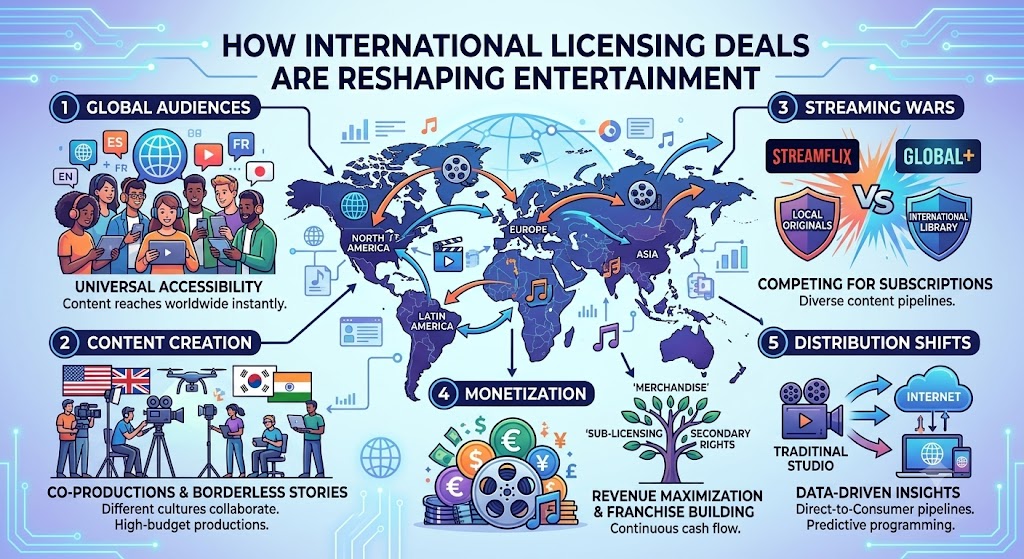
Streaming content spend crossed $101 billion for the first time in 2026, representing 40% of all global content investment, according to Ampere Analysis. That concentration of capital in a small number of platform buyers has restructured the entertainment supply chain in ways that most vendors are still catching up to. The volume, speed, and global scope of streaming production creates supply chain pressures that the traditional studio model never faced.
Simultaneous Multi-Territory Production
Netflix, Amazon, Apple TV+, and Disney+ don’t produce one or two tentpoles per year. They run dozens of productions simultaneously across 50+ countries. That model requires pre-qualified vendor networks in each territory, standardized technical specifications that local vendors can meet, and centralized procurement teams that can manage hundreds of vendor relationships in parallel. Traditional studio procurement teams, built for episodic slate management in two or three home markets, are structurally undersized for this task.
Compressed Production Timelines
Streaming platforms compete on catalog depth as much as individual title quality. That competitive pressure pushes production timelines down. Productions that once had 24 months from greenlight to delivery now target 14-18 months. Compressed timelines eliminate the slack that allowed reactive supply chain management to work. There’s no time to find a VFX house when the one you planned to use has overcommitted. The vendor backup has to be pre-qualified and ready.
AI’s Emerging Role in Content Supply Chains
McKinsey estimates that AI could influence approximately 20% of original content spend within five years of mass adoption. In supply chain terms, that influence plays out in vendor selection (AI-assisted matching of production requirements to vendor capabilities), production scheduling optimization, and automated quality control in post-production workflows. Streaming platforms are already building these capabilities internally. The broader vendor ecosystem is only beginning to adapt.
Post-Production and Localization as Critical Supply Chain Stages
The global post-production services market stands at $37.83 billion in 2025, projected to reach $113.53 billion by 2035, according to Spherical Insights. That 200% growth projection reflects the extraordinary demand generated by streaming’s multi-territory publishing model. Every title now needs to be delivered in multiple formats, frame rates, and audio configurations, and localized for audiences across dozens of language markets simultaneously.
Why Post-Production Is the Most Under-Managed Stage
Post-production tends to receive less strategic attention than production because its costs are less visible and its timelines sit later in the slate calendar. That’s a mistake. Post-production bottlenecks are the most common cause of delivery failures. A VFX sequence that runs over by six weeks can miss a theatrical window or trigger financial penalties in a streaming delivery agreement. The supply chain strategy that protects against this is simple: maintain two qualified alternatives for every critical post function.
Localization: A $13.87 Billion Supply Chain Problem
The global dubbing and subtitling market is worth $13.87 billion in 2025 and is projected to reach $17.41 billion by 2033, according to Global Growth Insights. Over 60% of global audiences now consume localized video content (Market.us). That consumer behavior creates a mandatory supply chain requirement: content that isn’t localized doesn’t reach its addressable market. Yet localization vendor networks are poorly mapped by most production companies, particularly for non-European language markets where quality control is harder to assess remotely.
“The global post-production services market is projected to grow from $37.83 billion in 2025 to $113.53 billion by 2035, driven by streaming platform demand for multi-territory content delivery at scale.”
— Spherical Insights, Global Post-Production Services Market Report, 2025
Technical Standards as a Supply Chain Filter
Streaming platforms publish extensive technical delivery specifications covering codec, loudness normalization, HDR standards, subtitle format, and accessibility compliance. Post-production vendors who cannot meet these specs are functionally excluded from the streaming supply chain, regardless of their creative quality. Building a post-production vendor network now requires verifying technical certification before a vendor is added to the approved list, not after they’ve delivered an out-of-spec deliverable at the last minute.
Cross-Border Co-Production: The Logistics Layer Most Companies Underestimate
Cross-border co-production is one of the most complex supply chain operations in any industry. It requires coordinating vendors across different legal systems, tax regimes, currency environments, and labor markets. The MPA’s 2025 report documents that the US film and TV industry supports 2.01 million jobs across 162,000+ businesses. Extend a single production across three or four countries, and the supply chain coordination challenge multiplies accordingly.
The companies that execute international co-production partnerships successfully share a common discipline: they build their cross-border vendor networks before they need them. They maintain pre-qualified contacts in the key production territories, they understand which local service companies have the capacity and technical standards for international productions, and they have legal and financial frameworks in place that don’t have to be negotiated from scratch each time.
Tax Incentive Optimization as Supply Chain Strategy
Where you source your production vendors is a financial decision as much as an operational one. The UK offers a 25% Audio-Visual Expenditure Credit. Australia’s Producer Offset runs up to 40% for feature films. Canada’s federal tax credit covers 25% of qualifying Canadian labor. These incentives create supply chain gravity: they make it financially rational to source vendors in qualifying territories, provided the right vendors exist and can be found. Supply chain strategy in co-production contexts is partly about optimizing vendor sourcing across these incentive structures.
Currency and Contractual Risk in Cross-Border Vendor Networks
Cross-border vendor contracts expose production budgets to currency risk. A production budgeted in USD with significant expenditure in a volatile currency market can face effective cost increases of 10-15% from exchange rate movements alone. Supply chain strategy should include currency hedging frameworks for major vendor relationships in non-dollar markets, clear force majeure provisions that account for local regulatory changes, and explicit contractual standards for technical delivery that align with the buyer’s streaming or broadcast requirements.
The Vendor Discovery Problem: How M&E Companies Find (and Lose) Supply Chain Partners
The vendor discovery problem is the single biggest structural weakness in entertainment supply chain management. There is no industry-standard database of qualified M&E vendors comparable to what manufacturing companies use. Instead, production companies accumulate vendor knowledge through project experience, market attendance, and informal referrals. That knowledge lives in the heads of key employees, and it walks out the door when those employees leave.
How Vendor Relationships Are Built (and Why It Doesn’t Scale)
The traditional vendor relationship cycle runs like this: meet someone at a market, do a small project together, build trust over time, add them to an informal preferred list. This process takes two to four years per territory per service category. A company building a production presence in five new markets simultaneously doesn’t have that time. The relationship-first model doesn’t fail in principle; it fails at scale.
The Information Asymmetry Between Buyers and Vendors
There’s a significant information asymmetry in M&E vendor discovery. Buyers don’t know what vendors exist in unfamiliar markets. Vendors, especially small and mid-size service companies in emerging production territories, lack the marketing resources to make themselves visible to international buyers. The result is a two-sided discovery failure: capable vendors remain invisible while buyers over-rely on a small, over-subscribed set of known names.
When Vendor Relationships Break Down
Vendor relationships break down in entertainment for predictable reasons: capacity overcommitment during production peaks, key-person dependency when a vendor’s lead talent exits, financial instability in smaller service companies, and technical obsolescence when vendors fail to invest in new equipment or workflows. A supply chain strategy that relies on three or four key vendors per service category with no qualified alternatives is one relationship failure away from a production crisis.
How to Build a Resilient Entertainment Supply Chain Strategy in 5 Steps
Building a resilient entertainment supply chain strategy is a structured process, not a one-time project. The five steps below represent a proven framework applicable to production companies, studios, streamers, and large independent producers. Companies that execute all five consistently report fewer production disruptions, shorter vendor onboarding cycles, and stronger negotiating positions with key service providers.
Step 1: Map Your Current Vendor Network
Start by documenting every vendor and service provider your company has engaged in the past three years. Categorize them by production stage, service type, and territory. Identify which relationships exist only in the heads of specific team members, and which are formalized in your procurement systems. This audit reveals both the depth of your existing network and the critical dependencies you may not have consciously recognized.
Step 2: Identify Coverage Gaps and Risk Concentrations
Once you have a complete vendor map, analyze it for coverage gaps and risk concentrations. Coverage gaps are service categories or territories where you have fewer than two qualified alternatives. Risk concentrations are single vendors handling a disproportionate share of your production volume. Both create supply chain fragility. Prioritize closing the gaps in the highest-value service categories first: VFX, post-production, and key production service markets.
Step 3: Build a Tiered Vendor Qualification Framework
Not every vendor warrants the same depth of due diligence. A tiered qualification system allocates your evaluation resources efficiently. Tier 1 vendors, who handle high-value or mission-critical work, receive full financial, technical, and operational assessment. Tier 2 vendors, who provide significant but more replaceable services, go through a streamlined checklist. Tier 3 vendors, who deliver commodity services with low switching costs, receive basic qualification only. Define clear criteria for each tier before you start evaluating anyone.
Step 4: Establish Performance Measurement and Feedback Systems
Supply chain performance can only be managed if it’s measured. For each active vendor, track delivery schedule adherence, budget performance, quality metrics (rework rates, technical compliance), and communication responsiveness. Capture this data systematically, not in post-project email threads. Aggregate vendor performance data becomes a competitive asset over time: it lets you identify which vendors to prioritize when capacity is tight and which to phase out before they cause a production failure.
Step 5: Build Intelligence Infrastructure for Continuous Discovery
The final step is making vendor discovery a continuous process rather than a reactive one. This means using structured intelligence sources to identify new vendors in target territories, tracking market activity to spot emerging service providers before your competitors do, and maintaining a pre-qualified pipeline of alternatives in each critical category. Intelligence infrastructure is what turns your supply chain map from a static document into a dynamic competitive advantage.
Technology Stack for Entertainment Supply Chain Management
The technology stack supporting entertainment supply chain management has historically been fragmented: a collection of project management tools, ERP systems adapted from other industries, and spreadsheets. That’s changing as the M&E sector builds dedicated infrastructure for the specific workflows production companies need. Understanding what each technology category does, and what it can’t do, is essential for building a coherent stack.
Production Management Platforms
Production management platforms (Movie Magic Budgeting, Showbiz Budgeting, StudioBinder) handle scheduling, budgeting, script breakdowns, and crew communication within a single production. They’re strong operational tools. Their supply chain limitation is that they don’t extend beyond the immediate production: they don’t help you find vendors, qualify new partners, or track performance across multiple productions over time.
Contract and Rights Management Systems
Rights management systems (Rightsline, Mediamorph) track license terms, territorial rights, and contract obligations. They’re essential for managing the distribution end of the supply chain. Companies that use these tools systematically avoid the costly errors that come from inadvertently licensing content into a territory where they don’t hold the rights, or failing to exercise options before they expire.
Intelligence and Vendor Discovery Platforms
The missing layer in most M&E technology stacks is a dedicated intelligence and vendor discovery platform. This is the system that answers the questions production management and rights management tools can’t: Who are the qualified VFX houses in Eastern Europe? Which production service companies in Southeast Asia have worked on Netflix originals? Which distributors in MENA are actively acquiring drama series? The entertainment industry platform category is built specifically to answer these questions at scale.
Entertainment Supply Chain KPIs and Performance Metrics
Effective supply chain management requires a disciplined measurement framework. Many M&E companies track production KPIs, such as budget variance and schedule adherence, but don’t measure supply chain performance as a distinct discipline. The metrics below give procurement and production leadership a clearer picture of supply chain health than production-only reporting provides.
Vendor Network KPIs
Vendor coverage ratio: the number of qualified alternatives per service category per territory. A ratio below 2 signals supply chain fragility. Vendor concentration index: the percentage of total production spend going to your top 5 vendors. Above 70% signals dangerous dependency. New vendor activation rate: the number of new qualified vendors added to your approved list per quarter, measured against a target that reflects your slate growth plans.
Operational Performance KPIs
On-time delivery rate: the percentage of vendor deliverables delivered on or before the contracted date. Best-in-class operations target 90%+. Rework rate: the percentage of deliverables requiring correction before acceptance. This metric is particularly important for post-production and localization vendors. Vendor onboarding cycle time: the number of days from first contact with a new vendor to their first approved engagement. Reducing this cycle time directly improves your ability to respond to production opportunities.
Strategic Resilience KPIs
Vendor substitution time: how quickly you can replace a failed vendor with a qualified alternative. This is the ultimate test of supply chain resilience. Supply chain disruption frequency: the number of production disruptions directly attributable to vendor failure per year. Tracking this metric gives leadership visibility into whether the supply chain strategy is actually reducing operational risk over time.
How VIQI Powers Entertainment Supply Chain Intelligence
VIQI is Vitrina’s entertainment intelligence platform, built specifically to solve the vendor discovery and supply chain visibility problems described throughout this guide. It indexes 159,223 verified M&E companies across service type, territory, production history, and deal activity. For production companies, studios, and streamers, it provides the intelligence infrastructure that makes systematic supply chain management possible at scale.
What VIQI Does for Content Buyers and Producers
VIQI lets production teams search for qualified vendors by service category, geography, technical capabilities, and production credits. A buyer sourcing VFX partners for a streaming co-production in Southeast Asia can filter by territory, output quality tier, and recent project history. A distributor building a localization vendor network for South Asian languages can surface and compare credentialed dubbing studios in minutes rather than months.
What VIQI Does for M&E Vendors and Service Companies
For M&E service companies, VIQI solves the visibility problem that keeps capable vendors from reaching international buyers. A post-production house in Poland with strong VFX credentials but limited marketing reach can list its services, territories, and production history on VIQI and become discoverable to Netflix, Amazon, and independent production companies sourcing European post partners. That discoverability translates directly to business development without requiring a team of market-circuit salespeople.
“Global streaming content spend crossed $101 billion for the first time in 2026, representing 40% of all global content investment. The scale of that spending requires a supply chain intelligence infrastructure that most M&E companies do not yet have.”
— Ampere Analysis, Global Content Investment Report, 2026
VIQI’s Role in the 5-Step Supply Chain Framework
VIQI provides the intelligence layer that accelerates all five steps of the supply chain strategy framework. Step 1 (mapping your current network) is faster when you can verify vendor details and production histories against a live database. Step 2 (identifying gaps) is more precise when you can search what qualified alternatives exist in underserved categories. Steps 4 and 5 (performance measurement and continuous discovery) become systematic processes rather than ad hoc exercises when you have a continuously updated intelligence platform as the foundation.
Conclusion
The entertainment supply chain is one of the most complex coordination problems in the global creative economy. With $255 billion in annual content investment flowing through tens of thousands of vendors across 100+ production territories, the gap between companies with structured supply chain strategies and those without is widening. The evidence is visible in slate execution speed, production cost efficiency, and the ability to capitalize on new market opportunities before competitors do.
The five-stage supply chain framework and the five-step strategy covered in this guide give production companies, studios, and streamers a clear starting point. Map what you have, find the gaps, qualify tiered alternatives, measure performance, and build the intelligence infrastructure that makes continuous discovery systematic. None of these steps requires a radical organizational transformation. They require discipline, the right tools, and a decision to treat supply chain management as a strategic function rather than a production logistics footnote.
The market conditions driving this shift: streaming’s $101 billion content spend, post-production’s capacity constraints, the mandatory localization requirement for 60%+ of global audiences. These aren’t temporary. They’re the new operating environment. The supply chain strategy you build now will compound in value as your slate scales and as new production territories open up. Start with the vendor map. The rest follows.
Frequently Asked Questions
What is entertainment supply chain strategy?
Entertainment supply chain strategy is the systematic framework M&E companies use to identify, qualify, manage, and optimize the vendors and partners who contribute to content creation and distribution across all five production stages. It addresses vendor discovery, risk management, cross-border complexity, and performance measurement. Companies with defined supply chain strategies execute productions faster and at lower cost than those managing vendor relationships reactively. The global content-creation value chain is worth $181 billion (McKinsey), making supply chain discipline a direct driver of competitive advantage.
What are the biggest challenges in the entertainment supply chain?
The three biggest challenges are fragmented vendor discovery, no upstream visibility beyond first-tier suppliers, and cross-border complexity without dedicated infrastructure. Research shows 45% of supply chain professionals across industries report zero visibility beyond their immediate supplier tier (McKinsey). In entertainment, that figure likely understates the problem, as most production companies have never formally mapped their supply chains. Vendor concentration, where a single service provider handles an outsized share of production volume, is an additional fragility that most companies only discover when that vendor fails.
How do streaming platforms affect content supply chain complexity?
Streaming platforms have fundamentally restructured supply chain complexity by driving simultaneous multi-territory production at unprecedented scale. Streaming content spend crossed $101 billion in 2026, representing 40% of all global content investment (Ampere Analysis). That concentration requires pre-qualified vendor networks across dozens of countries, standardized technical specifications for delivery, and procurement teams sized for hundreds of concurrent vendor relationships. Compressed production timelines eliminate the slack that previously allowed reactive vendor sourcing to work.
How do M&E companies find and vet supply chain partners?
Most M&E companies currently find vendors through market attendance, personal referrals, and word-of-mouth. That approach works for established relationships but fails when companies need to scale quickly or enter unfamiliar territories. A structured approach uses tiered qualification frameworks, production credit verification, technical standards assessment, and intelligence platforms like VIQI to search 159,223 verified M&E companies by service type, territory, and production history. Companies that systematize vendor discovery reduce onboarding cycle times and build a deeper qualified pipeline before capacity becomes urgent.
What tools are used for entertainment supply chain management?
The entertainment supply chain technology stack typically includes production management platforms (Movie Magic, StudioBinder) for within-production scheduling and budgeting, rights management systems (Rightsline, Mediamorph) for license tracking, and intelligence platforms for vendor discovery and market mapping. The intelligence layer is the most under-invested category in most M&E stacks. VIQI fills this gap by providing a searchable database of 159,223 verified M&E companies organized by service category, territory, and production history, enabling systematic supply chain mapping rather than reactive vendor discovery.
The Vitrina Research Team analyzes global M&E market trends, supply chain dynamics, and content investment flows to help production companies, studios, and streamers make better-informed strategic decisions. Research draws on VIQI’s database of 159,223 verified M&E companies across 100+ countries.