About Innovation Hub
 Global Content Pulse (Webinars)


 Global Production Financing
(Webinars)
Global Production Financing
(Webinars)  LeaderSpeak Podcast
  Global Entertainment Digest (Newsletter)
  About Vitrina
 About VIQI
 Our Story
 Our Solutions 🔥
 Film+TV Projects Tracker 🚀
 Case Studies
 Our Profile

| Strategic Pillar | Executive Insight |
|---|---|
| The 35% Hospitality Grant | The “Ospitalità” fund provides direct cash grants of up to 35% on local hospitality services, capped by project type. |
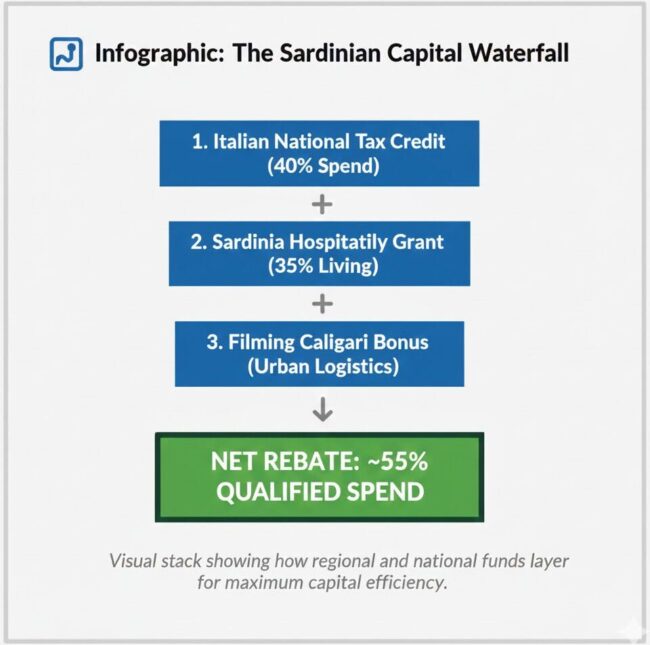
| Stackable ROI | Sardinian regional funds can be layered with the 40% Italian National Tax Credit, effectively lowering net costs by over 55% in specific cases. |
| Cagliari Gateway | The “Filming Cagliari” fund offers additional incentives for productions utilizing the capital city’s infrastructure and crew. |
| Vitrina Relevance | Identify verified Sardinian service producers with a 100% successful exit record in regional audit cycles. |
Table of Content
- The Fund Architecture: Navigating the Sardegna Film Commission Tiers
- Hospitality Mechanics: Maximizing the 35% “Ospitalità” Rebate
- The Stacking Strategy: Regional Cash vs. National Tax Credits
- Cagliari and Logistics: Unlocking the Urban Infrastructure Bonus
- Vitrina Briefing: How to Source Vetted Sardinian Supply Chain Partners
The Fund Architecture: Navigating the Sardegna Film Commission Tiers
The Sardinia Film Fund operates under a sophisticated, multi-tiered architecture managed by the Sardegna Film Commission. In the 2024-2025 cycle, the regional government has significantly increased its allocation, reflecting a 15% year-over-year growth in total incentive volume. According to data from the Italian Association of Film Commissions, Sardinia now ranks as one of the top three most fiscally aggressive regions in Italy.
For finance executives, the primary decision lies between the Selective Fund for high-quality audiovisual content and the Hospitality Fund. The Selective Fund targets international feature films and high-end episodic drama that showcase the cultural or landscape heritage of the island. This fund provides direct cash injections that are typically disbursed in two to three installments: the “Greenlight” deposit, the “Production” draw, and the “Final Audit” exit.
The bottom line is the Qualified Production Expenditure (QPE). To unlock these funds, a project must maintain a meticulous audit trail, ensuring every invoice is issued by a locally domiciled vendor. Why does this matter? Because the Sardinian government uses these funds as a mechanism for local vendor development; any spend outside the regional borders is immediately excluded from the rebate calculation.
Hospitality Mechanics: Maximizing the 35% “Ospitalità” Rebate
One of the most unique elements of the Sardinian framework is the Hospitality Incentive (Sardegna Ospitalità). Unlike traditional labor-based tax credits, this fund specifically rewards the “on-island” living costs of cast and crew. According to market intelligence from KFTV, this grant can cover up to 35% of eligible expenses related to accommodation, catering, and local transportation.
There is a tactical advantage here for high-budget productions: the hospitality grant is often disbursed faster than the national tax credit. This provides a critical cash-flow bridge during the middle stages of production. However, there are caps based on project type—feature films can often access up to €300,000 in hospitality grants, while episodic series may qualify for higher aggregate totals depending on the number of shooting weeks.
The Sustainability Factor is also now mandatory. The Sardegna Film Commission has implemented “Green Protocols” that can increase the rebate percentage if the production adheres to strict waste management and local sourcing benchmarks. In 2024, nearly 60% of supported projects utilized these green bonuses to maximize their final disbursement.
The Stacking Strategy: Regional Cash vs. National Tax Credits
The true “Insider” play in Sardinia is the Incentive Stack. While the Sardinia Film Fund provides direct cash, the Italian National Tax Credit provides a 40% rebate on all Italian-based spend. When these two layers are integrated, the effective net reduction in production costs is remarkable. According to data from the Italian Ministry of Culture, productions shooting in Sardinia often achieve an effective rebate rate of 50-55% on local expenses.
For studio executives, managing this stack requires a sophisticated Special Purpose Vehicle (SPV) in Italy. The national credit functions as a tax offset that can be sold (transferred) to local banks or corporations, whereas the Sardinian funds are direct grants. This dual-track system requires a local production service partner who can manage the national tax filing alongside the regional grant application.
It is important to note that the Sardinia Film Fund grants are often subject to “De Minimis” European Union state aid rules. This means that while you can stack incentives, you must ensure the total government support does not exceed the allowed “Intensity Caps” set by the EU, which usually peak at 50% for standard productions and 60% for “Difficult Works” or co-productions.
Cagliari and Logistics: Unlocking the Urban Infrastructure Bonus
Beyond the remote coastlines, the capital city of Cagliari offers its own localized fiscal layer via the Filming Cagliari Fund. This fund is specifically designed to support the urban logistics of major productions. In 2023, the city supported over 25 international projects, providing additional cash rebates for those using the local airport, port, and municipal facilities.
The Cagliari Gateway provides access to a highly dense supply chain of technical vendors, many of whom have handled recent “Hero Projects” like high-budget Italian streaming originals. By anchoring the production office in Cagliari, producers can maximize the “Filming Cagliari” bonus while easily accessing the rural locations that trigger the broader Sardinian regional grants.
According to industry intelligence from Variety, the city’s proactive approach to permitting—often providing street closures and location access at zero cost for supported projects—serves as an “Indirect Incentive” that can save a production up to 5% of its BTL (Below-the-Line) budget compared to more congested Italian hubs like Rome or Milan.
Vitrina Briefing: How to Source Vetted Sardinian Supply Chain Partners
Navigating the Sardinia Film Fund and the stackable Italian credits requires more than a local scout; it requires a verified supply chain. Vitrina de-risks this process by mapping the Sardinian ecosystem—from SIRECINE-registered service producers to specialized technical vendors who understand the nuances of regional audit compliance.
Accelerate with VIQI Intelligence
Strategic Conclusion
Sardinia has moved beyond its reputation as a picturesque backdrop to become a self-sustaining production superpower characterized by a high-yield fiscal stack. The integration of the 35% hospitality grant with the 40% national tax credit allows global studios to achieve a level of capital efficiency that is currently unmatched in the Mediterranean. However, the path to these funds is paved with administrative rigor; failing to engage SIRECINE-registered vendors or ignoring the “Green Protocol” benchmarks can result in a total loss of the regional bonus.
The path forward requires a shift from manual scouting to data-driven partner discovery. As the island’s stage capacity and technical crew base continue to expand, the ability to surface verified collaborators who understand the intricacies of Sardinian audit compliance is the ultimate competitive advantage. Vitrina provides the intelligence layer needed to connect with the decision-makers who can transform Sardinia’s fiscal promise into a tangible, high-ROI production reality.
Strategic FAQ
What is the minimum spend to qualify for the Sardinia Film Fund?
Eligibility typically requires a minimum regional expenditure threshold that varies by project type, often starting around €200,000 for features, to ensure a meaningful local economic impact.
Can the Sardinia Hospitality Fund be stacked with the 40% Italian National Tax Credit?
Yes, the 35% “Ospitalità” grant is stackable with the national tax credit, provided the total government intensity of support does not exceed EU state aid limits (usually 50%).
Are high-end TV series eligible for Sardinian regional grants?
Yes, both international feature films and episodic TV series are eligible for the Sardinia Film Fund and the hospitality incentives, with specific caps adjusted for series scales.
How long does it take for the Sardinia Film Fund to disburse grants?
Disbursements typically occur in stages, with a portion paid out after the submission of intermediate expenditure reports and the final balance released after the successful completion of a local audit.