By Vitrina Research Team | Published: July 3, 2026 | Updated: July 3, 2026 | 14 min read
When Netflix decided to commission House of Cards in 2013 — a $100 million series commitment with no pilot — the decision was not based on gut instinct or a studio executive’s taste. It was based on data: subscriber viewing patterns revealed a specific overlap between fans of the BBC original, Kevin Spacey films, and David Fincher-directed content. The algorithm identified the audience before a single scene was shot. The series earned nine Emmy nominations in its first year.
That moment marked the beginning of a fundamental shift in how the entertainment industry operates. Today, data analytics is not a competitive advantage — it is the operating system. Streaming platforms use it to decide what to make, what to recommend, when to release, and how much to spend. Sports organizations use it to price tickets dynamically, optimize broadcast cuts, and grow fanbase demographics. Music labels use streaming data to route tours and prioritize A&R investments. Advertisers use it to buy against audience segments rather than programs. This is how data analytics in media and entertainment actually works — and why the intelligence layer is becoming the most valuable part of the industry.
Key Takeaways
- 75–80% of all Netflix viewing hours are driven by its algorithmic recommendation engine (Netflix Research)
- The streaming analytics market is worth $4.34 billion in 2025, growing to $7.78 billion by 2030 at 12.4% CAGR (MarketsandMarkets)
- Digital video captured 58% of all U.S. TV ad spend in 2025 — up from 29% in 2020 — with over 90% of CTV ad spend now transacted programmatically
- Sports analytics market projected to reach $29.75 billion by 2034 at a 20.63% CAGR (Precedence Research)
- 53% of Gen Z say social media gives better content recommendations than streaming platforms (Deloitte 2025 Digital Media Trends)
- McKinsey estimates AI could influence approximately 20% of original content spend at streaming platforms within five years
List Your Company
Get discovered by analytics buyers, streaming platforms, and M&E intelligence teams actively researching on VIQI.
Research M&E Companies
Find analytics platforms, streaming tech companies, and intelligence vendors across 400,000+ global M&E companies.
The Scale of Data in Media and Entertainment
The entertainment industry generates more behavioral data per user per day than almost any other sector. Every play, pause, rewind, skip, search query, and device switch on a streaming platform creates a data point. Multiply that across 96.4 million connected TV households in the United States — each averaging nearly 5 hours of streaming daily across 6.9 services (Comscore, 2025) — and the data volume becomes staggering.
The infrastructure tracking this behavior is equally large. Nielsen’s Big Data + Panel now measures more than 1 trillion minutes of viewing per month across 45 million households and 75 million devices — a measurement scope that would have been technically impossible a decade ago. The streaming analytics market that processes this data was valued at $4.34 billion in 2025, growing to $7.78 billion by 2030 at a 12.4% CAGR (MarketsandMarkets). The TV analytics subset specifically sits at $3.59–3.75 billion in 2025, projected to reach $10.86–12.19 billion by 2030.
The broader entertainment and media industry reached $3.5 trillion in total revenues in 2025 (PwC Global E&M Outlook 2026), growing 5.3% year-over-year. Within this, AI-enabled advertising — the segment most directly powered by data analytics — is forecast to top $1.4 trillion by 2030 at a 5.6% CAGR, eclipsing consumer spending as the dominant revenue driver. The intelligence layer is not a support function for the entertainment industry; it is increasingly the primary value creator.
How Streaming Platforms Use Data Analytics
Streaming platforms sit on the richest behavioral datasets in entertainment history. They know exactly what each subscriber watches, for how long, on which device, at what time, in what room, with what audio settings, and at what point they abandon a title. This data feeds four primary use cases: content recommendation, content commissioning, pricing and tier strategy, and churn prediction.
Recommendation Engines: The Core Data Product
Netflix’s recommendation engine drives 75–80% of all viewing hours on the platform. This is not a minor feature — it is the primary mechanism by which content is discovered and consumed. Netflix internally estimates this recommendation system saves approximately $1 billion per year in subscriber retention, by reducing the probability that a subscriber fails to find content worth watching and cancels. The downstream evidence: Netflix maintains a monthly churn rate of approximately 2.3–2.4%, versus an industry average of 5–7%.
Every element a subscriber sees on their Netflix homepage — the title order, the artwork variant, the preview timing, the category row placement — is personalized based on their viewing history, viewing time patterns, device preference, and collaborative filtering signals from similar users. Netflix runs thousands of A/B tests simultaneously to optimize these variables. The homepage is a data product as much as it is a user interface.
Ad-Tier Analytics and AVOD Intelligence
The growth of ad-supported tiers has created a new data use case: audience targeting for advertising. Netflix’s ad-supported tier now accounts for 45% of total U.S. household viewing hours on the platform (Comscore, October 2025), up from 34% in 2024. This means nearly half of Netflix’s US viewing generates advertising data — viewer demographic segments, content genre affinities, device context, and time-of-day patterns that advertisers can target programmatically.
For streaming platforms, AVOD analytics creates a direct revenue link between audience intelligence and advertising rates: richer audience data commands higher CPMs. Platforms that can demonstrate cross-device attribution (proving that a viewer who saw an ad on streaming later converted on a retail site) command significantly premium rates over those offering only demographic guarantees.
Data-Driven Content Commissioning and Greenlight Decisions
Perhaps the most disruptive application of data analytics in entertainment is in content investment decisions. Traditional commissioning relied on executive taste, pilot testing, and genre precedent. Data-driven commissioning uses audience demand signals, competitive gap analysis, and predictive modeling to inform every greenlight decision.
Parrot Analytics — the leading global content demand analytics platform — measures “demand expressions” across social media, fan activity, streaming registrations, and piracy signals to produce a composite audience demand score for any title in any market. Its Content Valuation model correlates audience demand with subscriber churn avoidance and subscriber acquisition value, enabling studios to quantify what each title is worth to a specific platform. Parrot Analytics data shows that its demand scores correlate with subscriber counts at R-squared greater than 0.9. One unnamed major studio using Parrot Analytics data cut development costs by 50% and boosted library value by 126% by narrowing its development slate.
Squid Game’s global expansion trajectory illustrates what data-informed localization looks like at scale. Netflix used regional user behavior data to identify which markets had the highest demand for Korean thriller content before the series launched, enabling targeted localization (dubbing, subtitling, and marketing) that contributed to 142 million household views in the first four weeks — making it the most-watched series in Netflix history at its release.
McKinsey estimates that AI-driven analytics could directly influence approximately 20% of all original content spend at streaming platforms within five years — shifting from post-commissioning optimization (recommendation, marketing) to pre-commissioning intelligence (what to make, at what budget, for which market).
Audience Measurement: From Nielsen Panels to Cross-Platform Intelligence
For decades, audience measurement meant Nielsen’s panel-based ratings — a sample of households whose viewing behavior was extrapolated to represent the national audience. The streaming era has broken this model: viewing fragmented across dozens of platforms, devices, and time zones, making panel extrapolation increasingly imprecise.
Nielsen responded in September 2025 with its Big Data + Panel infrastructure — replacing pure sample extrapolation with actual ACR (automatic content recognition) data from 45 million households and 75 million devices, measuring more than 1 trillion viewing minutes per month. This “census-level” measurement approach represents the most significant methodology shift in audience measurement in decades, directly addressing the streaming fragmentation problem.
The competitive landscape for audience measurement now includes:
| Platform | Methodology | Primary Use Case |
|---|---|---|
| Nielsen Big Data + Panel | ACR + panel hybrid; 45M households, 75M devices | National TV/streaming ratings; currency for linear and digital |
| Comscore | Panel + census tagging; CTV-focused | Cross-platform reach and frequency; OTT measurement |
| Parrot Analytics | Demand expressions (social, piracy, streaming registrations) | Content valuation; greenlight intelligence; licensing decisions |
| Samba TV | ACR from 110M+ smart TV screens; 20 countries | Cross-screen attribution; advertising effectiveness |
| iSpot.tv | Real-time TV ad measurement; verified purchase outcomes | Advertising ROI measurement; competitive spend tracking |
| Tubular Labs | Cross-platform social video analytics (YouTube, Facebook, TikTok) | Creator and content performance; social video benchmarking |
Streaming captured 47.5% of total U.S. television viewing time in December 2025 — the highest share ever recorded (Comscore). By April 2025, streaming’s share hit 44.3%, up 15% versus April 2024, while cable fell 16% and broadcast fell 7% (Nielsen The Gauge). These measurement milestones underscore why accurate cross-platform measurement is now the central commercial priority for both media companies and advertisers.
CTV and Programmatic Advertising Analytics
The convergence of television and digital advertising — enabled by analytics infrastructure — has produced one of the fastest-growing segments in media: Connected TV (CTV) programmatic advertising.
Key 2025 data points for CTV advertising:
- Digital video captured 58% of all U.S. TV/video ad spend in 2025 — up from 29% in 2020, reaching $72 billion total (14% YoY growth). Digital surpassed linear TV for the first time in 2024 (IAB 2025 Digital Video Ad Spend Report)
- Over 90% of CTV display ad spend is now transacted programmatically; 47% of CTV inventory is available via real-time bidding, up from 34% in 2024 (MNTN Research / IAB)
- U.S. CTV ad spend reached $37.95 billion in 2025 (+14.5% YoY), forecast to surpass $52.53 billion by 2029 (Statista / StackAdapt)
- Audio remains significantly underinvested: consumers dedicate 31% of their media time to audio, but advertisers allocate only 9% of budgets to audio advertising — a 22-percentage-point gap that analytics data is beginning to close (Nielsen, 2025)
The programmatic CTV ecosystem is analytically sophisticated in ways that linear TV never was. Advertisers can target by household income, content genre affinity, device type, geographic precision, and purchase intent signals — and then measure campaign outcomes against actual purchase conversions rather than estimated reach. This attribution capability is what drives 90%+ of CTV ad spend through programmatic pipes.
Sports Analytics: From Player Performance to Fan Engagement
Sports analytics has evolved from a back-office statistical function into a multi-billion-dollar market that spans player performance optimization, fan engagement personalization, broadcast production, and commercial rights valuation.
The global sports analytics market is projected to reach $29.75 billion by 2034 at a CAGR of 20.63% (Precedence Research, 2025). The fan engagement analytics sub-market alone was valued at $7.24 billion in 2025, expected to reach $37.9 billion by 2035 (Future Market Insights). This growth reflects how deeply analytics has penetrated every commercial dimension of professional sports.
The NBA’s partnership with AWS illustrates the frontier of sports data analytics: converting billions of live game data points into personalized real-time insights delivered inside the NBA app — so that each fan sees statistics and highlights most relevant to the players and storylines they follow, not a generic broadcast experience. Meanwhile, Nielsen data shows the 2025 MLB postseason generated 58.2 billion viewing minutes (up 24% YoY), with Hispanic viewership up over 200% for the Tokyo Series — demographic shifts that analytics revealed and that now inform broadcast rights negotiations, marketing spend, and international distribution strategy.
Sports analytics use cases by function:
- Player performance: Computer vision, GPS tracking, and biometric data enable teams to optimize training loads, predict injury risk, and quantify player value
- Fan engagement: Real-time personalization of app experiences, dynamic pricing for tickets and merchandise, and targeted content recommendations based on fan behavior data
- Broadcast optimization: Live production teams use audience engagement data (channel switch rates, second-screen activity) to adjust camera coverage, commentary focus, and commercial break timing in real time
- Rights valuation: Media rights negotiators use audience demand data, demographic reach analysis, and streaming performance metrics to price broadcast packages — the $76 billion NBA media rights deal was underpinned by years of audience analytics demonstrating the sport’s cross-demographic and international growth
Research Sports Media Companies
Find sports broadcasters, analytics vendors, and rights holders across the global M&E ecosystem on VIQI.
Music Industry Analytics: Spotify, A&R, and Touring
The music industry’s relationship with data analytics has been transformed by streaming. Spotify — with 696 million monthly active users and 31.7% global market share as of Q3 2025 — generates the most comprehensive real-time dataset on music consumption ever assembled. Every stream, playlist add, skip, repeat listen, and geographic play location feeds back into A&R decisions, marketing strategy, and touring optimization for labels, publishers, and artists.
Spotify paid the music industry more than $11 billion in 2025 — up 10%+ year-over-year — with 13,800+ artists each earning at least $100,000 from the platform alone (Spotify Loud & Clear, March 2026). The granularity of Spotify’s data allows labels to identify which cities are generating organic listener growth for a specific artist weeks before traditional radio tracking would surface the same signal — enabling proactive tour routing and marketing spend allocation.
The U.S. live music market hit $18.51 billion in 2025 (projected $26.93 billion by 2031 at 6.45% CAGR), with AI-driven dynamic pricing and streaming-data-informed tour routing now standard practice for major concert promoters. The analytics loop is direct: streaming listen data identifies which markets have the highest engaged listener concentrations, dynamic pricing algorithms set ticket prices based on real-time demand signals, and post-tour analytics feed back into the next album cycle’s market prioritization.
The Walled Garden Problem: Entertainment’s Data Fragmentation Challenge
Despite the richness of data available within individual platforms, the entertainment industry’s central analytics challenge in 2026 is fragmentation. Each major streaming platform, social network, and device ecosystem operates a “walled garden” — a proprietary data environment that does not share behavioral signals with external parties. Netflix knows exactly what its subscribers watch, but Netflix’s data is not visible to Disney+, Amazon, or any advertiser without a direct deal. Amazon’s purchase data — the most commercially valuable intent signal in advertising — stays inside Amazon’s ecosystem.
The downstream impact: advertiser focus on cross-platform measurement climbed from 64% to 72% between 2025 and 2026 (eMarketer / Improvado) as walled garden attribution remains the leading pain point for media buyers. An advertiser running a campaign across Netflix, Hulu, YouTube, and Peacock simultaneously cannot easily measure unduplicated reach, frequency, or conversion across all four — each platform reports its own metrics using its own methodology.
The solutions emerging in 2025–26:
- Clean room partnerships: Platforms share aggregated, anonymized audience segments with advertisers in privacy-safe environments (e.g., Amazon Marketing Cloud, Disney’s clean room) without exposing individual user data
- Identity graphs: Companies like LiveRamp and The Trade Desk maintain probabilistic identity graphs that stitch together cross-device behavior across walled gardens without relying on third-party cookies
- ACR-based measurement: Automatic content recognition technology from Samba TV and others captures what’s playing on the TV screen regardless of source — creating a cross-platform measurement layer that operates independent of platform data sharing
- Currency-neutral buying: Nielsen and Comscore both now offer cross-platform reach and frequency measurement that advertisers can use as a unified buying currency across linear and digital
AI-Powered Analytics: Predictive Intelligence and What’s Next
The integration of AI into entertainment analytics is moving the capability from descriptive (what happened) and diagnostic (why it happened) toward predictive (what will happen) and prescriptive (what action to take). The generative AI in movies market will grow from $0.4 billion in 2025 to $1.03 billion by 2030 at a 23.9% CAGR (Research and Markets, 2026) — with AI tools now analyzing scripts, trailer sentiment, cast popularity signals, and social media buzz to produce predictive box office models before a film enters production.
AI/ML-driven streaming intelligence platforms are the fastest-growing sub-segment of the streaming analytics market, projected at a 16.3% CAGR through 2030 (MarketsandMarkets). The applications driving this growth:
- Hyper-personalization: Moving beyond collaborative filtering to individual “taste profile” modeling that predicts not just what a user has liked but what they will want to discover — incorporating mood signals, time-of-day context, and social influence patterns
- Churn prediction: Real-time models identifying subscribers at elevated risk of cancellation based on engagement pattern changes, enabling targeted retention interventions before the cancellation decision is made
- Dynamic ad insertion: AI systems selecting the optimal ad creative, length, and placement for each individual viewer in real time — based on content context, viewer history, and conversion likelihood
- Second-screen intelligence: 85–89% of Gen Z use a mobile device simultaneously while watching TV (Arena.im, 2025); analytics platforms are building systems to coordinate cross-screen experiences and attribute second-screen engagement to content performance
One finding from Deloitte’s 2025 Digital Media Trends survey reveals both the opportunity and the challenge: 53% of Gen Z say social media gives better content recommendations than streaming platforms, and 56% discover new shows through creator mentions online. For streaming platforms spending billions on proprietary recommendation engines, this finding suggests the social discovery layer — TikTok, YouTube, Instagram — is outperforming algorithmic recommendation for the most valuable demographic segment. Closing this gap is the next major analytics challenge the industry must solve.
How Vitrina Provides Intelligence for the M&E Industry
The analytics platforms described in this article — Nielsen, Comscore, Parrot Analytics, Samba TV, Tubular Labs — all address a specific dimension of the media and entertainment data challenge: measuring what audiences watch, how advertising performs, or which content titles have the most demand. What they do not address is the structural intelligence challenge facing B2B operators in the entertainment industry: understanding who the companies are, what they do, who they partner with, and where deals are being made.

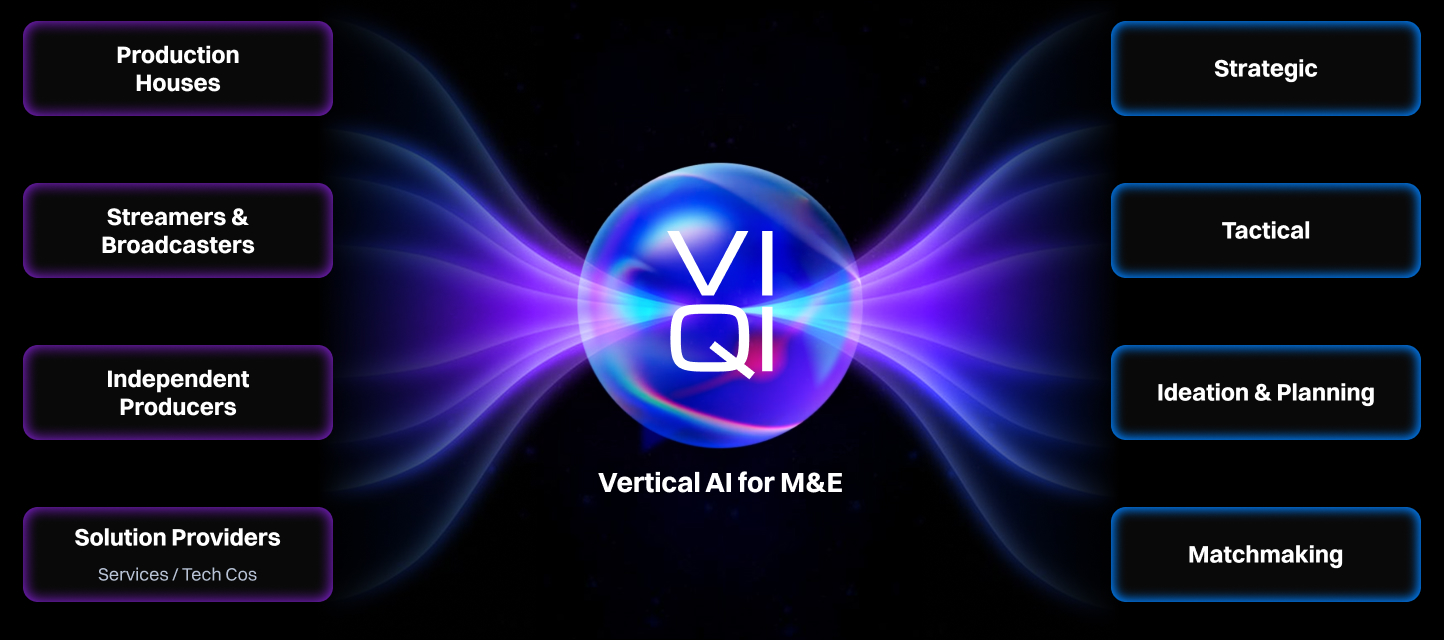
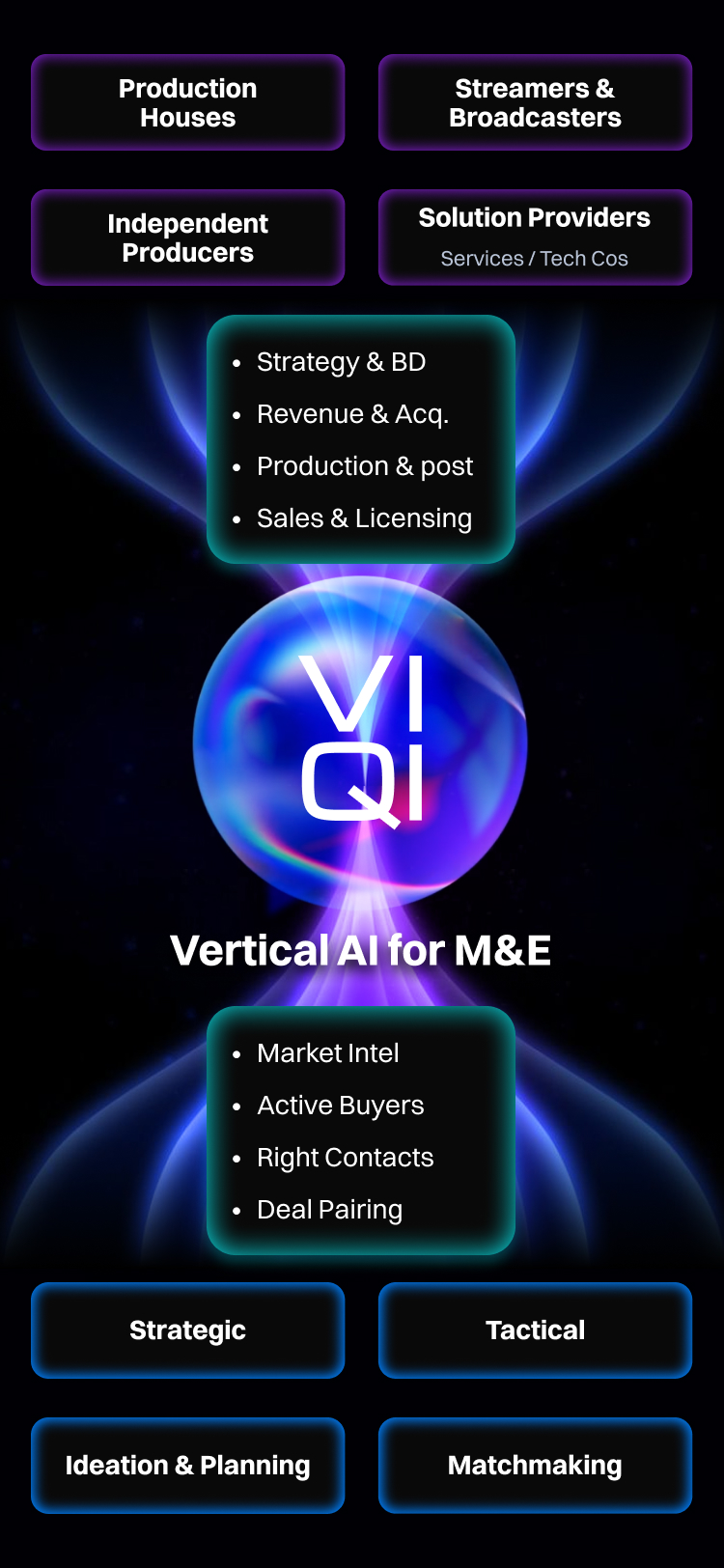
Vitrina Intelligence (VIQI) fills this gap. With a database of over 400,000 media and entertainment companies worldwide — production companies, distributors, streaming technology vendors, analytics platforms, post-production facilities, content studios, and service providers — VIQI provides the company-level intelligence layer that audience measurement platforms are not designed to deliver. For a production company seeking to identify which streaming platforms are commissioning in a specific genre and geography, or for a PE firm mapping potential acquisition targets in the analytics vendor space, VIQI turns an opaque, fragmented industry into a searchable, structured dataset.
As the entertainment industry’s data analytics infrastructure becomes more sophisticated, so does the demand for the intelligence that sits above the data — understanding the companies that produce, distribute, and monetize content, and how they connect. Vitrina’s role is to make that landscape visible and navigable for everyone operating in it.
Analytics & Tech Vendors: Get Listed
M&E companies and analytics vendors — list on VIQI to reach the procurement teams and partners that matter.
Research M&E Analytics Companies
Find analytics platforms, measurement companies, and intelligence vendors across the global entertainment ecosystem on VIQI.
Conclusion
Data analytics in media and entertainment has moved from competitive advantage to industry infrastructure. The $4.34 billion streaming analytics market, $37.95 billion CTV ad spend, $29.75 billion sports analytics projection, and $11 billion Spotify music royalty economy are all powered by the same underlying capability: the ability to convert behavioral data into actionable intelligence at scale.
The frontier is moving quickly. AI-powered recommendation, predictive box office modeling, cross-screen attribution, and dynamic ad insertion are transitioning from experimental to operational across the industry. The walled garden fragmentation problem — the industry’s most persistent measurement challenge — is being addressed through clean rooms, identity graphs, and ACR-based cross-platform measurement, though no definitive solution has emerged yet.
The finding that 53% of Gen Z say social media gives better content recommendations than streaming platforms is a signal that should concentrate industry attention: despite billions invested in proprietary recommendation infrastructure, the social layer is winning the discovery battle for the youngest and most valuable audience segment. The next phase of entertainment analytics will be defined by whoever closes that gap — and whoever builds the intelligence infrastructure to connect the fragmented data ecosystem into a coherent picture of audience behavior across every screen, platform, and format.
Frequently Asked Questions
How do streaming platforms use data analytics?
Streaming platforms use data analytics for four primary purposes: content recommendation (75–80% of Netflix viewing is driven by its algorithm), content commissioning (using audience demand data to inform greenlight decisions), pricing and tier strategy (optimizing ad-supported vs. paid tiers), and churn prediction (identifying subscribers at risk of cancellation before they cancel). Every element a subscriber sees on their platform homepage — title order, artwork, preview timing — is optimized using behavioral data.
What is the streaming analytics market size?
The streaming analytics market was valued at $4.34 billion in 2025 and is projected to reach $7.78 billion by 2030, growing at a 12.4% CAGR (MarketsandMarkets, October 2025). AI/ML-driven streaming intelligence platforms are the fastest-growing sub-segment at a 16.3% CAGR. The broader TV analytics market is estimated at $3.59–3.75 billion in 2025, reaching $10.86–12.19 billion by 2030.
What is the walled garden problem in entertainment data?
The walled garden problem refers to the fact that each major streaming platform, social network, and device ecosystem keeps its behavioral data proprietary. Netflix’s viewing data is not visible to Disney+ or any advertiser without a direct deal. This makes cross-platform audience measurement and advertising attribution very difficult — a challenge that 72% of advertisers cite as their top measurement priority in 2026 (eMarketer). Solutions include data clean rooms, identity graphs, and ACR-based cross-platform measurement.
How is data analytics used in sports entertainment?
Sports analytics applications span player performance (GPS, biometrics, computer vision), fan engagement personalization (real-time app personalization, dynamic ticket pricing), broadcast optimization (adjusting camera coverage based on live audience engagement signals), and commercial rights valuation (using audience demand data to price media rights packages). The NBA’s AWS partnership converts billions of live data points into personalized real-time insights for each fan in the app. The global sports analytics market is projected to reach $29.75 billion by 2034 at a 20.63% CAGR.
How does Spotify use data analytics for the music industry?
Spotify’s data analytics — spanning 696 million monthly active users and 31.7% global market share — enables labels and artists to track real-time listening patterns by city, playlist context, and demographic segment. This data drives A&R investment decisions, tour routing (identifying markets with the highest engaged listener concentration), marketing spend allocation, and release timing. Spotify paid the music industry more than $11 billion in 2025, with its data transparency tools giving even independent artists direct access to their audience analytics.
About the Author
Vitrina Research Team
The Vitrina Research Team produces intelligence-led analysis on media and entertainment industry structure, deal activity, and market trends. Our research draws on VIQI’s proprietary dataset of 400,000+ M&E companies worldwide.