By Vitrina Research Team | Published: July 3, 2026 | Updated: July 3, 2026 | 15 min read
In November 2021, Blackstone-backed Candle Media paid approximately $3 billion for a company most adults had never heard of but whose content their children watched obsessively. Moonbug Entertainment β owner of CoComelon, Blippi, and 27 other kids IP brands β became the headline deal in a frenzied PE-driven entertainment acquisition wave. Four years later, that deal has become a case study in both the upside and the limits of IP platform investing in media and entertainment.
The entertainment M&A market has since moved into a new phase. Total deal value in 2024 hit $119.2 billion across 2,221 transactions. In 2025, mega-deals dominated: a $8.4 billion Paramount-Skydance merger closed in August, a potential $82.7 billion Netflix-WBD deal was reported, and a proposed $55 billion PE buyout of Electronic Arts would be one of the largest entertainment LBOs ever. This is what’s happening in entertainment M&A β who’s buying, what they’re paying, and what the deal logic reveals about where the industry is headed.
Key Takeaways
- Blackstone-backed Candle Media acquired Moonbug Entertainment for ~$3 billion in 2021 β the largest dedicated kids IP acquisition in history at the time
- Moonbug’s CoComelon generates 200M+ YouTube subscribers and 273 million Netflix viewing hours in H1 2025 alone
- CoComelon moves to Disney+ in January 2027 after Disney outbid Netflix in a competitive licensing process
- Entertainment M&A hit $119.2 billion across 2,221 deals in 2024; 2025 surpassed it on deal value driven by streaming mega-deals
- Streaming platform EV/EBITDA multiples average 25β35x for top-tier platforms (vs. 7β8x for traditional cable)
- Music rights are now a $4 billion+ Blackstone bet, with Recognition Music Group (Hipgnosis) valued at $2.95 billion as of March 2025
List Your Company
Get discovered by PE firms, acquirers, and strategic partners actively researching the M&E landscape on VIQI.
Research M&E Companies

Map acquisition targets, portfolio companies, and deal activity across 400,000+ global M&E companies.
What Is Moonbug Entertainment and Why Did Blackstone Buy It?
Moonbug Entertainment is a London-founded kids content company that owns and operates 29 IP brands β including CoComelon, Blippi, Little Baby Bum, Little Angel, Oddbods, Gecko’s Garage, and more β distributed across more than 150 global platforms in 32 languages. Founded in 2018 and built through acquisition of existing YouTube-native kids channels, Moonbug became the dominant platform-agnostic operator in children’s digital entertainment within three years of its founding.
In November 2021, Blackstone-backed Candle Media β a media holding company led by former Disney executives Kevin Mayer and Tom Staggs β acquired Moonbug for approximately $2.75 billion, with earn-out incentives potentially pushing the total to $3 billion. At the time, the deal was described by Bloomberg as the CoComelon studio “fetching $3 billion.” It remains the largest dedicated kids IP acquisition in media industry history.
The deal logic was straightforward: Moonbug’s IP worked on YouTube, Netflix, Amazon Prime Video, Disney+, and every other streaming platform simultaneously. Unlike studio content that was tied to exclusive deals, Moonbug’s brands were genuinely platform-neutral. In an era where Netflix, Disney, and Amazon were each fighting to own the streaming experience, Moonbug’s CoComelon could sit atop the charts on all of them at once. For a PE firm, that platform-agnosticism represents a more defensible IP royalty stream than content tied to a single distributor.
The Candle Media Empire: Blackstone’s Entertainment Strategy
Moonbug was the second acquisition by Candle Media. The first was Reese Witherspoon’s Hello Sunshine, purchased in August 2021 for $900 million β with Blackstone paying approximately $500 million to buy out existing shareholders including AT&T and Emerson Collective. Together, the two acquisitions positioned Candle as a premium media holding company: Hello Sunshine for prestige adult content (driven by Witherspoon’s talent relationships) and Moonbug for global kids IP at scale.
By mid-2024, the model had run into headwinds. Candle Media carried approximately $1.4 billion in debt at an interest rate of roughly 12% β consuming most of its earnings. A 2024 debt restructuring allowed partial payment-in-kind rather than cash, buying time but not resolving the fundamental challenge: the streaming advertising market had corrected sharply, the Hollywood strikes disrupted production, and Candle’s 2023 profits came in approximately 50% below initial projections.
Candle responded with restructuring. In July 2024, all animation was consolidated under Moonbug Entertainment; live-action properties were rebranded under Candle Studios, led by Hello Sunshine CEO Sarah Harden. As of June 2025, Kevin Mayer stated that Candle plans to exit its individual brands separately β via sale or IPO β rather than sell the overall company. Moonbug is the primary exit candidate and, according to Axios, accounts for “the vast majority” of Candle’s profits.
Candle Media / Blackstone Deal Timeline
- August 2021: Candle Media acquires Hello Sunshine (Reese Witherspoon) β $900 million
- November 2021: Candle Media acquires Moonbug Entertainment β ~$2.75β3 billion
- 2021β2022: Additional acquisitions (Westbrook Inc. minority stake, ATTN:, Faraway Road) β undisclosed
- 2023: Profit shortfall β ~50% below projections; streaming ad market correction
- July 2024: Debt restructured ($1.4B at 12%); Candle Media split into Moonbug + Candle Studios
- May 2025: CoComelon licensing rights awarded to Disney+ (starting Jan 2027); Netflix loses the flagship brand
- June 2025: Kevin Mayer signals Moonbug is the likely exit candidate via sale or IPO
CoComelon and Blippi: The Numbers Behind the IP
The scale of Moonbug’s two flagship brands β CoComelon and Blippi β explains why Blackstone paid $3 billion for a company with limited physical assets and no studio infrastructure.
CoComelon is the 3rd most-subscribed YouTube channel overall and the 2nd most-viewed channel globally. The channel grew from approximately 60 million subscribers five years ago to approximately 200 million by August 2025. In January 2025 alone, Moonbug properties generated 10 billion views across all platforms. On Netflix, CoComelon logged 231.1 million views in H1 2024 β making it the #1 most-viewed series on the platform for the first half of that year β and 273 million viewing hours in H1 2025. In May 2025, Disney outbid Netflix for the CoComelon streaming rights, with the property migrating to Disney+ beginning January 2027 (CoComelon Lane and Blippi will remain on Netflix).
Blippi‘s main YouTube channel has 23.7 million subscribers and 17.5 billion total views as of March 2026, growing by 4.1 million subscribers in the 12 months to March 2025. The Blippi brand extends across merchandise, live touring shows, and multiple streaming deals β demonstrating the full commercial flywheel that makes kids IP valuable beyond the streaming licensing fee.
The CoComelon-to-Disney+ migration is a landmark moment in streaming content licensing. Netflix reportedly raised its existing licensing fee but was outbid by Disney β signaling that Disney values the IP not just for streaming viewership metrics but for the merchandise, theme park, and franchise extension potential that Disney’s infrastructure can unlock. For Moonbug and Blackstone, being in a position where Netflix and Disney are competing to host their IP validates the platform-agnostic thesis entirely.
| Brand | YouTube Subscribers | Streaming Home (2026) | Key Metric |
|---|---|---|---|
| CoComelon | ~200M (global) | Netflix β Disney+ (Jan 2027) | #1 series on Netflix H1 2024; 273M hours H1 2025 |
| Blippi | 23.7M (main channel) | Netflix | 17.5B total views; live touring shows globally |
| Little Baby Bum | ~50M+ (network) | Multiple platforms | Original YouTube-native nursery rhyme brand |
| Gecko’s Garage / Go Buster | Multi-million (each) | Netflix / YouTube | Vehicle-focused animation; top-ranked in toddler segment |
Blackstone’s Music Bet: Hipgnosis and the Rights Gold Rush
Moonbug is not Blackstone’s only entertainment IP bet. The firm has assembled approximately $4 billion in music assets β a parallel thesis to the kids IP play: buy defensible, royalty-generating IP that produces recurring income regardless of which platform dominates.
In July 2024, Blackstone acquired Hipgnosis Songs Fund from UK public investors for $1.58 billion (enterprise value approximately $2.2 billion), outbidding Concord. The 45,000-song catalog includes works by the Red Hot Chili Peppers, Neil Young, and Shakira. Renamed Recognition Music Group in March 2025, the catalog was independently valued at $2.95 billion by March 2025 β a meaningful uplift from the $2.2 billion enterprise value at acquisition, with Blackstone adding $340.8 million in additional assets post-close.
By mid-2025, Blackstone began monetizing: Sony Music is in advanced talks to acquire the full Recognition catalog in a potential $2 billion+ deal. Separately, Sony Music Publishing acquired Blackstone’s Hipgnosis Songs Group (formerly Big Deal Music) for approximately $70 million in June 2025. Blackstone’s music portfolio β which also includes SESAC (acquired 2017, ~$1 billion) and MNRK Music Group β reflects the same IP thesis that drove the Moonbug deal: predictable royalty streams, global licensing reach, and multiple exit pathways.
Major Entertainment M&A Deals 2023β2026
The entertainment M&A landscape in 2023β2026 has been defined by three parallel tracks: streaming platform consolidation, content IP acquisitions, and sports rights escalation. Here are the most significant deals:
| Deal | Value | Closed | Strategic Rationale |
|---|---|---|---|
| Paramount Global + Skydance Media | $8.4B | Aug 2025 | Scale Paramount+ to compete with Netflix; Ellison family capital injection |
| Liberty Media + MotoGP (Dorna Sports) | β¬4.2B | Jul 2025 | Adds MotoGP to Liberty’s F1 sports rights portfolio; 86% stake |
| Blackstone + Hipgnosis Songs Fund | $1.58B | Jul 2024 | 45,000-song catalog; music royalty IP as alternative asset class |
| RedBird IMI + All3Media | $1.45B | May 2024 | 50 production labels; The Traitors, Squid Game: The Challenge, Call the Midwife |
| KKR + Simon & Schuster | $1.62B | Oct 2023 | Publishing IP platform; standalone business after DOJ blocked Penguin deal |
| Sony Music + Michael Jackson Catalog (50%) | ~$600M | 2024 | 50% of Mijac Music; full catalog valued at $1.2β1.5B |
| Sony + Kadokawa (10% stake) | ~$318M | Jan 2025 | Access to FromSoftware / Elden Ring IP for live-action adaptation and anime |
| Scholastic + 9 Story Media Group | ~$186M | Mar 2024 | Daniel Tiger, True and the Rainbow Kingdom; established kids IP |
| EA + PE Consortium (proposed) | $55B | Proposed 2025 | Saudi PIF, Silver Lake, Affinity; one of the largest media LBOs ever proposed |
| Netflix + Warner Bros. Discovery (reported) | ~$82.7B | Reported 2025β26 | Would combine Netflix scale with HBO/WBD library and studios |
Private Equity’s Entertainment Playbook
Private equity’s interest in entertainment is structural, not cyclical. With approximately $4 trillion in global dry powder at end-2024, PE firms are pursuing scale plays in sectors with defensible IP, recurring revenue, and multiple exit pathways β all of which entertainment IP can offer when acquired at the right price.
The entertainment M&A market grew 82% in H1 2024 versus H2 2023 (FTI Consulting), with music and podcasting up 157%, social media up 283%, gaming and eSports up 71%, and publishing and digital media up 72%. Only filmed entertainment declined (-6%), reflecting the post-strikes correction in Hollywood production spending. The 2024 full year totaled 2,221 transactions with aggregate disclosed value of approximately $119.2 billion.
In H1 2025, deal count dropped approximately 14% from H1 2024 (from 631 to 541 deals), but disclosed deal value surged from $12.3 billion to $60 billion β almost entirely driven by streaming mega-deals. According to Bain & Company, more than half of all 2024 media and entertainment M&A involved a target or acquirer from outside the traditional media industry, with tech, gaming, sports, and consumer brands increasingly crossing into entertainment content ownership.
The key PE thesis in entertainment in 2025β26: buy IP platforms with recurring royalty streams, not production companies with lumpy project-by-project revenue. Moonbug (kids IP), Hipgnosis (music royalties), KKR’s Simon & Schuster (book IP), and the proposed EA buyout (gaming IP) all follow the same logic: own the catalog, not the studio.
What’s Being Acquired: Categories and Valuation Multiples
Not all entertainment assets are valued equally. Between Q1 2020 and Q2 2024, approximately $40 billion was deployed across 325 film, television, comic book, and animation acquisitions β with an average transaction value of $123 million per deal. Amazon’s $8.45 billion MGM acquisition remains the single largest content library transaction in that period.
| Asset Category | EV/EBITDA Multiple | Why Buyers Pay Up |
|---|---|---|
| Top-tier streaming platforms (Netflix) | 25β35x | Scale, subscriber lock-in, global distribution moat |
| Visual media distribution platforms (median) | 30x (mean 38x) | Platform network effects; library depth |
| Entertainment content / studios | 8β17x | IP library value; franchise extension potential |
| Traditional cable networks | 7β8x | Declining subscriber base; priced for cord-cutting |
| Music rights / publishing catalogs | Varies (NPS-based) | Perpetual royalty streams; AI training licensing upside |
| Sports rights / leagues | Premium to revenue | Live viewing irreplaceable; rights escalation history |
In the kids content subsector specifically, the acquisition strategy has shifted. Netflix’s commissions for new kids’ content dropped 42% from H1 2023 to H1 2024, while acquisitions of existing kids’ content jumped 7% β and 50% of all children’s titles announced in H1 2024 were renewals. Buyers are paying for proven IP with demonstrated audiences rather than betting on new original commissions. This favors established franchises like those in the Moonbug portfolio.
AI and M&A: The Intelligence Layer in Deal-Making
Artificial intelligence is reshaping entertainment M&A in two distinct ways: as an asset class driving acquisitions (AI firms, AI-powered production companies, music rights with AI training licensing upside) and as a due diligence tool compressing deal timelines and improving target identification.
On the asset side, music rights have gained a new valuation dimension: AI companies licensing training data. Music publishers and catalog owners β including Blackstone’s Recognition Music Group β are negotiating AI licensing deals as a new royalty stream on top of traditional sync, performance, and mechanical royalties. This upside potential has increased the attractiveness of music catalog acquisitions to PE buyers with long-hold horizons.
On the deal intelligence side, AI-powered company research platforms are becoming standard tools for investment teams mapping the entertainment landscape. Identifying acquisition targets in a market of hundreds of thousands of production companies, distributors, and tech vendors globally β and screening by geography, genre focus, deal history, and financial profile β is a problem that AI-assisted intelligence platforms are well suited to solve. The speed advantage in competitive M&A processes increasingly goes to the buyer who can identify and diligence targets faster.
How Vitrina Helps You Track Entertainment M&A
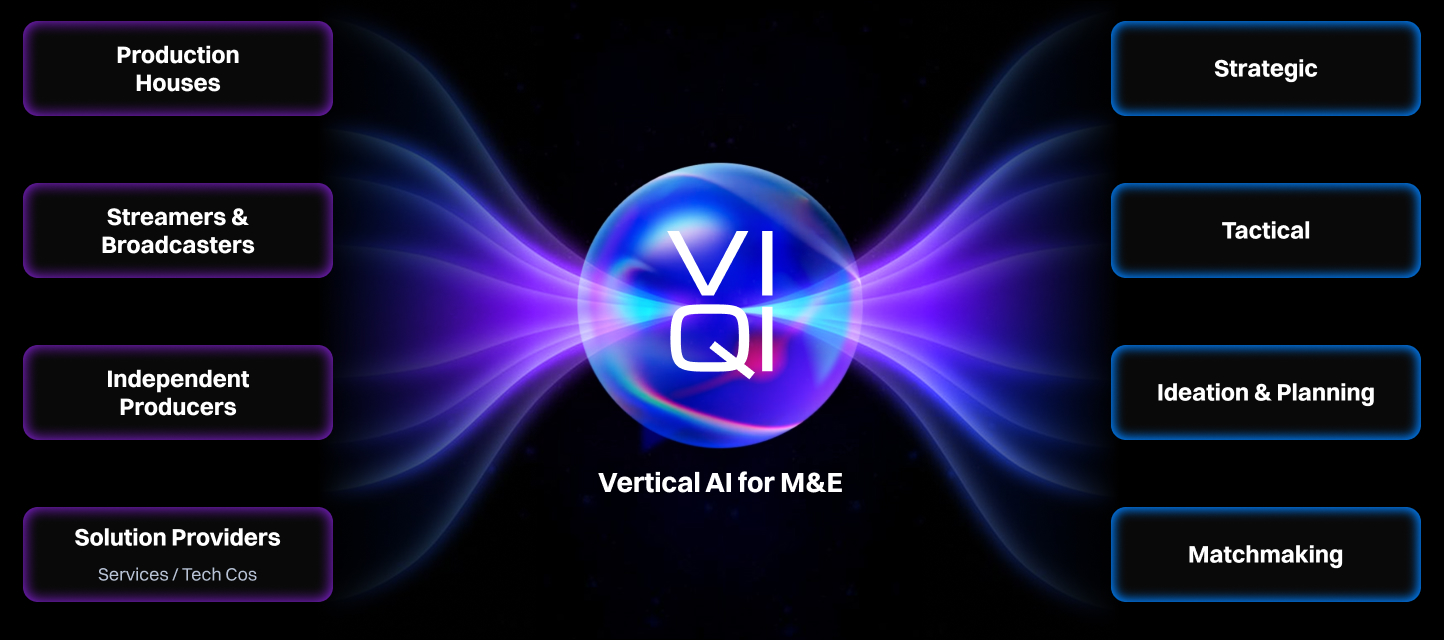
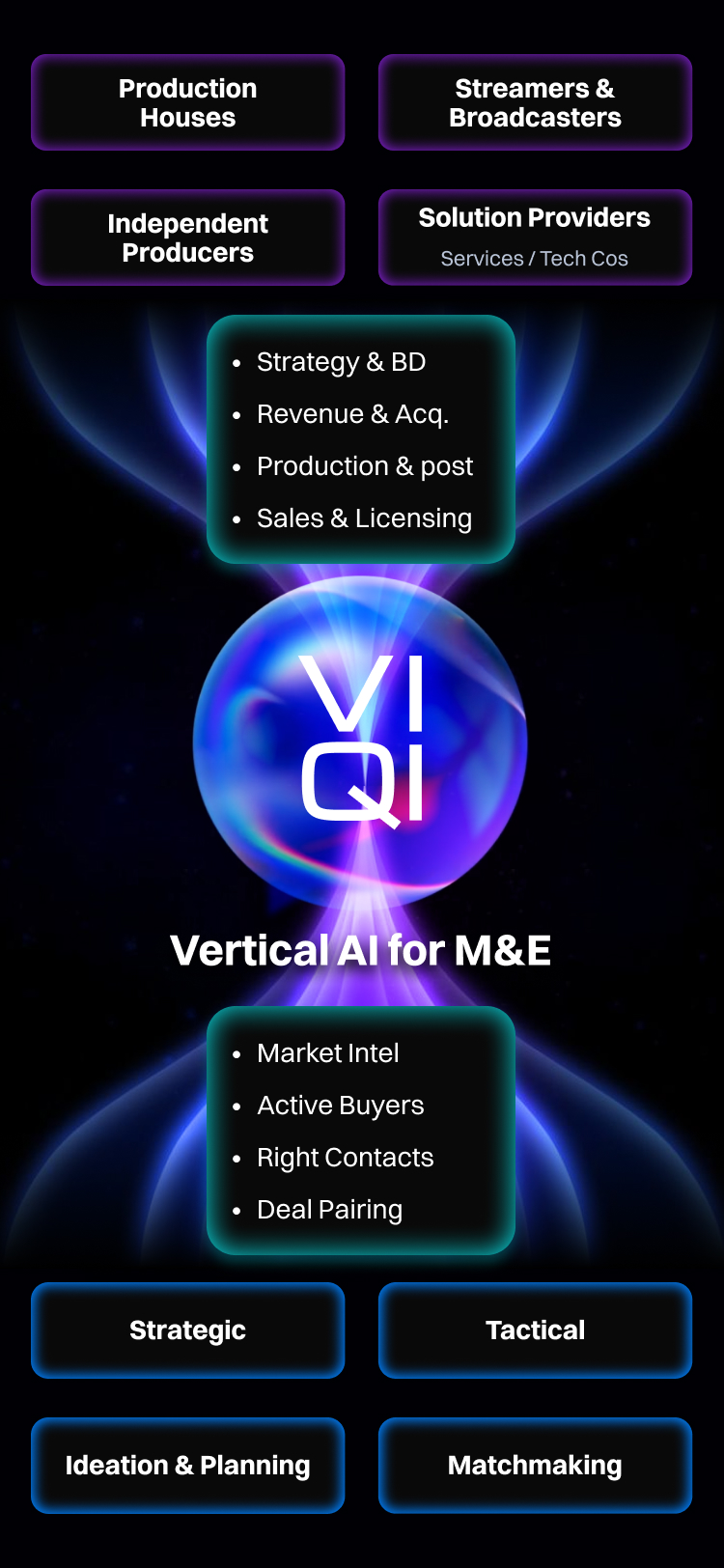
For PE firms, strategic acquirers, and investment banks working in entertainment M&A, the challenge is not finding deals β it is finding the right companies before the competitive process begins. Vitrina Intelligence (VIQI) indexes over 400,000 media and entertainment companies worldwide, providing a searchable, filterable database of production companies, content studios, distributors, IP owners, streaming technology vendors, and post-production facilities across every major market.
Where traditional deal sourcing relies on banker relationships and industry conferences, VIQI enables systematic screening: find all independent animation studios in the UK with known streaming distribution relationships, or all kids content companies in Southeast Asia operating across more than five platforms. This kind of structured market mapping β converting a complex, fragmented industry into an organized, queryable dataset β is the intelligence layer that PE and strategic teams need to run efficient origination processes.
For companies seeking to become acquisition targets or attract PE investment, Vitrina’s platform provides the equivalent of a structured first impression: a verified company profile accessible to every buyer and investor using the platform to research the entertainment landscape. In an industry where being visible to the right buyer at the right moment is the difference between a competitive process and a proprietary deal, platform presence matters.
Get on the Radar of Acquirers
List your M&E company on VIQI so that PE firms, studios, and strategic acquirers researching the landscape can find you.
Map the M&E Landscape
Research acquisition targets, portfolio companies, and deal activity across 400,000+ entertainment companies on VIQI.
Conclusion
The Moonbug deal encapsulates the defining logic of entertainment M&A in the 2020s: own the IP, not the infrastructure. Blackstone’s $3 billion bet on CoComelon and Blippi was a thesis about where children’s media consumption was heading β YouTube-native, platform-agnostic, globally scalable through licensing rather than exclusive deals. Despite the Candle Media debt headwinds and the 2023 profit shortfall, the thesis has largely played out: CoComelon’s migration to Disney+ after Netflix raised its own bid is a validation that the IP itself β not any single distribution relationship β holds the value.
The broader entertainment M&A market in 2025β26 reflects the same IP-first logic at every scale: music rights, publishing catalogs, kids content, gaming franchises, and sports rights are all attracting capital from PE, tech giants, and strategic consolidators simultaneously. The streaming era created both the demand for content at scale and the fragmentation that makes aggregation strategies valuable again.
For anyone operating in the entertainment ecosystem β whether as a content creator, distributor, technology vendor, or investor β understanding who is buying what and why is now a core strategic competency. The next phase of the streaming wars will be determined not just by which platforms survive, but by who owns the IP that those platforms are competing to license.
Frequently Asked Questions
What is Moonbug Entertainment and who owns it?
Moonbug Entertainment is a kids content company that owns 29 IP brands β including CoComelon, Blippi, Little Baby Bum, Gecko’s Garage, and Oddbods β distributed across 150+ global platforms in 32 languages. Moonbug was acquired in November 2021 by Candle Media, a holding company backed by Blackstone and led by former Disney executives Kevin Mayer and Tom Staggs, for approximately $2.75β3 billion.
How much did Blackstone pay for Moonbug?
Blackstone-backed Candle Media paid approximately $2.75 billion for Moonbug Entertainment in November 2021, with earn-out provisions potentially raising the total to $3 billion. The deal is the largest dedicated kids IP acquisition in media history.
Is CoComelon leaving Netflix?
Yes. In May 2025, it was reported that CoComelon’s streaming rights will move from Netflix to Disney+ beginning January 2027. Disney outbid Netflix in a competitive licensing process. CoComelon Lane (a Netflix original spinoff) and Blippi will remain on Netflix.
What is Blackstone’s role in entertainment beyond Moonbug?
Blackstone has assembled approximately $4 billion in music assets, including the acquisition of Hipgnosis Songs Fund for $1.58 billion in July 2024 (renamed Recognition Music Group, now being sold to Sony Music for ~$2 billion+). Blackstone also owns SESAC and MNRK Music Group, making it one of the largest PE investors in music rights globally.
What are the biggest entertainment M&A deals in 2025?
The largest closed deal in 2025 was the Paramount-Skydance merger ($8.4 billion, closed August 2025). The Liberty MediaβMotoGP acquisition (β¬4.2 billion, July 2025) was another major deal. A reported NetflixβWarner Bros. Discovery combination (~$82.7 billion) and a proposed $55 billion PE buyout of Electronic Arts represent the largest reported deals if completed in 2025β26.
About the Author
Vitrina Research Team
The Vitrina Research Team produces intelligence-led analysis on media and entertainment industry structure, deal activity, and market trends. Our research draws on VIQI’s proprietary dataset of 400,000+ M&E companies worldwide.