By Vitrina Research Team | Published: July 2, 2026 | Updated: July 2, 2026 | 14 min read

Global entertainment and media revenue hit $3.5 trillion in 2025. Online video overtook pay-TV revenue for the first time ever. And Netflix announced the largest streaming acquisition in history — $82.7 billion for Warner Bros. Discovery. These aren’t incremental shifts. The entertainment industry is restructuring at a pace that leaves most market intelligence dangerously out of date before it’s even published.

For B2B players — studio executives, content investors, distribution professionals, and market analysts — understanding the forces reshaping this market isn’t optional. M&A consolidation is narrowing the field of commissioning decision-makers. AI is compressing the cost base that defines which production partnerships are viable. Sports rights have become a $67 billion battleground where streamers are outbidding legacy broadcasters. Every one of these shifts creates new counterparties, new gaps, and new risks.

This guide covers the seven defining entertainment industry trends for 2026 — with data, deal details, and the B2B implications that matter for your decisions. We examine market scale, streaming’s structural shift to ad-supported models, AI adoption, the M&A wave, sports rights, international content growth, and theatrical recovery. Each section includes sourced statistics and actionable context for professionals working inside this industry.

Key Takeaways

  • Global E&M reached $3.5 trillion in 2025, growing 5.3% YoY, and is projected to hit $4.2 trillion by 2030 (PwC Global E&M Outlook 2026).
  • Online video overtook pay-TV revenue for the first time in 2025 ($176B vs $170B), signalling a permanent structural shift in how audiences and advertisers move money (Omdia, 2026).
  • Total media M&A exceeded $107 billion in 2025, with Netflix’s $82.7B acquisition of Warner Bros. Discovery setting a new benchmark for streaming consolidation.
  • AI in M&E is a $25.98B market growing at 24.2% CAGR, with potential to reduce TV and film production costs by up to 30% (Grand View Research; Morgan Stanley).
  • Sports rights crossed $67 billion globally in 2026; streaming platforms alone will spend $14.2 billion on sports rights this year (S&P Global; Ampere Analysis).

Research the 2026 Entertainment Landscape on VIQI

For Companies & Studios

List your company on VIQI and get discovered by buyers, investors, and co-production partners navigating 2026’s M&E landscape.

List Your Company →

For Buyers & Investors

Track deal activity, market shifts, and company intelligence across 400,000+ M&E companies on VIQI.

Research on VIQI →

Professional broadcast engineer working in a media production studio


What Is the Scale of the Global Entertainment Industry in 2026?

Global entertainment and media revenue reached $3.5 trillion in 2025, growing at 5.3% year-on-year, and is on track to reach $4.2 trillion by 2030 at a 3.4% CAGR, according to the PwC Global E&M Outlook 2026. This isn’t just growth — it’s the consolidation of entertainment as one of the world’s largest industrial sectors.

Global advertising crossed $1 trillion for the first time in 2025. PwC projects ad spend will reach $1.4 trillion by 2030, growing at a 5.6% CAGR. That milestone matters for B2B players because it signals the permanent shift of brand budgets toward digital and streaming inventory.

Total global content spend hit $255 billion in 2026, up 2% year-on-year. Streaming content spend crossed $100 billion for the first time, reaching $101 billion in 2026 alone, according to Ampere Analysis data reported by MediaPost in January 2026. That’s a meaningful signal: streaming is no longer a challenger to traditional content budgets. It has absorbed them.

Global E&M Market Revenue Milestones (USD Trillions)

Year Revenue Visual Scale
2023 ~$2.8T
2025 $3.5T
2030 (Projected) $4.2T

Source: PwC Global E&M Outlook 2026

For distribution professionals and content investors, these numbers carry a practical implication. A $3.5 trillion market growing at 5.3% means there is meaningful new money entering the system each year. But it’s not distributed evenly. Streaming content spend is growing faster than the overall market, while traditional broadcast is ceding share. Knowing where the money is flowing — which platforms, which formats, which markets — is the real intelligence challenge for 2026.

Citation Capsule: Global entertainment and media revenue totalled $3.5 trillion in 2025 (5.3% YoY growth), with global ad spend crossing $1 trillion for the first time and streaming content spend reaching $101 billion. The market is forecast to reach $4.2 trillion by 2030 at a 3.4% CAGR (PwC Global E&M Outlook 2026; Ampere Analysis, 2026).

Understanding how revenue flows through the supply chain is essential context for film distribution companies evaluating where to position in 2026.


How Is Streaming Changing Its Revenue Model in 2026?

Global OTT subscriptions rose 17.6% to 2.24 billion in 2025, and online video overtook pay-TV revenue for the first time ($176B vs $170B), according to Omdia (May 2026). That crossover is more than a headline — it marks the structural end of pay-TV’s four-decade revenue dominance. Streaming is no longer the challenger. It’s the incumbent.

Media screens displaying digital content in an entertainment technology context

Ad-Supported Tiers Are Now the Growth Engine

Netflix’s ad-supported tier accounted for 40% of active accounts globally in Q3 2025, up sharply from 26% in Q4 2024, according to Digital i. Disney+ showed a near-identical pattern, with its ad tier reaching 44% of accounts in Q3 2025 (up from 35% in Q4 2024). Morgan Stanley reported that 100% of US net subscriber additions for both Netflix and Disney+ in 2025 came from ad-supported tiers.

Ad-supported streaming time-on-platform grew 43% in 2025 (Comscore 2025 State of Streaming). That’s a dramatic engagement figure. It tells advertisers that AVOD audiences aren’t passive sign-ups — they’re active, high-frequency viewers who chose an ad-supported option deliberately.

The B2B implication here is significant. Ad inventory is no longer a fallback model for platforms that can’t hold SVOD pricing. It’s a core revenue architecture. For brands, media buyers, and production companies evaluating which platforms to pitch to, the ad tier breakdown of each streamer is now fundamental intelligence. For more on how these dynamics shape commissioning decisions, see our analysis of Netflix content acquisition strategy.

Citation Capsule: Online video revenue surpassed pay-TV for the first time in 2025 ($176B vs $170B), with global OTT subscriptions reaching 2.24 billion (up 17.6%). Netflix and Disney+ ad-supported tiers accounted for 40% and 44% of accounts respectively in Q3 2025, with 100% of US net subscriber additions coming from ad-supported plans (Omdia, May 2026; Digital i; Morgan Stanley).


How Is AI Reshaping Entertainment Industry Costs and Operations?

The AI in media and entertainment market was valued at $25.98 billion in 2024 and is projected to reach $99.48 billion by 2030, growing at a 24.2% CAGR, according to Grand View Research. Morgan Stanley Research estimates that generative AI could reduce production costs by up to 10% across all media, and as much as 30% specifically in TV and film. Those are structural cost shifts that change the economics of the entire supply chain.

Film production crew on set with professional camera equipment

Where AI Spend Is Concentrated

AI-driven personalization accounted for 27.4% of total AI in M&E market revenue in 2025 (Grand View Research). That’s the largest single application segment — reflecting how heavily platforms rely on recommendation systems to retain subscribers. After personalization, the next major spending categories are VFX automation, AI dubbing and localization, and audience analytics.

The workforce impact is real and accelerating. More than 17,000 M&E sector jobs were cut in 2025 — an 18% increase from 2024, according to The Wrap. AI adoption is one accelerant, alongside broader consolidation. It’s a reminder that cost reduction at the platform level doesn’t translate to reduced headcount painlessly.

For B2B decision-makers, the critical frame is this: AI isn’t just a tool for studios. It’s restructuring the cost base that determines which production partnerships are economically viable. A production company that can deliver localized content with AI-assisted dubbing at 40% lower cost becomes a different kind of counterparty than one that can’t. Knowing which companies have built that capability is competitive intelligence — not just a technology story.

Citation Capsule: AI in media and entertainment is a $25.98 billion market (2024) growing at 24.2% CAGR to $99.48 billion by 2030. Generative AI could reduce TV and film production costs by up to 30%, while AI-driven personalization already accounts for 27.4% of segment revenue. Over 17,000 M&E jobs were cut in 2025, up 18% from 2024 (Grand View Research; Morgan Stanley; The Wrap, 2025).


What Did the 2025 M&A Wave Mean for the Entertainment Industry?

Total media M&A announced in 2025 exceeded $107 billion through December 22, according to the Hollywood Reporter and PwC tracking data. H2 2025 deal value rose 35% to $151 billion compared to $112 billion in H2 2024, with deal count actually falling from 1,112 to 945 transactions. Fewer deals, larger transactions — a classic consolidation signal.

The Netflix-Warner Bros. Discovery acquisition dominated the narrative. Netflix announced the deal on December 5, 2025 at an $82.7 billion enterprise value ($72 billion equity), making it the largest streaming acquisition ever completed. The deal brings HBO, Warner Bros. Studios, DC, Harry Potter, and Game of Thrones into the Netflix IP portfolio — a scale of content asset consolidation with no precedent in streaming history.

Key 2025 M&A Deals at a Glance

Deal Value B2B Implication
Netflix acquires Warner Bros. Discovery $82.7B HBO, WB Studios, DC, Harry Potter enter Netflix IP portfolio; commissioning structure consolidates under one decision-maker
Saudi PIF, Silver Lake, Affinity Partners acquire Electronic Arts $55B Sovereign wealth capital enters gaming at scale; signals broader entertainment IP as an asset class for sovereign funds
Sony acquires Peanuts IP $467M Classic IP with multigenerational appeal commands premium; reinforces IP acquisition as a core Sony Pictures Television strategy

For B2B players, consolidation creates a double dynamic. Scale buyers with larger acquisition budgets emerge from mega-mergers, creating new deal-making opportunities for sellers. But at the same time, fewer independent commissioning decision-makers remain in the market. A distribution executive who had separate relationships with HBO Max and Netflix now faces a single combined entity. Networks of relationships built over years need to be remapped entirely.

Sony’s $467 million Peanuts acquisition in December 2025 reflects a separate but related dynamic. Classic IP continues to command premium valuations because it carries built-in audience familiarity and franchise extension potential. For more on how Sony deploys its acquisition strategy, our analysis of Sony Pictures Television‘s business model covers the detail.


Why Have Sports Rights Become a $67 Billion Battleground?

Global sports rights revenue surpassed $67 billion in 2026, according to S&P Global Market Intelligence. Streaming platforms will spend $14.2 billion on sports rights in 2026, up 7% from $13.2 billion in 2025 (Ampere Analysis). That growth rate outpaces total streaming content spend growth, confirming sports as the category where competitive bidding is most intense.

Live entertainment event with large audience and stage lighting

Which Platforms Are Spending the Most on Sports Rights?

Platform Sports Rights Spend 2026 Share of Streaming Total
Amazon Prime Video $3.8B 27%
DAZN $3.1B 22%
YouTube TV $2.0B 14%

The global sports online live streaming market was valued at $31.86 billion in 2025, growing to $38.76 billion in 2026 at a 21.6% CAGR, according to GlobeNewswire. That rate of expansion explains why Netflix, Amazon, and Apple all treat sports rights as subscriber acquisition tools rather than pure content plays. Live sports is the last remaining appointment-viewing format — it’s the one type of content that can’t be streamed later without losing its core value.

For rights holders, this is the most favorable bidding environment in history. For broadcasters and cable operators, it’s an existential challenge — losing major sports packages to streamers doesn’t just reduce viewership, it destroys the bundling logic that made pay-TV economically viable. The competitive dynamics around sports rights in 2026 deserve close monitoring by anyone involved in content licensing, distribution infrastructure, or platform strategy. Understanding how major distributors are navigating this is part of broader Disney Media and Entertainment Distribution strategy context worth reviewing.

Citation Capsule: Global sports rights revenue surpassed $67 billion in 2026, with streaming platforms spending $14.2 billion (up 7% YoY). Amazon Prime Video leads streaming sports spend at $3.8 billion (27% share). The global sports online live streaming market reached $38.76 billion in 2026, growing at a 21.6% CAGR (S&P Global Market Intelligence; Ampere Analysis; GlobeNewswire, 2026).


How Are Emerging Markets Reshaping Global Content Strategy?

India’s OTT market reached 601 million users with approximately $4.5 billion in revenue in FY2024-25, with regional language content growing 40% year-on-year on major platforms. The Asia-Pacific region is the fastest-growing media localization market at a 12.3% CAGR from 2025 to 2033, according to DataIntelo. Non-English content has passed the tipping point. It’s no longer a supplementary content category — it’s where global audience growth is concentrated.

The Localization Market Is Doubling

The global media localization market was valued at $5.6 billion in 2024 and is forecast to reach $12.8 billion by 2033 (DataIntelo). That’s more than a doubling in under a decade. The drivers are structural: platforms expanding into markets where local-language viewing is expected, not optional, and AI-assisted dubbing and subtitling compressing the cost barrier that once limited localization to high-budget titles.

Netflix has committed $2.5 billion to Korean content investment and signed multi-year Spanish-language content deals through 2028. These aren’t experimental bets. They’re platform-scale commitments that reflect where the next 500 million subscribers are coming from. India, MENA, and LatAm have been explicitly identified by major platforms as their “next wave” investment priorities.

For B2B players, localization capability is now a strategic differentiator. A production company in Southeast Asia that can deliver content natively localized for five regional languages — rather than relying on post-production dubbing — is a fundamentally different business from one that can’t. Similarly, distribution professionals need to understand which platforms have active localization infrastructure in their specific market, not which platforms have announced general international ambitions.

Citation Capsule: India’s OTT market reached 601 million users and ~$4.5 billion in revenue in FY2024-25, with regional language content growing 40% YoY. The global media localization market was $5.6 billion in 2024 and is forecast to reach $12.8 billion by 2033, with APAC growing at a 12.3% CAGR (DataIntelo; platform data cited in Outlook Respawn, 2025).


Is Theatrical Recovering — and What Does the Creator Economy Have to Do with It?

Global box office reached $33.55 billion in 2025, up 11.8% from $30 billion in 2024, according to Gower Street Analytics. That recovery is real. But it’s still 20.7% below the 2019 peak of $42.3 billion — a gap that reveals just how permanently the pandemic and streaming-at-home consumption shifted audience behavior. Theatrical isn’t dying, but it’s operating in a structurally different demand environment than 2019.

The creator economy is the context that makes theatrical recovery harder to read in isolation. The creator economy market was $254.4 billion in 2025 and is forecast to reach $313.95 billion in 2026, growing at a 23.41% CAGR (Precedence Research). That’s a $254 billion ecosystem competing for the same entertainment hours as cinema and streaming combined — and operating at dramatically lower per-minute production cost.

The Platform-Creator Scale Problem

YouTube has paid creators more than $100 billion over the past four years. Roblox paid $1 billion to creators in 2025 alone. YouTube Shorts generates 70 billion daily views — a volume of content consumption that dwarfs the daily audience of any single streaming platform or theatrical release. We’ve found that traditional entertainment professionals often underestimate this competitive pressure because creator economy metrics don’t appear in the same industry reports as box office and streaming.

The strategic implication for traditional M&E players is attention competition, not just content competition. A studio executive evaluating a $100 million theatrical release is now competing for audience hours against a $254 billion ecosystem that operates at faster production cycles, lower costs, and with direct creator-audience relationships. That doesn’t mean theatrical is unviable — franchise IP and spectacle formats remain strong. But it does change the risk calculus for mid-budget, non-franchise theatrical releases.


How Vitrina Helps You Navigate the 2026 Entertainment Landscape

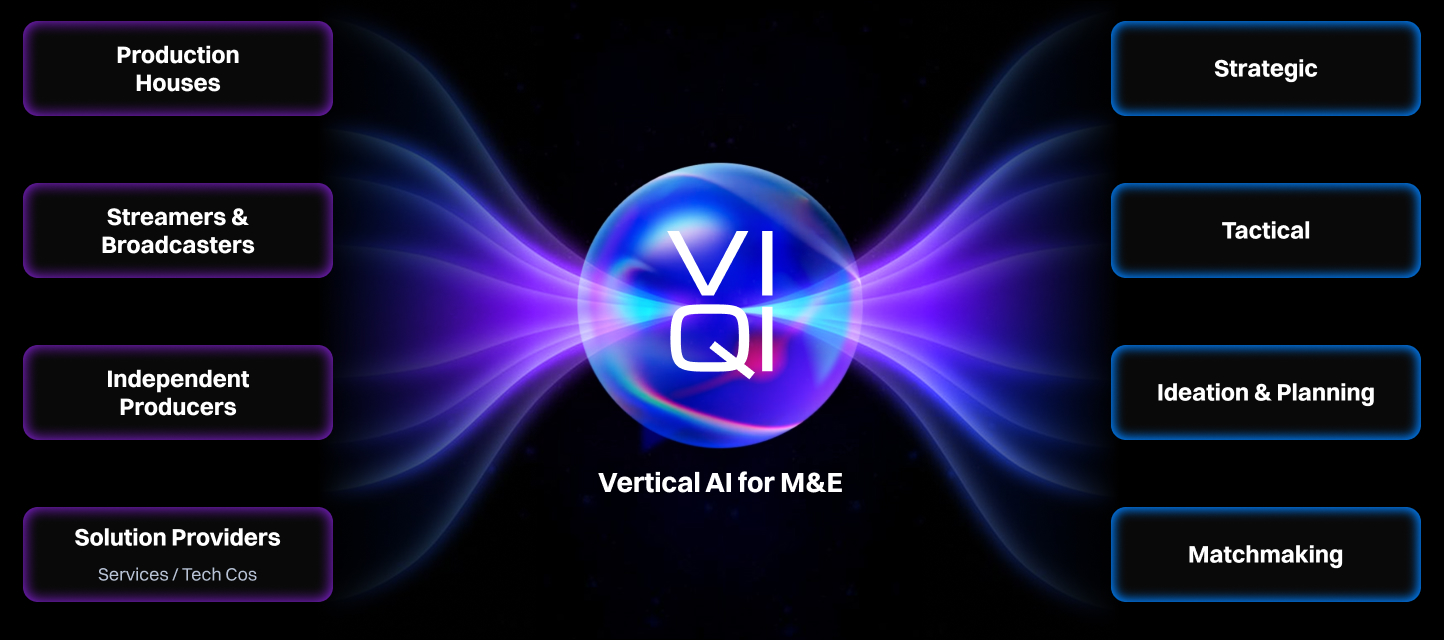
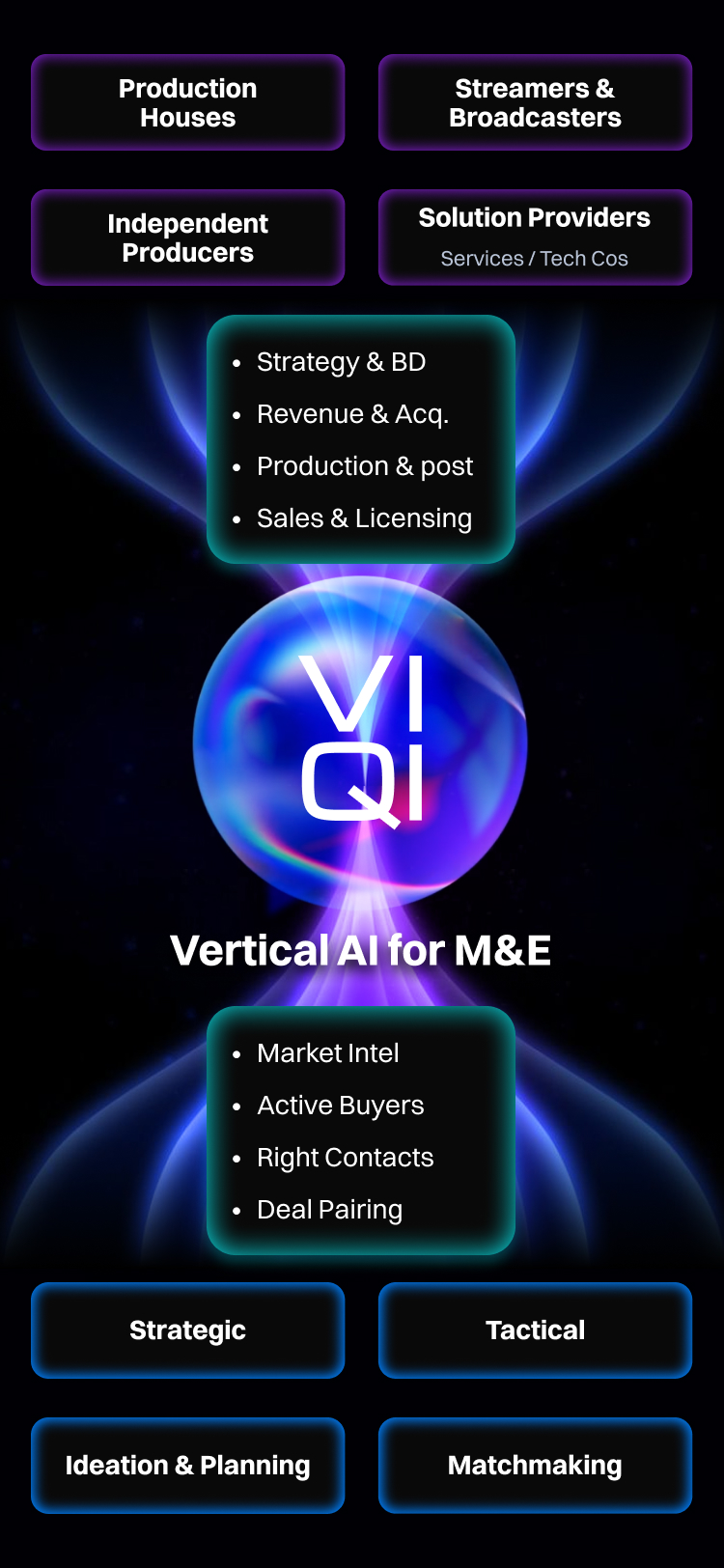
The 2026 entertainment landscape is defined by simultaneous complexity: a $3.5 trillion market, M&A consolidation that’s redrawing commissioning hierarchies, AI disruption compressing cost bases, and a live sports arms race involving sovereign wealth capital. Intelligence that’s six months old isn’t usable in this environment. VIQI provides real-time visibility into the M&E companies, deal activity, and partnership networks that drive these trends — drawing on a dataset of 400,000+ companies worldwide.

Specific use cases are where VIQI’s value becomes concrete. Investors tracking which studios are actively raising co-production capital in the aftermath of the Netflix-WBD integration. Distribution executives mapping which platforms are commissioning in their genre before committing development spend. International production companies identifying which streamers have active localization infrastructure in their target market. These aren’t questions that annual industry reports answer — they require company-level intelligence updated in near real-time.

Every trend covered in this article creates new counterparties, new acquisition mandates, and new gaps in the market. Streaming consolidation means fewer buyers but larger deal mandates. Sports rights inflation creates demand for rights management and distribution infrastructure. AI adoption creates a competitive split between production companies that have built AI capability and those that haven’t. VIQI’s 400,000+ company database gives you the intelligence layer to identify and act on those gaps before they become obvious to everyone else in the room.

Research the 2026 Entertainment Landscape on VIQI

For Companies & Studios

List your company on VIQI and get discovered by buyers, investors, and co-production partners navigating 2026’s M&E landscape.

List Your Company →

For Buyers & Investors

Track deal activity, market shifts, and company intelligence across 400,000+ M&E companies on VIQI.

Research on VIQI →


Conclusion

The seven trends covered in this analysis aren’t separate stories. They’re interconnected forces reshaping the same underlying market. A $3.5 trillion industry that crossed several structural thresholds simultaneously in 2025 — online video overtaking pay-TV, ad-supported tiers becoming the growth engine, streaming content spend exceeding $100 billion — is not a market in gradual transition. It’s a market that has already transitioned. The question for B2B players in 2026 is not whether to adapt, but how to adapt faster than competitors using better intelligence.

The M&A wave adds urgency to that challenge. When $107 billion in deals closes in a single year, counterparty maps get redrawn. Studios that were independent commissioning decision-makers are now subsidiaries of platform-scale acquirers with consolidated mandates. Distribution relationships built over years become obsolete overnight. In this environment, knowing which companies hold which mandates — and which are actively seeking new partners — is a measurable competitive advantage, not a nice-to-have.

Looking ahead, the entertainment industry trends that will define 2027 are already taking shape: the integration of the Netflix-WBD combined entity, the next round of sports rights cycles in major markets, AI capability becoming a baseline expectation rather than a differentiator, and emerging market platforms beginning to export content globally at scale. The companies that position now — with clear intelligence on the counterparties in each of these segments — will be better placed than those that wait for the next annual industry report to tell them what already happened.




Frequently Asked Questions

How big is the entertainment industry in 2026?

The global entertainment and media industry reached $3.5 trillion in 2025 and is projected to reach $4.2 trillion by 2030 at a 3.4% CAGR (PwC Global E&M Outlook 2026). Global advertising crossed $1 trillion for the first time in 2025. Total global content spend reached $255 billion in 2026, with streaming content spend alone crossing $101 billion — its first time exceeding the $100 billion mark (Ampere Analysis, 2026).

What are the biggest entertainment industry trends for 2026?

The seven defining entertainment industry trends for 2026 are: the $3.5 trillion market scale and where money flows; streaming’s structural shift to ad-supported models (40% of Netflix accounts now ad-supported); AI adoption with a 24.2% CAGR growth rate and 30% cost reduction potential in film/TV; a $107 billion M&A wave headlined by Netflix-WBD; sports rights exceeding $67 billion; non-English content emerging market growth; and theatrical recovery still running 20.7% below 2019 peak levels.

How is AI affecting the entertainment industry?

AI in media and entertainment is a $25.98 billion market (2024) growing to $99.48 billion by 2030 at a 24.2% CAGR (Grand View Research). Morgan Stanley estimates AI could reduce TV and film production costs by up to 30%. Key applications include content personalization (27.4% of AI segment revenue), VFX automation, AI dubbing and localization, and audience analytics. More than 17,000 M&E jobs were cut in 2025 — up 18% from 2024 — with AI adoption as one accelerant (The Wrap).

What M&A deals defined the entertainment industry in 2025?

Total media M&A announced in 2025 exceeded $107 billion. Three transactions stand out: Netflix’s $82.7 billion acquisition of Warner Bros. Discovery (the largest streaming deal ever, announced December 5, 2025); a $55 billion deal taking Electronic Arts private, backed by Saudi PIF, Silver Lake, and Affinity Partners; and Sony’s $467 million acquisition of Peanuts IP in December 2025 (Netflix IR; The Wrap). H2 2025 deal value rose 35% year-on-year to $151 billion, with deal count falling from 1,112 to 945 — confirming a consolidation pattern of fewer but larger transactions.

How can I track entertainment industry trends for my business?

Annual industry reports from PwC, Ampere Analysis, and S&P Global Market Intelligence provide macro trend data, but they’re typically six to twelve months behind market reality. For real-time company-level intelligence — deal activity, commissioning mandates, platform capabilities — VIQI’s database of 400,000+ M&E companies provides the operational layer that industry reports don’t cover. Whether you’re tracking which studios are raising co-production capital post-consolidation or which platforms have active localization infrastructure in your market, company-level intelligence is the practical tool for B2B decision-making. Start your research on VIQI →

About the Author

Vitrina Research Team

The Vitrina Research Team produces intelligence-led analysis on media and entertainment industry structure, deal activity, and market trends. Our research draws on VIQI’s proprietary dataset of 400,000+ M&E companies worldwide.