IHUB
IHUB
 Private Briefings (Webinars)


 LeaderSpeak Podcast
  Global Entertainment Digest (Newsletter)
  Premium Lists
 Membership Benefits
 About Vitrina
 Our Story

You’ve finished your production in Georgia, or New York, or Louisiana. You know you’ve earned a tax credit. But you’re not entirely sure what happens next — the credit feels more like an accounting entry than actual money, and the path from “we earned this” to “we have cash” is unclear.
This guide walks through the full lifecycle of a production tax credit after you’ve wrapped — what the credit is, how it moves through the system, and what options you have once it’s in your hands.
What the Credit Actually Is at Wrap
When your production wraps, you’ve incurred the qualifying expenditures — but the credit doesn’t yet exist as a formal instrument. At this stage, it’s more accurately described as a credit entitlement: based on what you’ve spent, you’ve earned the right to claim a specific credit amount, but that right hasn’t been officially certified yet.
The formal credit comes into existence after the state has reviewed and approved your claim. Until then, it typically sits on your balance sheet as a contingent asset or receivable — real in substance, but not yet liquid.
Step 1: The Audit and Certification Process
The first thing that happens after wrap is the audit and certification process.
Most major US incentive states require productions to have their qualifying expenditures audited by a CPA firm before the credit is officially certified. In some states (Georgia, New York, Louisiana), the CPA must be specifically registered with or approved by the state’s film incentive program. This isn’t just a standard audit — it’s a state-specific review focused on whether each expense meets the program’s definition of qualifying spend.
The audit process involves:
- Submitting your production’s detailed expense records to the CPA
- The CPA reviewing each line item against the state’s qualifying criteria
- The CPA issuing an agreed-upon procedures report certifying the qualifying amount
- The state reviewing the report and issuing the official credit certification
How long does this take? For most major states, expect 3–9 months post-wrap. Georgia and Louisiana tend to be at the faster end; New York can take longer depending on application volume. Production size and complexity also affect the timeline — a $30 million film will take longer to audit than a $2 million independent.
What does it cost? The CPA audit is an expense you’ll need to budget for. Fees vary by firm and production size, but are typically in the range of $15,000–$50,000 for mid-size productions.
Step 2: The Credit Certificate
Once the state has approved the audit, it issues a formal credit certificate — a document that specifies the exact credit amount, the production it relates to, and the state tax period for which it can be applied.
At this point, the credit moves from a contingent asset to a confirmed, enforceable credit instrument. It’s now something that can be:
- Applied against your own state tax liability (if you have it)
- Transferred to a third-party buyer (in transferable states)
- Refunded by the state (in refundable states like New York)
Most independent production companies and internationally-based companies don’t have meaningful in-state tax liability — which is why the transfer and refund mechanisms exist.
Step 3: Your Options
Option A — ApplyAgainst Your Own Liability
If your company has state tax liability in the incentive state, you can apply the credit directly against that liability, reducing or eliminating your state tax bill. For companies with significant in-state activity, this may be the simplest path.
The limitation is obvious: if you have no in-state liability, this option doesn’t apply. And even if you have some liability, it may not be enough to absorb a large credit in full.
Option B — Transfer to a Third-Party Buyer
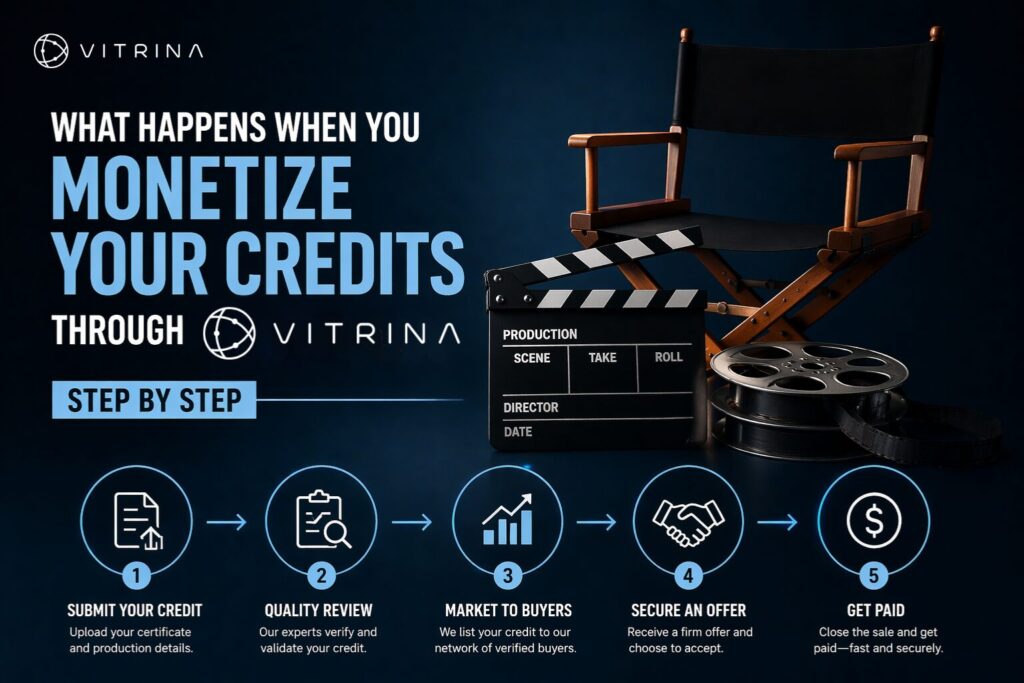
In Georgia, New Jersey, Illinois, Louisiana, and most other major incentive states, you can sell your credit certificate to a third-party buyer who can use it against their own state tax liability. The buyer pays you a discounted price — the discount is what makes it worth their while to purchase someone else’s credit.
Credits in major states typically trade in a range from 88–96 cents on the dollar, depending on the state, size, and current market conditions. Selling at 92 cents on a $2 million credit means receiving $1.84 million in cash — which most production companies will take over waiting for internal absorption that may never come.
Option C — Refund from the State
In New York, credits are refundable. If you have no offsetting New York tax liability, you can file for a refund from the state and receive the credit value in cash. Refund processing times vary, but this removes the need to find a private buyer entirely.
Option D — Hold
You can keep the credit on your books and absorb it over time as your company generates instate liability. This is the default outcome for companies that don’t actively manage their credit position. For many production companies, holding means the credit never gets fully used — especially if the company’s ongoing tax position doesn’t generate meaningful in-state liability
The “Accounting Line” Problem
One thing we hear regularly from producers: “The credit doesn’t feel like real money.” That’s because, for most of its early life, it isn’t — it’s a receivable, a certified amount, a line item. It doesn’t show up in your bank account.
This psychological friction is one of the main reasons production companies under-monetize their credits. The path from “we have a $2 million Georgia credit” to “$1.84 million in our account” requires action — finding a buyer, managing a transaction, completing legal documentation. For a team that’s already moved on to the next production, that process gets deprioritized indefinitely.
This is exactly what platforms like Vitrina exist to solve. The credit is real money. The infrastructure to convert it is there. The missing piece is usually a channel that makes it easy to start.
If Your Credit Is Sitting Unused
If you’ve wrapped a production and have credits on the books — certified or in the process of being certified — register at vitrina.ai/tax-incentive and find out what your credit is worth.