About Innovation Hub
 Global Content Pulse (Webinars)


 Global Production Financing
(Webinars)
Global Production Financing
(Webinars)  LeaderSpeak Podcast
  Global Entertainment Digest (Newsletter)
  About Vitrina
 About VIQI
 Our Story
 Our Solutions 🔥
 Film+TV Projects Tracker 🚀
 Case Studies
 Our Profile
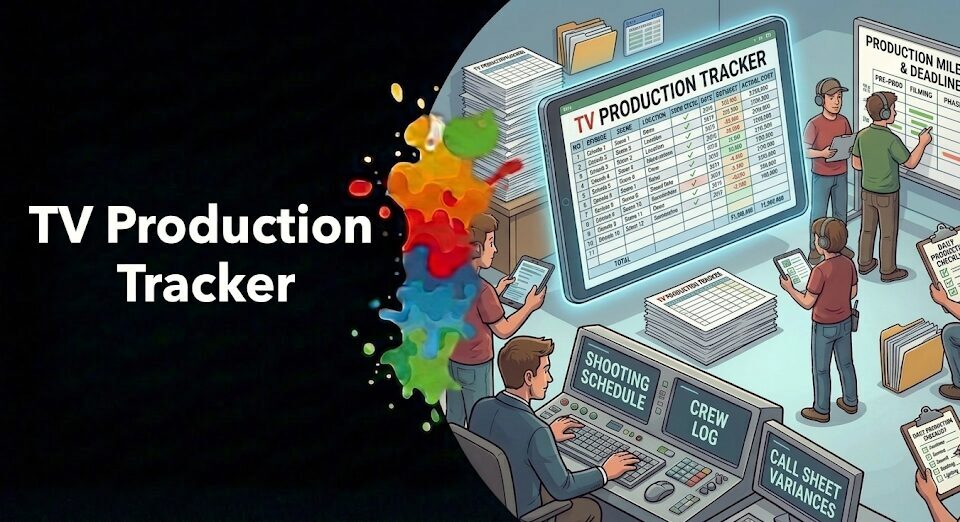
Global television production has never been more complex—or more critical to monitor. More than 516 original scripted series aired worldwide in 2023 (FX Research), and active productions span over 100 countries at any given moment. Whether you’re a studio executive, a post-production vendor, or a content financier, knowing which shows are in development, who’s commissioning them, and where they’re being made is the difference between winning new business and reacting too late.
This guide covers everything you need to know about TV production tracking: what it is, how it works, which data points matter most, and how platforms like Vitrina AI’s Global Film & TV Project Tracker give entertainment professionals a structured, real-time view of the global production pipeline.
Key Takeaways
- 516 original scripted series aired globally in 2023—down 14% from peak—while production timelines in Western Europe grew 40% longer between 2020 and 2025 (Ampere Analysis).
- U.S. TV production industry revenue reached .1 billion in 2025 (IBISWorld), underscoring the commercial scale at stake.
- Production starts fell 17% globally in Q3 2024 versus Q3 2022, creating both risk and opportunity for well-informed buyers and vendors (ProdPro).
- A purpose-built TV production tracker gives teams early visibility into projects before they publicly announce cast or crew—often the most actionable window for vendors and co-producers.
- Vitrina AI tracks 50,000+ active film and TV projects and 300,000+ companies across 100+ countries in a single platform.
What Is a TV Production Tracker?
A TV production tracker is a structured intelligence system that monitors television projects from early development through post-production and release. According to ProdPro’s Q3 2024 Global Production Report, 344 scripted productions started principal photography worldwide in Q2 2024 alone—tracking that volume manually is simply not feasible for any single team.
At its core, a production tracker aggregates commissioning data, production status updates, crew attachments, location filings, and deal announcements across broadcasters, streaming platforms, and independent producers. The best systems update in real time and link project data to company profiles and decision-maker contacts, giving users a full picture rather than disconnected data points.
The term covers a broad range of use cases. Vendors use trackers to identify shows entering production before they’ve publicly announced service providers. Studios use them to benchmark competitor slates. Financiers use them to assess a producer’s track record before committing capital. Broadcasters use them to monitor co-production partners and acquisition targets. In each case, the underlying need is the same: verified, timely data on what’s being made and by whom.
Why Television Production Monitoring Matters in 2025 and Beyond
The business case for structured television production monitoring has become more urgent as the industry contracts and consolidates. Western European scripted TV revenue growth fell from .2 billion during the Peak TV era (2020–2022) to .3 billion in the post-Peak TV period (2023–2025), according to Ampere Analysis—a 39% decline that has forced every participant in the supply chain to operate more efficiently.
When production budgets tighten, procurement decisions move faster and windows to win business narrow. A vendor that learns a show has entered prep through a press release has already missed the preferred vendor conversation. A co-production financier who discovers a project only after principal photography starts is too late to structure a meaningful deal. Real-time monitoring closes that gap.
Production timelines themselves have grown more complex. The average time from commission to release for a scripted series in Western Europe climbed from 288 days in 2020 to 404 days in 2025 (Ampere Analysis). Longer pipelines mean more decision points—and more moments where informed parties can step in with the right offer.
“The average time from order to release for a scripted series in Western Europe has climbed from 288 days in 2020 to 404 days in 2025. Only 2% fewer commissions were announced in 2025 compared to 2020, but they take on average 40% longer to produce—creating a structural bottleneck that affects every vendor and financier in the supply chain.” —Ampere Analysis, 2026
The Global TV Production Pipeline: Key Data Points to Monitor
Effective broadcast production data monitoring goes beyond knowing a show exists. The data points that drive real decisions span the entire lifecycle of a project. In 2024, the number of U.S. production starts recovered to 67% of 2022 levels by Q3—but that recovery was uneven across formats, genres, and commissioning platforms (ProdPro).
The most valuable data fields in a production tracker include:
- Project stage: Development, pre-production, principal photography, post-production, or released. The transition from development to pre-production is often the highest-value signal for vendors.
- Commissioner and distributor: Which network, streamer, or platform has ordered the show. This determines budget range, format expectations, and key decision-maker contacts.
- Production company: Who is making it. A company’s track record, verified credits, and existing vendor relationships shape outreach strategy.
- Genre and format: Scripted drama, unscripted reality, documentary, limited series, and so on. Genre affects production timelines—crime and thriller titles had the fastest turnarounds globally in 2025, while sci-fi and fantasy take the longest (Ampere Analysis).
- Location and country of production: Where filming is taking place. Toronto, the UK, Vancouver, Central Europe, and Australia led preferred filming locations for 2025–2026 (ProdPro).
- Key attachments: Director, showrunner, lead cast. These signal greenlight confidence and influence budget tier.
- Budget tier: Inferred or reported budget levels help vendors qualify opportunities and financiers assess deal structure.
TV Commissioning Intelligence: Understanding Who Orders What
TV commissioning intelligence tracks which platforms are ordering shows, how many, and what kinds—information that shapes market strategy for every supply chain participant. U.S. scripted commissioning recovered to 76% of 2021 peak levels in 2025, with commissions up 3% year-on-year, according to Ampere Analysis—but the mix of commissioners has shifted substantially.
Netflix, Prime Video, Hulu, Disney+, Apple TV+, and Globoplay were among the most active commissioners globally in 2024–2025 (Vitrina AI). But platform behavior diverged sharply: Apple TV+ held steady at 14–15 new U.S. commissions per year since 2022, while Netflix cut its new U.S. titles to roughly half its 2022 peak. Disney reduced combined Hulu and Disney+ commissions to just 12 new titles in 2024.
Commissioning intelligence answers the strategic questions that matter: Which platforms are expanding internationally? Which genres are being over-ordered relative to audience demand? Where are second-season renewal rates falling—and at what rate? Ampere reports that second-season renewals dropped from 32% to 19% between 2020 and 2025, meaning more first-season shows than ever are cancelled. Vendors and financiers who track renewal patterns can avoid over-committing to platform relationships with poor renewal track records.
“Second-season renewal rates across major streaming platforms fell from 32% in 2020 to 19% in 2025. For vendors and co-producers, tracking renewal patterns by platform is as important as tracking new commissions—it reveals where relationships are likely to be sustained and where first-season orders are effectively one-and-done.” —Ampere Analysis, 2026
International Co-Production Tracking: Why Cross-Border TV Has Never Been More Complex
International co-production has become central to how television gets financed and produced at scale. Production spend on projects originating from U.S. companies with budgets over million reached .91 billion in the UK and .41 billion in Canada in 2024, behind only the .54 billion spent domestically in the U.S. (Entertainment Partners / ProdPro). Cross-border production is the norm, not the exception, at premium budget tiers.
Tracking international co-productions requires monitoring multiple layers of the deal structure: which territory is the lead producer, which broadcasters or streamers hold rights by region, which tax incentive regimes are being accessed, and which local production companies are attached as co-producers. Each of those parties has different decision-making timelines and different procurement needs.
For vendors, the international dimension means that a show commissioned by a European broadcaster may be primarily shot in Canada with a U.S.-based VFX pipeline and music recorded in Australia. Knowing the full geography of a production—not just its broadcaster of record—is essential for targeting the right service providers at the right stage. Vitrina AI’s Solutions are specifically designed to surface these cross-border relationships across 100+ countries.
How to Use Broadcast Production Data for Competitive Intelligence
Broadcast production data becomes competitive intelligence when it’s structured, searchable, and linked to company and people profiles. The U.S. television production industry comprises 11,983 businesses, growing at a CAGR of 4.6% between 2020 and 2025 (IBISWorld)—that’s a large, fragmented market where tracking which companies are winning commissions gives a clear picture of who holds real buying power.
Competitive use cases include:
- Slate benchmarking: Comparing your commissioning volume and genre mix against direct competitors to identify gaps and opportunities.
- Vendor prospecting: Identifying shows in pre-production that haven’t yet locked their VFX, localization, or post-production vendors.
- Acquisition targeting: Finding completed or near-complete productions available for distribution rights before they reach market.
- Talent tracking: Monitoring which showrunners and directors are attached to upcoming projects and who they’ve worked with before.
- Market entry analysis: Assessing production activity in a new territory before committing resources to establish a local presence.
The key is moving from raw data to actionable signals. A tracker that tells you a show exists is useful; one that tells you the show is entering pre-production, the production company has a three-year relationship with one VFX vendor that’s now over capacity, and the showrunner has just moved to a new representation relationship—that’s intelligence.
Production Pipeline Tracking: From Development to Delivery
Production pipeline tracking maps every stage of a show’s journey from pitch to screen. In Q3 2024, the global number of projects actively filming fell 17% below Q3 2022 levels (ProdPro)—making it more important than ever to track projects upstream in development, where the pipeline remains fuller than on-set activity suggests.
The five key pipeline stages and what they signal:
- Development: Script commissioned, writer attached, concept optioned. Early stage, but signals which formats a commissioner is betting on. High volume, low conversion rate.
- Pre-production: Greenlit, crew hiring underway, locations being locked. This is the prime vendor outreach window. Most procurement decisions are made here.
- Principal photography: Cameras rolling. Late for most vendor conversations, but useful for location scouting intelligence and on-set services.
- Post-production: Edit, VFX, sound, color. Active procurement period for post-production vendors, localisation studios, and delivery platforms.
- Released/distributed: Available for acquisition, licensing, and format adaptation. Active window for distributors and format buyers.
Most organisations focus on announced productions—which means they’re competing at the same crowded moment. The teams that win business consistently are monitoring development-stage activity and reaching production companies before the RFP is issued.
Global TV Production by Region: Where Activity Is Concentrated
Global TV production activity is geographically concentrated but shifting. Production spend from U.S.-originated projects above million was distributed across the U.S. (.54 billion), UK (.91 billion), Canada (.41 billion), Australia and New Zealand (.04 billion), and Central Europe ( billion) in 2024 (Entertainment Partners). But lower-budget and mid-tier production is far more geographically distributed.
Key regional dynamics to monitor:
- North America: Still the largest single market. U.S. production revenue reached .1 billion in 2025 (IBISWorld), though production starts remain below 2022 levels. Canada continues to attract runaway productions via tax incentives.
- Europe: Strong commissioning from UK, German, French, Nordic, and Spanish broadcasters and streamers. The UK and Germany are among the most active co-production partners globally.
- Asia-Pacific: Production volume fell 35% in January 2025 year-on-year (Señal News), partly due to seasonal factors, but South Korea, India, and Australia remain significant production hubs with growing international footprints.
- Latin America: Globoplay, Televisa, and regional co-productions keep LATAM output steady. Brazil in particular has expanded its international co-production activity.
- Middle East & Africa: Emerging production ecosystems in the UAE, Saudi Arabia, Nigeria, and South Africa are growing in line with local streamer investment.
Choosing the Right TV Production Tracker: What to Look For
Not all production tracking tools are built for the same purpose. The global entertainment supply chain spans 300,000+ companies, 50,000+ active projects, and decision-makers across 100+ countries (Vitrina AI)—a tracker that covers only announced U.S. productions misses the majority of actionable intelligence.
When evaluating a TV production tracker, look for these core capabilities:
- Geographic coverage: Does it track productions across all major territories, or only English-language markets?
- Data freshness: Is project status updated in real time or on a weekly/monthly lag? In fast-moving production cycles, a week-old status update can mean a missed opportunity.
- Stage granularity: Does it differentiate between development, pre-production, and production? Or does it only surface greenlit shows?
- Company and people linkage: Are project records linked to production company profiles and key executive contacts? This is what turns a tracker into a prospecting tool.
- Search and filter depth: Can you filter by genre, budget tier, commissioner, territory, production stage, and format simultaneously?
- Co-production and deal data: Does it capture financing relationships, distribution deals, and co-production agreements—not just the lead commissioner?
- Integration: Can the data feed into your CRM, pipeline management, or business development workflows?
Vitrina AI’s Global Film & TV Project Tracker is purpose-built to meet these requirements, continuously verifying 50,000+ active projects and linking them to 300,000+ company profiles and the executives who greenlight and procure.
How Vitrina AI Powers TV Production Intelligence
Vitrina AI was built specifically for the global entertainment supply chain—a market where production intelligence is valuable only when it’s verified, current, and connected. The platform currently tracks 50,000+ active film and TV projects across 100+ countries, linked to over 300,000 company profiles including studios, production houses, streamers, distributors, post-production vendors, and VFX and animation studios.
Three capabilities make Vitrina’s approach distinct:
Real-time project verification. Vitrina’s data team continuously verifies project status rather than relying on press release aggregation. This means users see projects transitioning between pipeline stages as it happens, not after the trade press reports it.
Supply chain linkage. Every project in the tracker is structurally linked to the production company, the commissioner, the distributor, and the key executives responsible for greenlight and procurement decisions. Vendors can move from identifying a target project to finding the right contact in a single workflow rather than switching between multiple tools.
VIQI Vendor Intelligence Score. Vitrina’s proprietary VIQI score assesses and ranks vendors across the supply chain based on verified credits, capability breadth, and track record—giving buyers a structured way to evaluate partners beyond reputation and self-reported capability. Learn more about the full range of capabilities at Vitrina AI Solutions.
“Vitrina continuously verifies and updates the status of over 50,000 active films and TV series worldwide, with project data structurally linked to more than 300,000 companies and executives across 100+ countries. For supply chain participants who need to identify opportunities before they reach the open market, this kind of real-time, connected intelligence is the operational foundation.” —Vitrina AI Platform Overview
Common Challenges in TV Production Tracking—and How to Solve Them
Even organisations that recognise the value of production intelligence often face structural barriers to acting on it. The fragmentation of the global TV industry means relevant data is spread across trade press, regulatory filings, location permits, talent agency announcements, and platform press offices—all moving at different speeds.
The most common challenges:
- Data latency: Trade press coverage typically lags the actual production decision by weeks or months. By the time a greenlight is announced, the preferred vendor conversation is often already over.
- Coverage gaps: Most commercial tracking tools over-index on U.S. and UK English-language productions. Opportunities in Korea, Brazil, Germany, or the UAE are chronically undertracked.
- Data fragmentation: A project might appear in one tool as an unverified rumour, in another as a confirmed development, and in a third as actively shooting. Without a single source of truth, teams waste time reconciling conflicting signals.
- No contact layer: Knowing a show exists doesn’t help without knowing who to call. Production trackers that stop at project metadata leave business development teams without an actionable next step.
- Static snapshots: Annual reports and quarterly surveys are useful for strategic planning but too slow for day-to-day opportunity identification.
A purpose-built platform like Vitrina AI addresses all five challenges by combining continuous verification, global geographic coverage, unified project-company-people data, and real-time updates in a single interface.
FAQ: TV Production Tracker
What is a TV production tracker used for?
A TV production tracker monitors television projects across all stages from development through delivery. It’s used by studios and streamers for commissioning intelligence and slate benchmarking, by vendors for identifying upcoming production opportunities before they’re publicly tendered, and by financiers and co-producers for assessing production company track records and deal flow.
How many TV shows are in production globally at any one time?
The precise number varies by how “in production” is defined, but ProdPro reported 344 scripted productions starting principal photography globally in Q2 2024 alone. When you include development-stage projects across all formats and territories, active pipeline volume runs into the thousands at any given moment across the 100+ countries where television is produced.
How is television production monitoring different from a trade press database?
Trade press databases aggregate published announcements—which means the data is only as current as the last press release. A dedicated production monitoring platform like Vitrina AI verifies project status continuously, captures projects that haven’t been publicly announced yet, and links each project to company profiles and executive contacts rather than simply recording a headline.
Which regions does global TV production tracking cover?
The most capable platforms track production across all major territories. Vitrina AI covers 100+ countries including the U.S., UK, Canada, Australia, South Korea, India, Brazil, France, Germany, and emerging markets in the Middle East and Africa. Regional coverage matters because cross-border co-productions are standard practice at premium budget levels, with U.S.-originated projects alone spending .91 billion in the UK and .41 billion in Canada in 2024 (ProdPro).
How does production pipeline tracking help vendors win more business?
Vendors who rely on announced productions are competing at the most crowded moment in the procurement cycle. Pipeline tracking gives visibility into pre-production stage activity—before service providers are locked—which is the highest-value outreach window. When combined with production company profiles and decision-maker contacts, it becomes a complete business development system rather than just a monitoring tool.