About Innovation Hub
 Global Content Pulse (Webinars)


 Global Production Financing
(Webinars)
Global Production Financing
(Webinars)  LeaderSpeak Podcast
  Global Entertainment Digest (Newsletter)
  About Vitrina
 About VIQI
 Our Story
 Our Solutions 🔥
 Film+TV Projects Tracker 🚀
 Case Studies
 Our Profile
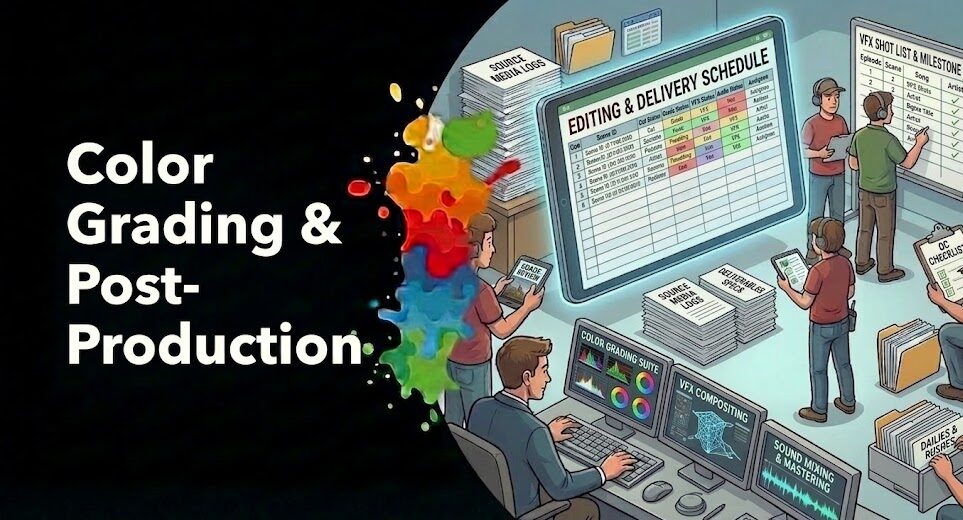
The best color grading and post-production outsourcing decisions in 2026 aren’t just creative ones. They’re capital decisions—driven by tax incentives, timezone economics, and which markets have built the infrastructure to handle Netflix-grade deliverables at scale.
Here’s the real dynamic: post-production outsourcing has matured far beyond “cheap labor.” India, Eastern Europe, Australia, and parts of Latin America are running world-class color pipelines on prestige theatrical and streaming content—not because they’re undercutting London or Los Angeles, but because their governments have made it financially irrational to grade and finish elsewhere.
This guide maps the six markets that matter right now, what each one actually costs, and how to vet the right partner before your delivery window closes.
In This Guide
- Why Post-Production Outsourcing Makes Financial Sense in 2026
- India: The Dominant Outsourcing Market
- UK: Enhanced VFX Credits and World-Class Colorists
- Eastern Europe: Quality at a Fraction of West Coast Rates
- Australia: The PDV Offset Advantage
- Latin America: Mexico and Brazil’s Rising Post Infrastructure
- MENA: The Sovereign Hub Wildcard
- How to Vet a Color Grading Partner Before You Commit
- Frequently Asked Questions
Ask VIQI: Which Color Grading Studios Are Working on Projects Like Mine?
VIQI is Vitrina’s AI assistant—trained on 1.6 million titles, 360,000 companies, and 5 million entertainment professionals. Ask it which post-production houses have delivered projects at your budget, genre, and territory.
✓ Included with 200 free credits | ✓ No credit card needed
Why Post-Production Outsourcing Makes Financial Sense in 2026
It’s not a cost-cutting conversation. It’s a capital stack conversation.
When your post-production qualifies for the UK’s 29.25% VFX tax credit, or Australia’s 30% PDV (Post, Digital, and VFX) Offset, or India’s 40% federal production rebate—you’re not just saving on day rates. You’re restructuring your effective budget. A $5M post budget run through the right jurisdiction can recoup $1.25M–$2M in incentives. That’s the real case for outsourcing in 2026.
And the talent is there. Full stop. The notion that world-class color grading only exists in Soho or Burbank hasn’t been accurate for years. DNEG runs global color pipelines from Mumbai and Chennai. PhantomFX handles Netflix and Hollywood VFX out of India. Prime Focus grades theatrical feature films on three continents. The talent gap closed a decade ago—the incentive gap is what you should be optimizing now.
As covered in our guide to the global post-production industry, the Fragmentation Paradox™ hits post-production particularly hard—thousands of qualified vendors operating in opacity, with no shared standard for discovery, vetting, or verification. That’s the gap to navigate.

Your AI Assistant, Agent, and Analyst for the Business of Entertainment
VIQI AI helps you plan content acquisitions, raise production financing, and find and connect with the right partners worldwide.
- Find active co-producers and financiers for scripted projects
- Find equity and gap financing companies in North America
- Find top film financiers in Europe
- Find production houses that can co-produce or finance unscripted series
- I am looking for production partners for a YA drama set in Brazil
- I am looking for producers with proven track record in mid-budget features
- I am looking for Turkish distributors with successful international sales
- I am looking for OTT platforms actively acquiring finished series for the LATAM region
- I am seeking localization companies offer subtitling services in multiple Asian languages
- I am seeking partners in animation production for children's content
- I am seeking USA based post-production companies with sound facilities
- I am seeking VFX partners to composite background images and AI generated content
- Show me recent drama projects available for pre-buy
- Show me Japanese Anime Distributors
- Show me true-crime buyers from Asia
- Show me documentary pre-buyers
- List the top commissioners at the BBC
- List the post-production and VFX decision-makers at Netflix
- List the development leaders at Sony Pictures
- List the scripted programming heads at HBO
- Who is backing animation projects in Europe right now
- Who is Netflix’s top production partners for Sports Docs
- Who is Commissioning factual content in the NORDICS
- Who is acquiring unscripted formats for the North American market
India: The Dominant Outsourcing Market
India isn’t a secondary option for post-production anymore. For high-volume episodic VFX, compositing, and color finishing, it’s the primary option for a significant percentage of global output—including work done for Netflix, Amazon Prime Video, and major US studios.
The federal incentive—40% reimbursement on qualifying post-production spend, capped at approximately $3.6M—covers VFX and animation services specifically. That’s meaningful. Productions routing post through India aren’t just benefiting from lower base rates; they’re stacking a government incentive on top. Prithul Kumar, Joint Secretary at NFDC under India’s Ministry of Information and Broadcasting, has publicly confirmed that international co-production agreements now explicitly facilitate outsourcing post services to Indian vendors as a qualifying category.
Key markets within India:
- Mumbai — Feature film color finishing, sound post, delivery. Home to Prime Focus and Red Chillies VFX (Shah Rukh Khan’s VFX company, responsible for major Bollywood and international productions).
- Chennai — High-volume VFX and compositing. PhantomFX, led by Bejoy Arputharaj, operates one of India’s fastest-growing international VFX pipelines here, working directly with Hollywood and streaming clients.
- Hyderabad / Bangalore — Cloud-based workflows and animation pipelines, growing rapidly with government infrastructure investment.
Day rate differential vs. London or Los Angeles: 35–55% lower for equivalent skill levels on compositing and grading. But the reason to go to India isn’t the rate—it’s the rate plus the 40% federal incentive plus the access to cloud-native pipelines that have been stress-tested on multinational streaming projects.
Neil Hatton (CEO, UK Screen Alliance) offers a useful counterpoint in this Vitrina LeaderSpeak episode—discussing how the UK’s own VFX incentive enhancements were designed specifically to compete with exactly these markets:

Find Verified Post-Production Partners in 48 Hours
Trusted by Netflix, Warner Bros, and Paramount. Join 140,000+ companies using Vitrina to surface post-production vendors by territory, capability, and previous project credits. Filter by color grading specialty, VFX stack, and delivery format in one platform.
✓ 200 free credits | ✓ No credit card required | ✓ Full platform access
UK: Enhanced VFX Credits and World-Class Colorists
The UK didn’t just defend its position as a global post-production hub—it upgraded it. As of April 2025, VFX work qualifying under the UK’s film and TV incentive receives a 29.25% cash rebate (up from 25%), with the cap on qualifying VFX expenditures removed entirely. That’s a meaningful structural change.
Combine that with 40% business rate relief for film studios through 2034, and you’re looking at a jurisdiction that has engineered long-term cost predictability for productions routing post through London or the wider UK. Productions including Jurassic World 4, Mission: Impossible, and Fantastic Four moved post work to the UK in 2024–2025 in part because the incentive math made it the most defensible choice for their capital stack.
From a talent perspective: Framestore, DNEG, Outpost VFX, and Electric Theatre Collective represent the kind of depth that doesn’t exist in many other markets. John Kilshaw, Creative Director and VFX Supervisor at Framestore, has discussed how his team’s episodic work on One Piece and Avatar: The Last Airbender for Netflix is built on a hybrid model—UK-based creative leadership with distributed global execution.
But the UK isn’t cheap. Day rates in London remain 20–35% higher than equivalent talent in Central Europe or India. You’re paying for depth of supervision, creative legacy, and incentive-bankability with lenders who’ve seen the UK program perform for 15 years.
Your AI Assistant, Agent, and Analyst for the Business of Entertainment
VIQI AI helps you plan content acquisitions, raise production financing, and find and connect with the right partners worldwide.
- Find active co-producers and financiers for scripted projects
- Find equity and gap financing companies in North America
- Find top film financiers in Europe
- Find production houses that can co-produce or finance unscripted series
- I am looking for production partners for a YA drama set in Brazil
- I am looking for producers with proven track record in mid-budget features
- I am looking for Turkish distributors with successful international sales
- I am looking for OTT platforms actively acquiring finished series for the LATAM region
- I am seeking localization companies offer subtitling services in multiple Asian languages
- I am seeking partners in animation production for children's content
- I am seeking USA based post-production companies with sound facilities
- I am seeking VFX partners to composite background images and AI generated content
- Show me recent drama projects available for pre-buy
- Show me Japanese Anime Distributors
- Show me true-crime buyers from Asia
- Show me documentary pre-buyers
- List the top commissioners at the BBC
- List the post-production and VFX decision-makers at Netflix
- List the development leaders at Sony Pictures
- List the scripted programming heads at HBO
- Who is backing animation projects in Europe right now
- Who is Netflix’s top production partners for Sports Docs
- Who is Commissioning factual content in the NORDICS
- Who is acquiring unscripted formats for the North American market
Eastern Europe: Quality at a Fraction of West Coast Rates
Prague and Budapest. That’s where to start this conversation.
Czech Republic raised its animation and digital production rebate to 35% effective January 2025 (up from 20%), and nearly tripled the per-project cap to $19M. For animation-heavy projects or productions with significant compositing workloads, that’s a material incentive shift—one that several European co-productions have already structured around.
Hungary‘s 30% tax credit continues to underpin productions like the Blade Runner 2049 and Mission: Impossible sequels—Budapest’s post infrastructure grew in lockstep with its production reputation. The colorist and compositing talent base is deep, English-language workflows are standard on international productions, and day rates run 40–50% below London equivalents.
The catch? Volume capacity. Eastern European post houses have absorbed significant workload from US and UK productions, and lead times have compressed. If you’re routing a large-scale episodic through Prague or Budapest in Q3 or Q4, book early—you’re not the only show in the building.
Australia: The PDV Offset Advantage
Australia built a specific incentive category for exactly this: the PDV (Post, Digital, and VFX) Offset at 30%, available to international productions routing post work through Australian vendors—regardless of where principal photography occurred.
That’s the distinctive feature. You don’t have to shoot in Australia to access the PDV Offset. You just need to spend qualifying post dollars with Australian suppliers. For productions that want to work with strong English-language colorists and finishing houses at rates below London and with a government-backed cash rebate, Australia’s post market—centered in Sydney and Melbourne—is structurally underutilized by international producers who default to the US or UK.
New South Wales adds a regional 10% uplift on top of the federal offset for qualifying spend. Stack those—and you’re looking at an effective 35–40% return on post budget routed through NSW-based vendors. That’s not a minor benefit. On a $3M color and finishing budget, that’s $900K–$1.2M back into your capital stack.
Latin America: Mexico and Brazil’s Rising Post Infrastructure
Neither market has the incentive depth of India, the UK, or Australia. But both have specific strategic advantages that make them worth a producer’s attention—depending on the project.
Mexico hosts Dinamita Post, led by Paulo Carballar—a post house that has driven projects to Oscar nominations and Emmy wins. Mexico City’s post infrastructure has matured around the country’s growing role as a Latin American production hub, with Netflix’s commitment to invest $1 billion in Mexico over four years accelerating that growth. For productions with significant Latin American distribution, routing post through Mexico can compress both cost and coordination timelines.
Brazil‘s O2 Films, led by CEO Paulo Barcellos, represents the kind of integrated production-to-post model that makes co-productions attractive. São Paulo and Rio de Janeiro have world-class color suites, strong sound post infrastructure, and day rates that run well below European benchmarks. Brazil’s Article 1 and Article 3 tax incentive mechanisms can be structured to capture post-production spend in ways that benefit qualifying projects—though you’ll need a local production accountant who knows how each mechanism applies to international content.
MENA: The Sovereign Hub Wildcard
Strategic players understand that the Sovereign Content Hubs™ in Saudi Arabia and the UAE are infrastructure plays, not just incentive plays. The $1 billion annual Vision 2030 Film Fund allocation in Saudi Arabia, and Abu Dhabi’s up to 50% cash rebate—currently among the highest in the world—are designed to build lasting post-production ecosystems, not generate short-term production tourism.
The honest position in 2026: MENA’s color grading and post infrastructure is still building. The incentives are extraordinary. The talent is being cultivated through partnerships with US and UK studios. The facilities are world-class and new. But for productions that need proven pipelines, deep colorist bench depth, and deliverables-tested workflows—MENA is a 2027–2028 story for post outsourcing, not 2026.
Watch the Abu Dhabi incentive closely. It’s structuring deals now that will define which international post houses anchor there by 2028.
How to Vet a Color Grading Partner Before You Commit
Insiders recognize that vendor failure in post isn’t usually a talent problem—it’s a capacity and deliverables problem. The colorist is great. But the studio double-booked two prestige projects in Q4, and yours is the one that slips. Here’s what to check before you’re in that situation.
- Active project load during your post window. Ask directly how many projects will be in color during your schedule. Any hesitation or vague answer is a signal.
- Platform deliverables track record. Netflix, Amazon, and Apple TV+ each have distinct IMF delivery specifications and quality control processes. Has this vendor delivered to your platform before? Ask for a specific title, not a general claim.
- Colorist continuity. Who specifically is grading your project? Get that name in the contract. Studios that sell you on a senior colorist and deliver a junior one at delivery are a known pattern in outsourced markets.
- Cloud pipeline capability. Remote collaboration between your editorial team and a colorist in Mumbai or Budapest requires low-latency review tools. Framelight Remote, Sohonet, and equivalent solutions should be standard. If the vendor doesn’t have this infrastructure, your review process will break down.
- Incentive bankability. If you’re structuring post against a rebate loan, your lender needs confidence the incentive program will pay. Established markets (UK, Australia, Canada) are more bankable than newer programs. Factor that into your cash flow planning.
For more detail on how to identify and qualify VFX and post-production outsourcing partners, Vitrina’s vendor qualification tools surface active project history, client relationships, and delivery credentials—so you’re not making a six-figure vendor decision based on a showreel and a sales deck.
Need the Right Post-Production Vendor? We’ll Match You Directly.
Vitrina Concierge is your Virtual Agent. Tell us your budget, timeline, and delivery specs—and we make warm introductions to post-production studios and color grading houses that have done this before, at your scale.
- LA producer → Post-production partner matched across 3 territories in 48 hours
- No commitment needed to start the conversation
Frequently Asked Questions About Post-Production Outsourcing
The Bottom Line on Global Post-Production Outsourcing in 2026
Color grading and post-production outsourcing is a capital strategy, not a compromise. The markets that matter—India, UK, Australia, Eastern Europe, Latin America—each offer a distinct combination of talent depth, incentive structure, and infrastructure maturity. Your job is to match your project’s budget, delivery requirements, and timeline to the market that de-risks each of those variables simultaneously.
The Fragmentation Paradox™ makes that harder than it should be. Thousands of qualified vendors, no standard discovery framework, and a vetting process that defaults to word-of-mouth. Vitrina’s post-production company tracking is built to surface the right vendors before your post window opens—not while you’re scrambling to fill slots three weeks before delivery.
Key Takeaways:
- India’s 40% federal rebate on VFX and post-production makes it the most aggressive incentive market for volume outsourcing—on top of rate advantages.
- The UK’s 29.25% VFX credit (April 2025) with no qualifying expenditure cap makes it the most bankable option for productions seeking rebate loans against post spend.
- Australia’s 30% PDV Offset is available without a shoot in Australia—one of the most accessible post-production incentives for international projects.
- Eastern Europe (Czech Republic at 35%, Hungary at 30%) runs deep colorist and compositing talent at 40–50% below London rates—but book early, capacity is constrained in Q3–Q4.
- Vet vendors on active load, platform delivery credits, and named colorist continuity—not showreels. The failure mode in outsourced post is capacity, not talent.
- MENA incentives are world-leading on paper (Abu Dhabi at up to 50%), but infrastructure depth for complex post pipelines is a 2027–2028 story for most productions.
Track Post-Production Vendors Across 100+ Countries on Vitrina
Netflix, Warner Bros, and Paramount use Vitrina to surface post-production partners before their windows close. Join 140,000+ companies already tracking the global entertainment supply chain. Start with 200 free credits—no credit card required.
✓ 200 free credits | ✓ No credit card required | ✓ Cancel anytime
Find Film+TV Projects, Partners, and Deals – Fast.
VIQI matches you with the right financiers, producers, streamers, and buyers – globally.
Producers Seeking Financing, Co-Pros, or Pre-Buys?
Vitrina Concierge helps producers reach the right financiers, commissioners, distributors, and co-production partners — with precision outreach, not cold pitching.
Join Industry Briefings Trusted by Leaders

Format Adaptations: Global Trends
Where formats are traveling, which adaptations are breaking out, and how streamers are backing remakes in 2025–2026.

Books, Novels & Comics Adaptations: Global Trends
Books, webtoons, and manga driving the next global screen hits. Discover how in this webinar.

Micro-Dramas & Mobile-First Storytelling
Micro-dramas are building real audiences and revenue. Understand the platforms, buyers, and economics behind the growth.

Navigating Global Content Licensing Trends
How global content licensing is shifting beyond flat fees to flexible, deal-driven models.