About Innovation Hub
 Global Content Pulse (Webinars)


 Global Production Financing
(Webinars)
Global Production Financing
(Webinars)  LeaderSpeak Podcast
  About Vitrina
 Our Story
 Our Solutions 🔥
 Film+TV Projects Tracker 🚀
 Case Studies
 Our Profile
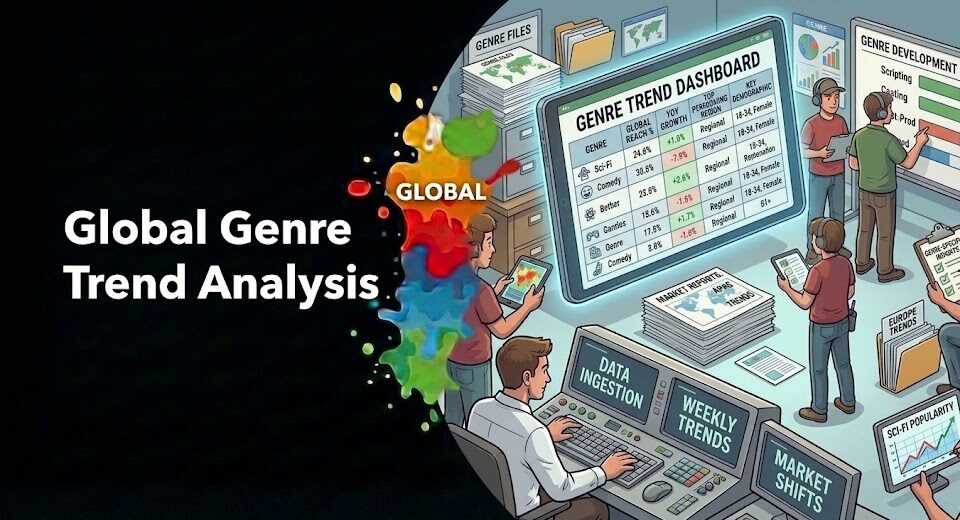
Here’s what most genre trend reports won’t tell you: the greenlight conversation in 2026 isn’t happening at the level of “drama vs. comedy.” It’s happening at the intersection of capital structure, territory value, and platform-specific audience behavior. And if you’re not reading those signals, you’re making acquisition decisions six months behind the curve.
The Fragmentation Paradox™ hits genre intelligence harder than almost any other area of the supply chain. There are 600,000+ companies globally producing content across every imaginable category—but the real-time signal on which genres are actually closing deals, getting MGs committed, gap financing approved, and greenlight decisions locked, stays buried inside relationships and deal memos that never see the trades.
So let’s cut through it. Based on intelligence gathered across Vitrina’s network of 140,000+ active entertainment companies—plus direct insight from industry operators at Head Gear Films, Peachtree Media Partners, OSN, and IPR VC—here’s the honest 2026 genre picture. What’s getting greenlit, what’s stalling, and where the smart money is moving right now.
Table of Contents
- The 3 Genres That Are Actually Getting Greenlit Right Now
- Drama’s Uncomfortable Truth in 2026—and Where It Still Works
- Animation and Anime: The Sovereign Hub Acceleration
- Documentary: Europe’s Darling, Asia’s Afterthought
- MENA’s Genre Formula: Crime, Thriller, and the Ramadan Factor
- Reality TV and Unscripted: Budget Pressure’s Unlikely Winner
- The Theatrical Comeback and What It Means for Genre Bet Sizing
- How to Track Genre Greenlight Activity Before It Hits the Trades
- Frequently Asked Questions
- Conclusion
Ask VIQI: Which Genres Are Buyers Committing To Right Now?
VIQI is Vitrina’s AI research assistant—trained on 1.6 million titles, 360,000 companies, and 5 million entertainment professionals. Ask it which content categories are generating active deal flow in your target territories.
✓ Included with 200 free credits | ✓ No credit card needed
The 3 Genres That Are Actually Getting Greenlit Right Now
That’s not a guess—it’s what buyers are telling producers to their face at every market from AFM to Berlin. Phil Hunt, founder and CEO of Head Gear Films, has financed over 550 films in his 25-year career and runs approximately 35-40 productions per year—more volume than most studios. His read on the current genre trends 2026 market is unambiguous.
In a Vitrina LeaderSpeak conversation, Hunt was direct: the genres working in the independent marketplace are, predominantly, “action, thriller, horror”—and drama, in his words, “is not really working.” That’s a sharp signal from someone processing more deal flow than almost anyone in the UK independent space. When the person writing the most checks calls out drama, that’s not commentary—it’s a capital allocation signal.
Phil Hunt (Founder & CEO, Head Gear Films) breaks down exactly why these genres dominate the independent film market in 2026—and what the “Big Crunch” means for greenlight decisions:

Joshua Harris, President and Managing Partner of Peachtree Media Partners, arrives at the same conclusion from a lending perspective. Peachtree lends against film IP—not equity—so Harris is making collateral-based decisions on territory value every day. His slate confirms it: while Peachtree is technically genre-agnostic, it consistently leans into “action movies, thrillers, psychological thrillers, and horror movies” because that’s where pre-sale MGs are credible enough to underwrite.
And that mechanism matters enormously. It’s not just that buyers prefer these genres—it’s that action, thriller, and horror unlock the financing architecture that makes productions viable. Gap lenders count territory MGs. Banks advance against those MGs. Pre-sales in action and horror are executable deals with real MG floors. Drama MGs in most international territories, without A-list cast, don’t clear the bar for gap financing approval. Your genre-specific content rights strategy for 2026 has to account for this structural reality—not just buyer preference.
Drama’s Uncomfortable Truth in 2026—and Where It Still Works
Drama isn’t dead. But it’s bifurcated in a way that’s trapping a lot of producers in a funding no-man’s-land—and most industry conversations aren’t honest about that split.
Here’s the thing: prestige drama absolutely gets greenlit in 2026. Netflix greenlights it. HBO greenlights it. But studio-backed prestige drama operates under an entirely different capital stack than independent drama. At the studio level, you’re not assembling pre-sales across 40 territories—you’re pitching a streaming commission that covers global rights in one conversation. That’s a direct commission model. The financing economics don’t resemble traditional independent film structure at all.
For independent producers working in the pre-sale and gap financing model, drama without an exceptional hook, festival pedigree, or A-list package is genuinely struggling to find financing. Hunt’s framing here is precise: the independent business “passes off the risk at each stage,” unlike studios that control the entire value chain. Drama, without cast-driven pre-sale value across major territories, concentrates risk instead of distributing it. That’s the problem.
Where drama does work in 2026? Prestige drama acquisitions increasingly favor limited series with identifiable IP—strong book adaptations, anti-hero serialized narratives with co-production treaty access—and elevated genre-drama hybrids that can qualify for the same gap financing windows as pure genre. Cultural drama in Spanish, Turkish, and Korean continues to perform. But the standalone character drama without a packaging hook? That’s where greenlight decisions stall—and where producers burn months on deals that don’t close.
Track Genre Deal Flow in Real Time—Not Last Quarter
Trusted by Netflix, Warner Bros, and Paramount. Vitrina tracks 400,000+ active projects across 140,000+ companies so you know which genres are converting—not which ones were converting six months ago.
✓ 200 free credits | ✓ No credit card required | ✓ Full platform access
Animation and Anime: The Sovereign Hub Acceleration
Animation is having a structural moment—not because the content suddenly got more interesting, but because the production geography is shifting underneath it. Fast.
Japan remains the dominant animation IP engine. The country’s incentive rate reaches up to 50% for qualifying productions, and anime’s global subscriber penetration has fundamentally changed what international buyers are willing to pay for anime rights. Netflix, Crunchyroll, and Prime Video have moved from licensing to commissioning—meaning deal structures are maturing, MGs are real, and the greenlight signals are traceable. As Variety has reported extensively, anime’s trajectory from niche to mainstream global category is now complete—and the greenlight activity reflects that shift.
But the bigger story in 2026 is what’s happening at the Sovereign Content Hubs™. Saudi Arabia and the UAE—with populations where 60%+ are under 30—are aggressively commissioning animation targeting local and regional audiences. This isn’t token cultural content. It’s government-backed production capital chasing a demographic that skews younger than almost any Western streaming market. Korean animation studios are seeing APAC co-production deal flow accelerate as a direct result.
And there’s an EBITDA protection play here that smart operators are already executing: anchoring animation co-productions across multiple Sovereign Hub incentive structures—Japan’s 50% incentive rate, South Korea’s location incentives, UAE’s content investment mandates—to stack soft money against what would otherwise be high-risk IP development. That’s how you de-risk animation greenlight decisions in 2026. Not hope. Structure.

Your AI Assistant, Agent, and Analyst for the Business of Entertainment
VIQI AI helps you plan content acquisitions, raise production financing, and find and connect with the right partners worldwide.
- Find active co-producers and financiers for scripted projects
- Find equity and gap financing companies in North America
- Find top film financiers in Europe
- Find production houses that can co-produce or finance unscripted series
- I am looking for production partners for a YA drama set in Brazil
- I am looking for producers with proven track record in mid-budget features
- I am looking for Turkish distributors with successful international sales
- I am looking for OTT platforms actively acquiring finished series for the LATAM region
- I am seeking localization companies offer subtitling services in multiple Asian languages
- I am seeking partners in animation production for children's content
- I am seeking USA based post-production companies with sound facilities
- I am seeking VFX partners to composite background images and AI generated content
- Show me recent drama projects available for pre-buy
- Show me Japanese Anime Distributors
- Show me true-crime buyers from Asia
- Show me documentary pre-buyers
- List the top commissioners at the BBC
- List the post-production and VFX decision-makers at Netflix
- List the development leaders at Sony Pictures
- List the scripted programming heads at HBO
- Who is backing animation projects in Europe right now
- Who is Netflix’s top production partners for Sports Docs
- Who is Commissioning factual content in the NORDICS
- Who is acquiring unscripted formats for the North American market
Documentary: Europe’s Darling, Asia’s Afterthought
There’s a pattern Vitrina’s deal flow data keeps surfacing: Europe is an enormous demand center for factual content and documentary. Asia—with the exception of Australia—largely isn’t.
This isn’t speculation. The observation surfaced directly in a Vitrina LeaderSpeak conversation with Rolla Karam, Senior Vice President of Content Acquisition at OSN: the MENA platform’s model prioritizes scripted entertainment, and while European-commissioned documentary has a clear acquisition path through broadcasters like BBC, ARD, and France Télévisions, the MENA region’s greenlight appetite sits firmly elsewhere.
True crime is the notable exception. Crime documentary and docuseries have found a genuinely global streaming audience, and platforms across APAC, MENA, and Latin America are acquiring them—particularly when the subject matter carries cross-cultural resonance. Screen International noted that true crime docuseries were among the most actively acquired categories at MIPCOM 2024, driven by completion rates that outperform most scripted drama on streaming platforms.
But standard documentary—nature, biography, historical—remains a European acquisition category with limited monetization leverage in most other markets. If your greenlight economics depend on territory pre-sales or gap financing eligibility, most documentary budgets are almost impossible to structure through traditional film finance routes. That’s not changing in 2026—and knowing it in advance is the difference between a well-structured pitch and six months chasing dead ends.
MENA’s Genre Formula: Crime, Thriller, and the Ramadan Factor
The MENA market in 2026 has a genre formula that producers targeting OSN, Shahid, or regional broadcasters need to understand precisely—because “open to all genres” is the diplomatic answer, and the operational reality is something more specific.
Karam was direct about what actually performs on OSN’s platform: “crime thriller, horror, and drama does very well” in Saudi Arabia—their core market. Turkish long-running series sit consistently in the platform’s top five. That’s not incidental. Turkish content has built two decades of MENA audience habit, and its structural advantage—high production value at competitive budget—makes it a category that regional platforms keep returning to. OSN’s current content mix sits at approximately 90% Western content with the remaining 10-15% split across Arabic, Turkish, and kids programming.
But here’s what matters for 2026: Karam’s stated focus for 2026 and 2027 is explicitly Arabic scripted series. OSN licensed scripted drama specifically for Ramadan as a proof-of-concept strategy—a signal that original Arabic scripted commissioning at the platform is genuinely beginning. During Ramadan, viewing habits across the region shift dramatically toward Arabic-language scripted content. That’s a cultural greenlight window that most Western producers haven’t fully mapped.
Format adaptations are also viable in MENA in a way they often aren’t elsewhere. Karam was clear: adapted formats work “as long as it’s packaged and done for the Arabic audience”—genuine cultural adaptation, not copy-paste. OSN covers 23 countries across MENA and North Africa, from Saudi and GCC core markets to Egypt’s massive audience base. That’s a multi-territory distribution footprint that many independent producers with format IP haven’t fully weaponized yet.
Reality TV and Unscripted: Budget Pressure’s Unlikely Winner
Budget pressure—the relentless squeeze on production costs across every category—is pushing buyers toward unscripted faster than most industry trend pieces acknowledge.
Reality TV and competition formats don’t sit at the top of any prestige content conversation. But they close. Per-hour production costs run a fraction of scripted drama. Formats adapt across markets without major re-investment. International format sales generate revenue streams that most scripted content can’t match. And the greenlight cycle is significantly faster—because the risk profile is understood before production starts, not after.
For acquisitions executives, unscripted in 2026 isn’t an exciting greenlight conversation. But in a capital environment where greenlight risk has genuinely contracted—post-COVID production excesses now working their way through P&Ls across the industry—”reliable” is doing a lot of heavy lifting. The operators with disciplined content acquisition strategy are building unscripted positions into slate portfolios precisely because the ROI math is predictable in a way that drama and action simply aren’t.
The Theatrical Comeback and What It Means for Genre Bet Sizing
After several years of streaming-first positioning, something shifted at AFM 2025. The theatrical conversation came back. Not gently.
Harris described it explicitly: “The entire base is really seeing the swing back to theatrical being the future of our business.” Coming from someone who lends against film IP for a living—whose collateral calculations depend on where revenue actually lands—that’s not a trend observation. It’s a capital signal that should be reshaping how you’re thinking about genre bet sizing right now.
The implications are direct. Theatrical action and horror outperform streaming-first versions of the same projects by meaningful margins when budgeted and positioned correctly. The $10-30M action film with recognizable concept-driven packaging—experienced sales agent, MG floor secured, tax incentives stacked—can clear theatrical P&A thresholds and generate back-end revenue that supports the full capital stack. But genre bet sizing has to match distribution ambition. The $5M psychological thriller built for SVOD needs a completely different financing structure than the $25M theatrical action film targeting a global release strategy.
Mixing those assumptions is exactly where producers lose deals and where gap lenders reject packages. Your global content acquisition strategy for 2026 has to account for which genre-budget combinations actually support which distribution windows—before you take the project to market, not after.
Get a Custom Genre Intelligence Briefing for Your Slate
Netflix UK identified co-production partners in 48 hours using Vitrina’s Concierge service. Let our team map the greenlight landscape—by genre, territory, and budget range—specific to your 2026 slate.
✓ Dedicated research team | ✓ Genre-specific deal flow analysis | ✓ No commitment required
How to Track Genre Greenlight Activity Before It Hits the Trades
The practical problem every acquisitions exec faces: by the time genre trend analysis reaches trade publications, the deals that informed it closed 3-6 months earlier. That’s the Data Deficit™ at work—and in genre intelligence, it’s expensive.
The Fragmentation Paradox™ compounds this. With 600,000+ companies operating across the global film and TV supply chain, and 140,000+ actively producing content, the real-time signal on which genres are getting greenlit—which financing structures are being approved, which territories are committing MGs—stays buried deep inside relationship networks and closed deal rooms.
The operators with Insider Advantage™ are tracking this at the deal level, not the trend report level. They know MENA greenlight appetite has shifted toward Arabic scripted series before the trades write about it. They know anime co-production deal flow between APAC and Europe is accelerating faster than any annual report captures. And they know because they’re monitoring active project deal flow—not reading year-end summaries.
This is the intelligence gap that Vitrina was built to close. Tracking 140,000+ companies and 400,000+ projects in real time means genre greenlight signals emerge from deal activity—not from surveys. Andrea Scarso, Managing Partner at IPR VC—a fund management firm that bridges institutional capital with the creative industry—puts it directly: “The challenge in the industry right now is not on deal flow, it’s on the quality of investing, it’s on how you structure the investment.” That quality of investing starts with knowing which categories are actually converting in your territory and budget range.
The question isn’t which genres are trending. It’s which genres are converting—which ones are getting MGs committed, productions greenlit, and financing approved right now, across the markets you care about. That intelligence layer is what changes how you allocate acquisition budget and structure your next pitch.
Frequently Asked Questions
Which genres are getting the most greenlight activity in 2026?
Action, thriller, and horror are the three genres generating the most consistent greenlight activity in 2026—across independent film markets, gap financing approvals, and pre-sale commitments in major territories. This is confirmed by operators like Phil Hunt (Head Gear Films, 550+ films financed) and Joshua Harris (Peachtree Media Partners), both of whom cite these genres as where buyer demand and capital structure converge. Animation—particularly anime—is also seeing accelerated greenlight activity due to Sovereign Hub investment in MENA and APAC.
Why is drama struggling to get greenlit in the independent film market?
Drama’s challenge in the independent market comes down to the capital stack. Without A-list cast, independent drama typically can’t generate the pre-sale MGs across major international territories needed to qualify for gap financing. The independent financing model passes risk off at each stage—and drama without cast-driven territory value concentrates risk instead. Prestige drama does get greenlit, but through studio or direct streaming commission models with completely different economics. Independent producers chasing drama MGs in foreign markets face a structurally difficult environment in 2026.
How is MENA content demand shaping genre trends in 2026?
MENA’s genre appetite in 2026 centers on crime, thriller, horror, and drama—confirmed by Rolla Karam (SVP Content Acquisition, OSN), whose platform reaches 23 countries across the region. Turkish scripted content is consistently performing in the platform’s top 5. But the major shift for 2026-2027 is OSN’s expanding Arabic scripted series commissioning. Ramadan represents a critical greenlight window—viewing habits shift strongly to Arabic-language scripted content during the holy month, creating seasonal acquisition demand that producers with regional partnerships are beginning to exploit.
What role does animation play in greenlight activity in 2026?
Animation and anime are seeing a structural greenlight acceleration driven by two factors. First, Japan’s incentive rate of up to 50% makes anime co-productions financially attractive while the anime format’s global streaming penetration is now established. Second, Sovereign Content Hubs™ in Saudi Arabia and the UAE—where 60%+ of the population is under 30—are actively commissioning animation content backed by government capital. South Korea’s animation sector is benefiting from increased APAC co-production deal flow as a result. Stack these incentive structures correctly and animation becomes one of the most de-risked genres in 2026.
How does the theatrical vs. streaming debate affect genre greenlight decisions?
Significantly. The theatrical comeback—confirmed by multiple operators at AFM 2025, including Joshua Harris of Peachtree—is reshaping how genre bet sizing works. Theatrical action and horror overperform when properly budgeted for the window. But genre bet sizing must match distribution ambition: a $5M psychological thriller targeting SVOD needs a different capital stack than a $25M theatrical action film. Mixing those assumptions is where financing packages fall apart. The greenlight decision requires knowing which window your genre and budget combination actually supports before approaching financiers.
What genres work best for pre-sales and gap financing in 2026?
Action, thriller, and horror consistently generate the strongest pre-sale MGs across major international territories—which is why they also get gap financing approval most reliably. Gap lenders advance against the value of unsold territories, and those territory values are highest in commercially proven genres. Comedy is typically weak for foreign pre-sales (“domestic pieces”), while drama’s value is highly cast-dependent. If your financing architecture requires pre-sales to trigger gap financing, genre selection isn’t just a creative decision—it’s a capital structure decision.
Is documentary getting greenlit internationally in 2026?
Documentary greenlight activity varies dramatically by region. Europe remains a major demand center—public broadcasters like BBC, ARD, and France Télévisions continue to commission and acquire documentary, particularly factual, historical, and investigative formats. Asia (excluding Australia) and MENA are not strong acquisition markets for standard documentary. True crime docuseries are the exception—they have found genuinely global streaming audiences and are being acquired across APAC, MENA, and Latin American platforms. But for traditional documentary categories, financing through pre-sales and gap financing is structurally very difficult.
How can producers and acquisition executives track real-time genre greenlight signals?
The challenge is that by the time genre trends hit trade publications, the deals that informed them closed 3-6 months earlier. Real-time genre intelligence requires monitoring active deal flow—which financing structures are being approved, which territories are committing MGs, which platforms are greenlighting which categories. Vitrina’s platform tracks 140,000+ active companies and 400,000+ projects in real time, enabling producers and acquisition teams to spot genre greenlight signals from deal activity rather than trend surveys. Ask VIQI specific questions about genre deal flow by territory, platform, and budget range to get actionable intelligence—not backward-looking reports.
Conclusion: Genre Is a Capital Decision, Not Just a Creative One
The global genre trend analysis for 2026 points in one clear direction: greenlight activity follows financing structure, not just audience preference. Action, thriller, and horror dominate because they unlock the capital stack. Animation is accelerating because government-backed Sovereign Hubs are deploying real money. Drama is bifurcating along the studio-vs-indie fault line. And MENA’s Arabic scripted series window is opening right now—before most Western producers have positioned to capture it.
Key Takeaways:
- Action, Thriller, Horror lead in 2026: Confirmed by operators financing 35-40 films/year—these genres unlock pre-sales, gap financing, and theatrical distribution simultaneously.
- Drama is bifurcated: Prestige drama works at the studio/streaming commission level; independent drama without cast-driven MG value faces serious structural headwinds.
- Sovereign Hub animation is accelerating: Japan’s 50% incentive, Saudi Arabia’s youth demographic (60%+ under 30), and Korean APAC co-production growth are stacking greenlight signals for animation.
- MENA’s Arabic scripted window is opening: OSN’s 23-country platform is actively commissioning Arabic scripted series for 2026-2027. Crime, thriller, and drama work. The Ramadan window is a critical greenlight catalyst.
- Theatrical is back—and genre bet sizing must adapt: The swing back to theatrical reported at AFM 2025 means action and horror projects need different capital stacks than SVOD-targeted equivalents.
- Real-time intelligence beats trend reports: By the time genre trends hit the trades, the deals are already 3-6 months closed. Tracking active deal flow through 140,000+ companies is the only way to stay ahead of the greenlight curve.
Start Tracking What’s Getting Greenlit Today
Trusted by Netflix, Warner Bros, Paramount, and Google TV. Join 140,000+ entertainment companies who track genre deal flow, active productions, and financing decisions in real time—not last quarter.
✓ 200 free credits | ✓ No credit card required | ✓ Cancel anytime
Need direct introductions to genre-specific buyers? Explore Concierge Service →
Find Film+TV Projects, Partners, and Deals – Fast.
VIQI matches you with the right financiers, producers, streamers, and buyers – globally.
Producers Seeking Financing, Co-Pros, or Pre-Buys?
Vitrina Concierge helps producers reach the right financiers, commissioners, distributors, and co-production partners — with precision outreach, not cold pitching.
Join Industry Briefings Trusted by Leaders

Format Adaptations: Global Trends
Where formats are traveling, which adaptations are breaking out, and how streamers are backing remakes in 2025–2026.

Books, Novels & Comics Adaptations: Global Trends
Books, webtoons, and manga driving the next global screen hits. Discover how in this webinar.

Micro-Dramas & Mobile-First Storytelling
Micro-dramas are building real audiences and revenue. Understand the platforms, buyers, and economics behind the growth.

Navigating Global Content Licensing Trends
How global content licensing is shifting beyond flat fees to flexible, deal-driven models.