About Innovation Hub
 Global Content Pulse (Webinars)


 Global Production Financing
(Webinars)
Global Production Financing
(Webinars)  LeaderSpeak Podcast
  About Vitrina
 Our Story
 Our Solutions 🔥
 Film+TV Projects Tracker 🚀
 Case Studies
 Our Profile
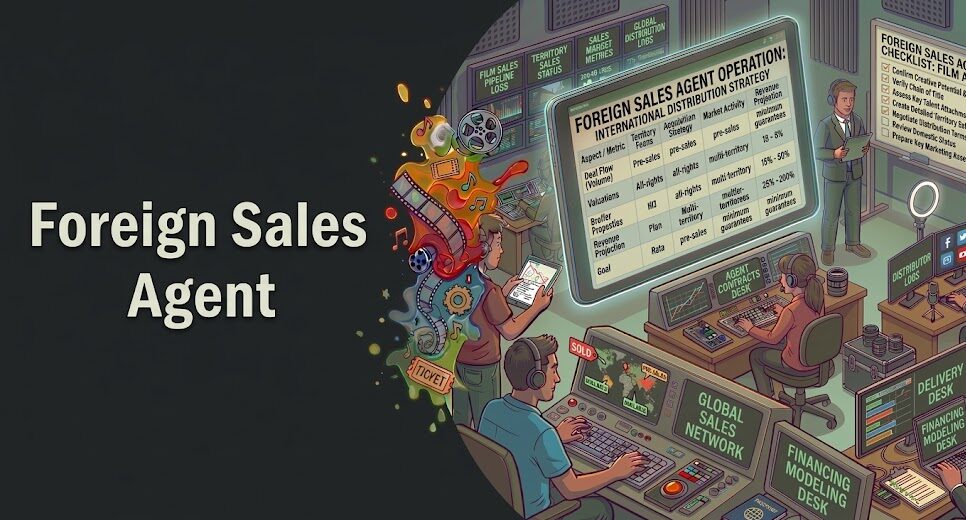
Pick the wrong foreign sales agent and you don’t just leave money on the table. You lock your film into a relationship that’s genuinely difficult to exit—while your territories sit unsold, your gap lender gets nervous, and the distribution windows you were counting on quietly close. It happens more than anyone wants to admit.
Choosing a foreign sales agent for your film is one of the highest-leverage decisions in independent production finance. Get it right and you’ve got an operator who can turn your finished cut into a capital stack—collateralizing MGs across Germany, France, Japan, Australia, and ten other markets to fund your next project before this one’s even delivered. Get it wrong and you’ve handed your IP to someone whose distributor relationships don’t hold water with gap lenders, whose sales estimates don’t survive contact with the market, and whose recoupable expense line somehow expands every quarter.
The framework below is data-driven—not gut-feel. It’s built from the mechanics that actually govern how sales agents function in 2026: how their deals are structured, what gap lenders actually require from them, which genre-market combinations are commanding real MGs right now, and how to use real-time intelligence to De-risk the selection process before you sign anything.
Table of Contents
- What a Foreign Sales Agent Actually Does—and What They Don’t
- The 5 Data-Driven Selection Criteria That Matter Most
- Contract Terms to Watch: Commission, Expenses, and the Recoupment Trap
- Genre-Market Matching: Not Every Agent Sells Every Film
- 6 Red Flags Your Due Diligence Should Surface
- The Data Intelligence Edge: Vetting Agents in 2026
- FAQ
- Conclusion
Ask VIQI: Which Sales Agents Are Actively Closing Deals in Your Genre Right Now?
Stop relying on market gossip. VIQI is Vitrina’s AI intelligence engine—trained on 1.6 million titles, 360,000+ companies, and 5 million entertainment professionals. Get real-time data on which agents are selling your genre, in which territories, at which MG levels—before you approach a single one.
✓ 200 free credits included | ✓ No credit card required
What a Foreign Sales Agent Actually Does—and What They Don’t
Let’s start with the basics, because there’s a version of this role that sounds straightforward but isn’t. A foreign sales agent—also called a world sales agent or international sales agent—licenses your film’s distribution rights territory by territory to distributors in each market. Germany, France, Japan, South Korea, Australia, Benelux, Scandinavia, the MENA region, Latin America. Each territory has a distributor willing to pay a Minimum Guarantee for the right to release your film in their market.
The agent works your film at markets—Cannes Marché du Film in May, AFM in November, EFM Berlin in February, TIFF in September—pitching your package to a network of distributor relationships they’ve built over years. When a distributor commits, they sign a license agreement for a territory, typically 15-20 years, with an MG structured as 10% on signing and 90% on delivery. The agent earns a commission of 10-15% of those MGs, plus recoupable expenses—typically capped at $50,000-$75,000 per film.
But here’s what they’re also doing that most producers don’t fully appreciate: they’re providing the sales estimates that your gap lender will scrutinize before advancing anything. Gap lenders require sales estimates to be 1.5-2× the gap loan amount—and they’ll discount whatever the agent projects by 30-50%, accepting only major-market estimates from distributors they themselves consider bankable. A sales estimate from an agent whose distributor relationships gap lenders don’t respect is worth nothing as collateral. That’s not a hypothetical. That’s the mechanism that kills gap-financed productions before principal photography starts.
Phil Hunt, founder of Head Gear Films—which has financed over 550 films and co-founded the foreign sales company Bankside Films—puts the market orientation plainly: “What we’re really primarily looking for are projects that the market really wants. We’re very much in the center of the carousel being the marketplace.” That dual perspective—lender and former sales company operator—is exactly the lens you need when evaluating which agent to trust with your film’s international rights.
The 5 Data-Driven Selection Criteria That Matter Most
Don’t choose an agent based on who sounds most enthusiastic at Cannes or who has the nicest hospitality suite. Choose based on verifiable, traceable evidence across five dimensions. Here’s the framework.
1. Genre-specific deal history in your target territories. An agent who’s successfully closed action/thriller MGs in Germany, France, Japan, and Australia over the past 24 months is a fundamentally different instrument to one who’s been active in documentary or arthouse drama—even if their overall slate looks impressive. Ask for a deal list covering their last 12-24 months. Specifically: territories sold, MG ranges, which distributors, at which budget levels. That data tells you whether their buyer network actually overlaps with your film’s market.
2. Distributor relationships that banks recognize. Not all MG contracts are created equal. Gap lenders rate distributors by territory—Constantin Film in Germany and Pathé in France are A-list relationships that banks advance against at 80-90% of face value. An unknown distributor in the same territory might not qualify for bank lending at all. Before signing with any agent, ask which distributors they work with in your top five target territories—and verify those distributors’ bankability with your entertainment attorney or prospective gap lender.
3. Sales estimate quality and lender acceptance rate. Has this agent’s sales estimates been accepted as gap collateral—and at what discount rate? This is genuinely hard to verify without industry relationships, but it’s the most operationally important data point. An agent whose estimates gap lenders accept at 70% of projected value versus one whose estimates get discounted to 40% creates a dramatically different capital stack for your project.
4. Slate size and attention capacity. Bigger agencies carry prestige—but they also carry 30, 40, sometimes 60 titles to every market. If your film isn’t in their top five priorities, it’ll get pitched passively at best. A boutique agent with a 10-12 title slate who genuinely believes in your project’s market position may outperform a larger agency where your film is an afterthought. Match slate size to the attention your project actually needs—not to the prestige of the logo.
5. Market presence and relationship depth in your primary territories. Presence at Cannes, AFM, and Berlin is table stakes. What matters is the depth of the agent’s relationships in the specific markets that matter for your film. A Latin American drama wants an agent with deep Ibero-American distributor relationships. A genre action thriller wants someone with proven German, French, Korean, and Australian relationships. Guido Rud, founder and CEO of FilmSharks International—which has operated as a world sales company for 25 years with a focus on the Ibero-American market—is explicit about how relationship depth within a regional specialty drives outcomes that generalist agents simply can’t match.
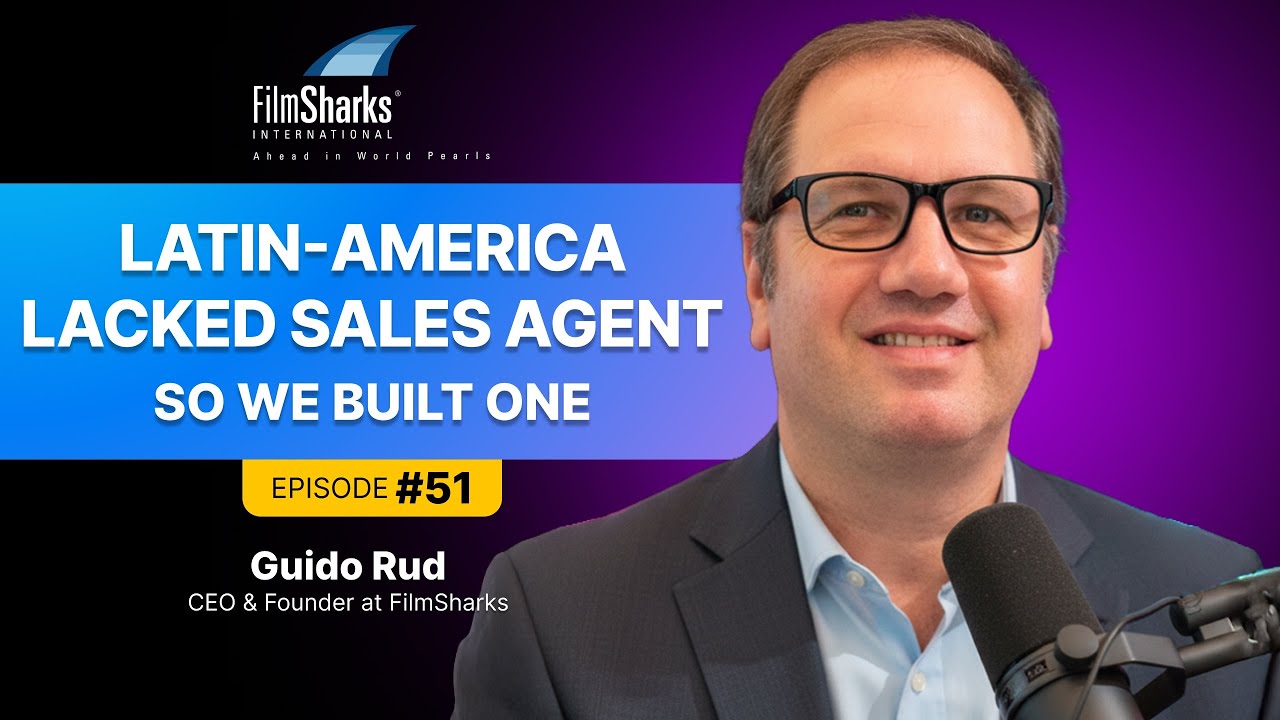
Guido Rud (Founder & CEO, FilmSharks International) on building a world sales operation across three business models—world sales, remake distribution, and production—over 25 years.
Track Active Sales Agents and Their Recent Deal Flow Before You Approach Them
Trusted by Netflix, Warner Bros, and Paramount. Join 140,000+ companies using Vitrina to map verified sales agent capabilities, track deal history across 400,000+ projects, and connect with the right operators before they’re fully booked.
✓ 200 free credits | ✓ No credit card required | ✓ Full platform access
Contract Terms to Watch: Commission, Expenses, and the Recoupment Trap
The standard sales agent commission structure runs 10-15% of MGs collected, plus recoupable expenses. That sounds simple. But the details inside those two numbers can meaningfully affect your recoupment waterfall—especially on lower-budget projects where every percentage point of the capital stack matters.
On commission: the rate itself is negotiable, but going below 10% with an agent who’s genuinely in demand in your genre is often a mistake—it signals to them that your project isn’t worth their full attention. On the expense side, $50,000-$75,000 is market standard for a capped recoupable expense line. Anything above $75K requires justification. Uncapped expense lines are a red flag—market costs (hospitality suites, physical screeners, travel, trade advertising) are real, but without a cap they can accumulate into a six-figure line that sits ahead of your equity recoupment and erodes investor returns before you’ve sold a single territory.
Watch for three specific contract structures. First: the holdback period. How long does the agent hold exclusive sales rights? Most agreements run 2-3 years. Anything beyond 3 years without performance milestones written in is problematic—you don’t want your rights locked with an underperforming agent for half a decade. Second: rights reversion clauses. What triggers reversion of unsold territory rights back to you? These should be automatic and clearly defined—not subject to negotiation at the time you want to reclaim rights. Third: streaming rights carve-outs. In 2026, a streamer buying worldwide rights is a real possibility for many projects. Does your agent contract allow for a worldwide streaming deal that supersedes their territory-by-territory mandate? If not, you’ve created a structural conflict that could kill your best exit at the worst moment.
One practical note: have your entertainment attorney review the agent agreement before signing, not after. The clauses that create problems—unlimited expense recoupment, ambiguous rights reversion triggers, undefined streaming carve-outs—are invisible to producers without legal experience but obvious to anyone who’s seen 20 of these agreements. The $3,000-5,000 legal cost to review the deal properly is trivial against the value of the rights you’re signing over.

Your AI Assistant, Agent, and Analyst for the Business of Entertainment
VIQI AI helps you plan content acquisitions, raise production financing, and find and connect with the right partners worldwide.
- Find active co-producers and financiers for scripted projects
- Find equity and gap financing companies in North America
- Find top film financiers in Europe
- Find production houses that can co-produce or finance unscripted series
- I am looking for production partners for a YA drama set in Brazil
- I am looking for producers with proven track record in mid-budget features
- I am looking for Turkish distributors with successful international sales
- I am looking for OTT platforms actively acquiring finished series for the LATAM region
- I am seeking localization companies offer subtitling services in multiple Asian languages
- I am seeking partners in animation production for children's content
- I am seeking USA based post-production companies with sound facilities
- I am seeking VFX partners to composite background images and AI generated content
- Show me recent drama projects available for pre-buy
- Show me Japanese Anime Distributors
- Show me true-crime buyers from Asia
- Show me documentary pre-buyers
- List the top commissioners at the BBC
- List the post-production and VFX decision-makers at Netflix
- List the development leaders at Sony Pictures
- List the scripted programming heads at HBO
- Who is backing animation projects in Europe right now
- Who is Netflix’s top production partners for Sports Docs
- Who is Commissioning factual content in the NORDICS
- Who is acquiring unscripted formats for the North American market
Genre-Market Matching: Not Every Agent Sells Every Film
Genre is the single biggest determinant of which sales agent is right for your project—more than budget level, more than cast profile. And the genre-market dynamics in 2026 have real specificity that your agent selection should reflect.
Action and thriller travel universally—strong MG potential in Germany, France, Japan, South Korea, UK, and Australia. These are the projects that gap lenders get most excited about because territory values are predictable and distributor bankability is high. If you’re in this genre, you want an agent with proven relationships in all six major markets. Look for agents at the Commercial/genre end of the slate spectrum: companies like Sierra/Affinity, Protagonist Pictures, Embankment Films, or WME Independent in this space.
Horror has a dedicated genre following internationally and commands surprisingly strong MGs in mid-tier markets—Spain, Scandinavia, Eastern Europe—as well as the majors. Specialist agents who focus on genre (Shudder-type content, elevated horror) can outperform generalists here because they’ve built relationships with the specific distributors who prioritize genre acquisition.
Drama is where agent selection becomes most consequential. Drama MGs are highly cast-dependent—unknown cast in a prestige drama does not command meaningful foreign MGs regardless of quality. If your drama doesn’t have a recognizable name, you need an agent who can either (a) help you package talent before they go to market, or (b) target the festival circuit first—where a Cannes or TIFF selection creates the sales momentum that MGs alone won’t provide. Festival-circuit agents—mk2 Films, Memento International, Cercamon—operate in this register.
Comedy is the hardest sell internationally—humor doesn’t export reliably across cultures, and gap lenders typically discount comedy territory estimates most aggressively. If you’re making a comedy, be honest with your agent about where the foreign MG potential genuinely sits versus where you wish it sat. An agent who tells you your British comedy will command premium German MGs is either wrong or telling you what you want to hear. Neither is useful.
The regional dimension matters enormously here. For a project targeting Ibero-American markets, an agent with deep Latin American distributor relationships—built over years of market presence in markets like MIPCOM, Ventana Sur, or NATPE—is worth more than a prestige UK or US agency with no regional infrastructure. As our guide to global streamer pre-sale market impact covers, regional market dynamics have shifted materially since the streaming expansion—and regional agent expertise has become a premium, not a consolation prize.
6 Red Flags Your Due Diligence Should Surface
Here’s the shortlist. Each one has cost producers real money.
1. Inflated sales estimates. The most common problem—and the hardest to catch before you’ve signed. An agent who shows you sales estimates of $3M across territories for a $5M drama without a name cast is telling you what you want to hear. Cross-reference their estimates against comparable titles from the past 18 months at the same budget level with similar cast profiles. If your entertainment attorney has gap lender relationships, run the estimates past a lender informally before committing. This takes two weeks and can save your entire production timeline.
2. No track record in your specific genre. A strong overall slate is not the same as a strong track record in your genre. Ask for deal lists filtered to your genre and budget range—not a general highlights reel. If they can’t provide it, that’s your answer.
3. Uncapped or vaguely defined expense lines. As noted above: uncapped expenses are not standard market practice. They should be non-negotiable red flags. If an agent won’t agree to a $50-75K expense cap, ask why specifically—and get the answer in writing from their business affairs team, not verbally from a sales exec at Cannes.
4. Overcommitted slate. If an agent is carrying 50+ titles to AFM, do the math: over a 5-day market with 10+ hours of buyer meetings per day, your film gets an average of roughly one hour of active pitch time. That’s not enough for a film that needs active selling. Smaller, more selective agents—or agents who explicitly commit to a maximum slate size—are often more effective for titles that aren’t self-selling.
5. Unfamiliar distributor relationships in key markets. Ask your prospective agent: who specifically buys action thrillers for the German market? Who handles horror acquisition for the French market? Who are your top three contacts at Korean distributors? An agent who can answer these questions immediately and with specificity has working relationships. One who’s vague or general about their buyer network doesn’t—and that’s a problem before you’ve shot a frame.
6. No reference from a completed film in your genre and budget range. Ask for two producer references from completed films, ideally in a similar genre, from the last 2-3 years. Call both references. Ask specifically: did MGs close as projected? Were expenses within the capped amount? Did the agent make themselves available during the critical selling windows? Did they communicate transparently when sales were slower than estimated? The answers will tell you everything the agent’s pitch won’t.
Ask VIQI: Who Are the Right Sales Agents for Your Specific Genre, Budget, and Territories?
Stop the guesswork. A Korean animation studio connected with Netflix Adult Animation in one week using Vitrina intelligence. A LA producer connected with Netflix UK, Fifth Season, and Fox Entertainment in 48 hours. That same intelligence is available for sales agent discovery—right now.
✓ Join 140,000+ companies on Vitrina | ✓ 200 free credits | ✓ No commitment
The Data Intelligence Edge: Vetting Agents in 2026
Here’s the problem traditional due diligence runs into: most of the intelligence that matters about a sales agent’s current performance isn’t publicly available. Deal history is confidential. Territory MG amounts are rarely disclosed. Which distributors a specific agent works with in which markets requires relationship access to verify. The Fragmentation Paradox operates at full force in sales agent selection—600,000+ companies in the entertainment supply chain mean that even well-networked producers are operating with a fraction of the market picture they need.
The producers who navigate this most effectively in 2026 are combining traditional reference-checking with real-time market intelligence tools. Instead of spending 3-6 months building a picture of the sales agent landscape through relationship networks—while your greenlight window is potentially closing—they’re using platforms like Vitrina to surface verified deal history, current project activity, and distributor relationship maps in days. That 80-90% compression in research timeline isn’t theoretical. It’s the difference between approaching a prospective agent with informed intelligence about their recent deal flow versus going in blind on the basis of a trade reputation that’s six months out of date.
Practically: before you approach any sales agent for a serious conversation, you should know their last 10-15 project credits (not self-reported—verified), which distributors they’ve worked with in your top three target territories in the last 24 months, and whether their current slate has capacity for your project. That intelligence is findable. It takes less time than you think when you’re not relying exclusively on relationship networks and trade anecdote to compile it.
As our analysis of how film and TV content is sold globally covers in depth, the shift toward data-driven partner selection isn’t coming for the independent market—it’s already here. The agents who’re closing the best deals for their producers in 2026 are the ones whose producers came in with better intelligence than the market expected. That asymmetry is worth building deliberately.
Frequently Asked Questions
What does a foreign sales agent actually do for your film?
A foreign sales agent licenses your film’s distribution rights territory by territory to distributors worldwide. They work major film markets—Cannes Marché, AFM, EFM Berlin, TIFF—pitching your package to their distributor network and negotiating Minimum Guarantee (MG) contracts. They also provide sales estimates by territory, which serve as collateral for gap financing. Their commission is typically 10-15% of MGs collected, plus recoupable expenses capped at $50,000-$75,000.
How do you choose a foreign sales agent for your film in 2026?
The five data-driven selection criteria are: (1) genre-specific deal history in your target territories over the past 24 months; (2) distributor relationships that gap lenders recognize as bankable; (3) sales estimate quality and historical acceptance rate by lenders; (4) slate size and the attention capacity your project will actually receive; and (5) market presence and relationship depth in your specific primary territories. Verify all of these against actual deal history—not pitch materials or self-reported credentials.
What commission do foreign sales agents charge?
Standard foreign sales agent commission is 10-15% of MGs collected, plus recoupable expenses. The expense cap is typically $50,000-$75,000 per film, covering market attendance costs (hospitality, travel, materials, trade advertising). Anything above $75K in expenses requires clear justification. Uncapped expense lines are a red flag and should be negotiated out before signing. Commission rate and expense structure are both negotiable, but going significantly below market on commission often signals reduced attention from the agent on your title.
How do sales agents support gap financing for independent films?
Gap lenders require sales estimates from a reputable agent, with estimates set at 1.5-2× the gap loan amount. Lenders then apply their own discount—typically accepting 50-70% of the agent’s projection—and only count major territories with bankable distributors. An agent whose distributor relationships gap lenders recognize can dramatically improve your collateral position. An agent with weak relationships can make gap financing structurally impossible even if their headline estimates look strong. This is why the agent’s specific distributor network—not just their reputation—is the key variable for gap-financed projects.
What genres travel best internationally in 2026?
Action and thriller remain the strongest performers internationally, with consistent MG demand across Germany, France, Japan, South Korea, Australia, and UK. Horror has a dedicated international genre following and strong mid-tier market MGs. Drama is highly cast-dependent—unknown cast in drama commands minimal foreign MGs regardless of quality. Comedy travels poorly in most markets. For any genre, genre-specialist agents typically outperform generalists because their buyer relationships are concentrated in the right distributor network for your content type.
What are the red flags when choosing a foreign sales agent?
Six key red flags: (1) inflated sales estimates not grounded in comparable recent deals at your budget and cast level; (2) no track record in your specific genre and target territories; (3) uncapped or vaguely defined recoupable expense lines; (4) slate too large for your title to receive meaningful active selling attention; (5) vague or unverifiable buyer relationships in your key markets; (6) no producer references from completed projects in a comparable genre and budget range in the last 2-3 years. Always call the references—verbal answers to direct questions reveal things deal lists don’t.
When should a film approach a foreign sales agent—before or after production?
Ideally before production begins, if you need presales as gap financing collateral. The typical presale strategy is to secure 50-70% of the budget through pre-production MGs, then use gap financing to bridge the remainder. If you’re not relying on presales for production financing, approaching after completion—or after a festival selection—is strategic: post-festival sales often command significantly higher MGs than pre-production deals. The timing decision depends entirely on your financing structure and whether your budget requires presale collateral to greenlight.
How has streaming changed the foreign sales agent landscape?
Significantly. Streamers can now purchase worldwide rights—bypassing traditional territory-by-territory sales entirely—or acquire specific territories in competition with traditional distributors. This creates more buyer competition and allows well-positioned agents to leverage streaming offers against territorial MGs. But it also creates structural complexity: if a worldwide streamer offer conflicts with existing presale territory commitments, you need clear contractual carve-outs for streaming rights in your agent agreement. Agents who haven’t updated their contract templates for the streaming era may inadvertently block your best exit.
Conclusion: Choosing a Sales Agent Is a Capital Stack Decision, Not Just a Distribution One
The foreign sales agent you choose isn’t just your distribution partner. They’re a structural component of your capital stack—whose sales estimates determine your gap loan capacity, whose distributor relationships determine what collateral your lender will advance against, and whose market activity determines how your territories convert from projected value to actual MGs. Treat the selection accordingly.
Key Takeaways:
- Genre-market fit trumps brand prestige: A specialist agent with proven deals in your genre and primary territories outperforms a larger generalist agency where your film is a lower priority title.
- Sales estimates must survive lender scrutiny: Gap lenders discount agent projections by 30-50% and only count bankable distributors. Verify your prospective agent’s relationship depth with major-market buyers before signing.
- Cap the expense line or don’t sign: Standard market rate is $50-75K recoupable. Uncapped expense structures silently erode your recoupment waterfall and should be non-negotiable to fix before the deal closes.
- Slate size determines attention: An agent carrying 50+ titles to AFM averages less than one hour of active selling time for your film. Smaller, more selective slates often deliver better outcomes for titles that aren’t already self-selling.
- Data beats relationships in the selection process: Real-time deal intelligence compresses 3-6 months of manual market research into days—and lets you approach shortlisted agents with verified intelligence about their recent performance, not market gossip from six months ago.
Find Your Ideal Sales Agent—Before Your Financing Window Closes
Vitrina maps 140,000+ verified entertainment companies including sales agents, their deal history, and their active distributor relationships—in real time. Stop relying on relationship networks and 6-month-old trade data to make capital stack decisions.
✓ 200 free credits | ✓ No credit card required | ✓ Cancel anytime
Want a warm introduction to the right agent for your project? Explore Concierge Service →
Find Film+TV Projects, Partners, and Deals – Fast.
VIQI matches you with the right financiers, producers, streamers, and buyers – globally.
Producers Seeking Financing, Co-Pros, or Pre-Buys?
Vitrina Concierge helps producers reach the right financiers, commissioners, distributors, and co-production partners — with precision outreach, not cold pitching.
Join Industry Briefings Trusted by Leaders

Format Adaptations: Global Trends
Where formats are traveling, which adaptations are breaking out, and how streamers are backing remakes in 2025–2026.

Books, Novels & Comics Adaptations: Global Trends
Books, webtoons, and manga driving the next global screen hits. Discover how in this webinar.

Micro-Dramas & Mobile-First Storytelling
Micro-dramas are building real audiences and revenue. Understand the platforms, buyers, and economics behind the growth.

Navigating Global Content Licensing Trends
How global content licensing is shifting beyond flat fees to flexible, deal-driven models.