About Innovation Hub
 Global Content Pulse (Webinars)


 Global Production Financing
(Webinars)
Global Production Financing
(Webinars)  LeaderSpeak Podcast
  About Vitrina
 Our Story
 Our Solutions 🔥
 Film+TV Projects Tracker 🚀
 Case Studies
 Our Profile
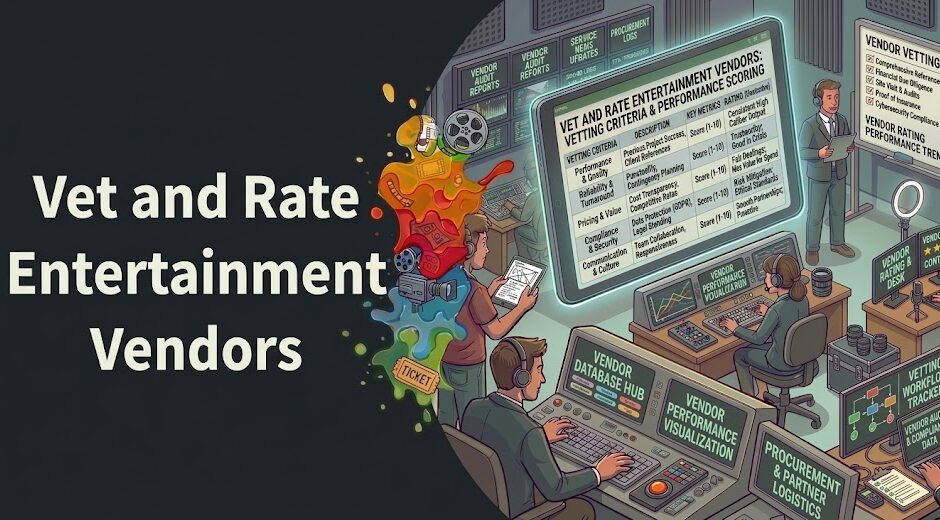
Here’s a number that should make any studio production chief wince: 15–20% margin leakage on every production budget—gone, not through bad creative decisions, but through poor entertainment vendor vetting. You picked the vendor your line producer knew. They marked up 15% because you had no pricing benchmark. And you’ll never know what you left on the table.
This is the Fragmentation Paradox™ in action. There are 600,000+ companies operating across the global film and TV supply chain—and most studios functionally have access to maybe 0.1% of them. Not because the others don’t exist. Because there’s no systematic way to find, verify, and rate them. Until now.
Whether you’re a Netflix-scale operation sourcing VFX for 40 titles a year or an independent studio packaging your first international co-production, the same structural problem applies: your vendor selection process probably still runs on referrals, intuition, and a showreel. That’s not due diligence. That’s a prayer with a conference call attached.
This framework gives you the 7 steps to actually de-risk vendor selection—from capability mapping through to live performance monitoring. It’s how the smart operators run it. And it’s how you close the information gap between what you know and what the market knows.
In This Guide
- Why Vendor Vetting Failures Cost Studios Millions
- Step 1: Map Your Technical Requirements First
- Step 2: Verify Track Record Beyond the Showreel
- Step 3: Audit the Hero Project Portfolio
- Step 4: Run Financial Health and Capacity Checks
- Step 5: Build a Weighted Vendor Scorecard
- Step 6: Conduct Reference Calls That Surface Real Risk
- Step 7: Use Live Intelligence to Monitor Vendor Health
- How Vitrina Accelerates Entertainment Vendor Vetting
- Frequently Asked Questions
Ask VIQI: Which VFX Vendors Have the Capacity for My Project Right Now?
VIQI is Vitrina’s AI assistant—trained on 1.6 million titles, 360,000 companies, and 5 million entertainment professionals. Ask it to surface verified vendors by capability, territory, and budget range in seconds.
✓ Included with 200 free credits | ✓ No credit card needed
Why Vendor Vetting Failures Cost Studios Millions
The math is brutal when you run it. A $10 million production typically allocates 40%—or $4 million—to services: VFX, post-production, location services, localization, sound. Now apply a 15% markup from relationship-based intermediaries who control your access to vendors you’ve never heard of. That’s $600,000 per production in direct EBITDA leakage. Not creative overspend. Information deficit.
But the margin leak isn’t even the worst part. It’s the timeline drag. The traditional vendor vetting cycle—ask contacts, get referrals, request capability decks, schedule discovery calls, verify hero projects manually, negotiate, legal review—runs 3 to 6 months. That’s talent holds expiring. Greenlight windows closing. Tax incentive deadlines missed. Entire seasons lost.
According to Variety, the current production environment has become one of the most competitive in recent memory—budgets are tighter, timelines shorter, and deliverables more technically demanding than ever. Studios that still rely on informal networks to source vendors are operating a decade behind.
Phil Hunt, Founder and CEO of Head Gear Films—which has financed 550+ movies and operates at a volume of 35–40 films per year—is direct about the industry reality: the whole landscape has become much harder in terms of getting projects off the ground and getting them sold. Vendor quality and reliability aren’t optional anymore. They’re existential. As we explore in our strategic vetting framework for global studios, the showreel era is over.
Phil Hunt (Founder & CEO, Head Gear Films) discusses the current production financing crunch and what it demands from vendor partnerships in this Vitrina LeaderSpeak episode:

So—what’s the right process? Here’s the 7-step framework the smartest studios are running in 2026.
Step 1: Map Your Technical Requirements Before You Search
Most vendor searches fail at step zero—because the brief is vague. “We need a VFX house” isn’t a spec. It’s an invitation for every vendor to self-describe as exactly what you need. Before you talk to a single company, build your technical requirements document.
This means specifying: the pipeline compatibility requirements (Unreal Engine, Houdini, DaVinci Resolve), the delivery specs for your primary distributor (Netflix IMF, AppleTV+ HDR10+), the budget range per department, the territory you’re sourcing in (which affects tax incentive eligibility), and your delivery timeline with hard milestones attached.
That last item matters more than most buyers appreciate. A vendor who’s technically capable of delivering your post-production work is useless if they’re booked solid for the next 8 months. Capacity verification has to happen before capability verification—not after you’ve fallen in love with their reel.
The output of Step 1 is a one-page technical brief you can use to qualify vendors rapidly. Anyone who can’t tick all the boxes doesn’t make the longlist. This alone cuts your vetting universe from hundreds of vendors to dozens.
Step 2: Verify Track Record Beyond the Showreel
The showreel is marketing. And it’s been optimized to impress—not to inform. Every vendor you’re considering has a showreel featuring their best work. The problem? That work might be 3 years old, might have been done by crew who’ve since left, and might represent a scale of project they’ve never replicated.
Verified track record means answering five specific questions:
- Who did they actually work for—not just who’s on their client list, but which specific projects, in which years, at what budget levels?
- What were they responsible for—lead facility or sub-contractor? The distinction is critical for liability and quality control.
- What’s the recency of comparable work? A studio that delivered broadcast-quality VFX in 2021 may have lost half its senior team to a streaming platform’s in-house facility since.
- Do the credits verify independently? IMDb is incomplete and self-reported. Cross-reference against distributor press releases, trade coverage, and completion bond records.
- Were there any delivery failures, disputes, or arbitration? You won’t find this in a deck. You find it by asking the right questions to the right sources.
This is where most studios stop—because manual verification is genuinely time-intensive. But skipping this step is exactly how you end up mid-production with a vendor who can’t deliver. The deep metadata approach to vendor qualification automates much of this cross-referencing at scale.
Find Verified Vendors Across 140,000+ Active Suppliers—Without the 6-Month Search
Trusted by Netflix, Warner Bros, and Paramount. Vitrina verifies capabilities, hero projects, and current capacity—so you close deals in days, not months.
✓ 200 free credits | ✓ No credit card required | ✓ Full platform access
Step 3: Audit the Hero Project Portfolio
Every vendor has a handful of flagship projects they’ll lead with—their “hero” portfolio. These are the titles that define their positioning: the major studio feature, the award-winning series, the streaming original with recognizable IP. Don’t just admire them. Audit them.
What you’re looking for is whether the hero project profile actually aligns with what you need. If a VFX house’s hero credits are action-heavy theatrical productions and you’re commissioning a nuanced character drama with photo-real creature work—those are completely different pipelines and creative cultures. But they’ll show you the hero reel and let you assume the transferability.
The audit questions for each hero project:
- Budget scale: Was the project comparable to yours in spend? A vendor who delivered $40M of VFX work for a studio tentpole may be totally ill-equipped—in project management, in systems, in team structure—for a $3M independent feature. And vice versa.
- Timeline adherence: Did the project deliver on schedule? Ask for the original delivery schedule vs. actual delivery date. Late delivery signals are often available in trade coverage if you know where to look.
- Creative alignment: Does the aesthetic of the hero project actually reflect where you need to go? Technical excellence in one genre doesn’t transfer automatically.
- Recency: Is the hero project from the last 24 months? Technology and team composition change fast in this industry. A 2021 hero credit tells you almost nothing about 2026 capability.

Your AI Assistant, Agent, and Analyst for the Business of Entertainment
VIQI AI helps you plan content acquisitions, raise production financing, and find and connect with the right partners worldwide.
- Find active co-producers and financiers for scripted projects
- Find equity and gap financing companies in North America
- Find top film financiers in Europe
- Find production houses that can co-produce or finance unscripted series
- I am looking for production partners for a YA drama set in Brazil
- I am looking for producers with proven track record in mid-budget features
- I am looking for Turkish distributors with successful international sales
- I am looking for OTT platforms actively acquiring finished series for the LATAM region
- I am seeking localization companies offer subtitling services in multiple Asian languages
- I am seeking partners in animation production for children's content
- I am seeking USA based post-production companies with sound facilities
- I am seeking VFX partners to composite background images and AI generated content
- Show me recent drama projects available for pre-buy
- Show me Japanese Anime Distributors
- Show me true-crime buyers from Asia
- Show me documentary pre-buyers
- List the top commissioners at the BBC
- List the post-production and VFX decision-makers at Netflix
- List the development leaders at Sony Pictures
- List the scripted programming heads at HBO
- Who is backing animation projects in Europe right now
- Who is Netflix’s top production partners for Sports Docs
- Who is Commissioning factual content in the NORDICS
- Who is acquiring unscripted formats for the North American market
Step 4: Run Financial Health and Capacity Checks
This is where most studio procurement processes have a blind spot—and where the real risk lives. A vendor who can’t survive financially through your production is a catastrophic problem, not just an inconvenient one.
As The Hollywood Reporter has noted, the post-2023 production correction left dozens of post and VFX facilities financially strained—some still operational, some carrying significant deferred obligations, some quietly winding down while still taking on new projects. You have no way to know which category your shortlisted vendor falls into unless you ask the right questions.
The financial health checklist:
- Completion track record: Have they completed every project they’ve started in the last 3 years, or are there partial deliveries in their history?
- Current project load: What’s their current pipeline? Overcommitment is as dangerous as under-capacity. A vendor with 8 simultaneous major projects is a bandwidth risk for yours.
- Key person dependency: Is the quality of output dependent on 2–3 senior artists or technicians who could leave? Ask directly about team stability.
- Payment terms history: Do they pay sub-contractors on time? Vendors who aren’t paying their own crew and facilities are signaling cash flow problems that will eventually hit your project.
- Insurance and bonding: Do they carry E&O insurance appropriate to your project scale? Are they bondable if your completion guarantor requires it?
But here’s the thing—getting accurate capacity data is genuinely hard without live market intelligence. Vendors aren’t going to tell you they’re overextended. This is exactly the intelligence gap that supply chain intelligence platforms are built to close.
Step 5: Build a Weighted Vendor Scorecard
Gut feel has no place in vendor selection at scale. You need a scoring framework that makes comparison systematic, defensible to stakeholders, and repeatable across every production in your slate. The weighted scorecard replaces “who do we know?” with “who scores highest against our actual requirements?”
Here’s a baseline weighting model for entertainment vendor evaluation:
You can adjust these weights by project type—a tight-turnaround episodic television production might weight capacity at 30% and technical capability lower. A prestige theatrical feature might flip the balance toward track record and financial stability. The critical point is that the weights are set before you start evaluating—not reverse-engineered to justify a pre-existing preference.
Step 6: Conduct Reference Calls That Actually Surface Risk
Reference calls are broken by design—because every vendor gives you references who will say positive things. But a well-structured reference conversation can still surface the information you actually need. The trick is in the questions.
Don’t ask “how was your experience working with them?” Ask these instead:
- “What would you do differently if you engaged them again?” — This question always surfaces friction, even from satisfied clients.
- “Was there ever a point in the project where you were worried about delivery?” — Forces honest conversation about timeline or quality stress points.
- “Who specifically on their team drove the quality of work?” — Identifies key-person dependency and lets you verify that person is still at the company.
- “How did they handle the first significant change request?” — Tests commercial flexibility and whether they became difficult when scope evolved.
- “Would you use them again for a project with a tighter timeline and budget?” — Stress-tests the relationship beyond ideal conditions.
And don’t limit yourself to provided references. Find adjacent contacts—crew who worked on the same production, post supervisors who interfaced with the vendor, distributors who received deliverables. Those conversations happen at festivals, in Slack channels, on the margins of industry events. That’s where the real signal lives.
Need Verified Vendors Sourced Specifically for Your Project?
Vitrina Concierge acts as your Virtual Agent. We don’t hand you a list—we make warm introductions directly to decision-makers who match your exact project requirements.
- LA producer → Netflix UK, Fifth Season, Fox Entertainment in 48 hours
- MENA studio → 3 qualified VFX partners with budget alignment in 1 week
- No commitment | No credit card | Tailored to your brief
Step 7: Use Real-Time Intelligence to Monitor Vendor Health Mid-Production
The vetting process doesn’t end when you sign the contract. In fact, some of the most significant vendor risks emerge mid-production—a key senior artist leaves, a competing project consumes team bandwidth, a financial stress point creates cash flow delays that ripple into your delivery schedule.
But most studios are flying blind once the deal is signed. You’re relying on weekly status calls and your line producer’s gut feel. That’s a single-layer, manual monitoring system for a multi-million-dollar dependency.
Real-time vendor monitoring means tracking:
- Project pipeline signals: Is your vendor suddenly taking on 3 additional major projects while in the middle of yours? That’s a bandwidth warning that doesn’t appear in any status call.
- Key personnel changes: Has the VFX supervisor or head of department changed since you signed? Team continuity is a direct quality proxy.
- Industry news and announcements: Is your vendor’s parent company being acquired, restructured, or cutting headcount? These signals appear in the trades before they appear in your production dashboard.
- Financial health indicators: Are there public signals—delayed supplier payments, equipment liquidations, office consolidations—that suggest cash flow stress?
This is the intelligence layer that separates reactive production management from proactive supply chain risk management. And it’s only possible with live data—not last month’s IMDb update or last quarter’s trades coverage.
How Vitrina Accelerates Entertainment Vendor Vetting for Global Studios
The 7-step framework above is sound. The challenge is execution time. Running each step manually—even with a dedicated team—is the 3–6 month cycle that kills greenlight windows and erodes capital efficiency.
Vitrina’s platform resolves the Fragmentation Paradox™ by mapping 140,000+ actively producing companies with verified capabilities, hero project portfolios, capacity status, and market pricing benchmarks. The difference in practice:
- Traditional vetting process: 3–6 months | 5–10 vendors reviewed | relationship-biased selection
- Vitrina-powered vetting: Days to weeks | 50–100 qualified vendors surfaced | data-driven comparison
Producers using Vitrina can search for “photorealistic VFX companies, available Q3 2026, budget range $2–4M, UK or MENA-based for tax incentive eligibility”—and receive a ranked, verified list in minutes rather than months. Studios like Warner Bros and Paramount are already running this intelligence layer on their supply chains.
And for complex sourcing needs—co-production partnerships, specialty post houses in emerging markets, localization vendors for non-English language distribution—Vitrina’s Smart Pairing capability matches project requirements against verified supplier profiles across 195 countries. That’s the Insider Advantage that used to require decades of festival contacts to develop. Now it’s accessible on day one.
Want to see how Vitrina handles the specific vendor categories in your next production? The executive guide to supply chain management and vendor qualification walks through the full platform workflow.
Frequently Asked Questions: Entertainment Vendor Vetting
What is entertainment vendor vetting and why does it matter in 2026?
Entertainment vendor vetting is the structured process of evaluating production service providers—VFX studios, post-production houses, localization vendors, location services—before engagement. In 2026 it matters more than ever because the post-production correction has left dozens of vendors financially strained, team structures have shifted dramatically post-COVID, and delivery requirements from streaming platforms have become more technically demanding. Studios that rely on informal referrals alone face 15–20% margin leakage and 3–6 month deal delays.
How long should entertainment vendor vetting typically take?
Traditional vetting—relying on relationship networks, manual capability verification, and sequential reference calls—typically runs 3 to 6 months per vendor category. With real-time supply chain intelligence platforms like Vitrina, the same depth of verification can be compressed to days or weeks, because hero project data, capacity status, and technical specifications are pre-verified across 140,000+ suppliers. For time-sensitive greenlit productions, that compression is often the difference between hitting your production window and missing it.
What are the biggest vendor vetting mistakes studios make?
The five most common vetting failures are: relying on showreels without verifying recency or scope; accepting vendor-provided reference lists without seeking independent contacts; skipping financial health checks until problems emerge mid-production; treating vetting as a one-time pre-contract exercise rather than an ongoing monitoring process; and evaluating vendors in isolation rather than against market benchmarks. Each of these failures has a direct cost—in margin, in timeline, or in production quality.
How do you verify a vendor’s capacity before signing a contract?
Capacity verification requires going beyond the vendor’s self-report. Ask for their current active project list with approximate team allocations and delivery dates. Cross-reference public project announcements and credits data to identify undisclosed concurrent commitments. Use industry intelligence platforms to track new project announcements by your shortlisted vendors in real time. And build contractual protections—milestone-based payment structures and replacement provisions—to manage capacity risk once you’re in production.
What is a vendor scorecard and how should studios weight the criteria?
A vendor scorecard is a weighted evaluation framework that scores vendors against predefined criteria to enable systematic comparison. For most entertainment productions, the key criteria are: technical capability (25%), track record and hero projects (25%), capacity and timeline reliability (20%), financial health (15%), and price vs. market benchmark (15%). These weights should be calibrated before evaluation begins—not adjusted to favour a preferred vendor. For time-critical productions, capacity weighting should increase significantly.
How can I vet entertainment vendors in emerging markets where information is scarce?
Vetting vendors in MENA, APAC, or LATAM markets is harder precisely because information infrastructure is less developed. Relying solely on local introductions creates a markup layer of 15–20% and exposes you to undisclosed conflicts of interest. The most effective approach combines: verified platform data from services like Vitrina that map 50,000+ production service companies globally; direct outreach to regional film commissions and trade bodies; cross-referencing completed productions from the territory for references; and engaging a specialist concierge service that has pre-verified local relationships.
What role does AI play in entertainment vendor vetting in 2026?
AI-powered tools now significantly accelerate the research and comparison stages of vendor vetting. Platforms trained on entertainment supply chain data can surface vendors matching specific capability, territory, and budget criteria in minutes. AI assistants like VIQI can answer complex questions about vendor capabilities based on a database of 360,000 companies and 5 million entertainment professionals. The critical point is that AI accelerates the intelligence-gathering phase—it doesn’t replace the human judgment required in reference calls, contract negotiation, and performance monitoring.
How does the Fragmentation Paradox affect vendor selection for independent studios?
The Fragmentation Paradox describes the counterintuitive situation where 600,000+ companies exist in the global film and TV supply chain, but information opacity means most studios functionally access less than 0.1% of them. For independent studios this is particularly acute: without the relationship networks of major studios, they’re even more dependent on introducers who mark up their fee, referrals from festivals, and word-of-mouth that’s both anecdotal and biased. Breaking this dependence requires real-time supplier intelligence—not a bigger festival circuit.
Bottom Line: Make Vendor Vetting a Competitive Weapon
The studios that win on margin in 2026 aren’t the ones with the biggest budgets. They’re the ones who’ve weaponized their supply chain intelligence—who know which vendors are genuinely available, genuinely capable, and genuinely priced fairly before they ever pick up a phone.
That’s not a passive advantage. It takes a systematic process—the 7 steps above—and the right data infrastructure behind it. But here’s the payoff: reduce your average margin leakage from 15% to 5% on a $10M production, and you’ve just protected $1 million in net return. Across a 5-title annual slate, that’s $5 million in recovered EBITDA. That’s not a technology investment. That’s an ROI no CFO in the room will argue with.
The information advantage used to require decades of festival relationships and insider networks to build. Now it’s available on day one—to any studio willing to run the process properly.
Key Takeaways
- Margin leakage is structural, not accidental: 15–20% margin is lost on every production through information asymmetry in vendor selection—not bad creative decisions.
- The showreel is marketing: Verified hero project audits, financial health checks, and reference calls that surface risk are the minimum standard for responsible vendor due diligence.
- Capacity verification must precede capability evaluation: A vendor who can’t absorb your project in your timeline is a zero regardless of their reel.
- Weighted scorecards replace gut feel: Set your criteria and weights before you evaluate—not after. This is how you defend decisions and eliminate bias.
- Vetting doesn’t end at contract signing: Real-time intelligence on vendor pipeline changes, team turnover, and financial signals is the only reliable mid-production risk management system.
Stop Losing Margin to Vendor Guesswork. Start with Verified Data.
Trusted by Netflix, Warner Bros, and Paramount. Join 140,000+ companies using Vitrina to source, vet, and track entertainment vendors across 195 countries.
✓ 200 free credits | ✓ No credit card required | ✓ Full platform access from day one
Find Film+TV Projects, Partners, and Deals – Fast.
VIQI matches you with the right financiers, producers, streamers, and buyers – globally.
Producers Seeking Financing, Co-Pros, or Pre-Buys?
Vitrina Concierge helps producers reach the right financiers, commissioners, distributors, and co-production partners — with precision outreach, not cold pitching.
Join Industry Briefings Trusted by Leaders

Format Adaptations: Global Trends
Where formats are traveling, which adaptations are breaking out, and how streamers are backing remakes in 2025–2026.

Books, Novels & Comics Adaptations: Global Trends
Books, webtoons, and manga driving the next global screen hits. Discover how in this webinar.

Micro-Dramas & Mobile-First Storytelling
Micro-dramas are building real audiences and revenue. Understand the platforms, buyers, and economics behind the growth.

Navigating Global Content Licensing Trends
How global content licensing is shifting beyond flat fees to flexible, deal-driven models.