About Innovation Hub
 Global Content Pulse (Webinars)


 Global Production Financing
(Webinars)
Global Production Financing
(Webinars)  LeaderSpeak Podcast
  About Vitrina
 Our Story
 Our Solutions 🔥
 Film+TV Projects Tracker 🚀
 Case Studies
 Our Profile
Here’s the real dynamic most production service companies won’t admit: their new business pipeline runs almost entirely on warm relationships and festival luck. A referral from a trusted line producer, a conversation at an AFM party, a chance reconnect at NAB.
It works—until it doesn’t. And in 2026, with 50,000+ production service companies operating across 195 countries and streaming platforms either pulling back or radically restructuring their vendor relationships, “relationship-dependent” is no longer a strategy. It’s a risk.
The companies winning new business consistently—the post-production houses landing Netflix projects out of Mexico City, the VFX boutiques getting called into UK high-end drama pre-production, the localization studios breaking into K-drama pipelines—aren’t doing it through networking alone. They’re doing it through lead generation for film TV production service companies that’s built on project intelligence, not proximity. This guide gives you the specific strategies they’re using.
This is written for the heads of business development and senior sales executives at VFX studios, post-production houses, localization service providers, line production companies, equipment rental operations, and related production services. You’re not a distributor and you’re not a content buyer—you’re the infrastructure the industry runs on. Your BD challenge is different. And so is the solution.
Table of Contents
- Why Lead Generation Is Broken for Most Production Service Companies
- Strategy 1: Project-State Monitoring — The Greenlight-to-Vendor Window
- Strategy 2: Replace Directory-Hunting with Real-Time Project Intelligence
- Strategy 3: Build Capability Profiles That Surface in the Right Searches
- Strategy 4: Outreach Sequencing Tied to Production Stage, Not Calendars
- Strategy 5: Sovereign Content Hubs as Untapped Client Markets
- Strategy 6: Hero Project Positioning — Let Your Track Record Sell First
- Strategy 7: Vitrina as Daily Lead Generation Infrastructure
- Strategy 8: Concierge Introductions for High-Value Account Break-In
- What Separates the Service Companies Winning New Business in 2026
- Frequently Asked Questions
- Conclusion
Ask VIQI: Which productions in my target market are entering pre-production right now?
VIQI is trained on 1.6 million titles, 360,000 companies, and 5 million entertainment professionals. Get project-state intelligence before your competitors even see the greenlight announcement.
✓ 200 free credits included | ✓ No credit card needed
Why Lead Generation Is Broken for Most Production Service Companies
The mechanics are straightforward enough, and yet most service companies can’t describe them clearly: you need to reach a production at the exact moment they’re sourcing vendors for a specific service—early enough that you’re in the room before the shortlist closes, late enough that the budget is confirmed and the project is actually happening. Miss the window on either side and you’re either pitching too early (before anyone cares) or too late (after the work is awarded).
The problem? Most production service companies have no systematic way to find that window. They wait for RFPs. They scan trade publications—which are typically 6-8 weeks behind actual project developments by the time news hits Deadline or Variety. They rely on their existing contacts to pass referrals. And when business slows, they double down on conference attendance and hope. None of this is lead generation. It’s lead reaction.
The Fragmentation Paradox™ compounds this. There are 140,000+ actively producing film and TV companies globally—the vast majority of which your BD team has never identified, let alone contacted. Your total addressable market is exponentially larger than what your current relationship network can reach. And because that market is fragmented across 195 countries, no directory captures it, no conference brings it all together, and no LinkedIn search gets you the project-level context you actually need to approach it intelligently.
Paulo Carballar, Founder and CEO of Dinamita Post—Mexico’s leading post-production house, with credits spanning Oscar-nominated and Emmy-winning productions—built his firm’s reputation through delivering exceptional work. But the step before delivery is sourcing the right projects at the right moment. That’s what separates a full calendar from an empty one. And it’s addressable—systematically—if you build the right infrastructure.

Your AI Assistant, Agent, and Analyst for the Business of Entertainment
VIQI AI helps you plan content acquisitions, raise production financing, and find and connect with the right partners worldwide.
- Find active co-producers and financiers for scripted projects
- Find equity and gap financing companies in North America
- Find top film financiers in Europe
- Find production houses that can co-produce or finance unscripted series
- I am looking for production partners for a YA drama set in Brazil
- I am looking for producers with proven track record in mid-budget features
- I am looking for Turkish distributors with successful international sales
- I am looking for OTT platforms actively acquiring finished series for the LATAM region
- I am seeking localization companies offer subtitling services in multiple Asian languages
- I am seeking partners in animation production for children's content
- I am seeking USA based post-production companies with sound facilities
- I am seeking VFX partners to composite background images and AI generated content
- Show me recent drama projects available for pre-buy
- Show me Japanese Anime Distributors
- Show me true-crime buyers from Asia
- Show me documentary pre-buyers
- List the top commissioners at the BBC
- List the post-production and VFX decision-makers at Netflix
- List the development leaders at Sony Pictures
- List the scripted programming heads at HBO
- Who is backing animation projects in Europe right now
- Who is Netflix’s top production partners for Sports Docs
- Who is Commissioning factual content in the NORDICS
- Who is acquiring unscripted formats for the North American market
Strategy 1: Project-State Monitoring — The Greenlight-to-Vendor Window
This is the most important lead generation concept for any production service company, and the one most consistently ignored. The greenlight-to-vendor window is the 4-8 week period between when a project is confirmed as going ahead and when vendor contracts are awarded. It’s your primary sales window. Everything after that is competing for scraps.
Here’s what’s actually happening in those weeks: line producers are assembling vendor shortlists, budget ranges are being locked, and departments are being asked for recommendations. If your company isn’t on those shortlists—because no one at the production has heard of you, or because your capabilities weren’t surfaced through the sourcing process—you don’t exist. Not because your work isn’t good. Because you weren’t present at the right moment.
The fix is project-state monitoring. Track your target accounts and segments for pre-production entry signals: confirmed greenlight news, announced financing, talent attachments, or production company announcements of new slates. When a project transitions from development into active pre-production, that’s your entry trigger. Vitrina tracks 400,000+ projects globally in real time—which means you can filter for your exact service category (VFX, post, localization, line production) and receive alerts the moment relevant projects enter your window.
Teams that respond to project triggers within 72 hours consistently outperform those relying on scheduled outreach sequences. And they’re reaching buyers 4-6 weeks ahead of when formal briefs reach the broader market. That’s not a marginal advantage—it’s the difference between getting the call and missing the shortlist entirely. As our guide on using the Projects Tracker for daily lead generation describes, this workflow becomes the engine of a proactive BD operation.
Strategy 2: Replace Directory-Hunting with Real-Time Project Intelligence
Static directories—KFTV, Mandy, The Production List, generic IMDb credits—were built to help buyers find vendors. They’re not built for vendors finding buyers. And in 2026, even the best static directories are fighting a losing battle against the velocity of the market. Productions spin up, slate priorities shift, and buyer mandates change faster than any annual directory publication cycle can track.
What you actually need isn’t a bigger directory. It’s a live map of which productions are happening, where, with what budget range, under what commissioning structure, and at what production stage right now. That’s the intelligence layer that transforms cold outreach into context-rich conversations—and why static directories are no longer sufficient as the primary BD tool for VFX and production service companies.
Here’s a concrete example. A localization studio in Warsaw wants to reach European streaming productions that are commissioning non-English drama with high-end dubbing requirements. A directory search gives them a list of streaming platforms. Real-time project intelligence gives them a list of specific productions currently in post-production at European streaming subsidiaries—with the production company, stage, budget tier, and relevant executive contact. Those are two completely different starting positions for a BD conversation.
VIQI—Vitrina’s AI research assistant—answers exactly these kinds of strategic queries. “Which high-budget scripted TV productions are currently in post-production in APAC and actively using international localization partners?” That’s not a Google search. It’s a business intelligence question with a specific, actionable answer. And it’s the kind of intelligence that drives 80-90% compression in deal research timelines compared to manual directory-based prospecting.
Find Your Next Client Before They Post an RFP
Trusted by Netflix, Warner Bros, Paramount, and Google TV. Join 140,000+ companies tracking 400,000+ active projects in real time — including the ones currently entering your sourcing window.
✓ 200 free credits | ✓ No credit card required | ✓ Full platform access
Strategy 3: Build Capability Profiles That Surface in the Right Searches
Inbound lead generation for production service companies lives or dies on one thing: whether buyers can find you when they’re looking for exactly what you do. Not generally. Specifically. A post-production house that describes itself as “full-service post for film and TV” competes with thousands of identically described companies. A post house that positions itself as “episodic high-end drama post with photorealistic VFX composite capability for streaming-native delivery in IMF and HDR”—that’s findable by a line producer sourcing for a specific project requirement.
Your capability profile needs three layers to generate meaningful inbound. First: hero project specificity—not “we’ve worked with major streaming platforms” but named productions, named platforms, named formats, specific deliverable types. Verified hero project history is the single highest-weight factor when a producer is shortlisting vendors they don’t have a prior relationship with. Second: technical specification depth—what workflows, what software, what delivery formats, what turnaround capacity at what budget tiers. Third: geographic and language capability—where you can physically deliver, what local production contexts you understand, what co-production treaty jurisdictions you operate within.
The Fragmentation Paradox™ creates a specific advantage here for companies willing to invest in capability documentation. Producers—under time pressure, sourcing across a 600,000+ company global supply chain—rely heavily on platforms like Vitrina to surface verified options. Your Vitrina Digital Storefront is a structured capability profile visible to the 140,000+ production companies actively using the platform. It’s inbound lead generation working while your BD team sleeps.
Paulo Carballar (Founder & CEO, Dinamita Post) on building a world-class post-production service business and landing Oscar-nominated and Emmy-winning productions—including how capability positioning and quality track records drive new client acquisition:
Strategy 4: Outreach Sequencing Tied to Production Stage, Not Calendars
Production stage defines everything about the right outreach message, the right contact, and the right ask. Most BD teams don’t segment by production stage—they segment by company type and run the same capabilities outreach regardless of where a production is in its lifecycle. That’s why open rates plateau and response rates stay low.
Here’s how stage-based sequencing actually works for production service companies. At development stage: you’re not selling yet—you’re planting flags. A relationship note, a reel relevant to their announced project type, a “here’s what we did on a similar project” context piece. No ask. Just visibility. At pre-production: this is your primary sales moment. Direct contact with the line producer or production supervisor, capability-specific pitch tied to their project’s confirmed format, budget tier reference, and availability confirmation. At production: targeted outreach only if you offer something actively needed mid-shoot (equipment, crew, additional post capacity). At post-production: if they’re already in post with someone else, you’re prospecting for the next project, not this one. Build the relationship for the follow-on.
The tactical detail that makes this work is knowing which stage a project is in in real time—not from a press release, but from actual project tracking. Seth Hallen and Craig German, whose work on AI in the entertainment supply chain was covered in a Vitrina podcast, both noted how production stage intelligence is reshaping how vendors position themselves proactively rather than reactively. That’s the operational shift the leading outreach automation frameworks are now built around.
Strategy 5: Sovereign Content Hubs as Untapped Client Markets
If your BD team is focused exclusively on established markets—US studios, UK broadcasters, major European streamers—you’re competing in the most crowded parts of the vendor landscape while systematically ignoring the fastest-growing production markets. The Sovereign Content Hubs™ that have emerged across MENA and APAC aren’t just regional stories. They’re your next growth market, and the vendor competition there is still far thinner than in Los Angeles or London.
Saudi Arabia’s MISA has been actively courting international productions through its 40% cashback incentive, with production spend accelerating through Neom Studios and the Vision 2030 content mandate. The UAE continues to position Abu Dhabi and Dubai as high-end production service markets. South Korea—a fully established Sovereign Content Hub—is producing K-drama and thriller content at a pace that has created consistent demand for international post and localization partners. These aren’t emerging markets in the classic sense. They’re mature-capital, government-backed production environments that are actively building their international vendor networks.
What’s actually happening in these markets: production volumes have grown significantly, local infrastructure is still developing, and international service vendors who establish relationships now are getting first-mover positioning before the market normalises. A UK VFX studio or a Latin American localization provider that builds relationships with Saudi production entities in 2026 isn’t chasing an uncertain bet—they’re entering a funded, government-prioritised production market before it becomes as competitive as conventional territories. Vitrina’s platform maps active production activity across all major Sovereign Content Hub markets, with company-level and project-level filtering that surfaces the right entry points for your specific service category.
Strategy 6: Hero Project Positioning — Let Your Track Record Sell First
What’s the trades don’t report on: most vendor shortlisting in production is done by people who are time-poor, risk-averse, and relying on quick heuristics to filter a long market of options to a short list of conversations. Those heuristics are almost entirely track-record-based. Who have you worked with that we know? What projects have you delivered that are comparable to ours? Can we verify the claims you’re making?
That’s why hero project positioning—leading your BD outreach and capability profile with your most relevant, most prestigious, most comparable credits—is a direct pipeline accelerant. Not a generic reel. Not a capabilities brochure. A specific project, named, with the platform, the format, the deliverables, and the result. “We delivered the complete VFX package for [Title] on [Platform]—12,000 shots in 18 weeks, IMF and HDR compliant, with zero post-delivery rejections.” That sentence does more lead generation work than 3 pages of generic capability copy.
And it works in both directions. Inbound—when a producer searches for vendors with comparable credits to their project, your verified hero project history surfaces you. Outbound—when your BD team reaches out to a cold contact, opening with a relevant comparable credit immediately establishes credibility before the capability pitch begins. The strategic framework for VFX client acquisition consistently identifies hero project verification as the highest-conversion cold-to-warm conversion lever available to service vendors.
Strategy 7: Vitrina as Daily Lead Generation Infrastructure
The operational question for any BD team isn’t “should we use Vitrina?” It’s “how do we build the daily workflow so that project intelligence feeds directly into our outreach queue?” Here’s how high-performing service company BD teams are structuring that.
Morning intelligence sweep. Daily filter of Vitrina’s Projects Tracker for your specific service category and target markets. Any projects transitioning into pre-production or post-production go into the active outreach queue immediately. This replaces the 30-60 minute morning scan of trade publications that yields maybe 1 actionable item per week with a targeted, filtered intelligence pull that yields multiple qualified leads per day.
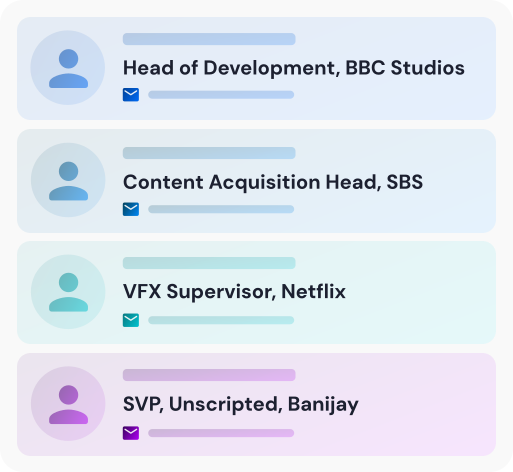
Decision-maker identification at account level. Once a target project is identified, Vitrina’s company and executive database—3 million verified entertainment professionals mapped to active projects—surfaces the line producer, the production supervisor, the VFX producer, or the post-production coordinator relevant to your service. You’re not cold-calling a company; you’re contacting the specific person who owns the vendor decision for the specific project you’ve already identified as a match.
VIQI for competitive market intelligence. Before any significant pitch or account approach, use VIQI to understand what comparable deals look like in your target market—what other vendors are active in that production ecosystem, what budget ranges are standard for your service type at that platform or budget tier. That’s the pricing and positioning context that turns a capabilities conversation into a confident, benchmark-grounded proposal. As the core case for Vitrina as a service company lead generation tool documents—the ROI isn’t just in finding more leads. It’s in finding better ones, faster.
Strategy 8: Concierge Introductions for High-Value Account Break-In
Cold outreach has its limits—and in entertainment, those limits are sharper than in most industries. Decision-makers are protective of their time, wary of unsolicited vendor pitches, and heavily reliant on trusted introductions when vetting new relationships. A warm introduction from a trusted industry context—where the introducer can vouch for both the service quality and the relevance to the specific project—converts at radically higher rates than any cold outreach sequence, regardless of how well-timed or capability-specific the message is.
Vitrina Concierge is designed exactly for this. It’s not a database handoff—it’s a managed introduction service that matches production service companies with active projects and decision-makers based on real project requirements, then makes direct introductions with context on both sides. A Korean animation studio was introduced to a Netflix Adult Animation executive within a single week. A Latin American post-production company was connected to three active acquiring producers within 48 hours of brief submission. These aren’t referral-network accidents—they’re repeatable outcomes from a structured introduction process built on verified intelligence.
For service companies trying to break into accounts that their relationship network doesn’t reach—a new streaming platform, a different budget tier, a geographic market they haven’t worked in before—Concierge is the fastest available path from qualified target to live conversation. The alternative is 6-12 months of conference attendance and festival networking, hoping the right contact shows up in the same room. That’s not a strategy. That’s luck with a calendar.
Skip the Cold Outreach. Get Warm Introductions to Active Productions.
Vitrina Concierge matches your service capabilities directly to productions with active vendor mandates — then makes the introduction.
- Korean animation studio → Netflix Adult Animation (week one)
- LA post-production company → Netflix UK, Fifth Season, Fox Entertainment (48 hours)
- MENA service vendor → Legendary Pictures (direct access)
What Separates the Service Companies Winning New Business in 2026
Look at the production service companies consistently landing new clients—across VFX, post, localization, equipment rental, and line production services—and the pattern isn’t primarily about quality. Quality is table stakes. The separating factor is systematic intelligence: knowing which projects are coming before the market does, knowing which decision-maker owns the vendor conversation, and showing up with a relevant pitch at the right moment instead of a generic one at any available moment.
The companies not winning? They’re working harder, not smarter. More conference badges. More trade press scanning. More cold emails to generic production company inboxes. More waiting for referrals from relationships that aren’t producing at the rate the business needs. That’s not a BD team problem—it’s a data problem dressed up as an effort problem. Add the right intelligence layer and the effort starts converting.
Insiders recognise the structural shift: the production services market is becoming bifurcated between companies with systematic BD processes—project tracking, verified contacts, stage-timed outreach, capability-first positioning—and those still running on relationship inertia. The gap between those two groups widens every quarter. A $10M production budget allocates roughly 40% to external services—that’s $4M in vendor spend per production. Getting into even a fraction of those projects, earlier, through better intelligence—that’s what pipeline acceleration actually means in financial terms.
Frequently Asked Questions
What is the single most effective lead generation strategy for a VFX or post-production company in 2026?
Project-state monitoring—tracking your target productions for the transition from development to pre-production and reaching out within 72 hours of that trigger. This gets you into the vendor sourcing window before the shortlist closes, 4-6 weeks ahead of when formal briefs hit the broader market. Vitrina’s Projects Tracker surfaces these transitions in real time across 400,000+ active productions globally, filtered by your specific service category and geographic focus. It converts reactive lead generation into proactive pipeline building.
How do production service companies find the right decision-maker to contact at a production?
The right contact depends on your service category. For VFX: the VFX producer or VFX supervisor, typically brought on in pre-production. For post: the post-production supervisor or the line producer. For localization: the distribution or content operations executive at the commissioning platform, not the production company. Vitrina’s executive database provides 3 million verified entertainment professionals mapped to active projects and companies—which means you can identify the specific person who owns the vendor decision for the specific project you’ve already identified as a target, with verified current role and project involvement, not a static LinkedIn title.
How many production service companies are competing for the same projects globally?
The scale is significant: there are over 10,000 VFX and post-production companies and more than 50,000 production service companies globally, distributed across 195 countries. That’s the Fragmentation Paradox™ in direct action—an enormous market of suppliers operating in opacity, where buyers lack the intelligence to discover most options and vendors lack the intelligence to find most buyers. The competitive advantage isn’t being better—it’s being findable and timely. Companies with verified capability profiles on platforms like Vitrina surface in producer searches that their competitors never appear in.
What’s the typical timeline from first contact to signed vendor contract in the production services market?
It varies significantly by budget tier and relationship depth, but a reasonable framework: with a warm referral or prior relationship, 2-4 weeks from first conversation to signed deal. With verified project intelligence and stage-timed outreach—where you’re contacting the right person at the right moment with a relevant capability pitch—3-6 weeks from first cold contact to shortlist to signed contract. With traditional cold outreach based on static directories and generic capability pitches, that extends to 3-6 months or never. The intelligence layer doesn’t just find more leads—it compresses the timeline on the ones it finds.
Should a production service company target emerging markets like MENA and APAC for new business?
For most international service vendors: yes, and sooner than feels comfortable. Sovereign Content Hubs™ in Saudi Arabia, the UAE, and South Korea are funded, government-backed production markets—not speculative opportunities. Saudi Arabia’s 40% cashback incentive and Vision 2030 content mandate have created a fast-growing production environment actively seeking international vendor relationships. South Korea’s K-drama pipeline is a mature, high-budget market with consistent demand for international post and localization partners. The vendor competition in these markets is still significantly thinner than in Los Angeles or London. The first-mover advantage is real, and it’s available now.
How should a production service company measure whether its lead generation is working?
Three metrics that actually predict revenue. First: time-to-vendor-window—how many of your outreach sequences initiate before a production’s vendor shortlist closes? Target above 50% of your proactive outreach. Second: shortlist conversion rate—what percentage of pitches you deliver result in a shortlist position (even without winning the contract)? Consistent shortlisting indicates capability relevance; low shortlisting with high pitch volume indicates a positioning or timing problem. Third: hero project referral rate—what percentage of new inquiries come via referral from a previous project credit? This is your relationship ROI metric and your strongest inbound signal.
What does Vitrina’s Digital Storefront do for a production service company’s inbound lead generation?
A Vitrina Digital Storefront is a structured, searchable capability profile visible to the 140,000+ production companies and professionals actively using the platform to source vendors. Unlike a company website—which requires a producer to already know you exist and actively search for you—a Storefront surfaces your company in filtered searches by service category, geographic capability, budget tier, project type, and verified credit history. It’s inbound lead generation running in the background of your normal BD operation. For production service companies with strong hero project history but limited outbound BD resources, it’s typically the highest-ROI low-effort capability positioning investment available.
How is AI changing lead generation for film and TV production service companies?
Two ways—one for the better, one that requires attention. The better: AI research tools like VIQI now allow BD teams to ask strategic intelligence questions (“Which productions entering post-production in LATAM in Q2 2026 are using international localization partners?”) and get structured, actionable answers in minutes rather than days of manual research. That compresses the research cycle and improves targeting quality significantly. The one requiring attention: AI is also increasing the volume of generic vendor outreach reaching production decision-makers, which is raising the bar on personalisation and relevance. Stage-timed, project-specific, capability-matched outreach stands out more today than it did two years ago, precisely because the baseline noise level has increased.
Conclusion: Lead Generation That Works at the Speed of Production
The production services BD problem isn’t about working harder or attending more markets. It’s about information timing—knowing which productions are entering your service window before the vendor shortlist closes, knowing which contact owns that decision, and arriving with a relevant capability pitch rather than a generic cold email. Every strategy in this guide addresses one part of that timing equation.
But here’s the thing: these strategies compound. Project-state monitoring finds the opportunity. Verified capability profiles surface you inbound. Stage-timed outreach sequencing ensures you arrive at the right moment. Hero project positioning establishes credibility before the conversation starts. Sovereign Content Hub targeting expands your addressable market. And VIQI and Concierge accelerate both research and relationship-building for high-value account break-in. Running even three of these in parallel creates a BD operation that no relationship-dependent competitor can match at scale.
Key Takeaways:
- The greenlight-to-vendor window is your primary sales moment — 4-8 weeks from greenlight to shortlist close. Be present before it opens, not after it closes.
- Static directories are not lead generation tools — real-time project intelligence from Vitrina replaces 3-6 months of manual sourcing research with daily filtered intelligence pulls.
- Hero project specificity beats generic capability pitches — verified, named, format-specific credits convert cold contacts to shortlists at 3-4x the rate of generic capability decks.
- Sovereign Content Hubs are growth markets with lower vendor competition — Saudi Arabia, UAE, and South Korea represent funded, government-backed production markets where first-mover vendor positioning is still available.
- The Fragmentation Paradox creates opportunity, not just noise — 50,000+ production service companies in opacity means buyers are actively seeking better discovery. Your presence on Vitrina’s platform puts you in front of 140,000+ producers who are looking.
Build a Pipeline That Finds Clients Before They Find You
Trusted by Netflix, Warner Bros, Paramount, and Google TV. Track 400,000+ active projects. Access 3 million verified executives. Surface the exact productions entering your service window — before your competitors do.
✓ 200 free credits | ✓ No credit card required | ✓ Cancel anytime
Ready for warm introductions to active productions right now? Explore Concierge Service →
Find Film+TV Projects, Partners, and Deals – Fast.
VIQI matches you with the right financiers, producers, streamers, and buyers – globally.
Producers Seeking Financing, Co-Pros, or Pre-Buys?
Vitrina Concierge helps producers reach the right financiers, commissioners, distributors, and co-production partners — with precision outreach, not cold pitching.
Join Industry Briefings Trusted by Leaders

Format Adaptations: Global Trends
Where formats are traveling, which adaptations are breaking out, and how streamers are backing remakes in 2025–2026.

Books, Novels & Comics Adaptations: Global Trends
Books, webtoons, and manga driving the next global screen hits. Discover how in this webinar.

Micro-Dramas & Mobile-First Storytelling
Micro-dramas are building real audiences and revenue. Understand the platforms, buyers, and economics behind the growth.

Navigating Global Content Licensing Trends
How global content licensing is shifting beyond flat fees to flexible, deal-driven models.