About Innovation Hub
 Global Content Pulse (Webinars)


 Global Production Financing
(Webinars)
Global Production Financing
(Webinars)  LeaderSpeak Podcast
  About Vitrina
 Our Story
 Our Solutions 🔥
 Film+TV Projects Tracker 🚀
 Case Studies
 Our Profile
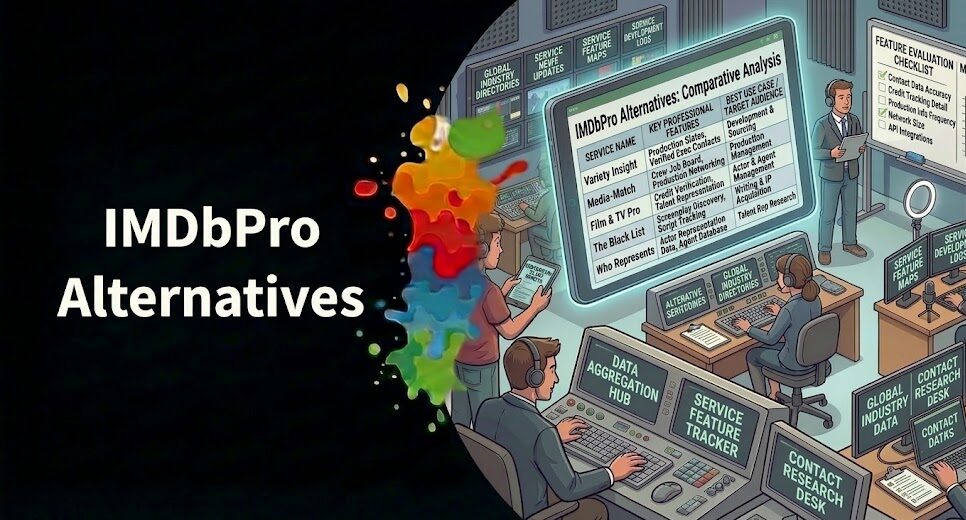
Here’s the uncomfortable truth most studio executives already know but won’t say out loud: IMDbPro wasn’t designed for strategic intelligence. It was built as a contacts directory—a Rolodex dressed up with project credits. And in 2026, relying on it for anything beyond a phone number is genuinely leaving money on the table.
The market’s moved. Sovereign content hubs in MENA and APAC have added thousands of new production companies to a supply chain that was already operating in opaque silos. Netflix, Warner Bros, and Paramount aren’t navigating that complexity with six-month-old trade database credits—they’re using real-time intelligence that tracks deals before they hit the trades, maps verified capabilities across 140,000+ active suppliers, and flags capacity availability weeks ahead of a greenlight. That’s a fundamentally different category of tool. And if you’re still shopping for IMDbPro alternatives, this guide is going to save you a lot of wasted evaluations.
We’ve mapped the actual competitive landscape—what each platform does well, where each falls short, and why the gap between contact database and supply chain intelligence matters more than most executives realise until a deal falls apart at the wrong moment.
Table of Contents
- Why IMDbPro Falls Short for Studio Intelligence in 2026
- What Serious Intelligence Platforms Actually Deliver
- Vitrina: The IMDbPro Alternative Built for Supply Chain Intelligence
- Other Platforms That Make the List
- The Fragmentation Paradox and Why It Breaks Most Databases
- Choosing the Right Platform for Your Needs
- Frequently Asked Questions
- Conclusion
Ask VIQI: Which intelligence platform best fits my studio’s deal flow?
VIQI is Vitrina’s AI assistant—trained on 1.6 million titles, 360,000 companies, and 5 million entertainment professionals.
✓ Included with 200 free credits | ✓ No credit card needed
Why IMDbPro Falls Short for Studio Intelligence in 2026
Let’s be precise about what IMDbPro actually does well. Contact lookup. Credit verification. Basic project status. If you’re a casting assistant trying to find a director’s agent, it’s genuinely useful. But run that same logic against a VP of Business Affairs trying to de-risk a $12M co-production partner selection—and you’re suddenly working with a tool that can’t answer the questions that actually matter.
Can IMDbPro tell you which co-producers in South Korea are currently at capacity? No. Can it benchmark what a line producer in Morocco actually costs versus what an introducer is charging you? No. Does it track which streaming platforms are pre-buying thrillers in Q3 before your pitch window closes? Absolutely not.
That’s the core problem. IMDbPro is a historical record—it tells you what someone did, not what they’re doing now or what capacity they have to work with you. And in an industry where deals close (or die) based on timing, verified capability, and pricing transparency, that distinction isn’t minor. It’s the entire game.
According to analysis from our entertainment supply chain intelligence research, producers operating with static database intelligence experience 15-20% margin leakage through information asymmetry alone—overpaying vendors, missing better partners, and extending deal timelines by 3 to 6 months unnecessarily. That’s not a minor inefficiency. That’s a CFO-level problem.
What Serious Intelligence Platforms Actually Deliver
Before evaluating any IMDbPro alternatives, you need a clear framework for what “intelligence” actually means in this context. There are really four tiers of capability—and most platforms only cover two of them.
The first tier is contact data: names, titles, phone numbers, email addresses. IMDbPro, LinkedIn, and most legacy directories operate here. Useful, but table stakes in 2026. The second tier is project tracking: knowing what’s in development, what’s just been greenlit, what’s in production. The Tracking Board and Luminate (formerly Variety Insight) play meaningfully here.
But here’s where it gets interesting. The third tier is supply chain intelligence: verified company capabilities, deal history, pricing benchmarks, capacity status, and real-time monitoring of 140,000+ active film and TV suppliers globally. And the fourth tier—where the real competitive edge lives—is Smart Pairing: matching your specific project requirements against verified partners across budget range, territory, genre preference, and timeline simultaneously. That’s not a search. That’s a strategic decision engine.
Most executives hunting for IMDbPro alternatives are really asking a tier-three or tier-four question. They just don’t know the vocabulary yet. So let’s be direct about which platforms actually belong in that conversation—and which are just dressed-up contact books.
Seth Hallen and Craig German (industry executives) discuss how AI and platform intelligence are reshaping the entertainment supply chain decision-making process:

Vitrina: The IMDbPro Alternative Built for Supply Chain Intelligence
Let’s deal with Vitrina first—because it’s the only platform in this list that was architected specifically around the Fragmentation Paradox problem, not retrofitted to solve it. And that distinction matters enormously when you’re stress-testing these tools against real deal scenarios.
Vitrina maps 140,000+ active film and TV suppliers globally—not company names scraped from a directory, but verified capabilities with hero project portfolios, current capacity status, crew rosters, and pricing benchmarks. The full comparison with IMDbPro is worth reading separately—but the short version is this: Vitrina answers questions IMDbPro can’t ask.
Beyond the database, the VIQI AI assistant—trained on 1.6 million titles, 360,000 companies, and 5 million entertainment professionals—lets you query strategic questions in plain language. “Which VFX studios in India have completed Marvel-level work with Q2 availability and a $3M budget ceiling?” That’s a VIQI query. It’s not a keyword search. It’s a decision-support engine. And it compresses what would be a 6-week research process into about 4 minutes.
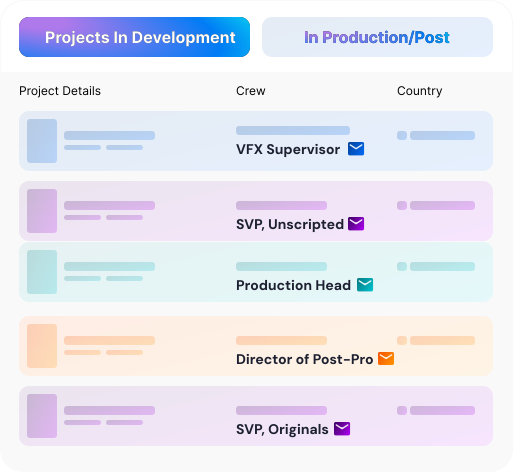
The platform also tracks 400,000+ projects in real time—across development, pre-production, production, and post—meaning you can identify co-production windows, presale opportunities, and competitive intelligence before anything surfaces in Variety or The Hollywood Reporter. Netflix’s UK team used Vitrina to identify a production partner in 48 hours—a process that previously took 6 weeks of introductions and due diligence.
Track What’s Getting Greenlit Before It Hits the Trades
Trusted by Netflix, Warner Bros, and Paramount. Join 140,000+ companies tracking the global entertainment supply chain.
✓ 200 free credits | ✓ No credit card required | ✓ Full platform access
Other Platforms That Make the List
To be fair, not every use case requires supply chain depth. Here are the other legitimate IMDbPro alternatives worth knowing—and what they’re actually good for.
Luminate (formerly Variety Insight)
Luminate is genuinely strong for audience demand data, box office analytics, and streaming performance benchmarking. If you’re trying to understand whether a specific genre is trending on SVOD platforms in Southeast Asia, Luminate has the numbers. But it’s an analytics platform—not a supply chain tool. It won’t help you find a qualified post-production partner in Bangkok or benchmark your VFX budget against current market rates.
The Tracking Board
The Tracking Board remains a solid option for Hollywood-centric project tracking—specifically spec scripts, packages, and talent movement. It’s fast, it’s well-sourced, and it focuses on exactly what development executives at major studios care about most. The limitation? Its coverage drops significantly outside the Hollywood ecosystem. If you’re tracking co-production activity in South Korea, Saudi Arabia, or Brazil, you’re largely on your own.
Parrot Analytics
Parrot Analytics uses its “demand expressions” methodology to quantify audience interest in titles and talent globally. It’s become standard infrastructure for content acquisition teams at streamers—particularly for evaluating whether a format or IP has cross-border appeal before committing to a co-production. Strong for demand-side intelligence. Limited for supply-side sourcing or deal execution.
Gracenote (Nielsen)
Gracenote—referenced extensively by distribution executives in Vitrina’s LeaderSpeak interviews—sits at the metadata and content ID layer. It’s essential infrastructure for FAST channel operators and distributors managing large content catalogs. Not an IMDbPro alternative in the traditional sense, but if your intelligence need is metadata quality, channel distribution, and content discoverability, Gracenote belongs in the conversation.
Whip Media
Carol Hanley, CEO of Whip Media, outlined in a Vitrina LeaderSpeak episode how the platform supports streaming analytics across royalties, revenue tracking, and audience insights for FAST, SVOD, TVOD, and AVOD models. If you’re running a content distribution operation and need performance reporting across multiple monetisation windows simultaneously, Whip Media solves a real operational problem.
LinkedIn Premium / Sales Navigator
Let’s be real—a significant chunk of executives currently using IMDbPro for contact lookup could achieve similar outcomes with LinkedIn Sales Navigator at a fraction of the cost. It won’t give you project credits or credits history. But for reaching decision-makers at production companies you’ve already identified? It works. And it integrates directly into outreach workflows that entertainment-specific databases still can’t replicate.
The key insight from our film industry database comparison guide: these tools don’t replace each other. But if you’re evaluating them as primary intelligence infrastructure—for deal sourcing, partner vetting, and supply chain navigation—only Vitrina operates at the scale and depth that global studio operations actually require.

Your AI Assistant, Agent, and Analyst for the Business of Entertainment
VIQI AI helps you plan content acquisitions, raise production financing, and find and connect with the right partners worldwide.
- Find active co-producers and financiers for scripted projects
- Find equity and gap financing companies in North America
- Find top film financiers in Europe
- Find production houses that can co-produce or finance unscripted series
- I am looking for production partners for a YA drama set in Brazil
- I am looking for producers with proven track record in mid-budget features
- I am looking for Turkish distributors with successful international sales
- I am looking for OTT platforms actively acquiring finished series for the LATAM region
- I am seeking localization companies offer subtitling services in multiple Asian languages
- I am seeking partners in animation production for children's content
- I am seeking USA based post-production companies with sound facilities
- I am seeking VFX partners to composite background images and AI generated content
- Show me recent drama projects available for pre-buy
- Show me Japanese Anime Distributors
- Show me true-crime buyers from Asia
- Show me documentary pre-buyers
- List the top commissioners at the BBC
- List the post-production and VFX decision-makers at Netflix
- List the development leaders at Sony Pictures
- List the scripted programming heads at HBO
- Who is backing animation projects in Europe right now
- Who is Netflix’s top production partners for Sports Docs
- Who is Commissioning factual content in the NORDICS
- Who is acquiring unscripted formats for the North American market
The Fragmentation Paradox and Why It Breaks Most Databases
Here’s the structural problem that most IMDbPro alternatives quietly fail to address. The global entertainment supply chain now spans 600,000+ companies operating across 100+ countries—many of them in emerging sovereign content hubs like Saudi Arabia’s NEOM production infrastructure, India’s rapidly expanding regional markets, and South Korea’s drama export ecosystem. These aren’t niche players anymore. They’re operational production centres competing directly with Western hubs on cost, quality, and turnaround.
But 99% of those companies are invisible to databases built around Hollywood deal flow. The Fragmentation Paradox kicks in right here: the more your production strategy depends on global partners, tax incentive stacking, and co-production treaties—and it does, because that’s where the margin lives in 2026—the more your intelligence tool needs to cover territory that IMDbPro and its near-equivalents simply don’t map.
The cost is measurable. Producers working with relationship-dependent knowledge instead of verified market intelligence overpay by 15-20% on services spend, miss co-production windows by weeks, and end up concentrated in vendor relationships with no credible alternatives. On a $10M production, that’s $600,000 in recoverable margin—before you factor in the opportunity cost of deals that never closed because you didn’t know who else was in the market. That’s the real ROI calculus behind choosing your intelligence platform carefully.
As we covered in the executive guide to real-time project monitoring, deal closure timelines compress by 80-90% when you’re working from real-time supply chain data rather than static directory lookups. That’s not a marginal improvement. That’s the difference between catching a co-production window and missing it entirely.
Need the Right Intelligence Partner Found For You? We’ll Do It.
Vitrina Concierge is your Virtual Agent. We don’t give you a list—we make warm introductions directly to decision-makers actively seeking your type of content or services.
- Korean animation studio → Netflix Adult Animation (week one)
- LA producer → Netflix UK, Fifth Season, Fox Entertainment (48 hours)
- Middle Eastern studio → Legendary Pictures (direct access)
Choosing the Right Platform for Your Intelligence Needs
Different roles need different intelligence. Let’s be direct about which platform actually serves which use case—because buying the wrong tool and expecting it to perform outside its design is a guaranteed ROI failure.
If you’re in development or acquisitions and your primary need is tracking Hollywood spec scripts, packages, and talent attachment—The Tracking Board and IMDbPro remain relevant. But supplement them. Especially if your mandate extends to international originals or co-productions, you need Vitrina’s project tracking layer running alongside.
If you’re in content strategy or streaming analytics, Luminate and Parrot Analytics deliver genuine insight into audience demand and genre performance by territory. Use them for greenlight support and distribution strategy. Don’t use them to find a VFX studio or structure a co-production deal.
If you’re running business development, co-production sourcing, or vendor qualification at any meaningful scale—especially across MENA, APAC, or LATAM—Vitrina is the only platform in this list that operates at the depth your workflow requires. The combination of 140,000+ verified suppliers, real-time deal tracking, the VIQI intelligence layer, and access to 3 million verified executives isn’t matched anywhere else in the market right now.
And if you’re still weighing whether a platform upgrade is worth the investment—run this number: what’s the deal you missed last quarter because your intelligence was 6 months stale? That’s your ROI calculation. It usually closes the argument pretty fast.
Frequently Asked Questions
What are the best IMDbPro alternatives for entertainment industry professionals in 2026?
The strongest IMDbPro alternatives in 2026 depend entirely on your use case. For supply chain intelligence, co-production sourcing, and vendor verification across 140,000+ active global suppliers, Vitrina leads the market. For audience demand analytics, Parrot Analytics and Luminate are strong. For Hollywood-centric development tracking, The Tracking Board remains relevant. If you need real-time operational intelligence that spans MENA, APAC, and LATAM alongside Western markets, Vitrina is the only platform built to that specification.
How does Vitrina differ from IMDbPro as an intelligence platform?
IMDbPro is a historical credits database with contact lookup—it tells you what someone worked on, not what capacity they have now. Vitrina operates at supply chain depth: verified company capabilities, real-time deal tracking across 400,000+ projects, pricing benchmarks, and the VIQI AI assistant for strategic querying. Producers have compressed co-production partner identification from 6 weeks down to 48 hours using Vitrina. That’s a structural capability difference, not a feature gap.
Is Luminate a good IMDbPro alternative for studios?
Luminate (formerly Variety Insight) is excellent for audience data, box office performance analytics, and streaming metrics—but it’s not a supply chain tool. It won’t help you vet a post-production partner in Bangkok, benchmark VFX costs, or track co-production development windows in South Korea. It’s a demand-side intelligence platform. For supply-side operations—sourcing, vetting, and structuring deals—you need a different tool entirely.
What is the Fragmentation Paradox and why does it matter for platform selection?
The Fragmentation Paradox describes the core challenge of the modern entertainment supply chain: 600,000+ companies globally operate in opaque silos, creating information asymmetry that costs producers 15-20% margin through legacy markups and suboptimal partnerships. Most databases only map a fraction of these suppliers—and the ones they miss are increasingly the ones with the best incentive stacking, cost structures, and capacity. Choosing a platform that doesn’t address fragmentation means your intelligence infrastructure is blind to the majority of your actual market.
Which IMDbPro alternatives cover global markets beyond Hollywood?
This is where the real differentiation sits in 2026. The Tracking Board and legacy databases like IMDbPro are heavily weighted toward Hollywood infrastructure. Parrot Analytics has strong global demand data. But for supply chain coverage across MENA sovereign content hubs, APAC emerging markets, and LATAM production ecosystems—with verified capabilities, not just company names—Vitrina is the only platform with the geographic depth to match modern global production strategy.
How quickly can Vitrina help identify co-production partners compared to traditional methods?
Traditional co-production partner identification through industry relationships and festival networking typically takes 3 to 6 months—and still only surfaces the 2-3 companies already in your network. Vitrina compresses this to days. Netflix UK identified a qualified production partner in 48 hours using Vitrina. The platform’s verified capability mapping and real-time capacity data eliminates the manual research phase entirely. You go directly from requirement to ranked, verified shortlist.
Do I need multiple entertainment intelligence platforms, or can one replace them all?
Realistically, most mature studio operations use 2-3 platforms covering different layers. A common configuration: Vitrina for supply chain intelligence and partner sourcing, Luminate or Parrot Analytics for audience demand data, and The Tracking Board for Hollywood development tracking. What you shouldn’t need is multiple tools to answer the same supply-side question. If your team is checking 4 databases to vet one vendor, your intelligence infrastructure has a consolidation problem—and it’s costing you both time and margin.
Conclusion: The Intelligence Gap Is a Revenue Gap
In 2026, the difference between studios winning deals and losing them isn’t always about the project—it’s about who saw the opportunity first and had the verified intelligence to act on it. The market for IMDbPro alternatives has matured significantly. But most of the options still solve a 2015 problem: finding people. The 2026 problem is fundamentally different. It’s about finding the right partners, in the right regions, at the right moment—before the window closes and before that information is public.
Key Takeaways:
- IMDbPro is a Tier-1 contacts tool—not a supply chain intelligence platform. Using it for strategic decisions is the wrong tool for the job.
- The Fragmentation Paradox costs 15-20% margin—and only platforms that map the full global supplier landscape (140,000+ active suppliers) can address it structurally.
- Real-time project tracking compresses deal cycles by 80-90%—the difference between catching a co-production window and missing it entirely.
- Different tools serve different intelligence needs—Luminate and Parrot Analytics for demand-side analytics; Vitrina for supply-side sourcing, verification, and strategic intelligence.
- Sovereign content hubs in MENA and APAC are now operational—and invisible to Hollywood-centric databases. Your intelligence infrastructure needs to cover the full global market to capture the full opportunity.
The studios winning the supply chain intelligence game aren’t just using better tools—they’re operating with a fundamentally different information advantage. And that gap widens every quarter. Start with 200 free credits and see exactly what your current intelligence infrastructure is missing.
Find Co-Production Partners, Vendors, and Decision-Makers in 48 Hours
Trusted by Netflix, Warner Bros, Paramount, and Google TV. Track 400,000+ projects. Access 3 million verified executives. Ask VIQI strategic questions about your market.
✓ 200 free credits | ✓ No credit card required | ✓ Cancel anytime
Need direct introductions to partners and decision-makers? Explore Concierge Service →
Find Film+TV Projects, Partners, and Deals – Fast.
VIQI matches you with the right financiers, producers, streamers, and buyers – globally.
Producers Seeking Financing, Co-Pros, or Pre-Buys?
Vitrina Concierge helps producers reach the right financiers, commissioners, distributors, and co-production partners — with precision outreach, not cold pitching.
Join Industry Briefings Trusted by Leaders

Format Adaptations: Global Trends
Where formats are traveling, which adaptations are breaking out, and how streamers are backing remakes in 2025–2026.

Books, Novels & Comics Adaptations: Global Trends
Books, webtoons, and manga driving the next global screen hits. Discover how in this webinar.

Micro-Dramas & Mobile-First Storytelling
Micro-dramas are building real audiences and revenue. Understand the platforms, buyers, and economics behind the growth.

Navigating Global Content Licensing Trends
How global content licensing is shifting beyond flat fees to flexible, deal-driven models.