About Innovation Hub
 Global Content Pulse (Webinars)


 Global Production Financing
(Webinars)
Global Production Financing
(Webinars)  LeaderSpeak Podcast
  About Vitrina
 Our Story
 Our Solutions 🔥
 Film+TV Projects Tracker 🚀
 Case Studies
 Our Profile
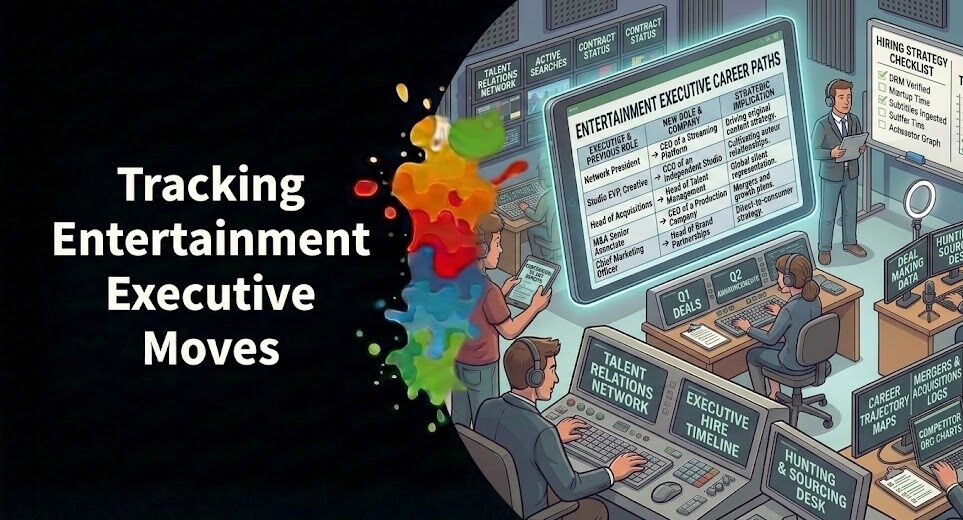
An acquisitions VP lands at a new platform. A head of scripted departs one streamer for a rival. A commissioning editor previously focused on European drama shifts to a Riyadh-based studio with a $4B production mandate. Each of these moves carries a signal—and most business development teams in the entertainment industry are reading those signals six months too late, if at all.
Tracking entertainment executive moves in 2026 is not a LinkedIn habit or a trade-reading ritual. It’s a real-time intelligence function that directly shapes your outreach strategy, your pitch timing, and your ability to reach the actual decision-makers before your competitors do. The Data Deficit—the chronic reliance on static databases, anecdotal network knowledge, and 6-month-old trade reports—costs business development teams deal cycles, relationships, and revenue they never see on any P&L because the missed opportunity is invisible.
Here’s what we’re seeing: the Fragmentation Paradox that erodes margins in production sourcing applies with equal force to people intelligence. With over 3 million entertainment professionals operating across 600,000+ film and TV companies globally, the executive landscape is as fragmented as the vendor landscape—and the information asymmetry is just as costly.
In This Guide
- Why Executive Moves Are Business Development Signals
- Sovereign Hubs Are Creating Entirely New Executive Classes
- The Data Deficit: Why Trades and LinkedIn Aren’t Enough
- Smart Pairing: Matching People Intelligence to Project Intelligence
- Building a People Intelligence System That Actually Works
- FAQ
- Conclusion
Why Executive Moves Are Business Development Signals—Not Just Industry Gossip
Every executive move in entertainment carries what insiders call a mandate signal. When a new head of drama takes over a platform, the first 90 days tell you everything—what genres they’re prioritizing, which producers they’re already calling, and what slate gaps they’re trying to fill. Get in front of them in week two and you’re shaping their thinking. Get in front of them in month eight and you’re responding to a brief that’s already crowded.
Phil Hunt, Founder and CEO of Head Gear Films—which has financed 550+ movies and operates at a volume of 35–40 films per year, more than most studios—puts the intelligence advantage simply: “We’ve got great deep relationships with the buyers and the sellers, which make the marketplace. So we listen to them all the time.” That real-time relationship intelligence is exactly what allows Head Gear to be, in Phil’s words, “in the center of the carousel being the marketplace.”
But here’s the catch. Head Gear has nearly 25 years and 550 projects worth of relationship capital to draw on. Most independent producers, distributors, and service companies don’t. They’re pitching into inboxes of executives they’ve never met, using contact details that are 18 months stale, based on trade announcements they caught three weeks after the appointment was made. That’s not business development. That’s cold email roulette.
The executive outreach challenge isn’t really about contact details. It’s about timing and context. You need to know not just who holds a title, but what mandate they arrived with, what content they’ve historically greenlit, which producers are already in their network, and whether the platform’s acquisition appetite has shifted since their arrival. That’s a data problem—and a real-time one.
Ask VIQI: Which Executives at [Platform] Are Actively Acquiring in Your Genre Right Now?
VIQI is Vitrina’s AI intelligence engine—trained on 1.6 million titles, 360,000 companies, and 5 million entertainment professionals. Ask it to identify acquisition decision-makers by platform, genre, territory, and recent deal history.
✓ Included with 200 free credits | ✓ No credit card needed
Sovereign Hubs Are Creating Entirely New Executive Classes—And Most BD Teams Are Missing Them
Here’s where the executive tracking challenge compounds in 2026: it’s not just about staying current with Hollywood and London appointments. The emergence of Sovereign Content Hubs—Saudi Arabia, UAE, South Korea, and India as operational production centers, not simply service markets—has created entirely new classes of commissioning executives that most Western-centric BD teams have never mapped.
Saudi Arabia alone has deployed over $71.2B toward Vision 2030 entertainment objectives, with $4B+ specifically allocated to film infrastructure. That capital is flowing through commissioning executives whose mandates—local content production, export-ready drama, Arabic-language originals—have virtually no overlap with the brief a Netflix or HBO acquisitions VP operates under. But the volume of content they need to acquire and produce is significant, and growing fast.
OSN’s Rolla Karam, SVP Content Acquisition, runs acquisition for a platform covering 23 countries across MENA and North Africa. Her mandate—exclusive, same-minute Western content plus an expanding Arabic and Turkish catalog, from the region for the region—shapes what gets bought across the entire Gulf and North Africa. Turkish content “does amazingly well” on the platform, she’s noted, and Arabic-language exclusives are increasingly central to OSN’s competitive positioning against regional rivals. That’s not incidental intelligence. That’s the brief for any producer or distributor targeting the MENA OTT market.
And South Korea—already exporting globally through the Hallyu Wave, with Netflix’s $2.5B committed investment in Korean content—has a commissioning executive class operating at genuine international scale. These executives aren’t on the radar of most European or American distributors because their hiring isn’t announced in Variety or The Hollywood Reporter. They appear in Korean trade publications, government film commission announcements, and platform-specific communications—none of which most BD teams are monitoring systematically.
What’s actually happening is a structural shift in where acquisition decisions are being made. And the producers and distributors who’ve mapped those new decision-maker networks—before they become crowded—are the ones securing first-look relationships that their competitors haven’t discovered yet. That’s the Insider Advantage in people intelligence: real-time coverage of the full global executive landscape, not just the Western markets that dominate trade coverage.

Your AI Assistant, Agent, and Analyst for the Business of Entertainment
VIQI AI helps you plan content acquisitions, raise production financing, and find and connect with the right partners worldwide.
- Find active co-producers and financiers for scripted projects
- Find equity and gap financing companies in North America
- Find top film financiers in Europe
- Find production houses that can co-produce or finance unscripted series
- I am looking for production partners for a YA drama set in Brazil
- I am looking for producers with proven track record in mid-budget features
- I am looking for Turkish distributors with successful international sales
- I am looking for OTT platforms actively acquiring finished series for the LATAM region
- I am seeking localization companies offer subtitling services in multiple Asian languages
- I am seeking partners in animation production for children's content
- I am seeking USA based post-production companies with sound facilities
- I am seeking VFX partners to composite background images and AI generated content
- Show me recent drama projects available for pre-buy
- Show me Japanese Anime Distributors
- Show me true-crime buyers from Asia
- Show me documentary pre-buyers
- List the top commissioners at the BBC
- List the post-production and VFX decision-makers at Netflix
- List the development leaders at Sony Pictures
- List the scripted programming heads at HBO
- Who is backing animation projects in Europe right now
- Who is Netflix’s top production partners for Sports Docs
- Who is Commissioning factual content in the NORDICS
- Who is acquiring unscripted formats for the North American market
The Data Deficit: Why Trades and LinkedIn Are the Wrong Tools for 2026
Let’s be direct about what most business development teams are actually using to track entertainment executives. Variety and The Hollywood Reporter announce major appointments—C-suite moves at studios, streamer leadership changes, high-profile acquisitions executive hires. Those get picked up. But most decisions about content acquisition—the VP of Drama who just took over at a mid-tier platform, the regional director of a Sovereign Hub studio who arrived with a co-production mandate, the head of international acquisitions at a FAST channel aggregator—those don’t make the trades at all. Or they appear as a two-line brief six weeks after the appointment.
LinkedIn is worse. Self-reported, incentive-misaligned, and with no mechanism to distinguish a title from an actual mandate, LinkedIn profiles tell you what someone was doing 18 months ago, dressed up to look current. The typical executive profile updates on LinkedIn lag real-world role changes by 3–6 months—by which time the appointment is old news and the executive’s acquisition brief is already being shaped without your input.
The real dynamic is this: the information about who’s making decisions, where, and with what mandate—that information exists. It’s just distributed across deal announcements, project trackers, platform content pipelines, co-production agreements, and commissioning outputs. Someone who can aggregate and verify it in real-time has a genuine business development edge. Someone relying on trades and LinkedIn is operating with a 6-month information lag in a market where relationships are won in the first weeks of an executive’s tenure.
As we’ve covered in our guide to finding verified contacts in the TV industry, the challenge isn’t volume—there’s no shortage of names. It’s verification and context. A contact database that tells you someone holds a title but can’t tell you what they’re actively developing, what their deal history looks like, or whether their platform is actively acquiring in your genre is operationally useless for business development.
Track 3 Million Verified Entertainment Executives—With Deal History, Platform Context, and Current Mandates
Trusted by Netflix, Warner Bros, Paramount, and Google TV. Join 140,000+ companies tracking entertainment professionals and project pipelines across 195 countries on Vitrina.
✓ 200 free credits | ✓ No credit card required | ✓ Full platform access
Smart Pairing: Where People Intelligence Meets Project Intelligence
The most sophisticated business development teams in entertainment aren’t just tracking executives in isolation. They’re matching people intelligence to project intelligence—knowing not just that an executive moved, but mapping that move against the active content pipeline at their new company, the acquisition patterns of the platform, and the slate gaps that their arrival is most likely intended to fill. That’s what Vitrina calls Smart Pairing: connecting people intelligence with project and company data to surface genuinely actionable outreach targets.
Here’s a concrete example of how this plays out. A new Head of International Acquisitions joins a major SVOD platform. You could approach this as a simple contact update—add the name, get the email, pitch your catalog. Or you could approach it with full context: what did this executive greenlight at their previous role? What genre patterns define their acquisition history? What does the platform’s current content pipeline reveal about the gaps their hire is meant to address? The second approach generates outreach that lands—because it demonstrates you understand the mandate, not just the title.
This context-first approach is especially important when engaging with executives at Sovereign Hub platforms and studios. A commissioning executive at a Gulf-state broadcaster arrives with a brief shaped by local content quotas, regional audience preferences, and government content objectives—none of which maps onto the Western commercial mandate that most distributors default to addressing. Pitching them with a generic catalog deck built for Netflix misreads the room entirely. But pitching them with a package built around the Arabic-language drama gap, timed to their platform’s stated strategic priorities, is a fundamentally different conversation.
According to as reported by Variety, executive turnover at streaming platforms accelerated throughout 2024–2025 as platforms recalibrated content strategies following profitability mandates. Each of those transitions—visible in deal announcements, content pipeline shifts, and platform earnings commentary—represents a business development window. The teams who map those decision-makers in real time are the ones getting calendar time. The others are waiting for the executive to have already locked their slate.
Phil Hunt (Founder & CEO, Head Gear Films) on why deep relationships with buyers and sellers—and listening to them constantly—is the real competitive advantage in the current market:

Building a People Intelligence System That Drives Real Business Development
So what does a functional people intelligence system actually look like for an entertainment business development team in 2026? Four components—and most BD teams have maybe one of them.
Real-time executive tracking. Not quarterly database updates. Not trade monitoring with a six-week lag. Alerts when decision-makers at your target platforms and companies change roles, change mandates, or launch new projects—fast enough that you can reach them before the appointment announcement is two weeks old and their inbox is already full of pitches from everyone who read the same Deadline story. Vitrina’s platform tracks 3 million entertainment professionals with verified role data, giving business development teams a live view of executive movements across the global supply chain.
Deal history integration. An executive’s title tells you their authority. Their deal history tells you their taste, their risk appetite, and their acquisition patterns. Knowing that a new VP of Drama has historically greenlit procedural crime in the $3–5M per episode range is more actionable for an independent production company than any generic outreach template. This is the intelligence layer that separates verified contact data from genuinely useful business intelligence.
Platform pipeline mapping. Executive intelligence in isolation is only half the picture. You need to map executives against the content pipelines at their organizations—what’s in development, what’s in production, what’s in acquisition. A platform that’s announced 12 new originals in a single genre is clearly not buying more of the same right now. A platform that’s shifting commissioning toward a region it hasn’t historically served is creating a supply gap. Real-time production tracking across 400,000+ projects gives you the context to make that read.
Global coverage, not Hollywood-first. And this is the piece most BD teams genuinely don’t have. A Sovereign Hub commissioning executive in Riyadh who just received a mandate to develop 20 local-language originals for regional release is a business development opportunity. So is a new head of acquisitions at a South Korean platform with a brief to source international format adaptations. These executives exist, they’re actively acquiring, and the business development window with them is wide open—because most of your competitors aren’t covering them at all.
As covered in The Hollywood Reporter’s ongoing coverage of streaming platform executive transitions, the pace of leadership change across the content acquisition landscape has created a persistent cycle of new mandates—each representing a window that closes within 90 days as the executive’s preferences become known and their pipeline fills. The teams winning in this environment are the ones tracking entertainment executives by department and specialization in real time, not reading about appointments after the fact.
Need Warm Introductions to Decision-Makers Who Are Actively Acquiring Right Now?
Vitrina Concierge is your Virtual Agent. We don’t give you a list—we make direct warm introductions to the right executives at the right time, matched to your content and your targets.
- LA producer → Netflix UK, Fifth Season, Fox Entertainment in 48 hours
- Korean animation studio → Netflix Adult Animation workflow (week one)
- Middle Eastern studio → Legendary Pictures (direct access)
Frequently Asked Questions
Why does tracking entertainment executive moves matter for business development?
Every executive move in entertainment carries a mandate signal—the first 90 days of a new appointment define what a platform will acquire, co-produce, or commission for the next 12–24 months. Business development teams who reach new executives in the first weeks of their tenure shape their thinking before the slate is locked. Teams who respond to trade announcements six weeks later are pitching into an already-crowded queue. The timing advantage of real-time executive tracking translates directly into first-mover relationships, earlier pitch slots, and higher conversion rates on outreach.
How do entertainment executive moves typically signal acquisition strategy shifts?
Executive appointments signal strategy through three patterns: genre reorientation (a new drama head with a crime background suggests a shift toward genre scripted), geographic focus (a VP hired from a MENA or APAC background signals regional expansion), and budget tier (an executive who historically greenlit $10M+ projects at a studio arriving at an indie platform usually indicates a bid to move upmarket). Mapping an executive’s project history against their new platform’s existing content pipeline reveals the acquisition gaps their hire is designed to fill—and gives you the brief before it’s been formally articulated.
What is the Data Deficit in entertainment business development?
The Data Deficit describes the competitive disadvantage of relying on static, outdated intelligence—trade publications with 6-week lag times, LinkedIn profiles that update 3–6 months after actual role changes, and anecdotal relationship knowledge that only covers a fraction of the global executive landscape. In practice, it means most business development teams are operating with information that’s already been acted on by their best-connected competitors. The opposite condition—the Insider Advantage—comes from real-time intelligence that covers role changes, deal history, and acquisition patterns across the full global supply chain, not just the Hollywood and London markets that dominate trade coverage.
How are Sovereign Content Hubs changing the entertainment executive landscape?
Sovereign Content Hubs—Saudi Arabia (Vision 2030, $71.2B entertainment investment), UAE, South Korea, and India—have created entirely new commissioning executive classes operating with mandates that differ fundamentally from Western streamer acquisition briefs. Saudi studios are building Arabic-language originals for regional and global audiences. South Korean platforms are commissioning international format adaptations at global scale. OSN in MENA runs content acquisition across 23 countries with its own distinct genre and cultural preferences. These executives are making real acquisition decisions with real budgets—but most Western-centric BD teams haven’t mapped them at all, creating a significant first-mover opportunity for producers and distributors who do.
What is Smart Pairing in entertainment business development?
Smart Pairing is Vitrina’s framework for connecting people intelligence with project and platform intelligence—so that executive tracking translates directly into contextually appropriate outreach rather than generic contact data. When a new acquisitions VP is identified, Smart Pairing surfaces their deal history, maps their track record against their new platform’s content pipeline, and identifies the specific supply gaps that their appointment is most likely designed to address. The result is outreach that demonstrates mandate understanding, not just title awareness—which is the difference between getting a meeting and getting ignored.
How many entertainment professionals does Vitrina track globally?
Vitrina tracks over 3 million verified entertainment professionals across 360,000 companies and 195 countries, with data spanning 1.6 million titles. Unlike LinkedIn (self-reported, incentive-misaligned, slow to update) or static industry databases, Vitrina’s people intelligence is cross-referenced against project pipelines, deal history, and platform acquisition activity—giving business development teams context alongside contact data. VIQI, Vitrina’s AI intelligence engine, can be queried for specific executive searches by platform, genre, territory, budget tier, or deal history pattern.
What is the business development window after an entertainment executive appointment?
The effective business development window after an executive appointment is typically the first 60–90 days. During this period, the executive is actively forming their acquisition strategy, identifying content gaps in the existing pipeline, and establishing the producer and distributor relationships they’ll rely on for their tenure. After 90 days, the brief has crystallized, the preferred supplier relationships are forming, and access becomes progressively more competitive. Business development teams who reach executives in the first two to four weeks—before the trade announcement has generated mass outreach—have a substantial first-mover advantage.
Why is the Fragmentation Paradox relevant to people intelligence in entertainment?
The Fragmentation Paradox—originally framed around the opacity of the 600,000+ company global supply chain—applies with equal force to people intelligence. With over 3 million entertainment professionals distributed across 600,000 companies in 195 countries, the executive landscape is as fragmented as the vendor landscape. Most business development teams know 2–5% of the relevant executives in their target market. They’re blind to the other 95%—including the entire executive classes emerging at Sovereign Content Hubs. The information asymmetry creates the same cost structure as vendor fragmentation: longer cycles, lower conversion, and missed opportunities that never appear on any pipeline report.
Conclusion: People Intelligence Is the Unfair Advantage Most BD Teams Don’t Have
The entertainment industry’s deal cycles are still relationship-driven. That’s not changing. But the scale of the relationship landscape has changed fundamentally—from a Hollywood-centric world where knowing the right 200 people covered most of your BD needs, to a global supply chain where Sovereign Content Hubs in MENA, APAC, and LATAM are creating new commissioning classes at scale, and where streaming platform executive turnover is generating mandate signals faster than any trade publication or LinkedIn feed can surface them.
Key Takeaways:
- The 90-Day Window Is Real: Executive appointments carry a mandate signal and a business development window. The first 60–90 days define the acquisition brief. Reach new executives in week two, not month four.
- Sovereign Hubs Are Creating Uncovered Executive Classes: Saudi Arabia, UAE, South Korea, and India have commissioning executives with real mandates and real budgets. Most Western BD teams haven’t mapped them. That’s a first-mover opportunity.
- The Data Deficit Costs Real Revenue: Relying on trades and LinkedIn means operating 6 months behind the market. The Insider Advantage comes from real-time intelligence on executive moves, deal history, and platform acquisition patterns.
- Context Beats Contact Data: An executive’s title is the starting point. Their deal history, genre patterns, and platform pipeline context is what turns a contact into a relationship. Smart Pairing connects people intelligence to project intelligence for genuinely actionable outreach.
- Global Coverage Is Non-Negotiable: With 3 million+ entertainment professionals across 195 countries, people intelligence that only covers Hollywood and London is structurally incomplete. The business development edge is in the 95% of the executive landscape most teams aren’t monitoring.
The business development teams winning in the current market aren’t just better connected. They’re better informed—faster. And the intelligence infrastructure to achieve that at scale, across the full global executive landscape, exists now. The only question is whether you’re using it.
Start Tracking the Entertainment Executives Who Are Actively Acquiring Right Now
Trusted by Netflix, Warner Bros, Paramount, and Google TV. Track 400,000+ projects. Access 3 million verified executives. Use VIQI to surface decision-makers by platform, genre, territory, and deal history—before your competitors do.
✓ 200 free credits | ✓ No credit card required | ✓ Cancel anytime
Find Film+TV Projects, Partners, and Deals – Fast.
VIQI matches you with the right financiers, producers, streamers, and buyers – globally.
Producers Seeking Financing, Co-Pros, or Pre-Buys?
Vitrina Concierge helps producers reach the right financiers, commissioners, distributors, and co-production partners — with precision outreach, not cold pitching.
Join Industry Briefings Trusted by Leaders
Streamers – Netflix vs. Amazon – The 2026 Strategy
How Netflix and Amazon’s content and revenue strategies are diverging ahead of 2026.

Format Adaptations: Global Trends
Where formats are traveling, which adaptations are breaking out, and how streamers are backing remakes in 2025–2026.

Books, Novels & Comics Adaptations: Global Trends
Books, webtoons, and manga driving the next global screen hits. Discover how in this webinar.

Micro-Dramas & Mobile-First Storytelling
Micro-dramas are building real audiences and revenue. Understand the platforms, buyers, and economics behind the growth.