About Innovation Hub
 Global Content Pulse (Webinars)


 Global Production Financing
(Webinars)
Global Production Financing
(Webinars)  LeaderSpeak Podcast
  About Vitrina
 Our Story
 Our Solutions 🔥
 Film+TV Projects Tracker 🚀
 Case Studies
 Our Profile
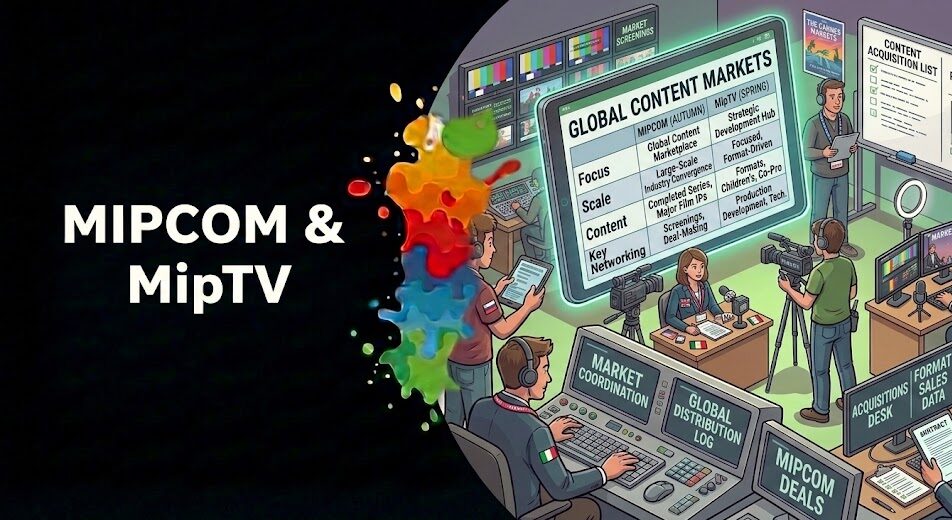
You’ve done the markets before. You know the Palais. You know the hotel lobby meetings that run 15 minutes over, the dinner pitches that go nowhere, and the one conversation on Day 3 that makes the whole trip worth it. But here’s what’s changed: MIPCOM and MipTV 2026 are operating in a fundamentally tighter market—and sellers who show up without a data-backed strategy are going home with business cards instead of term sheets.
The post-COVID production surge is fully unwound. Buyers across linear, SVOD, and FAST are under real pressure to justify every MG. And the Fragmentation Paradox that’s always complicated global deal-making has only deepened: over 600,000 companies now operate in the global film and TV supply chain, yet information asymmetry means most sellers still walk into MIPCOM working off a six-month-old email list and their festival contacts.
That’s not enough anymore. This guide gives you a 7-step playbook to de-risk your market strategy, accelerate deal closure, and walk out of Cannes with signed paper—not promises.
In This Guide
- What’s Changed: The 2026 Seller Landscape
- Step 1: Build Buyer Intelligence Before You Land
- Step 2: Package Your Slate for What the Market Actually Wants
- Step 3: Master the Pre-Market Outreach Window
- Step 4: De-Risk Your MG and Territory Strategy
- Step 5: Pitch Across Every Buyer Profile
- Step 6: Close Deals Faster With Real-Time Intelligence
- FAQ
- Conclusion
What’s Changed: The 2026 Seller Landscape You Can’t Ignore
Phil Hunt, Founder & CEO of Head Gear Films—the company that’s financed 550+ movies and runs at 35–40 films per year, more than most major studios—put it plainly in his October 2025 Vitrina LeaderSpeak interview: “The whole industry has become much, much harder in terms of getting movies off the ground and getting movies sold.” That’s not pessimism. That’s the operating reality you’re walking into at MipTV this April and MIPCOM this October.
The “big crunch” isn’t just rhetoric. Post-COVID production capital flooded the market in 2021 and 2022, then contracted sharply. Buyers are more selective. Commissioning windows are tighter. And the streamers who once bought broad are now buying precise—genre-specific, audience-specific, budget-specific.
But here’s the flip side. Sellers who arrive with verified intelligence on what specific buyers are actively acquiring—not what they acquired 18 months ago—have a real edge. The data deficit that hurts most sellers is entirely solvable. And solving it before the market opens is what separates a productive Cannes from an expensive one.
Step 1: Build Buyer Intelligence Before You Land in Cannes
Most sellers do this backwards. They build their slate deck first, then figure out who to show it to. The smarter move—the one Head Gear and other high-volume operators run—is to start with buyer intelligence and work backwards to presentation strategy.
What does “buyer intelligence” actually mean? At minimum, it’s four things:
- Active acquisition mandates — What genres and formats is this buyer commissioning right now, not last year
- Budget ranges — Are they a $2M-per-episode buyer or a $500K-per-episode buyer for your genre
- Territory coverage — Are they buying worldwide rights, or do they have gaps you can fill
- Deal history — Who have they transacted with recently, and at what terms
Without this, you’re pitching in the dark. And the MIPCOM floor is too crowded to waste a single meeting. When you’ve got verified mandate intelligence, every conversation you book is a qualified conversation—not a speculative one.
Find Active Buyers for Your Slate Before MIPCOM Schedules Fill Up
VIQI is Vitrina’s AI intelligence engine—trained on 1.6 million titles, 360,000 companies, and 5 million entertainment professionals. Ask it which buyers are acquiring your genre, territory, and budget range right now.
✓ Included with 200 free credits | ✓ No credit card needed
Step 2: Package Your Slate for What the Market Actually Wants
Hunt’s formula at Head Gear is blunt: “What we’re really primarily looking for are projects that the market really wants.” Not what wins festivals. Not what’s culturally important. What the market will actually buy.
Right now, that translates to a few specific realities for sellers at MIPCOM and MipTV 2026:
- Low-cost, high-concept action, thriller, and horror continue to lead in international pre-sales—these genres travel without stars
- True crime and premium documentary series remain strong acquisition targets, particularly for SVOD platforms filling their unscripted slates
- Format rights are back in demand—local remakes represent lower MG commitments and lower risk for buyers under margin pressure
- MENA and APAC-originated content is drawing genuine acquisition interest. Rolla Karam, SVP Content Acquisition at OSN—which covers 23 countries across MENA and North Africa—has been explicit about expanding its Arabic-originated catalog
Your packaging has to signal commercial viability fast. Buyers at MIPCOM are evaluating hundreds of titles. Your one-pager, your screener, your pitch—all of it has to answer the ROI question before you open your mouth. And as we covered in our guide to selling at MipTV, leading with territorial exclusivity windows and pre-sales history is what moves conversations from “interesting” to “let’s talk deal terms.”
Phil Hunt (Founder & CEO, Head Gear Films) discusses why market-driven packaging defines what actually gets sold in today’s tighter financing environment:

Step 3: Master the Pre-Market Outreach Window (6 Weeks Is the Real Deadline)
Here’s something most first-time MIPCOM sellers learn the hard way. The deals that close on the floor? They were seeded weeks before the market opened. Senior acquisition executives from Netflix, Warner Bros, Paramount Global, and the major European broadcasters begin scheduling their meeting calendars 4–6 weeks out. By the time you walk into the Palais, their agendas are largely locked.
Your pre-market outreach window—for MipTV 2026, that’s now—needs to accomplish three things:
- Get your one-pager and teaser into the right inboxes before it hits the trades
- Qualify buyers by confirming they’re actively acquiring in your genre and territory range
- Secure confirmed meeting slots—not “let’s connect at the market” placeholder commitments
But who exactly do you target? That’s where the Fragmentation Paradox bites most sellers. With 140,000+ active production and distribution companies globally, knowing which 30 to prioritize for your specific slate requires real intelligence—not a trade magazine’s “who to watch” list from last October.
According to Screen International, the volume of content submitted to major markets has increased significantly since 2022, even as acquisition budgets have tightened. That ratio—more supply, constrained demand—means pre-qualification is no longer optional. It’s the entire game.
Map Every Active Buyer for Your Genre in 48 Hours
Trusted by Netflix, Warner Bros, Paramount, and Google TV. Join 140,000+ companies tracking the global entertainment supply chain on Vitrina.
✓ 200 free credits | ✓ No credit card required | ✓ Full platform access
Step 4: De-Risk Your MG and Territory Strategy Before Day One
Let’s talk deal mechanics—because most sellers still walk into MIPCOM with a territory map in their head but no real pricing intelligence for what MGs those territories will bear right now.
The pre-sale ecosystem still functions on a core structure: 10% of the MG on contract signature and 90% on delivery. Banks will typically lend against 70–90% of confirmed MG value, depending on the distributor’s creditworthiness. But the crucial variable right now is which territories are actually funding at what levels—and that depends entirely on genre, budget, and talent.
Here’s the strategic framing you need at MIPCOM 2026. Don’t try to presell everything. The classic error is committing all your territories before completion in a rush to hit your financing number, then having nothing left to leverage when a worldwide streamer comes in post-festival with a premium offer. The smarter model—what experienced producers call recoupment acceleration—is to pre-sell 50–70% of your budget through territorial MGs, hold back your most valuable markets, and use gap financing to bridge the production shortfall.
As we’ve detailed in our gap financing guide, this approach protects your IRR while keeping you agile enough to close a worldwide rights conversation at the market—or at TIFF six months later. Don’t let deal urgency in Cannes foreclose your optionality in Toronto.

Your AI Assistant, Agent, and Analyst for the Business of Entertainment
VIQI AI helps you plan content acquisitions, raise production financing, and find and connect with the right partners worldwide.
- Find active co-producers and financiers for scripted projects
- Find equity and gap financing companies in North America
- Find top film financiers in Europe
- Find production houses that can co-produce or finance unscripted series
- I am looking for production partners for a YA drama set in Brazil
- I am looking for producers with proven track record in mid-budget features
- I am looking for Turkish distributors with successful international sales
- I am looking for OTT platforms actively acquiring finished series for the LATAM region
- I am seeking localization companies offer subtitling services in multiple Asian languages
- I am seeking partners in animation production for children's content
- I am seeking USA based post-production companies with sound facilities
- I am seeking VFX partners to composite background images and AI generated content
- Show me recent drama projects available for pre-buy
- Show me Japanese Anime Distributors
- Show me true-crime buyers from Asia
- Show me documentary pre-buyers
- List the top commissioners at the BBC
- List the post-production and VFX decision-makers at Netflix
- List the development leaders at Sony Pictures
- List the scripted programming heads at HBO
- Who is backing animation projects in Europe right now
- Who is Netflix’s top production partners for Sports Docs
- Who is Commissioning factual content in the NORDICS
- Who is acquiring unscripted formats for the North American market
Step 5: Pitch Across Every Buyer Profile—Not Just the Streamers
The streamer-first mentality has cost a lot of sellers at recent markets. Yes, Netflix, Amazon Prime Video, and Apple TV+ represent the highest-profile deal opportunities. But they’re also the most competitive pitching environment on the floor—and their mandate shifts quarterly.
The sellers consistently closing deals at MIPCOM are pitching across the full buyer spectrum. That includes:
- Regional streaming platforms — OSN’s 23-country MENA footprint and similar platforms in APAC are actively acquiring to build differentiated content libraries
- Linear broadcasters with FAST strategies — Public broadcasters across France, Germany, Italy, and Scandinavia are buying content to fuel FAST channel slates at scale
- Sovereign content fund-backed buyers — The rise of Sovereign Content Hubs in Saudi Arabia, UAE, and South Korea means a new class of buyer with government-backed acquisition budgets that most sellers haven’t mapped yet
- Format buyers — A title that won’t sell as a finished program may sell as format rights at a lower MG with built-in renewal upside
Rolla Karam of OSN made a telling point: “Turkish content does amazingly well on our platform.” That’s not just a content observation—it’s a signal about what a 23-country buyer with MENA-wide reach is prepared to pay a premium for. If you’re selling Turkish content, or content with a similar cultural adjacency profile, OSN is a genuine tier-one target that many Western sellers overlook entirely. And according to Variety, MENA-originated acquisitions at MIPCOM have increased meaningfully year over year since 2022—reflecting a structural shift in where deal flow is moving.
Step 6: Close Deals Faster With Real-Time Intelligence—Not 6-Month-Old Trade Reports
Here’s the insider truth about why deals stall at markets: information asymmetry. The buyer knows more about your distribution options than you do. They know which other sellers are pitching adjacent titles. They know which territories are soft on your genre. And they use that asymmetry to hold terms open or push MGs down.
The way to flip that dynamic—to walk into a MIPCOM meeting with genuine leverage—is to arrive with current intelligence on what comparable titles have actually been selling for, which territories are actively buying in your genre right now, and who this specific buyer has transacted with in the last 90 days.
That’s the core of what Vitrina delivers. The platform maps 400,000+ active projects and tracks deal flow across 3 million verified entertainment professionals—giving sellers the kind of real-time market intelligence that previously only the biggest sales agents carried. When a LA-based producer used Vitrina’s concierge service ahead of a recent market, they got warm introductions to Netflix UK, Fifth Season, and Fox Entertainment within 48 hours—not weeks of cold outreach. That’s the difference between arriving as a vendor and arriving as a qualified deal partner.
Smart sellers also use VIQI—Vitrina’s AI intelligence engine—to run targeted queries before the market. “Which European co-production partners have active slate gaps in Nordic crime drama?” is the kind of question that previously took six weeks of relationship mining to answer. Now it takes minutes. And minutes matter when MipTV schedules lock six weeks out.
Need Buyers Warm-Introduced Before MIPCOM Schedules Lock? We’ll Find Them.
Vitrina Concierge is your Virtual Agent. We don’t give you a list—we make warm introductions directly to decision-makers actively seeking your type of content.
- Korean animation studio → Netflix Adult Animation (week one)
- LA producer → Netflix UK, Fifth Season, Fox Entertainment (48 hours)
- Middle Eastern studio → Legendary Pictures (direct access)
Frequently Asked Questions
When should sellers start preparing for MIPCOM and MipTV 2026?
For MipTV 2026 (April), preparation should be well underway now—senior buyers lock their meeting calendars 4–6 weeks before the market opens. For MIPCOM 2026 (October), intensive pre-market outreach should begin no later than August. Sellers who start buyer qualification and scheduling in September are already behind. Use the pre-market window to get your materials in the right inboxes before the floor conversations begin.
What content genres are selling best at MIPCOM and MipTV right now?
Low-cost, high-concept action, thriller, and horror continue to dominate international pre-sales because they don’t require A-list cast to travel globally. Premium documentary series remain strong for SVOD platforms. Format rights are seeing renewed demand as buyers manage acquisition risk. And regional content from MENA, Turkey, and South Korea is drawing increasing interest from platforms with global mandates—particularly in SVOD and FAST distribution.
How do pre-sales work at MIPCOM and MipTV for independent sellers?
Pre-sales involve selling distribution rights to a territory before production completes. The typical structure is 10% of the minimum guarantee (MG) paid on signing and 90% paid on delivery. Banks can then lend against 70–90% of confirmed MG value, depending on distributor creditworthiness. The strategic goal for most sellers is to pre-sell 50–70% of their production budget through territorial MGs while holding back high-value markets for post-completion sales at potentially higher prices.
What’s the biggest mistake sellers make at MIPCOM?
The most costly mistake is arriving without pre-qualified buyers. Sellers who rely on the floor for discovery—rather than converting pre-existing relationships into meeting slots—consistently leave with interest but no term sheets. A close second: over-committing territories before completion to hit an early financing number, then having nothing to offer when a worldwide buyer arrives at the market. The Fragmentation Paradox compounds this—with over 600,000 companies in the global supply chain, most sellers are working with a tiny, biased sample of the actual buyer universe.
How can sellers find buyers outside the major streamers at MIPCOM?
Regional platforms, FAST-focused broadcasters, and Sovereign Content Hub-backed buyers represent the most underworked buyer categories at MIPCOM for most independent sellers. Platforms like OSN—which serves 23 countries across MENA and North Africa—are actively building content libraries with genuine acquisition budgets. The challenge is that most sellers don’t know these buyers’ current mandates. Vitrina’s platform maps 360,000+ active companies with real-time intelligence on who’s acquiring what, so sellers can build targeted outreach lists well before the market opens.
What is a “seller survival guide” strategy for closing deals at MipTV 2026?
Closing at MipTV 2026 requires: (1) buyer intelligence built before you land, not on the floor; (2) slate packaging aligned to current market demand, not festival taste; (3) pre-market outreach launched 6 weeks out to secure confirmed meeting slots; (4) a territory strategy that protects optionality for post-market worldwide buyers; and (5) real-time deal intelligence that eliminates the information asymmetry buyers typically exploit. Sellers using Vitrina have converted buyer identification to warm introduction in under 48 hours—a decisive edge in a market where schedules lock weeks before Day One.
What is gap financing and how does it help sellers at content markets?
Gap financing bridges the difference between confirmed pre-sale MGs (which pay 90% on delivery) and the production capital needed upfront. For sellers at MIPCOM or MipTV, gap financing allows you to start production without waiting for delivery-contingent payments—maintaining deal momentum while your territorial contracts are in place. Companies like Head Gear Films, which operates across 35–40 films per year, use structured gap and senior equity positions to keep projects moving through production without stalling deal cycles.
How has the MIPCOM and MipTV seller environment changed since 2022?
The 2021–2022 post-COVID production surge flooded the market with content—then the capital contracted sharply. Buyers are more selective, commissioning windows are tighter, and the streamers who previously bought broadly are now buying precisely by genre, territory, and budget. As Phil Hunt of Head Gear Films noted in late 2025, the industry has become “much harder in terms of getting movies off the ground and getting movies sold.” But sellers with real-time buyer intelligence, pre-qualified meeting slates, and market-aligned packaging are still closing—they’ve just replaced hope with data.
Conclusion: Preparation Is the Only Edge That Survives the MIPCOM Floor
MIPCOM and MipTV 2026 will reward sellers who’ve done the work before the market opens—not those who rely on floor serendipity in a tighter, more competitive acquisition environment. The data deficit that’s always cost sellers margin and deals is now solvable at scale, and the sellers using real-time intelligence are already building a structural advantage over those still working from relationship memory and trade reports.
Key Takeaways:
- The 6-Week Window Is Real: Senior buyers lock their MIPCOM and MipTV schedules 4–6 weeks before the market. Pre-market outreach isn’t optional—it’s when deals are actually seeded.
- Market-Driven Packaging Closes: Low-cost high-concept action, thriller, and horror lead international pre-sales. Format rights and MENA-originated content are drawing genuine new acquisition interest.
- De-Risk Your Territory Map: Pre-selling 50–70% of budget through MGs while holding back high-value territories preserves your optionality for worldwide buyers—and protects your IRR.
- The Fragmentation Paradox Is Costing You Deals: With 600,000+ companies in the supply chain, most sellers are working with a tiny, biased buyer sample. Real-time intelligence expands your universe to 140,000+ active companies—and cuts deal closure time by up to 80%.
- Information Asymmetry Is Negotiable: Sellers who arrive with verified data on comparable title MGs, active buyer mandates, and deal history have the leverage to push back on unfavorable terms—rather than accepting whatever’s on the table.
The sellers walking out of MIPCOM 2026 with signed paper won’t be the ones with the best content. They’ll be the ones who built their buyer map, locked their meetings, and arrived knowing exactly what their content was worth in every territory they were selling. That preparation starts now—not in Cannes.
Find Your MIPCOM Buyers Before Schedules Lock—Start With 200 Free Credits
Trusted by Netflix, Warner Bros, Paramount, and Google TV. Track 400,000+ projects. Access 3 million verified executives. Ask VIQI strategic questions about your market before you land in Cannes.
✓ 200 free credits | ✓ No credit card required | ✓ Cancel anytime
Find Film+TV Projects, Partners, and Deals – Fast.
VIQI matches you with the right financiers, producers, streamers, and buyers – globally.
Producers Seeking Financing, Co-Pros, or Pre-Buys?
Vitrina Concierge helps producers reach the right financiers, commissioners, distributors, and co-production partners — with precision outreach, not cold pitching.
Join Industry Briefings Trusted by Leaders
Streamers – Netflix vs. Amazon – The 2026 Strategy
How Netflix and Amazon’s content and revenue strategies are diverging ahead of 2026.

Format Adaptations: Global Trends
Where formats are traveling, which adaptations are breaking out, and how streamers are backing remakes in 2025–2026.

Books, Novels & Comics Adaptations: Global Trends
Books, webtoons, and manga driving the next global screen hits. Discover how in this webinar.

Micro-Dramas & Mobile-First Storytelling
Micro-dramas are building real audiences and revenue. Understand the platforms, buyers, and economics behind the growth.