About Innovation Hub
 Global Content Pulse (Webinars)


 Global Production Financing
(Webinars)
Global Production Financing
(Webinars)  LeaderSpeak Podcast
  About Vitrina
 Our Story
 Our Solutions 🔥
 Film+TV Projects Tracker 🚀
 Case Studies
 Our Profile
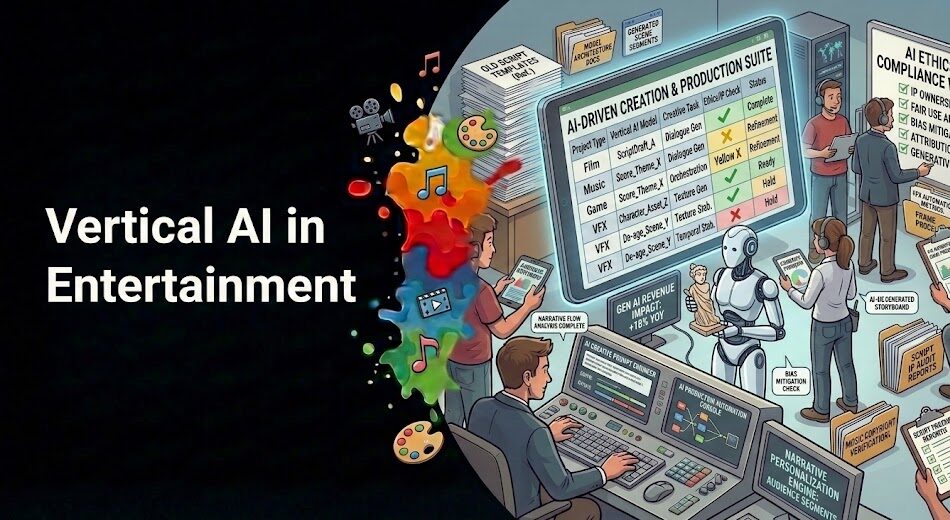
Here’s what’s actually happening inside the technology stacks at the world’s most serious media and entertainment companies right now: the teams that deployed general-purpose AI tools 18 months ago are quietly replacing them. Not because AI doesn’t work—but because they’ve discovered that vertical AI built specifically for M&E outperforms generic models at every layer of the production and distribution workflow. The gap isn’t theoretical. It’s measurable in budget hours, error rates, and delivery timelines.
General AI—your ChatGPTs, your Claudes, your Geminis—was trained on the entire internet. Impressive breadth. But entertainment is a highly specialized industry with domain-specific vocabulary, proprietary workflows, regulatory frameworks, guild structures, and cultural context that general models simply don’t carry. Ask a general AI to analyze chain-of-title complexity for a multi-territory co-production, or to flag an ADR session that’s straying from the emotional register of the original performance. It will produce something plausible-sounding. Whether it’s actually right is another matter entirely.
This piece is for the CTOs, COOs, and heads of production technology making AI adoption decisions right now. It examines where vertical AI in entertainment is demonstrably winning against horizontal models—localization, post-production, supply chain intelligence, metadata, rights—and what a sound build-vs.-buy strategy looks like in 2026’s vendor landscape.
Table of Contents
- Why General AI Keeps Failing M&E Teams
- What “Vertical AI” Actually Means in an Entertainment Context
- The Localization Stack: Vertical AI’s Clearest Win
- Post-Production: Where Domain-Trained Models Are Earning Their Keep
- Supply Chain Intelligence as a Vertical AI Discipline
- The Fragmentation Paradox™ and Why Horizontal AI Can’t Solve It
- Build vs. Buy: How Studios Are Structuring Their Vertical AI Stack
- What the Next 18 Months Look Like for Vertical AI in M&E
- How Vitrina Delivers Vertical AI Intelligence Across the M&E Supply Chain
- FAQ
- Conclusion
Ask VIQI: Which Vertical AI Vendors Are Actually Deployed at M&E Companies Like Yours?
VIQI is Vitrina’s entertainment-trained AI engine—built on 1.6 million titles, 360,000 companies, and 5 million entertainment professionals. Get specific intelligence on which vertical AI tools are being adopted across production, post, localization, and supply chain functions—by studio tier, territory, and workflow type.
✓ 200 free credits included | ✓ No credit card required
Why General AI Keeps Failing M&E Teams
The failure mode isn’t dramatic. General AI rarely produces something obviously wrong—it produces something that looks authoritative but contains subtle errors that only domain experts catch. And in entertainment, those subtle errors compound fast.
Here’s the practical problem: M&E has its own language. “MG” means minimum guarantee to a distribution executive and muscle group to a fitness app. “Clean version” means a censored broadcast cut to a post supervisor and a fresh contractual draft to a lawyer. “Greenlight” describes a completely different decision architecture than anything in the general training corpus. General AI models aren’t wrong about these terms—but they don’t carry the contextual disambiguation that experienced M&E professionals do automatically.
Dig deeper and the problems multiply. Dubbing workflows involve scene-level emotional sync requirements that general models have no frame for. Script breakdown tools need to understand the difference between a practical location and a build—and factor in which union rules apply in which territory. Rights management requires understanding windowing logic across SVoD, broadcast, theatrical, and FAST with territory-specific carve-outs. None of this is rocket science for an M&E professional. It’s completely opaque to a model trained on Reddit, academic papers, and news articles.
Seth Hallen and Craig German—two of the industry’s most respected voices on AI adoption in the entertainment supply chain—have consistently made the same point: the value isn’t in AI that can write a press release. It’s in AI that genuinely understands the operational and regulatory specifics of entertainment workflows well enough to automate tasks that currently require specialized human judgment. That’s a vertical AI problem. And general models aren’t equipped to solve it.
What “Vertical AI” Actually Means in an Entertainment Context
Vertical AI is domain-specific—trained or fine-tuned on data that reflects the actual workflows, terminology, regulatory environment, and business logic of a specific industry. In entertainment, that means training data that includes production schedules, guild agreements, distributor contracts, localization specs, post-production delivery requirements, rights databases, and decades of deal structures. Not the internet’s general sense of those things. The actual documents.
But vertical AI isn’t just about training data. It’s about the model’s operational context—what it’s being asked to do, what feedback loop it’s plugged into, and what human expertise validates its outputs. The best vertical AI systems in entertainment aren’t replacing domain experts. They’re amplifying them. An experienced dubbing director using DeepDub’s emotional AI voice stack isn’t doing less creative work—they’re doing better-targeted creative work, faster, with AI handling the mechanical alignment tasks.
There are three tiers of vertical AI in M&E right now. First: purpose-built platforms with proprietary entertainment training data—Prime Focus Technologies’ CLEAR platform, Vionlabs’ content intelligence engine, Respeecher’s voice synthesis stack. Second: horizontal AI platforms with entertainment-specific fine-tuning and workflow integrations—companies layering GPT-4 or similar models onto entertainment-specific context layers and connecting them to existing production toolchains. Third: studio-internal models trained on proprietary deal, production, and performance data that haven’t been externalized as products. Netflix’s recommendation AI and Amazon’s content analytics platforms live in this tier.
The strategic question for most M&E companies isn’t whether to use vertical AI—it’s which tier makes sense for which workflow. And that decision has real financial stakes. As our guide to AI reshaping the entertainment supply chain covers, the ROI variance between well-deployed vertical AI and poorly-selected general tools is significant enough to affect project EBITDA at scale.

Your AI Assistant, Agent, and Analyst for the Business of Entertainment
VIQI AI helps you plan content acquisitions, raise production financing, and find and connect with the right partners worldwide.
- Find active co-producers and financiers for scripted projects
- Find equity and gap financing companies in North America
- Find top film financiers in Europe
- Find production houses that can co-produce or finance unscripted series
- I am looking for production partners for a YA drama set in Brazil
- I am looking for producers with proven track record in mid-budget features
- I am looking for Turkish distributors with successful international sales
- I am looking for OTT platforms actively acquiring finished series for the LATAM region
- I am seeking localization companies offer subtitling services in multiple Asian languages
- I am seeking partners in animation production for children's content
- I am seeking USA based post-production companies with sound facilities
- I am seeking VFX partners to composite background images and AI generated content
- Show me recent drama projects available for pre-buy
- Show me Japanese Anime Distributors
- Show me true-crime buyers from Asia
- Show me documentary pre-buyers
- List the top commissioners at the BBC
- List the post-production and VFX decision-makers at Netflix
- List the development leaders at Sony Pictures
- List the scripted programming heads at HBO
- Who is backing animation projects in Europe right now
- Who is Netflix’s top production partners for Sports Docs
- Who is Commissioning factual content in the NORDICS
- Who is acquiring unscripted formats for the North American market
The Localization Stack: Vertical AI’s Clearest Win
If you want a single use case that illustrates why niche AI models outperform general AI in M&E, localization is it. The gap is enormous—and it’s widening.
The global video localization market sits at approximately $6.5 billion, according to Anton Dvorkovich, CEO of Dubformer—a company specializing in AI-powered video localization at scale. That market is now being actively restructured by vertical AI tools purpose-built for the specific demands of entertainment localization: lip sync accuracy, emotional register preservation, cultural adaptation, and dialect precision. These are requirements that a general translation model handles badly, and that a vertical model—trained on thousands of hours of professionally dubbed content with corresponding quality feedback—handles materially better.
Ofir Krakowski, CEO and Co-Founder of DeepDub, came from the Israeli Air Force’s AI unit before building what’s become one of the most sophisticated emotional AI voice stacks in entertainment. His core insight is that dubbing quality has historically been limited by the assumption that voice actors work in isolation from the emotional arc of a scene. DeepDub’s vertical AI connects the emotional context of a scene—scene type, character arc position, dramatic register—directly to the voice synthesis parameters. The result is dubbed content that doesn’t just match lip movement. It carries the emotional weight of the original performance into a new language.
Papercup, Respeecher, Neural Garage—the localization vertical AI space now has multiple serious players, each with distinct technical approaches but a common structural advantage over general models: they’ve been trained on entertainment-specific data with entertainment-specific quality feedback. A general AI asked to produce a French dub of an English-language thriller has no concept of what a French dubbing director would accept as emotionally accurate. A vertical model trained on thousands of validated dubbing sessions knows exactly what the standard looks like.
But Rolla Karam, Chief Content Officer at OSN, has correctly identified one frontier where even current vertical AI still falls short: Arabic dialectal localization. The six distinct registers of Arabic aren’t yet reliably handled by AI dubbing systems—which is why OSN’s 2026 AI localization roadmap involves AI tools that handle the mechanical lift while human specialists validate the cultural register. That’s the right hybrid model for any market where linguistic nuance runs deeper than current training data can capture.
Find Vertical AI Vendors and Vetted M&E Technology Partners Instantly
Used by Netflix, Warner Bros, Paramount, and Google TV. Access 140,000+ verified companies across the global entertainment supply chain—including vertical AI vendors, localization specialists, and post-production technology providers.
✓ 200 free credits | ✓ No credit card required | ✓ Full platform access
Post-Production: Where Domain-Trained Models Are Earning Their Keep
Post-production is the workflow where the gap between general AI and vertical AI is most consequential in dollar terms. VFX budgets on high-end episodic production routinely run $3–8 million per episode. Even a 10% efficiency improvement from well-deployed vertical AI tools changes the project’s EBITDA profile meaningfully.
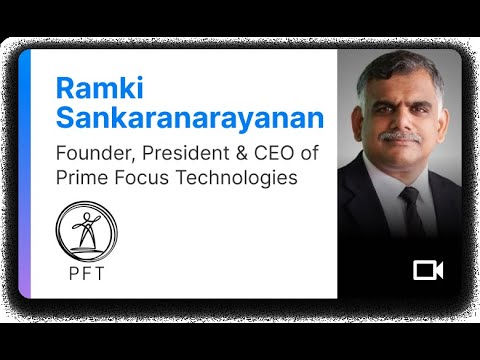
Ramki Sankaranarayanan, CEO of Prime Focus Technologies, has built one of the most sophisticated vertical AI platforms in the entertainment supply chain—PFT’s CLEAR platform handles end-to-end media workflows with AI and automation designed specifically for studio and broadcaster operations. The key differentiator isn’t the underlying model quality. It’s the operational context PFT has baked in: delivery specifications, studio technical requirements, broadcast standards compliance, metadata tagging structures, and workflow orchestration logic that no general AI tool carries.
Ramki Sankaranarayanan (CEO, Prime Focus Technologies) discusses how vertical AI is transforming the entertainment supply chain end-to-end—from production workflows to the CLEAR platform’s impact on studio and broadcaster operations:
Ramy Katrib, CEO of DigitalFilm Tree, has articulated the same insight from the post-production collaboration angle: general tools don’t understand the data structures of production workflows. Avid project files, Final Cut libraries, cloud rendering queues, conforming pipelines—these have their own logic that vertical AI systems built around the actual technical infrastructure of post houses understand natively. General AI doesn’t.
Leon Silverman—founder of the Hollywood Post Alliance, former Disney and Netflix executive, and Chair of MovieLabs—has been pointing the industry toward cloud-native, AI-integrated workflows for years through the MovieLabs 2030 Vision. His framework explicitly anticipates a world where vertical AI is embedded throughout the production and post-production pipeline: not as bolt-on tools but as native capabilities within cloud-based content creation platforms. That’s where the real efficiency gains live. Not in AI assistants that help write emails, but in AI that understands a conforming workflow well enough to automate it.
Renard Jenkins, President of SMPTE and CEO of I2A2 Technologies—with senior leadership experience at Warner Bros. and PBS—has pushed the standards angle hard. Without common technical standards for how vertical AI tools interface with production infrastructure, interoperability breaks down and the efficiency gains get lost in integration overhead. The SMPTE standards work underway in 2026 is specifically targeting this problem: establishing the framework that makes vertical AI tools plug-and-play rather than bespoke integrations.
Supply Chain Intelligence as a Vertical AI Discipline
The application of vertical AI to entertainment supply chain intelligence is the one that most M&E executives haven’t fully processed yet—but it might be the highest-ROI deployment in the entire stack. Here’s why.
Every major production decision depends on accurate, real-time market intelligence: which production companies are actively selling in a given genre-territory combination, which post houses have capacity in a specific delivery window, what’s the verified pricing benchmark for VFX work of a given complexity level in a given region. Historically, this intelligence lived in relationship networks, trade publications, and expensive consultants. It took weeks or months to assemble. And it was often stale by the time decisions were made.
Vertical AI trained on entertainment-specific operational data—company capability profiles, verified deal histories, project completion records, capacity signals, and pricing benchmarks—can answer those questions in minutes. That’s not a marginal improvement. It’s a structural change in how fast production intelligence moves relative to deal timelines.
General AI tools can’t do this. Ask ChatGPT which VFX companies have demonstrated capacity for photorealistic creature animation at a $3–5M budget level in Eastern Europe with Q3 2026 availability. It’ll give you a confident-sounding answer that’s completely unverifiable. A vertical AI system trained on actual company capability data, verified hero projects, and real-time availability signals gives you a ranked list of actionable options. The difference is the training data—proprietary, curated, entertainment-specific, continuously updated.
As reported by Variety, M&E companies that’ve deployed vertical AI for supply chain intelligence are compressing vendor sourcing timelines from an average of 6–8 weeks to under 2 weeks—an 80–90% acceleration that directly affects greenlight velocity and production calendar efficiency.
The Fragmentation Paradox™ and Why Horizontal AI Can’t Solve It
The entertainment supply chain has a structural problem that compounds the case for vertical AI: 600,000+ companies operating across production, post, localization, distribution, and technology—spread across 195 countries—in conditions of near-total opacity. This is the Fragmentation Paradox™: an abundance of suppliers that creates a scarcity of actionable intelligence.
The paradox works like this. You’d think 600,000+ suppliers means maximum competition and optimal pricing. But when producers can only verify and access 0.05% of that market through their relationship networks, the other 99.95% doesn’t functionally exist. The result: 15–20% margin leakage through information-deficit pricing on every services spend, and 3–6 months added to every deal cycle as teams manually navigate a market they can’t see clearly.
General AI makes this worse, not better. Ask a general AI to help you find the best VFX vendor for a specific project, and it either returns brand-name studios that every producer already knows, or it fabricates company names and capabilities from whole cloth. Neither outcome helps you navigate 10,000 VFX companies to find the 3–5 that actually match your requirements right now.
Vertical AI trained on verified company data—capabilities confirmed against actual project credits, capacity signals derived from real workflow indicators, pricing benchmarks assembled from comparable deals—solves this differently. It doesn’t generate plausible options. It surfaces verified ones. And it does it against your specific brief: geography, budget, genre, timeline, technical spec. The Fragmentation Paradox™ is fundamentally an information problem. Vertical AI is an information solution.
Our analysis of Hollywood’s AI adoption from expert perspectives in 2026 consistently finds that the highest-performing teams are deploying vertical tools for sourcing, vendor vetting, and market intelligence—not general AI assistants.
Build vs. Buy: How Studios Are Structuring Their Vertical AI Stack
The build-vs.-buy decision for vertical AI looks different depending on where you sit in the supply chain. Major studios and global streamers with massive proprietary data sets—viewing behavior, production records, rights databases, vendor performance history—have compelling cases for building internal vertical models. Netflix’s recommendation AI, Amazon’s content analytics stack, Disney’s production intelligence platform: these are proprietary because the training data itself is a competitive asset. You can’t buy the data advantage that comes from operating at their scale for a decade.
But most of the M&E supply chain isn’t operating at Netflix scale. For mid-tier studios, independent production companies, broadcasters, distributors, and post houses—the ROI calculation almost always points to buying vertical AI rather than building it. Building a domain-specific AI system requires not just data scientists but M&E domain experts who can curate training data and validate outputs. That talent combination is expensive, rare, and carries a 2–4 year build timeline before you’re running anything production-grade.
Buying vertical AI—from PFT’s CLEAR platform, from DeepDub or Papercup for localization, from Vionlabs for content intelligence, from Gracenote for metadata enrichment—gives you training data advantage you couldn’t build independently. DeepDub’s emotional voice stack was trained on thousands of hours of validated professional dubbing. Vionlabs’ emotional analysis engine was built on a video corpus that no single studio could assemble. The training data moat that makes these tools work is a collective industry asset built over years of production. You can’t accelerate past it by throwing budget at a build project.
The smart stack in 2026 looks like this: buy specialized vertical AI for workflow-specific applications (localization, post, metadata, scheduling), build internal models only where your proprietary data creates genuine differentiation (viewer behavior, deal performance, vendor relationships), and use a supply chain intelligence platform with vertical AI at its core to connect the whole thing with real-time market data. As The Hollywood Reporter has tracked, the studios moving fastest on AI adoption are the ones with clear frameworks for that build-vs.-buy line—not the ones trying to do everything in-house.
Need Direct Access to Vertical AI Vendors and M&E Technology Specialists?
Vitrina Concierge connects you directly to decision-makers at the vertical AI vendors, localization technology providers, and post-production specialists best matched to your workflow requirements—across any territory, budget tier, and delivery timeline.
- LA production company → Netflix UK production partnership (48 hours)
- Korean animation studio → Netflix Adult Animation (week one)
- Middle Eastern studio → Legendary Pictures (direct access)
What the Next 18 Months Look Like for Vertical AI in M&E
Several convergences are going to make the vertical AI advantage more decisive in M&E over the next 18 months—not less. Here’s what to track.
Standards consolidation. SMPTE’s work on AI interoperability standards—led by Renard Jenkins—is moving toward ratification in 2026. When those standards land, vertical AI tools built to spec will plug into existing infrastructure without bespoke integration. That compresses deployment timelines from months to weeks and removes the integration cost that’s been the biggest barrier to adoption at mid-tier studios and post houses. Adoption accelerates once the plumbing is standardized.
Multimodal vertical models. The current generation of entertainment vertical AI is largely single-function: a dubbing tool, a metadata enrichment engine, a content intelligence platform. What’s coming is multimodal—models that process video, audio, script, and production data simultaneously to deliver integrated intelligence across workflow functions. PFT’s direction with CLEAR, MovieLabs’ 2030 Vision, Vionlabs’ product roadmap all point toward this convergence. When it arrives, the gap between vertical and general AI in M&E becomes structural rather than just practical.
Sovereign content hub demand. Saudi Arabia’s Vision 2030 entertainment buildout, India’s rapidly expanding streaming market, and South Korea’s continued content export momentum are all generating demand for AI tools that understand regional M&E workflows—local guild structures, language-specific localization requirements, territory-specific distribution logic. General AI doesn’t serve these markets well. Vertical AI built for regional M&E specifics does. The next 18 months will see several significant Sovereign Hub-focused vertical AI platforms either launched or heavily capitalized.
Rights and chain-of-title automation. The Authorized AI™ framework—the industry’s transition to licensed AI training data with verified chain-of-title—is creating demand for vertical AI tools that can audit, track, and manage rights provenance across complex multi-territory, multi-platform content libraries. General AI can’t do this reliably. Vertical systems trained on actual rights structures and IP management workflows are being built and deployed now. This is the workflow where the legal exposure of getting it wrong is highest—and where the ROI of getting it right is clearest.
How Vitrina Delivers Vertical AI Intelligence Across the M&E Supply Chain
Vitrina is a vertical AI platform built specifically for the M&E supply chain—and that distinction matters in exactly the ways this article has described. VIQI, Vitrina’s AI intelligence engine, isn’t a general AI assistant with an entertainment skin. It’s trained on 1.6 million titles, 360,000 companies, and 5 million entertainment professionals—curated M&E-specific data that general models don’t carry.
The practical result: when an acquisition executive asks VIQI which production companies in Turkey are actively producing psychological thrillers with verified Netflix delivery track records and Q4 2026 availability, they get a ranked, verifiable answer—not a plausible-sounding hallucination. When a co-production executive asks about the capital stack structure of recent MENA productions that used Saudi Vision 2030 incentive frameworks alongside European gap financing, VIQI surfaces the actual deal patterns. That’s vertical AI solving the Fragmentation Paradox™ in real time.
Vitrina’s platform maps 140,000+ active production and distribution companies with verified capabilities, real deal history, and current availability signals. It tracks 400,000+ projects in active development, production, and post globally. And the Vitrina Concierge service adds a human-intelligence layer on top of the AI—for situations where what you need isn’t just information but a warm introduction to the right decision-maker, delivered before the trade has picked up the story.
For M&E executives choosing their vertical AI stack, Vitrina is the supply chain intelligence layer—the platform that tells you what’s actually happening across the global production market and surfaces the partners, vendors, and content opportunities that match your specific operational requirements. Our deeper analysis at end-to-end AI integration across media production and distribution covers how this layer connects with the rest of your vertical AI stack in practice.
Frequently Asked Questions
What is vertical AI in entertainment, and how is it different from general AI?
Vertical AI in entertainment refers to AI systems specifically trained or fine-tuned on M&E domain data—production workflows, guild agreements, localization specifications, rights structures, distribution logic, and industry-specific terminology. Unlike general AI (ChatGPT, Gemini, Claude), vertical entertainment AI carries operational context that general models don’t: it understands what “MG” means in a distribution context, what chain-of-title verification requires, and what a dubbing director needs from an emotional performance register. General AI produces plausible-sounding outputs. Vertical AI produces verifiable, operationally accurate ones.
Which M&E workflows benefit most from vertical AI over general AI tools?
The workflows where vertical AI demonstrates the clearest performance advantage are: localization and dubbing (emotional register, lip sync, cultural adaptation), post-production automation (delivery spec compliance, workflow orchestration, quality control), metadata enrichment (scene-level tagging, emotional and cultural classification), supply chain intelligence (vendor sourcing, capacity verification, market intelligence), and rights and chain-of-title management (provenance tracking, IP audit, Authorized AI compliance). In each of these, domain-specific training data is what separates accurate from merely plausible outputs.
What is the Fragmentation Paradox, and how does vertical AI solve it?
The Fragmentation Paradox™ is the counterintuitive situation where 600,000+ companies in the global M&E supply chain create information scarcity rather than abundance. Because producers can only access 0.05% of the market through their relationship networks, they overpay (by 15–20% in margin leakage) and wait too long (3–6 months added to deal cycles) due to information asymmetry. General AI makes this worse—it hallucinates company names or returns brand-name studios everyone already knows. Vertical AI trained on verified company capability data, real deal histories, and capacity signals surfaces actionable options from across the real market in minutes.
What are the leading vertical AI companies in M&E right now?
Key vertical AI platforms across M&E functions include: Prime Focus Technologies (CLEAR platform—end-to-end supply chain AI for studios and broadcasters, led by CEO Ramki Sankaranarayanan), DeepDub (emotional AI voice dubbing, led by Ofir Krakowski), Vionlabs (content intelligence and emotional scene analysis, led by Arash Pendari), Respeecher (synthetic voice for entertainment, led by Alex Serdiuk), Gracenote (metadata enrichment and content IDs), Papercup (AI dubbing for global content distribution), and Vitrina/VIQI (supply chain intelligence trained on 1.6 million titles and 360,000 companies). Each operates in a specific M&E vertical with domain-specific training data advantages.
Should M&E companies build or buy vertical AI tools?
For most M&E companies below major studio tier, buying vertical AI delivers better ROI than building it. Purpose-built platforms like PFT’s CLEAR or DeepDub’s voice stack carry training data advantages accumulated over years that no individual company can replicate on a 2–4 year build timeline. The build case is strongest for companies with genuinely proprietary data that creates defensible differentiation—Netflix’s viewing behavior data, Amazon’s deal performance records. For mid-tier studios, broadcasters, independent producers, and distributors, buying specialized vertical AI tools while using a supply chain intelligence platform to connect them produces the best outcome.
What role do AI standards play in vertical AI adoption for entertainment?
SMPTE, led by President Renard Jenkins, is actively working on AI interoperability standards for the entertainment industry in 2026. These standards define how vertical AI tools interface with production infrastructure—enabling plug-and-play deployment rather than bespoke integration. Without them, each vertical AI tool requires custom integration work that can take months and costs $200K–$500K per implementation. When ratified, these standards will dramatically compress vertical AI deployment timelines and accelerate adoption across studios, post houses, and broadcasters that have been waiting for the technical framework to stabilize before committing budgets.
How is vertical AI performing in non-Western M&E markets?
Performance in non-Western markets is uneven and improving. Localization AI for languages with large standardized training data—Spanish, French, Mandarin, Portuguese—performs well. Arabic represents the current frontier challenge: OSN’s Chief Content Officer Rolla Karam has confirmed that AI localization for Arabic dialectal registers is still in active development for 2026 deployment, requiring human specialist validation. For supply chain intelligence in markets like MENA and APAC, vertical AI that incorporates Sovereign Hub data—Saudi Vision 2030 incentive structures, Indian production frameworks, Korean content pipeline data—outperforms tools trained primarily on Hollywood-centric data.
How does VIQI differ from general AI tools like ChatGPT for entertainment research?
VIQI is trained on 1.6 million entertainment titles, 360,000 companies, and 5 million M&E professionals—verified, curated industry data that ChatGPT doesn’t carry. When asked to find production companies, content trends, or deal structures, general AI produces plausible answers that may be outdated, incomplete, or fabricated. VIQI surfaces verifiable intelligence from the actual market: which companies are actively selling, which projects are in what stage, which partnerships are in development. It’s the difference between a general assistant and an expert system trained on the specific data you need to make production and acquisition decisions.
Conclusion: The Vertical AI Advantage Is a Decision You Make Now
The M&E companies pulling ahead on AI aren’t the ones that deployed the most AI tools fastest. They’re the ones that deployed the right tools—vertical AI built for entertainment specificity, connected to real operational data, solving real workflow problems that general models simply can’t address. The performance gap between a domain-trained dubbing AI and a general translation tool, between a supply chain intelligence engine trained on 140,000+ verified companies and a chatbot describing the industry from its general training data, is decisive in dollar terms.
Key Takeaways:
- General AI fails M&E on specificity: The subtle domain errors that general models produce compound into operational costs—wrong terminology, hallucinated companies, unverifiable outputs—that experienced M&E teams catch but automation cannot.
- Localization leads the vertical AI performance gap: Purpose-built tools like DeepDub, Papercup, and Respeecher demonstrate measurable quality advantages over general models in the $6.5B localization market specifically because their training data reflects professional entertainment dubbing standards.
- The Fragmentation Paradox™ requires vertical intelligence to resolve: With 600,000+ companies and 15–20% margin leakage from information asymmetry, the supply chain intelligence problem can only be solved by AI trained on verified M&E operational data—not general models.
- Buy before you build: The training data advantages that make vertical AI tools like PFT’s CLEAR platform work are years in the making. Mid-tier M&E companies capture more ROI buying proven vertical tools than spending 3–4 years building internal models.
- Standards are the unlock: SMPTE’s AI interoperability work in 2026 will compress vertical AI deployment timelines from months to weeks—making this the right moment to finalize your vertical AI vendor selections before adoption accelerates and capacity gets constrained.
The vertical AI advantage in M&E isn’t coming. It’s here. And the companies that de-risk their AI stack now—by choosing domain-trained tools over general-purpose substitutes—will be the ones protecting their EBITDA margins and accelerating their deal velocity when the adoption wave fully hits in the next 18 months.
Weaponize Vertical AI Intelligence Across Your Entire M&E Supply Chain
Trusted by Netflix, Warner Bros, Paramount, and Google TV. VIQI—Vitrina’s vertical AI engine—is trained on 1.6 million titles, 360,000 companies, and 5 million M&E professionals. Track 400,000+ projects globally. Get verified intelligence—not plausible hallucinations.
✓ 200 free credits | ✓ No credit card required | ✓ Cancel anytime
Need direct introductions to vertical AI vendors matched to your stack? Explore Concierge Service →
Find Film+TV Projects, Partners, and Deals – Fast.
VIQI matches you with the right financiers, producers, streamers, and buyers – globally.
Producers Seeking Financing, Co-Pros, or Pre-Buys?
Vitrina Concierge helps producers reach the right financiers, commissioners, distributors, and co-production partners — with precision outreach, not cold pitching.
Join Industry Briefings Trusted by Leaders

Streamers – Netflix vs. Amazon – The 2026 Strategy
How Netflix and Amazon’s content and revenue strategies are diverging ahead of 2026.

Format Adaptations: Global Trends
Where formats are traveling, which adaptations are breaking out, and how streamers are backing remakes in 2025–2026.

Books, Novels & Comics Adaptations: Global Trends
Books, webtoons, and manga driving the next global screen hits. Discover how in this webinar.

Micro-Dramas & Mobile-First Storytelling
Micro-dramas are building real audiences and revenue. Understand the platforms, buyers, and economics behind the growth.