About Innovation Hub
 Global Content Pulse (Webinars)


 Global Production Financing
(Webinars)
Global Production Financing
(Webinars)  LeaderSpeak Podcast
  Global Entertainment Digest (Newsletter)
  About Vitrina
 About VIQI
 Our Story
 Our Solutions 🔥
 Film+TV Projects Tracker 🚀
 Case Studies
 Our Profile
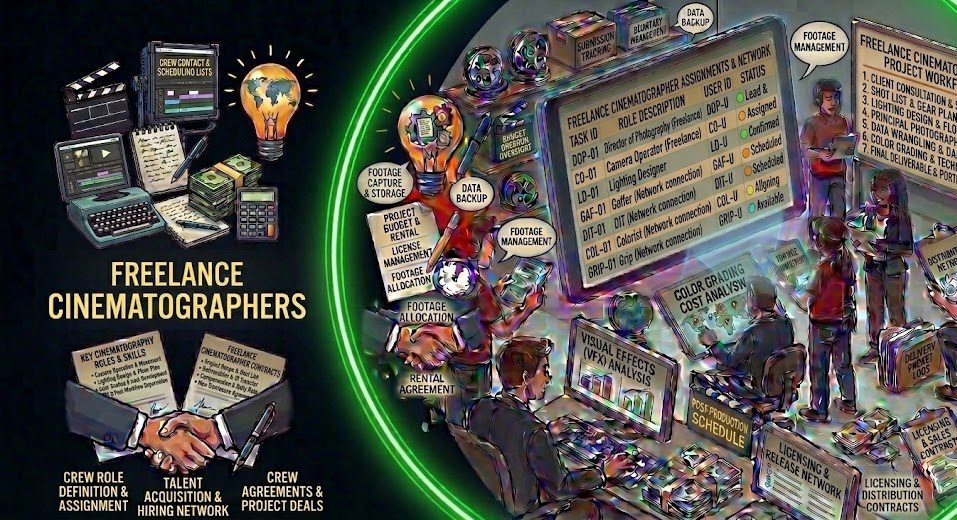
Finding freelance cinematographers for hire in the US is one of the most consequential decisions you’ll make before a single frame rolls. Not because DPs are scarce—they aren’t. But because the US market is fragmented across dozens of guild rosters, regional networks, freelance platforms, and informal referral chains that don’t talk to each other.
The right DP for your project is in there. Getting to them fast, with enough confidence to commit, is the actual challenge.
This guide cuts through that fragmentation. Whether you’re packaging a micro-budget indie, a branded content series, or a mid-range TV pilot, the sourcing and vetting logic is the same. You need verified credits, confirmed availability, budget-scale alignment—and you need it before your timeline compresses and you’re making a $1,500-a-day hire from a place of desperation rather than intelligence.
Here’s a 7-step framework to find, vet, and lock a freelance cinematographer in the US who can actually deliver your vision—and protect your production calendar while doing it.
In This Guide
- Why the DP Decision Is Your Highest-Stakes Hire
- Step 1: Define Your Brief Before You Search
- Step 2: Know Your US Sourcing Channels
- Step 3: Read the Reel—and Then Look Past It
- Step 4: Vet for Scale, Not Just Talent
- Step 5: Navigate US Rates Without Getting Burned
- Step 6: Understand Union vs. Non-Union in the US
- Step 7: Lock Your DP Before You Announce
- How Vitrina Accelerates Your DP Search
- FAQ: Freelance Cinematographers in the US
Ask VIQI: Which Cinematographers Are Active in My State?
VIQI is Vitrina’s AI assistant—trained on 1.6 million titles, 360,000 companies, and 5 million entertainment professionals. Ask it to surface freelance DPs with credits in your genre, budget tier, and US territory.
✓ Included with 200 free credits | ✓ No credit card needed
Why the DP Decision Is Your Highest-Stakes Hire
The real dynamic here is one that doesn’t always get stated plainly: your cinematographer doesn’t just shoot your film. They co-architect it—collaborating on coverage decisions that either protect or destroy your editorial options, managing the camera department so your 1st AD can hold the schedule, and setting the visual tone that determines whether acquisitions executives take your cut seriously in the first pass.
In US independent production, DP day rates typically represent 8–12% of your entire BTL budget. That’s before you factor in camera package costs, which many experienced DPs negotiate separately. Get this hire wrong and the damage compounds—misaligned visual language, coverage gaps that cost you in the edit, department friction that bleeds schedule days. Get it right and everything downstream gets easier.
But here’s what we’re seeing across the independent space: producers spend 60–70% of their DP search time watching reels and almost no time validating the two things that actually predict outcome—budget-scale fit and on-set professional conduct. This guide rebalances that.
Step 1: Define Your Brief Before You Search
Don’t open a browser until you’ve written a one-page DP brief. It sounds obvious. Most producers skip it. And then they spend three weeks in exploratory conversations that go nowhere because they can’t answer basic questions about what they actually need.
Your brief should specify:
- Production format — Feature narrative, episodic pilot, documentary, branded content, commercial? These require genuinely different skill sets. A documentary DP who excels at run-and-gun handheld work may not be the right call for a slow-burn psychological thriller that needs precise blocking coverage.
- Shoot location and dates — Are you in Los Angeles, Atlanta, New York, or a smaller market? US DP availability varies dramatically by city. Atlanta’s 30% tax credit has attracted a deep BTL talent pool; smaller markets may require you to offer travel accommodation.
- Visual reference — Two or three comparable films with a visual language that aligns with yours. This narrows your candidate pool faster than any other filter.
- Budget ceiling for the DP package — Including day rate, prep days, and any camera package costs you’re expecting them to source. Don’t be vague about this; DPs who can’t work at your number will tell you, saving both parties time.
- Union or non-union status — Determines your candidate pool entirely. More on this in Step 6.
For a deeper look at how to structure this exercise alongside your full crew plan, see our guide to hiring film production crew and professional services.
Step 2: Know Your US Sourcing Channels
The US market offers more sourcing options for freelance cinematographers than almost any other territory. But more options doesn’t mean better signal. Here’s how to rank what you’re looking at:
Producer-to-Producer Referrals
Highest signal, always. A peer who put a specific DP on a $600K genre feature and finished on schedule is telling you something worth more than a two-minute reel. Build this network at Sundance, AFM, and through the IFP and Film Independent communities—before you need it. If you’re already in pre-production, call producers you know and ask directly. Most will answer.
Vitrina’s Professional Database
Vitrina tracks top directors of photography and their latest projects across the US and globally, with credits tied to actual productions in the platform. This isn’t a passive directory—it’s a live intelligence layer that tells you who’s active, what they’ve shot recently, and whether their recent credits align with your project profile. You can also use Vitrina to track top cinematographers and their latest projects before committing to outreach.
IATSE Local Rosters
For union productions, IATSE Local 600 (International Cinematographers Guild) is your primary source. Locals vary by region: Local 600 covers the national scope for camera professionals. Reach out directly to the local business agent in your shooting territory—they can often make informed recommendations based on your project scale and genre.
Film Commissions
State and regional film commissions maintain crew directories filtered by department and tier. Georgia, New Mexico, New York, and California commissions are particularly well-resourced. Staff often know informally who the strong local DPs are at your budget level—that informal intelligence is worth a 15-minute call.
IMDb Pro and Industry Databases
Useful for credits verification and contact information—but not for active availability signals. Someone may have five strong credits on IMDb Pro and be fully committed for the next six months. Use it to validate candidates, not discover them.
Track Active DPs and Cinematographers on Vitrina
Trusted by Netflix, Warner Bros, and Paramount. Join 140,000+ companies using Vitrina to surface verified production talent and service providers across the global entertainment supply chain.
✓ 200 free credits | ✓ No credit card required | ✓ Full platform access
Step 3: Read the Reel—and Then Look Past It
A strong reel is a necessary condition. It’s not sufficient. Here’s why: showreels are curated to show the best possible work, often across multiple productions with very different conditions. What a reel doesn’t tell you is whether that stunning long take happened on a $4M set with a full lighting package and a 10-person camera department—or on a $300K production with a two-person crew and a rented Alexa Mini LF.
So—watch the reel for visual intelligence and aesthetic alignment. Then immediately ask these questions:
- “Which three credits on this reel most closely match my project’s budget and shooting conditions?” Let them pick. Then investigate those three.
- “What camera and lighting package did you work with on [specific project]?” A DP who can’t answer in detail wasn’t really running that department.
- “Have you shot on location in [your territory]? What were the logistical constraints?” US regional production realities—weather, permitting, crew depth—vary dramatically between Atlanta, Albuquerque, and upstate New York.
The answers accelerate your vetting faster than any amount of additional reel-watching.

Your AI Assistant, Agent, and Analyst for the Business of Entertainment
VIQI AI helps you plan content acquisitions, raise production financing, and find and connect with the right partners worldwide.
- Find active co-producers and financiers for scripted projects
- Find equity and gap financing companies in North America
- Find top film financiers in Europe
- Find production houses that can co-produce or finance unscripted series
- I am looking for production partners for a YA drama set in Brazil
- I am looking for producers with proven track record in mid-budget features
- I am looking for Turkish distributors with successful international sales
- I am looking for OTT platforms actively acquiring finished series for the LATAM region
- I am seeking localization companies offer subtitling services in multiple Asian languages
- I am seeking partners in animation production for children's content
- I am seeking USA based post-production companies with sound facilities
- I am seeking VFX partners to composite background images and AI generated content
- Show me recent drama projects available for pre-buy
- Show me Japanese Anime Distributors
- Show me true-crime buyers from Asia
- Show me documentary pre-buyers
- List the top commissioners at the BBC
- List the post-production and VFX decision-makers at Netflix
- List the development leaders at Sony Pictures
- List the scripted programming heads at HBO
- Who is backing animation projects in Europe right now
- Who is Netflix’s top production partners for Sports Docs
- Who is Commissioning factual content in the NORDICS
- Who is acquiring unscripted formats for the North American market
Step 4: Vet for Scale, Not Just Talent
Scale mismatch is the most expensive mistake you won’t see coming. A DP whose recent credits are all studio-backed productions at $10M+ brings genuine skill to your $500K indie. But they also bring an embedded understanding of resource availability that doesn’t transfer cleanly. They’ll be used to larger lighting packages, more prep days, and camera department depth that you simply can’t fund at your level.
That said, the reverse is also true. A DP who’s only shot short-form content, music videos, or student films hasn’t navigated the continuity demands and coverage consistency required across a 20-day feature schedule. Day 14 looks very different from Day 1 when you’re deep in a low-budget shoot with a shrinking scope of options.
What you want is someone with documented credits within one budget tier above or below your project—and ideally someone who’s worked your specific genre. The visual problem-solving required for a handheld documentary thriller is fundamentally different from a studio drama with carefully blocked coverage.
Strategic players understand that the reference call with a producer who worked with this DP at your exact budget scale is worth more than any reel segment. Ask specifically: “Did they understand the constraints? Did they solve problems or escalate them?” That answer is everything.
Our analysis of cost vs. quality when hiring creative services goes deeper on how to optimize this trade-off without compromising your production value.
Step 5: Navigate US Rates Without Getting Burned
US freelance cinematographer rates are genuinely wide-ranging—and negotiable in ways that aren’t always obvious to producers without BTL experience. Here’s the honest breakdown by market and tier:
- Micro-budget indie (sub-$300K): $500–$1,200/day. Deferment packages common. Many DPs at this level work below market for projects with strong creative merit or festival potential.
- Low-to-mid indie ($300K–$2M): $1,200–$3,000/day. This is where the experienced indie DP pool concentrates. Expect 5–7 prep days plus shoot days.
- TV pilot / branded content ($2M–$8M): $3,000–$6,500/day for experienced, credited DPs with episodic history.
- Studio-adjacent or studio co-finance: $6,500–$15,000+/day. Union minimums under IATSE Low Budget Agreements can be significantly lower—worth understanding before you negotiate.
But here’s the thing about rates: the day rate is often not the full picture. Camera package costs—if the DP is expected to source a rental—can run $2,000–$8,000 per week depending on your format. Clarify who owns that cost before you start talking day rates. As Deadline‘s coverage of the independent production space has consistently highlighted, budget blowouts in BTL hiring almost always trace back to costs that weren’t scoped in the initial conversation.
Don’t negotiate against the rate in isolation. Negotiate the full package: day rate, prep days, wrap days, overtime provisions, and camera package cost-sharing. Get it in writing. Every line of it.
Step 6: Understand Union vs. Non-Union in the US
This decision shapes your entire candidate pool—and your production structure. Don’t treat it as an afterthought.
IATSE Local 600 covers cinematographers on union productions. If you’re shooting under a SAG-AFTRA agreement (even a low-budget one), you’ll typically need to work with IATSE crew as well—the two guild agreements interact. Local 600 has tiered agreements that cover low-budget and ultra-low-budget productions, with minimum rates that are genuinely accessible for well-structured indie projects.
Non-union DPs often have strong credits—especially in documentary, branded content, and micro-budget narrative. Some of the most adventurous, adaptable cinematographers in the US don’t hold guild cards by choice, not limitation. The talent pool is real. The tradeoff is that you’re operating without the labor structure that protects both parties if things go sideways on set.
The practical calculus:
- If you’re SAG-AFTRA signatory → strongly consider union DP to avoid cross-union complications
- If you’re producing under a modified low-budget agreement → review IATSE tiered rates first; they may be closer to your number than you think
- If you’re fully non-union → the freelance pool is wider, but your vetting needs to be proportionally tighter, since there’s no guild professional standards backstop
Step 7: Lock Your DP Before You Announce
The moment your production gets visibility—whether that’s a trades mention, a social announcement, or a festival pitch—your DP candidates start fielding competing inquiries. This isn’t paranoia. It’s the US production calendar working as designed. Projects cluster around the same weather windows, the same tax incentive deadline cycles, the same festival submission timelines.
Insiders recognize this as one of the most avoidable production failures: a handshake agreement two weeks before announcement, followed by a DP who moves to a better-paying project that materialized in the window. The solution is simple: signed deal memo before announcement. Not after. Before.
Your lock checklist:
- Signed deal memo with specific start date, wrap date, and all rate terms
- Confirmed prep days and any tech scout schedule built in
- Camera package agreement—who sources it, who pays, at what cap
- Kill fee clause—protects both parties if the production delays or collapses before shoot date
- Travel and accommodation terms if they’re coming from out of state
How Vitrina Accelerates Your DP Search
The Fragmentation Paradox™ in US crew hiring is real. Thousands of working cinematographers are scattered across guild rosters, regional directories, freelance platforms, and producer referral networks that don’t integrate. A DP with exactly the right credits for your project may be invisible to you unless you happen to know the right producer who worked with them in Atlanta two years ago.
Vitrina’s platform surfaces verified production professionals—including active DPs and cinematographers—linked to real credits across 400,000+ tracked projects. You can filter by territory, production type, budget tier, and recent activity. That’s not a passive database; it’s an active intelligence layer that tells you who’s currently available and what they’ve actually shipped.
The VIQI AI assistant takes it further. Ask it a specific question—”Which DPs with horror feature credits are active in Georgia?”—and it cross-references 5 million entertainment professionals against production history to surface relevant options in minutes, not weeks. As reported by Variety, the ability to access verified, up-to-date production intel—rather than relying on incomplete guild directories and informal networks alone—is one of the structural advantages that separates well-resourced productions from ones that scramble through pre-production.
For a step-by-step breakdown of how to use metadata to qualify production professionals before outreach, see our guide to qualifying production vendors using deep metadata.
Find Verified Cinematographers in the US—Start Free
A LA-based producer connected with Netflix UK, Fifth Season, and Fox Entertainment in 48 hours through Vitrina’s Smart Pairing. Join 140,000+ companies already using the platform to de-risk production decisions.
✓ 200 free credits | ✓ No credit card required
FAQ: Freelance Cinematographers for Hire in the US
Conclusion: The Right DP Doesn’t Fall Into Your Inbox
Finding the right freelance cinematographer for your US production requires a structured approach, not a lucky referral. The market has the talent. The Fragmentation Paradox™ is what keeps most independent producers from reaching it efficiently—scattered across guild rosters, regional networks, and informal channels that don’t integrate.
Define your brief first. Source from multiple verified channels. Vet against real credits and producer references—not just reels. Understand the full rate package, not just the day rate. And lock with a signed deal memo before you announce, not after.
The producers who move fastest through this process—and finish with the strongest production teams—are the ones who treat crew discovery as a strategic exercise, not an administrative task. Platforms like Vitrina exist precisely to accelerate that exercise for the productions that don’t have six weeks to waste on exploratory conversations.
Key Takeaways:
- Start your DP search 10–14 weeks out—the best US cinematographers book 8–12 weeks in advance, often more during peak windows.
- Combine multiple sourcing channels—producer referrals, Vitrina’s professional database, IATSE Local 600, and state film commissions for regional hires.
- Rate negotiation is a full-package conversation—day rate plus prep days plus camera package costs; scope all three before committing.
- Scale match matters as much as talent—verify the DP has credits at your budget tier and genre before any chemistry conversation.
- Signed deal memo before announcement—verbal commitments dissolve the moment competing projects appear in your DP’s inbox.
Discover and Track Active Cinematographers on Vitrina—Free
Join 140,000+ companies on Vitrina, trusted by Netflix, Warner Bros, and Paramount. Track top DPs and cinematographers with verified credits across the US—filtered by territory, genre, and production tier.
✓ 200 free credits | ✓ No credit card required | ✓ Cancel anytime
Need a DP Fast? We’ll Surface the Right Candidates.
Vitrina Concierge is your Virtual Agent. We don’t send you a list—we make warm, direct introductions to verified production professionals actively seeking projects like yours. Korean animation studio to Netflix Adult Animation in week one. LA producer to Netflix UK in 48 hours.
Find Film+TV Projects, Partners, and Deals – Fast.
VIQI matches you with the right financiers, producers, streamers, and buyers – globally.
Producers Seeking Financing, Co-Pros, or Pre-Buys?
Vitrina Concierge helps producers reach the right financiers, commissioners, distributors, and co-production partners — with precision outreach, not cold pitching.
Join Industry Briefings Trusted by Leaders

Format Adaptations: Global Trends
Where formats are traveling, which adaptations are breaking out, and how streamers are backing remakes in 2025–2026.

Books, Novels & Comics Adaptations: Global Trends
Books, webtoons, and manga driving the next global screen hits. Discover how in this webinar.

Micro-Dramas & Mobile-First Storytelling
Micro-dramas are building real audiences and revenue. Understand the platforms, buyers, and economics behind the growth.

Navigating Global Content Licensing Trends
How global content licensing is shifting beyond flat fees to flexible, deal-driven models.