About Innovation Hub
 Global Content Pulse (Webinars)


 Global Production Financing
(Webinars)
Global Production Financing
(Webinars)  LeaderSpeak Podcast
  Global Entertainment Digest (Newsletter)
  About Vitrina
 About VIQI
 Our Story
 Our Solutions 🔥
 Film+TV Projects Tracker 🚀
 Case Studies
 Our Profile
Ask ten writers which screenwriting software they use, and you’ll get eleven answers—six of which involve an impassioned defense of something they’ve been using since 2009. But the market’s actually moved.
The tools that survive a real production—where your script gets passed between a director in London, a development exec in LA, and a line producer in Cape Town—aren’t the ones with the most features. They’re the ones that hold up when 50 people are working in the same document at the same time.
This guide covers the best professional script formatting software for 2026—what each tool actually does well, who it’s built for, and where the gaps are. We’re not reviewing these from a hobbyist perspective. If you’re writing on spec, any tool works. But if your script needs to survive a production pipeline from greenlight to final delivery, the choice matters more than most people admit.
In This Guide
- What Actually Matters in Screenwriting Software (For Working Productions)
- The Top Screenwriting Tools in 2026—Ranked by Professional Use Case
- Script Collaboration on Live Productions: What Actually Works
- AI-Assisted Screenwriting: Where It Helps, Where It Doesn’t
- Script Formatting Standards: What Buyers and Networks Actually Require
- Beyond Software: Getting Your Script in Front of the Right Buyers
- FAQ: Screenwriting and Script Formatting Software
Find Productions and Buyers Actively Seeking Scripts Right Now
Ask VIQI—Vitrina’s AI intelligence agent—to identify production companies, streamers, and development execs sourcing scripts in your genre. Used by 140,000+ companies including Netflix, Warner Bros, and Paramount.
200 free credits · No credit card required
What Actually Matters in Screenwriting Software (For Working Productions)
The feature list on any screenwriting app’s website will tell you it formats sluglines, handles scene headings, and auto-corrects action lines. That’s table stakes. What separates professional tools from casual ones is what happens after page 1 exists—when a second writer joins the project, when production needs a breakdown, when the director’s cut changes 14 scenes overnight, and when legal needs a locked PDF before breakfast.
Here’s what actually drives the decision on professional productions:
- Real-time collaboration. Can multiple writers work simultaneously without version collision? This is now a baseline requirement on any series room.
- Production breakdown integration. Does the file format export cleanly to scheduling and budgeting tools like Movie Magic Scheduling or Showbiz Budgeting? If you’re losing data on export, you’re creating work for your production coordinator.
- Revision tracking. Colored revision pages (draft, blue, pink, yellow, green) need to be handled correctly—automatically, not manually. On a union production, this isn’t optional.
- PDF export fidelity. The PDF a development exec reads needs to look identical to what you wrote. Margin drift, font substitution, and page count changes on export are not rare—they’re constant complaints about mid-tier tools.
- Mobile and cross-platform access. Writers work on planes. Directors annotate on iPads. If the tool doesn’t function cleanly across devices, it creates friction that slows the whole pipeline down.
The Top Screenwriting Tools in 2026—Ranked by Professional Use Case
There’s no single winner. The right tool depends on where you are in the production cycle, how many people are touching the document, and what your delivery format needs to be. Here’s an honest breakdown.
Final Draft (v13) — Still the Industry Standard for Good Reason
Final Draft remains the most widely accepted script format in professional production. Development executives at major studios and streamers receive thousands of scripts—and Final Draft .fdx files are still the default expected format at most US networks. That network effect matters. It’s not the most collaborative tool, and the subscription pricing has frustrated longtime users, but when you need a script that a WGA signatory production will accept without questions, this is still where most people start.
Best for: Feature film writers, TV writers delivering to US studios, anyone working within WGA-adjacent productions. Pricing: ~$99–$129 one-time purchase (Final Draft 13). Collaboration requires separate licensing.
WriterDuet — The Collaboration-First Choice for TV Writers’ Rooms
WriterDuet is the tool that ate the mid-budget TV writers’ room market. Real-time collaboration that actually works—multiple writers in the same document, changes synced live, conflict resolution handled cleanly. For any production where more than one person is writing concurrently, WriterDuet removes 2–3 hours of daily version management friction that other tools create.
The formatting output is clean, exports to PDF and .fdx without drama, and the web-based interface means no install barriers for guest writers. Best for: TV series rooms, showrunners managing multiple writers, remote writing teams. Pricing: Free tier available; Pro at ~$9.99/month; Team plans at ~$29.99/month.
Highland 2 — The Writer’s Writer’s Choice (Mac-Exclusive)
If you’re on a Mac and write alone, Highland 2 is genuinely excellent. It uses Fountain—a plain text screenplay format—which means your script is never locked in a proprietary format. The interface stays out of your way. Exports are clean. But it’s Mac-only, has no real-time collaboration, and lacks the production breakdown features that matter once a script moves into active development. Think of it as the best first-draft tool in the market—not the best production tool.
Best for: Solo feature writers, WGA members who write first drafts before moving to Final Draft, writers who prioritize focus over features. Pricing: ~$49.99 one-time (Mac App Store).
Fade In Pro — The Final Draft Alternative That Doesn’t Cost $99
Fade In Pro does 95% of what Final Draft does at about a third of the cost (~$79.99 one-time, all platforms). Cross-platform, clean formatting, solid PDF export, reads .fdx files. It’s the tool a lot of international writers use because it’s accessible and doesn’t require a subscription. The trade-off is adoption: when you’re sending files back and forth with US-based development teams who default to Final Draft, you’ll occasionally hit compatibility questions.
Best for: International writers, budget-conscious productions, writers who want Final Draft parity without the price. Pricing: ~$79.99 one-time, all platforms.
Scripto — The Enterprise Script Management Platform
This is a different category entirely. Scripto isn’t just a writing tool—it’s a cloud-based script workflow platform built for large productions where live data matters. Josh Klein, CEO of Scripto, described this distinction clearly in a Vitrina LeaderSpeak conversation: the platform is built around the idea that scripts are living documents in production, not static files.
According to Klein, Scripto was created precisely because existing tools treat the script as something finished once written—but on a series, the script is never done until picture lock. The platform handles versioning, distribution, and production-side annotation in ways that individual writing tools don’t attempt. Best for: Episodic series, large writers’ rooms, productions with significant distribution and annotation workflows.
Josh Klein, CEO of Scripto, discusses how cloud-based script management changes production efficiency and collaboration on large-scale series:

Scriptation — Script Annotation and Review at Production Scale
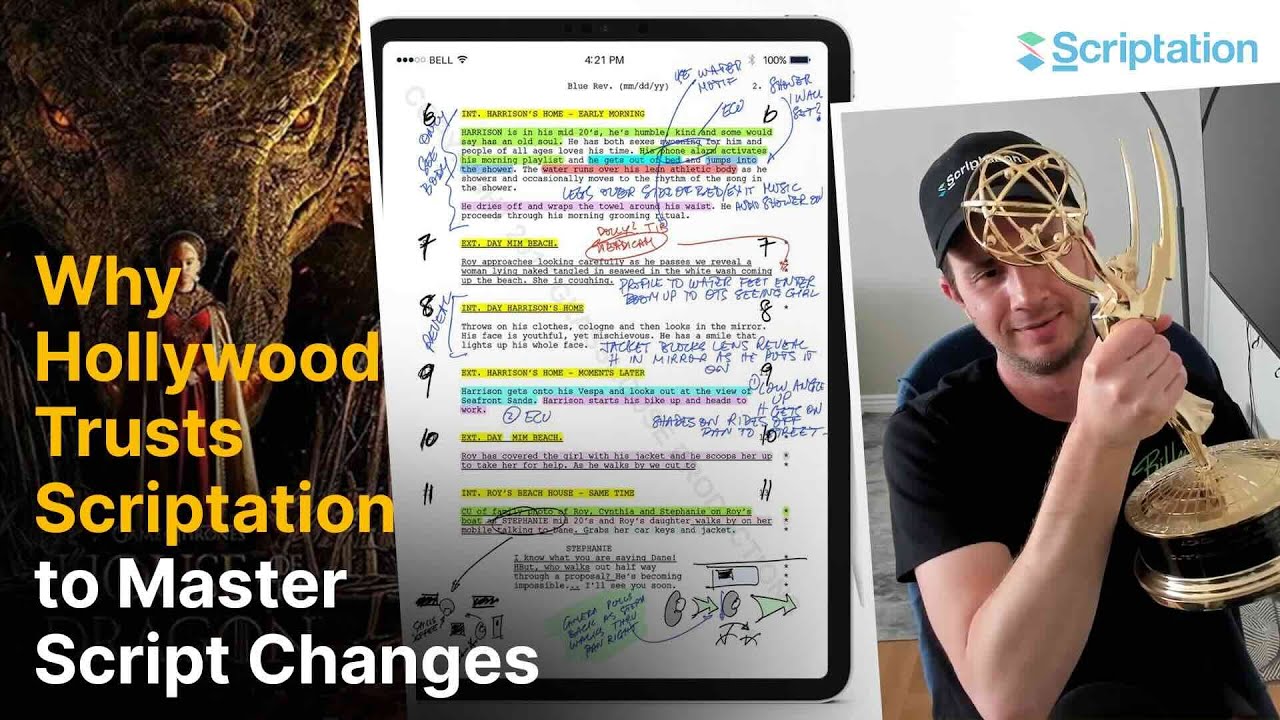
One more tool that deserves its own category: Scriptation. This is not a writing tool—it’s a script reading, annotation, and distribution platform. Steve Vitolo, founder and CEO of Scriptation, built the Emmy-winning app after working in writers’ rooms and watching productions manage script revisions through a chaos of PDFs, email chains, and printed sides.
Shows like Game of Thrones and Saturday Night Live have used Scriptation for exactly this reason: when you have hundreds of crew members who need to access, annotate, and track revisions on the same document in real time, a writing app isn’t the right tool. Scriptation fills the gap between “the script is written” and “the script is on set and being used by 200 people.”
Steve Vitolo (Founder & CEO, Scriptation) explains how the platform transformed script distribution and revision tracking across major productions:
Track 400,000+ Projects—Find the Right Production for Your Script
Vitrina’s platform maps active productions, development slates, and buyer acquisition criteria globally. The same intelligence used by Netflix, Paramount, and Warner Bros sourcing teams—now available to writers and producers.
Get 200 Free Credits — Start Now
No credit card required · Cancel anytime
Script Collaboration on Live Productions: What Actually Works
Here’s where most discussions of screenwriting software go wrong: they treat the script as a static document when it’s actually one of the most actively managed files in the entire production. A single episode of a scripted series can go through 8–12 named revisions between first draft and production draft—each one needing to be distributed, annotated, and tracked across a crew that may span three time zones.
The tools that handle this well share a few things in common. They treat revision tracking as a first-class feature, not an afterthought. They have clean distribution workflows that don’t require someone to manually email PDFs. And they separate the act of writing from the act of managing—because those are genuinely different jobs that require different tools.
What doesn’t work: using Google Docs as your primary script tool on a production with union crew. It’s free and familiar, but it doesn’t produce compliant script formatting, doesn’t handle revision pages correctly, and creates a paper trail that’s difficult to manage when legal needs a locked draft. Writers use it for outlines and story documents. Not for scripts.
The Tool Stack That Actually Works on Episodic Series:
- Writing: Final Draft or WriterDuet for active authoring
- Collaboration: WriterDuet or Scripto for live multi-writer environments
- Distribution & Annotation: Scriptation for on-set use, crew distribution, and revision tracking
- Breakdown Integration: Export to Movie Magic Scheduling via .fdx or Final Draft formats
AI-Assisted Screenwriting: Where It Helps, Where It Doesn’t
The AI screenwriting conversation has generated more heat than light—mostly because people confuse two different use cases. AI as a replacement for writers is a different question entirely from AI as a production workflow tool. Let’s keep those separate.
Where AI tools genuinely help writers:
- Script breakdown and analysis. AI tools that tag characters, locations, props, and action elements automatically can save a production coordinator 3–5 days of manual breakdown work per episode. This isn’t controversial—it’s just a faster version of a task humans already do.
- Continuity checking. Character name consistency, timeline tracking, prop continuity across drafts—AI handles this faster than any human reader and without fatigue.
- Research scaffolding. Generating background material, dialogue seeds, or structural outlines as a starting point that writers then develop. Most serious writers who use it treat it as a first-draft brainstorm tool, not a finished output machine.
Where AI tools fall short: voice. The specific writer’s voice that makes a script compelling—the reason a development exec passes on a technically perfect script but greenlights one that breaks a rule on page 3—isn’t something current tools replicate. A script can be correctly formatted, structurally coherent, and entirely lifeless. AI tools are good at avoiding the wrong things. They’re not yet good at creating the right things.
For a deeper look at how AI is changing the pre-production workflow around script breakdown and scheduling, Vitrina’s post on AI script breakdown software in 2026 covers the current tool landscape in detail.

Your AI Assistant, Agent, and Analyst for the Business of Entertainment
VIQI AI helps you plan content acquisitions, raise production financing, and find and connect with the right partners worldwide.
- Find active co-producers and financiers for scripted projects
- Find equity and gap financing companies in North America
- Find top film financiers in Europe
- Find production houses that can co-produce or finance unscripted series
- I am looking for production partners for a YA drama set in Brazil
- I am looking for producers with proven track record in mid-budget features
- I am looking for Turkish distributors with successful international sales
- I am looking for OTT platforms actively acquiring finished series for the LATAM region
- I am seeking localization companies offer subtitling services in multiple Asian languages
- I am seeking partners in animation production for children's content
- I am seeking USA based post-production companies with sound facilities
- I am seeking VFX partners to composite background images and AI generated content
- Show me recent drama projects available for pre-buy
- Show me Japanese Anime Distributors
- Show me true-crime buyers from Asia
- Show me documentary pre-buyers
- List the top commissioners at the BBC
- List the post-production and VFX decision-makers at Netflix
- List the development leaders at Sony Pictures
- List the scripted programming heads at HBO
- Who is backing animation projects in Europe right now
- Who is Netflix’s top production partners for Sports Docs
- Who is Commissioning factual content in the NORDICS
- Who is acquiring unscripted formats for the North American market
Script Formatting Standards: What Buyers and Networks Actually Require
The good news: standard screenplay format hasn’t changed materially in decades. 12-point Courier, 1-inch margins, scene headings in caps—that’s still the baseline everywhere. The nuance is in what different buyers require beyond the baseline.
A few things that actually get scripts rejected at the format stage before anyone reads them:
- Page count outside acceptable range. Feature scripts above 120 pages signal an amateur. TV pilots above 60 pages for drama, or 40 for half-hour, do the same. Your software’s auto-pagination matters more than most writers realize.
- Wrong file format for the recipient. Some development execs explicitly request .pdf only—because it’s read-only and can’t be accidentally edited. Others want .fdx for breakdown purposes. Know before you send.
- Locked PDFs that strip annotations. If your PDF export doesn’t allow annotation on the reader’s end, production teams will convert it themselves—often badly. Scriptation addresses this directly by creating annotatable, distributable script PDFs as its core function.
- Non-standard title pages. WGA format for title pages is specific. Production company name placement, contact information, registration number—these are details that mark whether a writer has worked professionally before.
According to Screen International‘s ongoing coverage of global development trends, international co-production scripts increasingly need to accommodate both US-standard and European formatting conventions—particularly when EBU (European Broadcasting Union) member networks are involved. If your script is targeting a co-production between a US streamer and a European broadcaster, your formatting tool needs to handle both cleanly.
Get Your Script in Front of Active Buyers—Without Cold Outreach
Vitrina’s Concierge team builds curated buyer shortlists for your script based on genre, budget tier, and acquisition history—so you’re pitching to companies that are actively acquiring, not just listed in a directory.
No commitment required to start
Beyond Software: Getting Your Script in Front of the Right Buyers
Here’s the part of the conversation that screenwriting software guides skip entirely: writing and formatting the script is the easy part. Getting it to the right development exec, at the right production company, during the right acquisition window—that’s where most writers lose momentum.
The Fragmentation Paradox works against you here just as much as it does in any other part of the entertainment supply chain. There are 140,000+ active production companies in Vitrina’s network alone—each with a different acquisition appetite, budget range, and genre focus. Most writers know 10–20 of them, sourced from trade coverage and industry contacts. That’s a fraction of the real market.
Vitrina’s intelligence layer maps production company development slates, acquisition histories, and buyer preferences across global markets. You can identify which companies are actively acquiring scripts in your genre, which streamers are building out content in specific territories, and which production companies have the co-production infrastructure to actually get a project into production—not just option it and sit on it for three years.
The concept-to-distribution workflow for scripts has changed. Platforms like Vitrina are part of why: writers and producers who use verified acquisition intelligence are closing deals faster and with better-matched buyers than those who rely on cold outreach and festival relationships alone.
FAQ: Screenwriting and Script Formatting Software
The Bottom Line on Screenwriting Software
No single tool wins across every production scenario—and anyone who tells you otherwise is selling something. The professional move is to understand what each tool does best, build a stack that matches your production’s stage and scale, and stop letting software debates delay the actual writing.
But here’s what gets overlooked in every comparison guide: the best-formatted script in the world doesn’t move without getting to the right buyer at the right time. That’s an intelligence problem as much as a craft problem. And it’s one that platforms like Vitrina are built specifically to solve.
Key Takeaways
- Final Draft is still the format standard at US networks—use it for final submission drafts to major buyers regardless of what you write in.
- WriterDuet wins for real-time TV writers’ room collaboration; it removes 2–3 hours/day of version management friction on multi-writer series.
- Scriptation fills the gap between writing and production—essential on any series where hundreds of crew members need annotatable, revision-tracked script access.
- AI tools help with breakdown and continuity, not with voice—use them to accelerate workflow, not to replace the specific creative decisions that make a script worth buying.
- Getting to the right buyer matters as much as formatting correctly—Vitrina maps 140,000+ production companies globally so you can identify who’s actively acquiring in your genre right now.
Track the Productions Buying Scripts Like Yours
Join 140,000+ companies using Vitrina to discover active buyers, development slates, and acquisition opportunities globally. Start with 200 free credits—no credit card required.
Get 200 Free Credits — Discover Script Buyers
Or Work With Our Concierge Team →
No credit card required · Cancel anytime
Find Film+TV Projects, Partners, and Deals – Fast.
VIQI matches you with the right financiers, producers, streamers, and buyers – globally.
Producers Seeking Financing, Co-Pros, or Pre-Buys?
Vitrina Concierge helps producers reach the right financiers, commissioners, distributors, and co-production partners — with precision outreach, not cold pitching.
Join Industry Briefings Trusted by Leaders

Format Adaptations: Global Trends
Where formats are traveling, which adaptations are breaking out, and how streamers are backing remakes in 2025–2026.

Books, Novels & Comics Adaptations: Global Trends
Books, webtoons, and manga driving the next global screen hits. Discover how in this webinar.

Micro-Dramas & Mobile-First Storytelling
Micro-dramas are building real audiences and revenue. Understand the platforms, buyers, and economics behind the growth.

Navigating Global Content Licensing Trends
How global content licensing is shifting beyond flat fees to flexible, deal-driven models.