About Innovation Hub
 Global Content Pulse (Webinars)


 Global Production Financing
(Webinars)
Global Production Financing
(Webinars)  LeaderSpeak Podcast
  Global Entertainment Digest (Newsletter)
  About Vitrina
 About VIQI
 Our Story
 Our Solutions 🔥
 Film+TV Projects Tracker 🚀
 Case Studies
 Our Profile
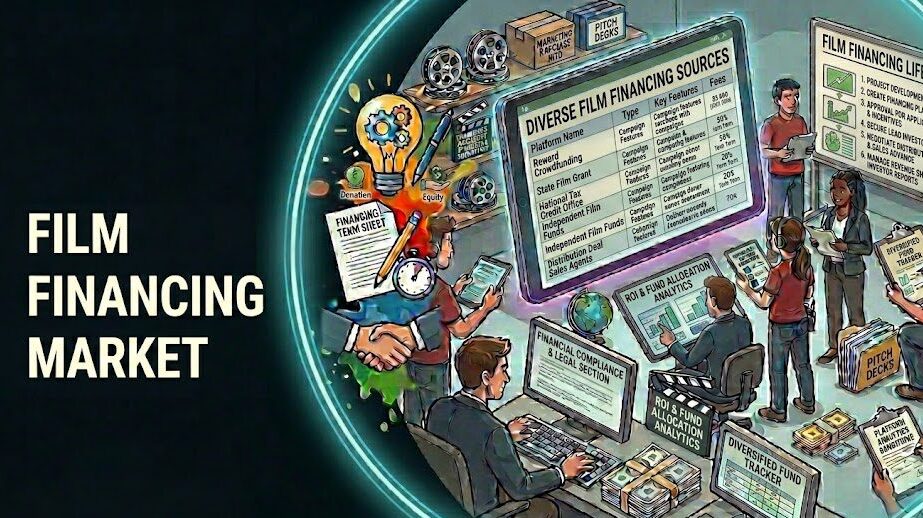
The film financing market has never been more complex—or more stratified. Capital that flowed freely during the post-COVID production boom has pulled back hard. Streamers that once bought everything have become selective to the point of paralysis for independent producers. And yet, private capital, sovereign wealth funds, and a restructured debt market are quietly filling the void. The question isn’t whether money exists. It’s whether your project is positioned to access it.
This guide maps the current film financing market the way a CFO would—capital stack by capital stack, market shift by market shift. Whether you’re assembling your first $2M independent feature or managing a $50M slate, you need to understand where the money is coming from in 2025, what each capital source actually demands, and how the Fragmentation Paradox is costing producers 15-20% margin before they’ve shot a single frame. Let’s get into it.
As we cover in detail in our complete guide to how film financing works, the capital stack isn’t a single source—it’s a layered architecture. But in 2025, the architecture itself has shifted. Understanding those shifts is the first step to closing your deal.
In This Article
- The State of the Film Financing Market in 2025
- How the Modern Capital Stack Is Structured
- Equity Financing: Private Capital Fills the Bank Gap
- Debt & Gap Financing: The Mechanics of Mezzanine Money
- Presales: How Territory Sales Still Build Capital Stacks
- Tax Incentives: The Soft Money Layer Every Producer Needs
- Sovereign Content Hubs: The New Financing Frontier
- The Fragmentation Paradox and What It Costs You
- Smart Pairing: Building a Financing Strategy That Closes
- Frequently Asked Questions
- Key Takeaways
Ask VIQI: Which Film Financiers Are Actively Deploying Capital Right Now?
VIQI is Vitrina’s AI assistant—trained on 1.6 million titles, 360,000 companies, and 5 million entertainment professionals. Ask it which equity funds, gap lenders, and co-production partners match your project’s genre, budget, and territory right now.
✓ Included with 200 free credits | ✓ No credit card needed
The State of the Film Financing Market in 2025
Here’s what nobody’s saying loudly enough: the film financing market didn’t just contract—it restructured. The 2021–2022 “revenge production” boom flooded the market with projects and capital in equal measure. Streamers were buying aggressively, gap lenders were competing for deals, and producers who’d spent years scrambling suddenly had options. That era is over.
Phil Hunt, Founder and CEO of Head Gear Films—who has financed over 550 movies across nearly 25 years in the business—described the current moment directly in a Vitrina LeaderSpeak interview: the industry has entered what he calls a “Big Crunch,” where it’s become “much, much harder to get movies off the ground and much harder to get movies sold.” Head Gear now processes 35–40 films per year, more than most studios—and even from that privileged position, Hunt sees finance plans that simply won’t work.
The crunch has specific mechanics. Streamers stopped buying from all-rights distributors at scale. That collapsed the pay-one revenue window—which Hunt notes represented roughly 75% of a film’s value—pushing distributors into transactional revenue that “dribbles in a few dollars here, a few dollars there.” When distributor advance capacity drops, the domino effect lands squarely on producers trying to build presale-backed capital stacks.
But the crunch also created opportunity—particularly for private capital and Sovereign Content Hubs. Joshua Harris, President and Managing Partner of Peachtree Media Partners, points to City National Bank’s retreat from entertainment lending as the clearest signal: “City National lost their strategic focus… that created an enormous gap in the marketplace.” Peachtree—which lends against film IP rather than taking equity—is scaling toward $100 million in commitments precisely because that gap exists and is growing.
The market, in short, is harder for bad projects and more navigable than ever for properly packaged ones. What’s changed is the filter.
Stop Guessing Who’s Financing. Get Targeted Outreach.
Stop searching and start getting funded. We identify the exact decision-makers currently backing projects like yours, turning raw data into risk-aligned capital partnerships.
Major Studios
Scouting early stage projects, IP, and Regional partners for global studio pipelines.
IP Owners & Leads
Connecting creative leads with qualified financiers and major streaming platforms.
Streamers
Securing high-value pre-buy content and discovering early-stage global IP for platforms.
Indie Producers
Bridging the gap for indie filmmakers to reach executive production partners and capital.
Global Financing Ecosystems
Mapping complex markets and pairing projects with disciplined, risk-aligned capital across global territories worldwide.
How the Modern Film Capital Stack Is Structured
A film’s capital stack is the layered architecture of every financial source that funds production. Each layer carries different risk, different cost, and a different position in the recoupment waterfall. Understanding this structure isn’t optional—it’s the foundation of every financing conversation you’ll have with any serious financier.
A typical $10M independent feature in 2025 looks something like this:
Example Capital Stack — $10M Feature Film
- Equity: $2M (20%) — Private investors, family offices, equity funds
- Presales: $4.5M (45%) — Territory distribution agreements, minimum guarantees
- Tax Incentives: $2M (20%) — Cash rebates or refundable credits by jurisdiction
- Gap Financing: $1.5M (15%) — Debt against unsold territorial rights
The recoupment waterfall flows in reverse order of risk: gap lenders get paid before equity investors, who get paid before profit participants. This hierarchy is why each capital source demands different collateral, different completion guarantees, and different project characteristics before committing.
What’s shifted in 2025 is the weighting. Presales have become harder to secure without name talent attached, so the equity layer often needs to come in earlier to demonstrate viability. Tax incentives—particularly from Sovereign Content Hubs—have become more generous, filling budget gaps that would have previously required additional debt. And the gap financing tier has contracted as lenders demand stronger pre-sales before advancing.
Track Which Financiers Are Active in Your Genre & Territory
Trusted by Netflix, Warner Bros, and Paramount. Join 140,000+ companies using Vitrina to track the global entertainment supply chain—including active film financiers, co-production partners, and gap lenders.
✓ 200 free credits | ✓ No credit card required | ✓ Full platform access
Equity Financing: Private Capital Fills the Bank Gap
Equity financing remains the most flexible—and most dilutive—layer of the film financing stack. Equity investors take ownership stakes in your project in exchange for capital. They recoups after all debt is repaid, which means they carry the highest risk. But they also retain backend upside if the film performs.
The current equity market is polarizing. On one end, first-time producers are finding it harder than ever to attract institutional equity without a proven track record. On the other, established producers with credible packages—name talent attached, reputable sales agent, completion bond secured—are attracting capital from a new class of private investors.
Andrea Scarso, Managing Partner at IPR VC—a Helsinki-founded fund with 12 years of film and TV equity investing—frames the challenge clearly: “The challenge in the industry right now is not on deal flow, it’s on the quality of investing, it’s on how you structure the investment.” IPR VC, which raises from institutional investors, family offices, and insurance companies, takes equity positions in individual projects rather than companies—a portfolio approach designed to manage risk across multiple IP bets. Their model reflects a broader shift toward disciplined equity structures in independent film finance.
Family offices and high-net-worth private investors have also become significant players. Joshua Harris at Peachtree notes their sweet spot is “finding those investors who are interested in doing something a little unique and different that has a higher multiple”—people who want portfolio diversification plus the cultural cachet of premiere invitations at Cannes and SXSW. That’s a real market, and it’s growing as traditional financial returns compress elsewhere.
But equity is never free. Dilute too much and your producers’ backend participation becomes academic. The strategic question isn’t just “can I get equity?”—it’s “how much equity do I actually need, and what does my recoupment model look like if this film performs?”
Phil Hunt (Founder & CEO, Head Gear Films) explains the current independent film financing landscape—including why genre, packaging, and deal structure determine whether capital is available at all:

Debt & Gap Financing: The Mechanics of Mezzanine Money
Gap financing is debt—specifically mezzanine debt secured against a film’s unsold territorial distribution rights. It typically covers 10–30% of total production budget and sits in the capital stack between senior production debt and equity. Gap lenders advance against the projected value of territories that haven’t yet been pre-sold, using sales estimates from your sales agent as their primary collateral analysis.
Here’s the thing most producers don’t fully internalize: gap financing isn’t a fallback. It’s a product designed for projects that already have 65–80% of their budget secured. Arrive at a gap lender with only 40% of your budget confirmed and you’ll hear a polite no—every time. As outlined in our detailed breakdown of gap financing mechanics, lenders require a reputable sales agent, a completion bond, and sales estimates that are at least 1.5–2× the gap amount to proceed.
The effective cost of gap financing runs 8–15% annually, plus origination fees of 1–2%. That makes it expensive capital—and the interest clock starts ticking from day one of funding. Budget 15–20% effective total cost into your ROI model before you pursue it.
Peachtree’s model takes this further: they advance against future territory value before distribution agreements are executed. “We will take the value of certain territories or the value of future distribution and before a distribution agreement is executed, we will advance that to the production,” Harris explains. It’s a higher-risk position for the lender—which is why Peachtree charges accordingly—but it enables producers to maintain creative control rather than surrendering equity for what is functionally a bridging loan.
The commercial bank retreat—City National, Silicon Valley Bank—has pushed gap and production lending increasingly toward private capital firms. Matthew Helderman at BondIt Media Capital built his company specifically to fill this void after the 2008 credit crisis. The market for private production lending has deepened significantly since, with new entrants alongside established players like Head Gear, BondIt, and Peachtree competing for well-packaged deals.
What Gap Lenders Actually Need to See
The package that a gap lender wants isn’t mysterious—it’s just demanding. You need a reputable sales agent (WME, Film Nation, Black Bear), A or B-list cast attachments that drive quantifiable territory value, a director with a delivery track record, a completion bond from a recognized guarantor, and presales already in place covering the majority of your budget. Without that full package, the gap simply won’t close. As Phil Hunt puts it: “If you’ve got a Jason Statham movie without Jason Statham, you’re screwed.”
Stop Guessing Who’s Financing. Get Targeted Outreach.
Stop searching and start getting funded. We identify the exact decision-makers currently backing projects like yours, turning raw data into risk-aligned capital partnerships.
Major Studios
Scouting early stage projects, IP, and Regional partners for global studio pipelines.
IP Owners & Leads
Connecting creative leads with qualified financiers and major streaming platforms.
Streamers
Securing high-value pre-buy content and discovering early-stage global IP for platforms.
Indie Producers
Bridging the gap for indie filmmakers to reach executive production partners and capital.
Global Financing Ecosystems
Mapping complex markets and pairing projects with disciplined, risk-aligned capital across global territories worldwide.
Presales: How Territory Sales Still Build Capital Stacks
Presales—distribution agreements signed before or during production—remain the backbone of independent film financing, even in a contracted market. A presale converts a future distribution right into a present-value minimum guarantee (MG), which you can then use as collateral to draw down a production loan from a bank or private lender.
The mechanics haven’t changed. The difficulty has. In the pre-streaming era, Hunt notes, “there used to be a time when you could pre-sell a film off an idea before a script was even written.” That’s no longer the world we’re in. Today’s buyers—in action, thriller, and horror above all—want completed packages: cast confirmed, director attached, sales estimates from a reputable agent, evidence of commercial viability. The idea alone is worthless.
Practically, the target for a presale-backed capital stack is covering 50–70% of your budget through presales and incentives combined before pursuing gap or mezzanine debt. Strong presales from major territories (Germany, France, UK, Australia, Japan) carry the most lender confidence. North American rights are typically excluded from gap collateral—lenders consider domestic performance “performance risk,” not quantifiable future value.
According to Screen International, the genres commanding the strongest presale values in 2024-2025 remain action and thriller, followed by horror—exactly the genres Phil Hunt describes as “what the market really wants.” Drama, outside festival-circuit prestige projects, continues to struggle for presale traction in international markets.
Tax Incentives: The Soft Money Layer Every Producer Needs
Tax incentives—cash rebates, refundable tax credits, and transferable credits—are the non-dilutive soft money layer that every producer should be optimizing before touching equity or debt. Unlike presales or equity, incentives don’t dilute ownership or carry interest costs. They simply return a percentage of your qualified local spend, paid after production and audit.
The global incentive landscape in 2025 is more competitive than ever:
- Abu Dhabi (UAE): Up to 50% cash rebate—the highest rate globally, with 0% taxation for 50 years in free zones
- Saudi Arabia: 40% cash rebate via Vision 2030 Film Fund, backed by $1B annual allocation
- Ireland: Up to 40% tax credit for smaller films under the Section 481 program
- Greece: 40% cash rebate with €105M allocated for 2025
- UK: 25% cash rebate (29.25% for VFX as of April 2025), with business rate relief for film studios through 2034
- India: 40% rebate (increased from 30%), with additional 5% for significant Indian content
- Japan: Up to 50% rebate, capped at $6.7M per project
The strategy of stacking incentives across two jurisdictions—filming principal photography in one location, completing VFX and post in another—is how sophisticated producers extract maximum non-dilutive capital. A co-production between a UK producer and Saudi studio, for instance, can access both the UK’s 25% rebate on qualifying UK spend and Saudi Arabia’s 40% rebate on Saudi-incurred costs simultaneously. That’s a material improvement to your capital stack with no dilution and no debt service.
Browse our global film TV incentives tracker for jurisdiction-by-jurisdiction details and current program status.
Sovereign Content Hubs: The New Film Financing Frontier
The single biggest structural shift in the global film financing market over the past five years isn’t streaming—it’s the emergence of Sovereign Content Hubs. These are territories where government-backed capital—sovereign wealth funds, state incentives, infrastructure investment—has created vertically integrated production ecosystems with the ambition to compete with, not merely service, Hollywood.
Saudi Arabia is the clearest example. Since the 2018 cinema ban lift, Vision 2030 has deployed $71.2B into entertainment infrastructure broadly and $4B+ into film-specific development. The Public Investment Fund (PIF) is funding 17 studio complexes, Film AlUla, NEOM production facilities, and a target of 100 films by 2030. Saudi producers are actively seeking international partners—not just service providers. They want co-productions that give them IP ownership and distribution reach.
Abu Dhabi moves even faster. Its 50% rebate is the highest globally—and its free zone structure offers 0% taxation for 50 years on qualified productions. These aren’t temporary promotional rates—they’re long-term structural advantages designed to permanently redirect global production capital.
But here’s what most Western producers still haven’t processed: Sovereign Hubs aren’t emerging markets any more. South Korea has Netflix’s $2.5B committed investment and a cultural export machine. India produces more films annually than Hollywood and controls the world’s largest domestic theatrical market. These hubs are operational, capitalized, and actively seeking inbound partnerships—not waiting to be discovered.
For producers, the financing implication is direct. Structuring a co-production with a Sovereign Hub partner doesn’t just give you access to their incentive rate—it gives you access to their distribution relationships, their local content mandates as a demand floor, and often their direct government backing as a risk mitigant. That’s a fundamentally different capital stack than you can build through Western sources alone.
Need Film Financiers Matched to Your Project? We’ll Find Them.
Vitrina Concierge is your Virtual Agent. We don’t give you a list—we make warm introductions directly to decision-makers actively seeking your type of content.
- LA producer → Netflix UK, Fifth Season, Fox Entertainment (48 hours)
- Middle Eastern studio → Legendary Pictures (direct access)
- Korean animation studio → Netflix Adult Animation (week one)
The Fragmentation Paradox and What It’s Costing Your Production
Here’s a problem that never shows up in your financing pitch deck but erodes your ROI regardless: the Fragmentation Paradox. With 600,000+ companies operating across the global film and TV supply chain—and 140,000+ actively producing content—you’d expect competition to drive prices down and options up. The reality is the opposite.
More suppliers create opacity, not transparency. Capabilities are unknown. Deal history is invisible. Pricing has no public benchmarks. Producers who don’t know the market pay whatever they’re quoted. And those quotes carry a 15–20% legacy markup built into the system by intermediaries who profit from information asymmetry.
On a $10M production with $4M in services spend, that’s $600,000 in margin leakage—before you’ve addressed a single financing cost. It also adds 3–6 months to deal cycles, as producers work through personal networks to find VFX vendors, co-production partners, or location service companies instead of accessing verified intelligence instantly.
This is where Vitrina’s intelligence platform directly addresses the film financing market problem. By mapping verified capabilities, real-time capacity, and market pricing benchmarks across 140,000+ active suppliers, Vitrina compresses the research timeline from months to days and eliminates the information deficit that drives overpaying. As reported by Variety, intelligence-led production decisions are becoming a competitive differentiator as budgets tighten and margin pressure intensifies.
Smart Pairing: Building a Film Financing Strategy That Actually Closes
The most effective producers in 2025 aren’t chasing a single capital source. They’re applying what we call the Smart Pairing approach—matching each capital layer to its optimal purpose in the stack, sequenced to maximize the speed at which the overall financing closes.
Step 1: Lock the tax incentive layer first. Before approaching presales buyers or lenders, identify your highest-value incentive jurisdiction and structure your production around maximizing qualified spend there. This is non-dilutive capital—it should be fully optimized before you touch equity or debt. If a co-production structure adds a second jurisdiction’s incentive, model that scenario explicitly.
Step 2: Build the presales from a complete package. Don’t approach sales agents or buyers speculatively. Arrive with A or B-list cast confirmed, a director with a delivery record, and a commercial genre that the current market actually wants—action, thriller, horror. Premature presale efforts with incomplete packages waste your most important commercial window and damage your project’s market credibility.
Step 3: Bring equity in early, selectively. Equity investors—whether a family office, a VC like IPR VC, or a strategic co-production partner—add credibility to your package for lenders. Harris at Peachtree is explicit: “We like for producers to have a nugget of equity… it reinforces that somebody else also is willing to invest in the picture.” That subordinate equity position isn’t just capital—it’s a signal.
Step 4: Use gap financing to close, not open. Gap is a finishing mechanism. It should close the final 10–20% of your budget once 70%+ is already committed. Attempting to use gap financing as a primary capital source leads to the exact “pie in the sky” finance plans that Phil Hunt sees flooding his inbox—plans that look comprehensive on a spreadsheet but lack the market confidence signals that lenders require.
Step 5: Consider Sovereign Hub co-production as a structural accelerant. A co-production with a Saudi, UAE, or Korean partner doesn’t just add incentive rates—it can add distribution pre-commitment, reduce your completion risk profile, and open access to sovereign-backed financing that simply doesn’t exist through Western sources alone. If your project has any international appeal, this conversation is worth having before you close your capital stack elsewhere. Learn more about co-production deal structures and studio financing to understand how those arrangements work in practice.
Frequently Asked Questions About the Film Financing Market
What is the film financing market and how does it work?
The film financing market is the ecosystem of capital sources—equity investors, gap lenders, presale buyers, tax incentive programs, and co-production funds—that fund film and television production. Producers assemble a capital stack combining multiple sources, each carrying different risk profiles and recoupment positions. The total stack covers 100% of the production budget, with the recoupment waterfall determining which sources get paid back first from distribution revenues.
How has the film financing market changed in 2025?
The film financing market in 2025 is more selective and more stratified than in 2021–2022. Streamers have pulled back from buying independent films through all-rights distributors, collapsing the presale revenue model for drama. Action, thriller, and horror with name talent attached remain fundable. Private capital and sovereign wealth-backed financing have grown to fill gaps left by commercial banks retreating from entertainment lending. Tax incentives from Sovereign Content Hubs have become more competitive than traditional Western markets.
What is gap financing in film and when should I use it?
Gap financing is mezzanine debt secured against a film’s unsold territorial distribution rights. It typically covers 10–30% of the production budget and is used as a closing mechanism once 65–80% of the budget is already secured through equity, presales, and tax incentives. It costs 8–15% annually plus origination fees. Gap financing requires a reputable sales agent, completion bond, and sales estimates at least 1.5–2× the gap amount. It should never be used as a primary capital source.
Which countries have the best tax incentives for film production in 2025?
Abu Dhabi offers the highest global film incentive rate at up to 50% cash rebate. Saudi Arabia offers 40% through the Vision 2030 Film Fund. Ireland’s Section 481 reaches 40% for qualifying smaller films. Greece offers 40% with €105M allocated in 2025. The UK offers 25% (29.25% for VFX). India offers 40% federal rebate. Japan offers up to 50% capped at $6.7M per project. Producers can stack incentives across jurisdictions in co-production structures to maximize non-dilutive capital.
What is a film capital stack and what layers does it typically include?
A film capital stack is the layered architecture of all financing sources funding a production. A typical $10M independent feature includes: equity (20%), presales (45%), tax incentives (20%), and gap financing (15%). Each layer carries different risk and recoupment priority. Equity investors recoups after all debt, meaning they carry highest risk and highest potential return. Gap lenders recoups before equity, making their position safer but their return capped. Tax incentives are non-dilutive and have no recoupment obligation.
What are Sovereign Content Hubs and why do they matter for film financing?
Sovereign Content Hubs are territories where government-backed capital—sovereign wealth funds, state incentives, infrastructure investment—has created vertically integrated production ecosystems. Saudi Arabia, UAE, South Korea, and India are primary examples. They matter for film financing because they offer higher incentive rates than traditional Western markets (40–50% versus 25–30%), add co-production capital access, create local content mandates as distribution demand floors, and provide government backing that de-risks projects for other investors.
Why are presales harder to secure for independent films in 2025?
Presales are harder because streamers have significantly reduced their buying from all-rights distributors, which collapsed the pay-one revenue window that previously represented 75% of a film’s distributor value. Without reliable SVOD buyouts, distributors can’t offer meaningful presale advances—especially for drama, which lacks reliable foreign theatrical revenue. Action, thriller, and horror with name talent still generate presale interest, but unpackaged or drama-led projects face a dramatically more difficult presale environment than 2019–2022.
Key Takeaways: The Film Financing Market in 2025
The film financing market is more demanding, more stratified, and more global than it’s been in decades. But for producers who understand the architecture—and who package correctly—capital is available. Here’s what to take away:
- The market hasn’t dried up—it’s filtered. Well-packaged commercial projects with name talent, reputable sales agents, and complete finance plans are still getting made. Poorly packaged projects aren’t, and won’t.
- Tax incentives are your first stop, not your last. Non-dilutive capital from incentive programs—especially Sovereign Hub rates of 40–50%—should be fully optimized before touching equity or debt.
- Gap financing is a closing mechanism, not a launch vehicle. It requires 65–80% of your budget already secured and costs 15–20% effective annually. Use it precisely.
- Private capital has replaced commercial banks. Firms like Peachtree, BondIt, and IPR VC are the new lender and equity infrastructure—relationship-driven, collateral-focused, and increasingly well-capitalized.
- Sovereign Content Hubs are a genuine financing frontier. Saudi Arabia, UAE, South Korea, and India aren’t emerging markets—they’re operational co-production hubs with better incentive rates and strategic distribution mandates.
- The Fragmentation Paradox costs you 15–20% before you start. Producers who use verified intelligence to source vendors, partners, and financiers protect their margin and close deals faster—a structural advantage in a margin-compressed market.
Find Co-Production Partners & Financiers for Your Project in 48 Hours
Trusted by Netflix, Warner Bros, Paramount, and Google TV. Track 400,000+ projects. Access 3 million verified executives. Ask VIQI which capital sources match your project right now.
✓ 200 free credits | ✓ No credit card required | ✓ Cancel anytime
Or explore Vitrina Concierge for hands-on introductions to active film financiers and co-production partners.
Find Film+TV Projects, Partners, and Deals – Fast.
VIQI matches you with the right financiers, producers, streamers, and buyers – globally.
Producers Seeking Financing & Partnerships?
Book Your Free Concierge Outreach Consultation
(To know more about Vitrina Concierge Outreach Solutions click here)
Join Industry Briefings Trusted by Leaders
The Mid-Budget Comeback: Why Mid-Budget Films Is the Smartest Bet in the Room
Mid-budget films are attracting new capital. See why this segment is becoming one of the strongest bets in Film today.
Franchise Fatigue vs. IP Dependency: What Studios Should Be Betting On Now
s franchise performance softens, where will the next generation of valuable IP come from? Join the briefing.

Unscripted Is Eating the World: The Multi-Billion Reality and Format Boom
Unscripted is the new prestige — inside the $19.8B global format boom reshaping how streaming platforms compete.

How Co-Productions and Regional IP Are Reshaping Global Drama
As global drama evolves, which stories travel, which stay local, and how are they getting financed?