About Innovation Hub
 Global Content Pulse (Webinars)


 Global Production Financing
(Webinars)
Global Production Financing
(Webinars)  LeaderSpeak Podcast
  Global Entertainment Digest (Newsletter)
  About Vitrina
 About VIQI
 Our Story
 Our Solutions 🔥
 Film+TV Projects Tracker 🚀
 Case Studies
 Our Profile
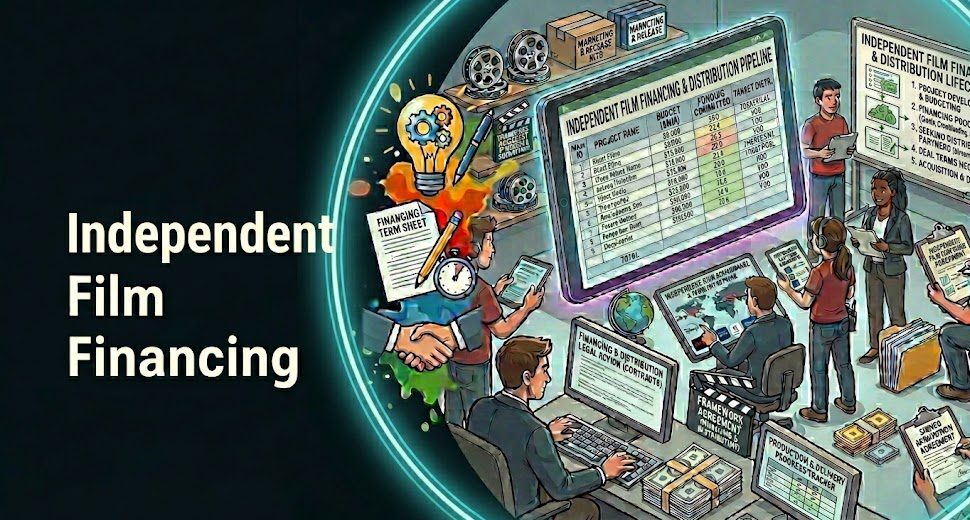
Ask ten producers how they financed their last film and you’ll get ten different answers. That’s not evasion—it’s the reality of independent film financing. There’s no single method. No standard template. What there is, though, is a set of proven instruments that experienced producers combine into a capital stack that works for their specific project, budget, and market position.
In 2025, the landscape is harder than it was three years ago. Phil Hunt, Founder and CEO of Head Gear Films—a company that has financed 550+ films over 25 years at a pace of 35–40 productions per year—put it plainly: the industry has become “much, much harder in terms of getting movies off the ground and getting movies sold.” Capital is more selective. Buyers are more conservative. The window between greenlight and delivery is scrutinized more heavily than it’s been in a decade.
But films are still getting financed. And the producers doing it are working the same six or seven core instruments—just more precisely and with better information than their competitors. This guide maps every major method for independent film financing, explains how each one actually works mechanically, and shows you how they fit together into a coherent capital stack.
In This Guide
- What Is Independent Film Financing?
- Pre-Sales: Territory Rights as Production Capital
- Tax Incentives and Cash Rebates
- Equity Investment: Angels, Funds, and Family Offices
- Gap Financing: Closing the Final Budget Shortfall
- Co-Production Deals and Treaty Financing
- Grants and Soft Money
- Negative Pickup Deals and Streaming Commissions
- How to Build Your Capital Stack
- Frequently Asked Questions
Find Co-Producers, Financiers & Sales Agents Instantly
Vitrina maps 140,000+ verified entertainment companies—including equity funds, gap lenders, co-producers, and foreign sales agents—used by teams from Netflix, Warner Bros, and Paramount. 200 free credits. No credit card required.
What Is Independent Film Financing?
Independent film financing is the process of assembling a production budget from multiple sources—outside the major studio system—where each source carries a different risk profile, cost of capital, and priority in the revenue waterfall. Unlike studio productions, where a single entity funds and controls the project, independent films are financed through a structured combination of debt, equity, incentives, and pre-negotiated rights deals.
The core concept is the capital stack: a layered financing architecture where each instrument fits a specific position. Senior debt sits at the top—paid first from revenues. Equity sits at the bottom—paid last, bearing the most risk, expecting the highest return. In between live gap loans, tax incentives, and co-production contributions. Understanding this structure isn’t optional. It’s the map that tells you which source to pursue in which order, and why each lender or investor cares about what you’ve already secured.
The recoupment waterfall—the order in which parties get paid from film revenues—runs roughly like this:
- Distribution and sales agent fees (20–35% of gross)
- P&A (prints and advertising) recoupment
- Senior debt repayment (bank production loans)
- Gap financing repayment + interest
- Tax credit / soft money recoupment
- Equity investor recoupment
- Deferred fees and net profit participation
Every method described below fits somewhere in this architecture. Let’s work through them one by one.
Stop Guessing Who’s Financing. Get Targeted Outreach.
Stop searching and start getting funded. We identify the exact decision-makers currently backing projects like yours, turning raw data into risk-aligned capital partnerships.
Major Studios
Scouting early stage projects, IP, and Regional partners for global studio pipelines.
IP Owners & Leads
Connecting creative leads with qualified financiers and major streaming platforms.
Streamers
Securing high-value pre-buy content and discovering early-stage global IP for platforms.
Indie Producers
Bridging the gap for indie filmmakers to reach executive production partners and capital.
Global Financing Ecosystems
Mapping complex markets and pairing projects with disciplined, risk-aligned capital across global territories worldwide.
Method 1: Pre-Sales — Monetizing Territory Rights Before Production
Pre-sales are distribution agreements closed before or during production. A foreign distributor commits a minimum guarantee (MG) for the rights to release your film in their territory. You bring that contract to an entertainment bank, which advances 70–90% of the MG value as production capital. That advance is your funding.
It’s the most powerful first move in independent film financing when the project qualifies—because pre-sales fund production and validate market demand simultaneously. Richard Linklater’s Hit Man closed 15 presale contracts before cameras rolled across territories including Canada, Italy, Poland, Turkey, and the Middle East. The MGs covered a significant portion of the budget. The film later sold to Netflix for domestic—maximizing the upside on unsold territories.
But not every project qualifies. Pre-sales require name talent (recognizable cast for foreign markets), a commercial genre (action and thriller travel internationally; comedy typically doesn’t), and a reputable foreign sales agent with an established track record with buyers and banks. The bank’s loan against your MG contract depends entirely on how they rate the distributor in that territory—a lesser-known distributor may not qualify for financing at all, regardless of the contract’s face value.
The major pre-sales markets are Cannes Marché du Film (May), American Film Market (November), and European Film Market Berlin (February). Your sales agent distributes packages to buyers 2–3 weeks before each market—not during it. That’s when decisions are actually made. By opening day, you want conversations in motion, not starting.
Method 2: Tax Incentives and Cash Rebates
Government film tax incentives are one of the most underused layers in the independent film financing stack—and in 2025, the competition between jurisdictions to attract productions means rates are more favorable than they’ve ever been.
The mechanics differ by territory but the principle is consistent: spend money on qualifying production costs in a jurisdiction, receive a rebate or credit worth a percentage of that spend. The UK’s Audio-Visual Expenditure Credit (AVEC) returns up to 40% on qualifying UK spend, with an additional 5% for VFX. Georgia (USA) offers a flat 30% transferable tax credit. Ireland’s Section 481 delivers 32% on qualifying Irish spend above €125,000. Australia increased its Location Offset from 16.5% to 30% in July 2024. Japan launched a rebate program returning up to 50% on qualifying spend, capped at $6.7M.
Two mechanics matter for your cash flow planning. First: most incentives are backend money—they’re paid after production completes and an audit confirms qualifying expenditure. You can’t use the incentive to fund production; you use it to replenish capital after delivery. Second: because the incentive is certain and quantifiable once production is complete, banks will lend against it. A rebate loan—advance at 80–90% of the incentive’s face value—gives you access to that capital during production rather than waiting for the government payment.
And you can stack them. A properly structured international co-production can access incentives in two or more jurisdictions simultaneously. A UK–Ireland co-production accessing both countries’ programs can generate combined incentive coverage of 35–45% of the total budget—before a single presale or equity contribution.
Track Every Financing Partner Across 140,000+ Companies
Vitrina’s platform gives you verified data on equity funds, gap lenders, sales agents, and co-producers—filtered by budget, territory, and genre. 200 free credits. No credit card required.
Method 3: Equity Investment — Angels, Funds, and Family Offices
Equity financing means investors provide capital in exchange for an ownership stake and profit participation. It’s the most expensive capital in your stack—equity investors sit at the bottom of the waterfall, recouping only after all debt is repaid—which means they price their risk accordingly. Standard equity targets are 120–125% of principal: invest $2M, expect $2.4–$2.5M back before participating in further upside.
Andrea Scarso, Managing Partner at IPR VC—a Helsinki-based equity fund that has co-financed films with A24, MK2, and XYZ Films—is direct about the challenge: “The challenge isn’t deal flow. It’s the quality of investing and how you structure the investment.” Equity investors are evaluating the waterfall structure, the comparable revenue analysis, and whether your distribution strategy actually supports their recoupment—not whether your film wins awards.
There are four equity investor types you’ll realistically encounter in independent film financing. Angel investors—high-net-worth individuals investing personal passion money—typically commit $50K–$500K and may want producer credits. Film investment funds like IPR VC take a portfolio approach, spreading risk across multiple projects at $500K–$5M per film. Family offices vary widely but often bring longer investment horizons and a genuine interest in the cultural asset, not just the financial return. And private equity firms typically require $10M+ commitments and focus on slate financing or company equity, not single-project deals.
What moves equity capital: a clean chain of title, signed deal memos (not letters of intent) from cast, a completed budget with 10% contingency, a completion bond in place, transparent waterfall modeling under three scenarios (conservative, base, upside), and an experienced producer who can demonstrate comparable project revenues. Don’t pitch the artistic vision. Pitch the business case.
Phil Hunt (Founder & CEO, Head Gear Films) discusses why independent film financing has become structurally harder—and the lending model that still closes deals at 35–40 films per year:

Method 4: Gap Financing — Bridging the Final Shortfall
Gap financing is a mezzanine debt facility secured against a film’s unsold territorial distribution rights. It’s designed to close the final 10–30% of the production budget that pre-sales, tax incentives, and equity don’t cover. And it’s often the piece that actually gets a film into production—without it, many budgets that are 70–80% financed stay on the shelf indefinitely.
Joshua Harris, President and Managing Partner of Peachtree Media Partners, explains the model clearly: “We’re not investing in film and TV. We lend in film and TV. We take a collateral position against the film IP.” Peachtree advances capital against future territory value—even before distribution agreements are executed. That’s the mechanism that bridges the gap between what you’ve pre-sold and what you still need.
But the cost is real. Gap lenders charge upfront fees of 7–15% of the loan amount plus interest at roughly prime plus 3–8%. On an 18-month gap loan, your all-in cost can reach 22% of the original principal. Budget for this from day one and plan aggressive repayment from early distribution revenues.
Qualifying requirements are strict. Most gap lenders require:
- 60–80% of budget already secured from other confirmed sources
- Reputable sales agent with proven track record providing territory estimates
- Sales estimates at 1.5–2x the gap amount from unsold territories
- Completion bond in place—no exceptions
- Name talent attached with signed deal memos
- Minimum budget threshold of $2M+ (most lenders focus on $5M+ projects)
The King’s Speech ($15M budget, $400M+ worldwide gross) used gap financing to close its capital stack. The gap loan was repaid quickly from strong early revenues—exactly the repayment dynamic lenders price into their model. Fast recoupment from a performing film means lower net cost of capital. Plan your release strategy accordingly.
Match Your Film to the Right Financing Partners
Vitrina’s Concierge Service connects your project directly with verified gap lenders, equity funds, and co-production partners from 140,000+ companies. Trusted by Netflix, Paramount, and independent producers worldwide. No commitment required to start.
Method 5: Co-Production Deals and Treaty Financing
International co-productions are one of the most capital-efficient methods in independent film financing when structured correctly. A formal treaty co-production gives your project national status in each partner country—unlocking local incentives, national film fund access, broadcaster pre-buy obligations, and distribution credibility in both markets simultaneously.
The treaty network is substantial. Canada has bilateral co-production treaties with 60+ countries, processing 60+ official co-productions annually worth $500M CAD. The UK has treaties with Australia, Canada, France, India, and over a dozen others. France maintains 61 bilateral treaties and even has joint production funds with specific partners—the France-Italy joint fund is worth €1M annually. Under the revised European Convention (updated 2018), multilateral co-productions across 43 European countries can now include a minimum partner contribution as low as 5% of the budget.
The financial mechanism is the key insight: each co-producing country’s contribution can count toward that territory’s incentive qualification. A UK-Canada co-production structured to access both countries’ tax programs can stack incentives covering 50%+ of the combined budget before pre-sales or equity enter the picture. That’s the Fragmentation Paradox in reverse—using the global spread of production infrastructure to multiply your capital access rather than simply your costs.
Finding the right co-production partner used to take six months of festival circuits. Today, platforms like Vitrina surface verified co-producers by territory, genre, budget range, and confirmed project history—compressing that search dramatically. What matters in a co-production partner: genuine creative and financial contribution (auditors check this), complementary incentive access, and an aligned distribution strategy. A shell arrangement that exists only to access tax benefits will fail regulatory scrutiny and potentially invalidate the entire financing structure.
Find the Financiers Backing Your Genre
Stop searching and start getting funded. We identify the exact decision-makers currently backing projects like yours, turning raw data into risk-aligned capital partnerships.
Method 6: Grants and Soft Money
Soft money—grants from film funds, cultural organizations, and public bodies—is the most valuable capital in any independent film financing stack because it doesn’t require repayment or equity dilution. The tradeoff is competition and lead time. Grant applications typically take 3–6 months to process, and success rates can be low at national bodies with high demand.
Major grant sources by territory include the BFI (British Film Institute) in the UK, France’s CNC (Centre National du Cinéma), Screen Ireland, Australia’s Screen Australia, and Germany’s German Federal Film Fund (DFFF). Eurimages—the Council of Europe’s co-production fund—supports European co-productions with contributions of up to €750,000 per project. The Doha Film Institute in Qatar funds Arab and emerging-voice productions with direct grants and lab programs.
In MENA, soft money opportunities have expanded rapidly alongside the region’s infrastructure growth. Saudi Arabia’s Cultural Development Fund (CDF) has deployed $62.4M+ into film projects since 2021, with a target of $266M ($1B SAR) toward film by 2030. The Daw’ Programme specifically supports Saudi filmmakers developing original content. These aren’t charity programs—they’re strategic tools for building a domestic industry, which means projects that align with local creative and cultural priorities get serious consideration.
The application strategy that works: match your project to the fund’s stated mandate with precision, not proximity. A fund dedicated to emerging voices doesn’t want a project from an established director. A regional fund for local stories doesn’t want a project with no connection to their territory. Read the brief, apply accordingly, and understand that grants are competitive because the vagueness of a generic application disqualifies most candidates before anyone reads the script.
Method 7: Negative Pickup Deals and Streaming Commissions
Two additional instruments deserve a place in any comprehensive map of independent film financing methods: negative pickup deals and streaming platform commissions.
A negative pickup deal is a distribution agreement where a studio or distributor commits to purchase a completed film for a fixed sum upon delivery—before production begins. You finance production independently (through the methods above), then deliver the finished film and collect the pickup payment. The negative pickup contract can be taken to a bank and used as collateral for a production loan—effectively functioning like a pre-sale but with a domestic distributor rather than a foreign one.
Streaming commissions are the modern evolution of this model. Platforms like Netflix, Apple TV+, and Amazon commission films directly—paying a fee that covers production costs and a margin, in exchange for global or territorial rights. Netflix’s $2.5B commitment to Korean content production is a live example of this at scale. For independent producers, a streaming commission is the closest thing to fully funded production: one buyer, global rights (or significant territories), clear delivery terms, no recoupment waterfall to navigate.
The challenge: getting a commission requires either an existing relationship with the platform, a project that’s already attracting attention in the market, or an agent with direct commissioning relationships. It’s not a first-call strategy for most independent producers—but it’s a real method that closes budgets, and understanding how platforms structure these deals shapes how you package your project for every other financing conversation you have.
How to Build Your Independent Film Capital Stack
The question isn’t which method to use. It’s which combination—and in which sequence. Here’s the architecture that closes most successful independent film budgets.
The sequencing matters as much as the mix. Secure your tax incentive jurisdiction first—it’s the most location-dependent decision and it shapes every other conversation. Then develop pre-sales strategy with your sales agent, targeting major territories. Use the confirmed pre-sales and incentives to approach equity investors with a credible, partially de-risked project. And close the remaining gap only once 60–80% of the budget is already locked—because that’s the threshold gap lenders require before they engage.
A real-world example: a $5M independent drama might close as follows—$2M equity (40%), $1.8M pre-sales (36%), $700K tax incentives (14%), and $500K gap financing (10%). The gap lender engages only after the first $4.5M is confirmed. The film completes, delivers, and the gap loan is repaid over 18 months from distribution revenues. That’s a stack. That’s how this works.
Frequently Asked Questions About Independent Film Financing Methods
What are the most common methods for independent film financing?
The six most common methods for independent film financing are: pre-sales (selling territorial distribution rights before production), tax incentives and cash rebates (government programs returning 15–50% of qualifying spend), equity investment (from angel investors, film funds, or family offices), gap financing (mezzanine debt against unsold territory rights), co-production deals (partnering with foreign producers to access multiple incentive programs), and grants or soft money (non-repayable funds from public film bodies). Most productions combine three or more of these into a capital stack.
How do pre-sales work in independent film financing?
Pre-sales are distribution agreements—minimum guarantee (MG) contracts—closed before production begins. A foreign distributor commits to pay for the rights to release your film in their territory. That MG contract is taken to an entertainment bank, which advances 70–90% of its value as production capital. Pre-sales work best for commercial genres (action, thriller, horror) with name talent attached. A reputable foreign sales agent is essential—banks rate their confidence in the distributor per territory before lending against contracts.
What is gap financing in independent film production?
Gap financing is a mezzanine debt facility secured against a film’s unsold territorial distribution rights. It covers the final 10–30% of the production budget that pre-sales, tax incentives, and equity don’t reach. Lenders require 60–80% of the budget already confirmed, sales estimates from a reputable agent at 1.5–2x the gap amount, a completion bond, and minimum budget of $2M+. All-in cost of gap capital typically runs 15–22% of the loan amount over an 18-month period.
What is the recoupment waterfall in independent film financing?
The recoupment waterfall is the order in which parties are paid from a film’s revenues. It typically runs: distribution/sales agent fees (20–35%), P&A recoupment, senior debt repayment, gap financing repayment, tax credit recoupment, equity investor recoupment, and finally deferred fees and net profit participation. Equity investors recoup last, which is why they carry the highest risk and demand the highest return targets (120–125% of principal).
How do co-production treaties help with film financing?
Official co-production treaties grant a project national status in each co-producing country, enabling simultaneous access to local incentives, national film fund grants, broadcaster pre-buy obligations, and distribution credibility. Canada has treaties with 60+ countries; the UK with over a dozen. A properly structured UK–Ireland co-production can stack incentives covering 35–45% of the total budget before pre-sales or equity contributions. Partners must genuinely contribute creatively and financially—shell arrangements fail regulatory scrutiny.
What do equity investors look for in an independent film?
Equity investors need a business case, not an artistic pitch. They want: clean chain of title, signed deal memos from cast and crew, a detailed line-item budget with 10% contingency, a completion bond in place, waterfall modeling under conservative/base/upside scenarios, and comparable revenue analysis from similar films. They typically target 120–125% return on principal given their last-out position in the waterfall. Timeline to recoupment is typically 18 months to 5 years from completion.
Which film tax incentive jurisdictions offer the highest rates?
Among major production jurisdictions: Japan offers up to 50% on qualifying spend (capped at $6.7M). Abu Dhabi returns up to 50%. The UK’s AVEC provides up to 40% (plus 5% for VFX). Saudi Arabia offers a 40% cash rebate with a minimum spend of $200K for features and $50K for documentary/animation. Australia’s Location Offset increased to 30% in July 2024. Ireland’s Section 481 returns 32% above €125,000 in qualifying Irish spend. Most incentives are backend—paid after production and audit—and can be accessed during production through rebate loans at 80–90% of face value.
How can Vitrina help with independent film financing?
Vitrina maps 140,000+ verified entertainment companies—including gap lenders, equity funds, foreign sales agents, co-production partners, and grant bodies—across 400,000+ active projects. You can filter by financing type, territory, budget range, and genre. VIQI, Vitrina’s AI assistant, lets you query the database conversationally: ask who’s actively financing action films in the $5–10M range, which sales agents have AFM deal history, or which co-producers are active in your target territory. Start with 200 free credits, no credit card required.
Conclusion: The Stack Is the Strategy
There’s no single method for independent film financing. There’s a stack—and your job as a producer is to assemble it intelligently, in the right sequence, with each source unlocking the next. Pre-sales de-risk the project for gap lenders. Tax incentives reduce the equity burden. Co-productions multiply your incentive access. And a clean, complete financing package is what gets you into every room the budget requires you to be in.
The market is selective in 2025. But selective doesn’t mean closed. The Fragmentation Paradox—where capital exists but is distributed across dozens of sources, territories, and deal structures—means information advantage is the actual competitive edge. Knowing which lenders are active, which incentive programs are open, which co-production partners are aligned with your project: that intelligence is what separates funded films from permanently developing ones.
Key Takeaways
- There are seven core methods: pre-sales, tax incentives, equity investment, gap financing, co-production deals, grants/soft money, and negative pickup/streaming commissions.
- The capital stack is the architecture: each method occupies a specific position in the recoupment waterfall, with different risk profiles, costs, and sequencing logic.
- Secure 65–80% before approaching gap lenders: pre-sales plus tax incentives should cover most of this before you need mezzanine debt.
- Tax incentives are stackable: co-productions structured through treaty countries can simultaneously access multiple government programs, covering 35–50% of the budget before equity enters.
- Information asymmetry is the real barrier: finding the right gap lender, sales agent, co-producer, and equity fund for your specific project is where deals are won or lost—not in the negotiation room.
Start Building Your Film’s Financing Network Today
Join 140,000+ entertainment professionals using Vitrina to find verified gap lenders, equity investors, co-production partners, and foreign sales agents—filtered by project type, budget, and territory.
200 free credits. No credit card required.
Find Film+TV Projects, Partners, and Deals – Fast.
VIQI matches you with the right financiers, producers, streamers, and buyers – globally.
Producers Seeking Financing, Co-Pros, or Pre-Buys?
Vitrina Concierge helps producers reach the right financiers, commissioners, distributors, and co-production partners — with precision outreach, not cold pitching.
Join Industry Briefings Trusted by Leaders

Format Adaptations: Global Trends
Where formats are traveling, which adaptations are breaking out, and how streamers are backing remakes in 2025–2026.

Books, Novels & Comics Adaptations: Global Trends
Books, webtoons, and manga driving the next global screen hits. Discover how in this webinar.

Micro-Dramas & Mobile-First Storytelling
Micro-dramas are building real audiences and revenue. Understand the platforms, buyers, and economics behind the growth.

Navigating Global Content Licensing Trends
How global content licensing is shifting beyond flat fees to flexible, deal-driven models.