About Innovation Hub
 Global Content Pulse (Webinars)


 Global Production Financing
(Webinars)
Global Production Financing
(Webinars)  LeaderSpeak Podcast
  Global Entertainment Digest (Newsletter)
  About Vitrina
 About VIQI
 Our Story
 Our Solutions 🔥
 Film+TV Projects Tracker 🚀
 Case Studies
 Our Profile
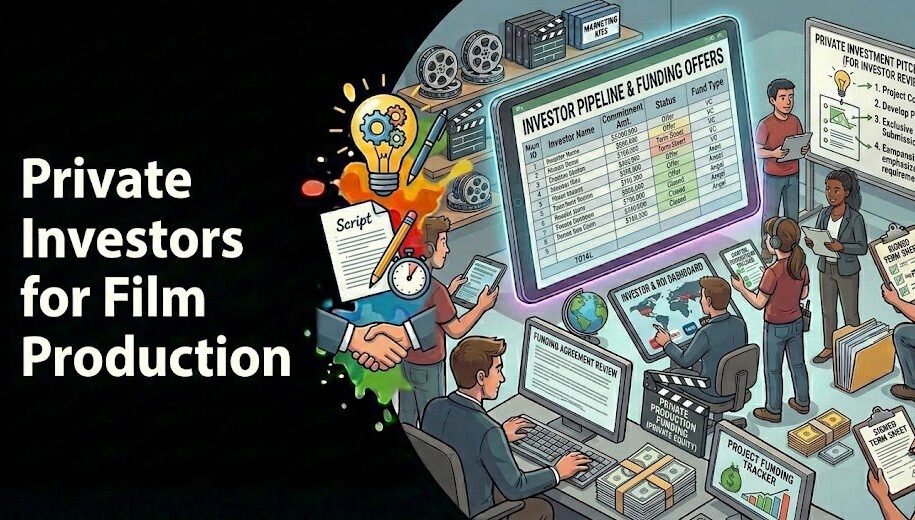
The pitch deck’s polished. The director’s attached. Your script’s been through seven drafts—maybe eight. But without private investors for film production, none of it moves forward.
Here’s what nobody tells you upfront: most producers spend 12–18 months pitching to the wrong people in the wrong rooms. They attend every market, work their network relentlessly, and still come away empty-handed. Not because their project isn’t fundable. Because they don’t know where private capital for film actually lives—or how it moves.
That’s changing fast. Private investment has become the primary engine of independent film and television financing, filling a void left by commercial banks that retreated from entertainment lending over the last decade. And the producers who understand this landscape—who know the difference between a family office mandate and a film fund’s equity position—are closing deals before the competition even gets a meeting.
This guide covers seven proven strategies to find private investors for film, what they actually want to see in a package, and how Vitrina’s intelligence platform helps production companies connect with active investors in days, not months.
Connect With Active Film Investors Before Your Window Closes
Over 140,000+ entertainment companies—including active equity investors, film funds, and co-production partners—are tracked live on Vitrina. Netflix, Warner Bros., and Paramount use this intelligence to track the market. You can too.
No credit card required. 200 free credits to start.
Why Private Capital Now Dominates Film Financing
A few years ago, City National Bank was a cornerstone of entertainment lending. Then it retreated. Joshua Harris, President and Managing Partner of Peachtree Media Partners, describes the aftermath directly: City National “lost their strategic focus,” and that created “an enormous gap in the marketplace.” Private capital stepped in—and it didn’t step quietly.
Today, private investors for film production range from high-net-worth individuals writing $200K checks to institutional funds managing $500M+ in content assets. But the Fragmentation Paradox makes finding them harder than it used to be. There are now 140,000+ companies active across the global entertainment supply chain. Capital moves constantly—across borders, genres, and budget tiers. What a family office was funding in 2022 may have shifted completely by now. Static directories and outdated contact lists won’t cut it.
You need live intelligence. But first, you need to understand who these investors actually are.
7 Proven Ways to Find Private Investors for Film
1. Family Offices
Family offices are the most underrated source of film equity—full stop. They manage substantial private wealth for ultra-high-net-worth families and increasingly allocate portions of their portfolios to alternative assets. Film fits neatly: it’s uncorrelated to public markets, offers cultural prestige, and when structured correctly, delivers returns that justify the risk.
Peachtree’s Joshua Harris confirms this is where the real money is moving. Their ideal investors are family offices who want diversification that “feels a lot like real estate, but actually is a little sexier”—people who take genuine pride in their association with productions. The Cannes premiere invite isn’t trivial to them. It’s part of the return. And that motivation makes them more patient, more flexible, and more willing to invest in emerging producers than institutional funds.
2. Specialized Film Investment Funds
These are institutional investors whose entire mandate is content. IPR VC—founded in Helsinki in 2014 and now investing across Europe, the UK, and North America—provides equity financing for film, television, and IP through strategic partnerships. They raise capital from institutional investors, family offices, and insurance companies, then take equity positions in individual projects using a portfolio approach to manage risk across the slate.
Andrea Scarso, Managing Partner at IPR VC, frames the challenge clearly: “The challenge in the industry right now is not on deal flow—it’s on the quality of investing, it’s on how you structure the investment.” These funds don’t just write checks. They function as genuine executive producer-level partners, helping navigate co-production structures, tax incentive stacking, and territorial pre-sales strategies. That expertise is often worth as much as the capital itself.
Andrea Scarso (Managing Partner, IPR VC) covers IPR’s equity partnership model and what producers need to understand before approaching film investment funds in Vitrina LeaderSpeak Episode 70 — “Equity Financing in Film & TV: IPR VC’s Strategic Partnership Model.”
3. Entertainment Markets—But Not the Way You Think
EFM. Cannes. AFM. MIPCOM. You know the calendar. But here’s the thing—the real deals don’t happen on the main floor. They happen in dinners the night before, in hotel suites on the margins, over coffees at 7am before the official slate presentations begin.
The producers who consistently close private investment at these events aren’t necessarily the loudest in the room. They’re the ones who’ve done their homework. They show up knowing which family office rep just exited a tech position and is now actively seeking entertainment exposure. They know whose mandate has shifted. That intelligence—knowing who’s active and what they’re targeting before the market opens—separates deal-makers from deal-hopefuls. According to Variety‘s ongoing coverage of independent film finance, the strongest relationships at major markets are built before anyone boards a plane.
4. Co-Production Partners as De Facto Equity
This one gets overlooked constantly—and it shouldn’t. When a European co-producer brings 30% of your budget through local subsidies, tax incentives, and regional soft money, that’s functionally equity you didn’t have to raise from a private investor. And it de-risks the remaining capital raise significantly.
Andrea Scarso at IPR VC describes exactly this dynamic. Looking at co-production opportunities “especially in those territories where you can maximize some of the local incentives, some of the tax credits or local subsidies or local pre-sales has become crucially more important.” IPR’s geographic reach—offices in London, Helsinki, and Paris—lets them bridge North American content producers into Europe’s co-production infrastructure from the packaging stage, not after the fact.
Want to go deeper? Our guide to finding co-production opportunities in Europe breaks down the territory-by-territory incentive landscape.
5. Angel Investors and High-Net-Worth Individuals
Angel investors typically commit $50K–$500K per project. They’re not purely financial animals—many are successful entrepreneurs or executives drawn to the creative world. The executive producer credit matters. The premiere invite matters. The story of “my film” at a dinner party matters.
But don’t mistake passion for naivety. The sophisticated film angels who survive beyond one project want to understand the waterfall structure, the completion bond arrangement, and the distribution pathway before they write the check. Can you fluently explain where their capital sits in the recoupment stack? Can you walk them through the worst-case scenario honestly? If not, you’re not ready to pitch private capital—regardless of how good your script is.
Find Film Investors Without Attending Every Market
Vitrina tracks 400,000+ active projects and the companies financing them—updated in real time. Production companies backed by Netflix, Paramount, and Warner Bros. use Vitrina’s Smart Pairing to identify investors whose current mandates match their projects. You can start in minutes.
200 free credits. No credit card required. Cancel anytime.
6. Online Film Finance Platforms and Networks
Platforms like Slated and the PACT Financing Network create structured access to film investment opportunities. These work particularly well for sub-$2M independent productions—ticket sizes that are too small for institutional funds but too large for a single angel investor to absorb alone.
But—and this matters—don’t mistake access to a platform for a relationship. Conversion from platform introduction to closed investment is significantly higher when there’s been prior relationship-building, even if that relationship started online. The platform gets you in the room. You still have to close.
7. Data-Driven Intelligence Platforms
Here’s where most producers leave serious money on the table. The old approach—working your network, hoping introductions materialize, attending every market and hoping to get lucky—is slow, expensive, and increasingly unreliable. Not because relationships don’t matter. Because relationships built on outdated intelligence produce meetings with investors whose mandates have already moved on.
The Fragmentation Paradox makes this worse by the year. The entertainment industry now has 600,000+ companies operating globally in fragmented silos. A family office that invested in three UK indies in 2023 might have pivoted to APAC content entirely by now. Without live intelligence, you’re always chasing yesterday’s capital.
Vitrina’s platform resolves this directly—tracking 140,000+ active companies across the global entertainment supply chain, including equity investors, film funds, and co-production partners. Smart Pairing technology matches your project’s genre, budget range, and production stage to investors whose current mandate aligns. That’s the difference between a database and actual intelligence.
See how Vitrina is actively helping production companies find financiers and co-pro partners in 2025.

Your AI Assistant, Agent, and Analyst for the Business of Entertainment
VIQI AI helps you plan content acquisitions, raise production financing, and find and connect with the right partners worldwide.
- Find active co-producers and financiers for scripted projects
- Find equity and gap financing companies in North America
- Find top film financiers in Europe
- Find production houses that can co-produce or finance unscripted series
- I am looking for production partners for a YA drama set in Brazil
- I am looking for producers with proven track record in mid-budget features
- I am looking for Turkish distributors with successful international sales
- I am looking for OTT platforms actively acquiring finished series for the LATAM region
- I am seeking localization companies offer subtitling services in multiple Asian languages
- I am seeking partners in animation production for children's content
- I am seeking USA based post-production companies with sound facilities
- I am seeking VFX partners to composite background images and AI generated content
- Show me recent drama projects available for pre-buy
- Show me Japanese Anime Distributors
- Show me true-crime buyers from Asia
- Show me documentary pre-buyers
- List the top commissioners at the BBC
- List the post-production and VFX decision-makers at Netflix
- List the development leaders at Sony Pictures
- List the scripted programming heads at HBO
- Who is backing animation projects in Europe right now
- Who is Netflix’s top production partners for Sports Docs
- Who is Commissioning factual content in the NORDICS
- Who is acquiring unscripted formats for the North American market
What Private Investors for Film Actually Want to See
Andrea Scarso puts it plainly: think about your financing structure from the packaging stage, not after the package is complete. “From when they start thinking about packaging and putting together the projects. There are many different solutions available and for producers to at least have an understanding of what those solutions could be and decide which one to go for has become increasingly important.”
That means your investor pitch can’t just be about the project’s creative potential. It needs to address the capital stack clearly and honestly. Before you pitch any private investor, make sure you can answer these questions:
- Waterfall position clarity: Where does your investor sit in recoupment? After senior debt and gap financing? Be honest—sophisticated investors already know, and evading it destroys credibility.
- Sales agent attachment: Even a soft letter of interest from a recognized sales agent validates territory estimates and signals professional packaging.
- Completion bond status: Institutional investors and lenders won’t move without one. Arrange it before you start pitching, not after they ask.
- Budget defensibility: Does your budget hold up against comparable productions? Can you explain every line item? Investors compare budgets to comps—you should too.
- Named distribution targets: Not “we’re hoping for Sundance.” An actual strategy with specific platforms and territories identified.
Joshua Harris at Peachtree describes their ideal inbound deal: sales agent attached, talent attached, director with a track record, and a completion bond already engaged. “That’s the package that we love to see.” Build toward that standard before you start reaching out—not after you get the first meeting.
Equity vs. Debt: Know the Difference Before You Pitch
This distinction matters enormously—and confusing the two in a pitch signals inexperience the room won’t forgive.
Equity investors take an ownership stake. They’re paid only if the film is profitable. They share in the upside, but they absorb the downside too. Standard waterfall positions them at number six—after distribution fees, P&A recoupment, and senior debt. The return has to justify that exposure. Don’t promise guaranteed profits, and don’t undersell the risk.
Lenders like Peachtree Media Partners are categorically different. As Joshua Harris states directly: “We’re not investing in film and TV. We lend in film and TV. We take a collateral position against the film IP.” Peachtree advances capital against future territory value, pre-sales, distribution agreements, and tax incentives—but they want collateral, not creative participation.
Know which you need. Pitch accordingly. Mixing them up wastes months—yours and theirs.
For a complete breakdown of every financing mechanism available to you, read our complete guide to film financing. And if you’re specifically building an equity raise strategy, our guide to attracting equity investors covers the pitch-to-close process in detail.
De-Risk Your Investor Search With Live Market Intelligence
Vitrina gives you real-time visibility on active investors, their recent projects, and their current investment mandate—so you’re pitching the right people at exactly the right moment. Join 140,000+ companies already using the platform.
No credit card required. 200 free credits.
Key Takeaways: Finding Private Investors for Film
- Private capital—family offices, film funds, and PE firms—has replaced commercial banks as the primary engine of independent film financing since institutions like City National retreated
- The five main private investor types are: angels ($50K–$500K), family offices, specialized film funds like IPR VC, private equity firms, and strategic co-production partners who bring soft money
- Package quality is the single biggest conversion factor—sales agent attachment, talent, director track record, and a completion bond are table stakes before any institutional pitch
- Equity investors and lenders have fundamentally different risk profiles and waterfall positions—confuse them in a meeting and you’ve already lost the room
- The Fragmentation Paradox—600,000+ companies operating in opaque silos—makes data-driven intelligence essential; static directories reflect where capital was, not where it is now
- Co-production structures can function as de facto equity through regional soft money and tax incentives, de-risking the private capital raise before it starts
Frequently Asked Questions: Private Investors for Film
Where do private investors for film production come from?
Private investors for film come from five main sources: angel investors (high-net-worth individuals with entertainment interest, typically $50K–$500K per project), family offices managing private wealth portfolios, specialized film investment funds like IPR VC that raise capital from institutional investors and insurance companies, institutional private equity firms targeting slate financing, and strategic co-production partners who contribute regional soft money and tax incentives. Each type has different ticket sizes, waterfall expectations, and risk tolerances. Understanding which type fits your project’s budget and capital structure is the first step before approaching any of them.
How do I find private investors for film without an existing network?
You can find private investors for film without an established network by using data-driven platforms like Vitrina, which tracks 140,000+ entertainment companies and their active investment activity in real time. Online film finance platforms like Slated and PACT’s Financing Network also provide structured access to investors. Converting introductions to commitments still requires relationship-building—but data intelligence helps you identify the right targets first, so you’re building the right relationships rather than cold-pitching at random.
What do private investors look for in a film investment?
Private investors for film evaluate several key factors: the clarity of the recoupment waterfall and their exact position within it, sales agent attachment and territory valuations, completion bond status, budget defensibility against comparable productions, and a credible distribution pathway to revenue. Institutional investors like film funds also evaluate how the project fits within a portfolio risk model across a slate. Sophisticated investors—particularly those with prior entertainment exposure—will examine all of these before committing capital, so prepare for those questions before your first meeting.
How much equity do private investors typically take in a film?
Private equity investors typically contribute 10–50% of a film’s total budget in exchange for a corresponding ownership stake and profit participation. A $5M film might source $1.5M–$2.5M from equity investors, with the remainder from gap financing, pre-sales, and tax incentives. The exact percentage depends on negotiation, the investor’s risk tolerance, and how much soft money is already committed. Equity investors sit after senior debt in the recoupment waterfall—which is why they require higher potential returns to justify their exposure.
What’s the difference between film equity investors and film lenders?
Equity investors take an ownership stake in the film or production company and share in profits or losses. Lenders—like Peachtree Media Partners—advance capital against collateral including film IP, pre-sales, distribution agreements, and tax incentives, and get repaid regardless of the film’s commercial performance. Equity investors only recoup if the waterfall reaches their position; lenders recoup first. Both types of private capital are valid financing tools, but they serve different roles in the capital stack and require completely different pitch propositions.
Are family offices good private investors for independent film?
Yes—family offices are increasingly active in independent film financing and are often the most flexible source of private capital. They manage private wealth on long-term horizons, which means they’re not under the same quarterly return pressure as institutional fund managers. Many are attracted to entertainment for both financial diversification and cultural prestige. Joshua Harris of Peachtree Media Partners identifies family offices as their primary investor base, noting they want something with “a higher multiple” that also offers a lifestyle dimension—like being associated with a premiere at Cannes or South by Southwest.
How can Vitrina help me find private investors for film?
Vitrina tracks 140,000+ companies across the global entertainment supply chain—including active equity investors, film funds, and co-production partners—with live updates on their project activity and investment mandates. Smart Pairing technology matches your project’s genre, budget range, and production stage to investors whose current mandate aligns, replacing outdated static databases with real-time intelligence. Companies like Netflix, Warner Bros., and Paramount use Vitrina’s platform for market intelligence. Producers can start exploring with 200 free credits and no credit card required at app.vitrina.ai.
What film markets are best for meeting private investors?
The European Film Market (EFM) in Berlin, the Cannes Marché du Film, the American Film Market (AFM) in Los Angeles, and MIPCOM in Cannes are the four primary global markets where private film investors are active. The most valuable meetings rarely happen on the main floor—they happen in dinners the night before, in hotel suites on the margins, and in morning coffees before official events begin. Producers who arrive already knowing which investors are active and what they’re targeting—through live intelligence rather than guesswork—consistently outperform those relying on chance introductions.
Find Your Next Film Investor Before the Competition Does
Vitrina tracks 400,000+ active projects and 140,000+ companies—including the equity investors, film funds, and family offices financing productions right now. Netflix found a UK production partner through Vitrina in 48 hours. What could you find?
200 free credits. No credit card required. Cancel anytime.
Find Film+TV Projects, Partners, and Deals – Fast.
VIQI matches you with the right financiers, producers, streamers, and buyers – globally.
Producers Seeking Financing, Co-Pros, or Pre-Buys?
Vitrina Concierge helps producers reach the right financiers, commissioners, distributors, and co-production partners — with precision outreach, not cold pitching.
Join Industry Briefings Trusted by Leaders

Format Adaptations: Global Trends
Where formats are traveling, which adaptations are breaking out, and how streamers are backing remakes in 2025–2026.

Books, Novels & Comics Adaptations: Global Trends
Books, webtoons, and manga driving the next global screen hits. Discover how in this webinar.

Micro-Dramas & Mobile-First Storytelling
Micro-dramas are building real audiences and revenue. Understand the platforms, buyers, and economics behind the growth.

Navigating Global Content Licensing Trends
How global content licensing is shifting beyond flat fees to flexible, deal-driven models.