IHUB
IHUB
 Global Content Pulse (Webinars)


 Global Production Financing
(Webinars)
Global Production Financing
(Webinars)  LeaderSpeak Podcast
  Global Entertainment Digest (Newsletter)
  About Vitrina
 About VIQI
 Our Story
 Our Solutions 🔥
 Film+TV Projects Tracker 🚀
 Case Studies
 Our Profile
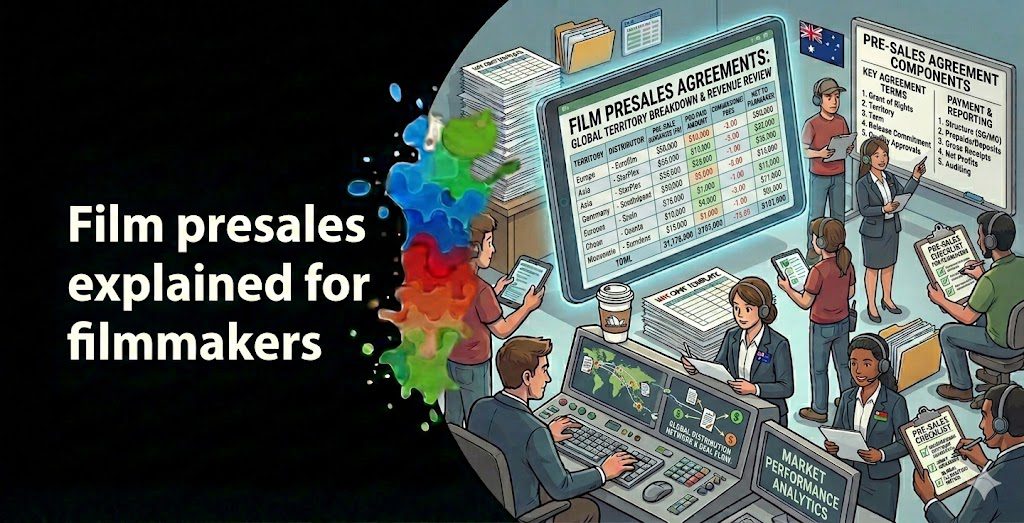
You’ve got a script. You’ve got a director attached. Maybe you’ve got a name actor — or you’re working on it. But you don’t have a budget. Not yet. Film presales are one of the primary mechanisms independent producers use to close that gap — turning signed commitments from distributors into the collateral that banks will actually lend against.
Here’s what nobody explains clearly: a presale isn’t a sale. It’s a promise of a future payment — and that promise only converts into production cash through a specific chain of steps that most first-time producers don’t fully understand until they’re already in the middle of a market cycle and scrambling.
This guide breaks down how film presales actually work — from packaging through to bank drawdown — including what makes a project presaleable in today’s market, how MGs get valued by territory, and what the current independent film environment really looks like for producers trying to use this model in 2026.
Find Active Distributors for Your Project — Before the Market Opens
VIQI — Vitrina’s AI intelligence engine — surfaces active buyers and distributors across 140,000+ companies by genre, territory, and acquisition appetite. Teams at Netflix, Warner Bros, and Paramount use Vitrina to identify deal-ready counterparties weeks before Cannes, AFM, and Berlin.
200 free credits. No credit card required.
What a Film Presale Actually Is
A film presale is a license agreement where a distributor commits to pay a Minimum Guarantee (MG) for the right to distribute a completed film in a specific territory — before that film has been made. The key word is “completed.” The distributor isn’t paying for a script or a pitch. They’re pre-committing to pay for a finished, delivered film that meets the technical and creative specifications in the contract.
The standard MG payment structure: 10% on contract signature and 90% on delivery of the completed film. That 90/10 split is the crux of why presales create a financing problem as much as they solve one. You have a signed contract — a binding commitment from a real distributor — but you don’t have most of the cash until you’ve already made the film. And you need cash to make the film. That’s the gap. That’s literally where gap financing gets its name.
So the presale’s value to production financing isn’t the MG payment itself — it’s what the MG contract enables you to borrow. Banks will lend against confirmed presale contracts. Typically 70-90% of the MG face value, depending on the distributor’s credit rating in that territory. A presale to a major German distributor like Constantin Film gets treated very differently from a presale to an unknown buyer. That lender confidence differential is something most producers don’t factor into their financing plans until it’s too late.

Your AI Assistant, Agent, and Analyst for the Business of Entertainment
VIQI AI helps you plan content acquisitions, raise production financing, and find and connect with the right partners worldwide.
- Find active co-producers and financiers for scripted projects
- Find equity and gap financing companies in North America
- Find top film financiers in Europe
- Find production houses that can co-produce or finance unscripted series
- I am looking for production partners for a YA drama set in Brazil
- I am looking for producers with proven track record in mid-budget features
- I am looking for Turkish distributors with successful international sales
- I am looking for OTT platforms actively acquiring finished series for the LATAM region
- I am seeking localization companies offer subtitling services in multiple Asian languages
- I am seeking partners in animation production for children's content
- I am seeking USA based post-production companies with sound facilities
- I am seeking VFX partners to composite background images and AI generated content
- Show me recent drama projects available for pre-buy
- Show me Japanese Anime Distributors
- Show me true-crime buyers from Asia
- Show me documentary pre-buyers
- List the top commissioners at the BBC
- List the post-production and VFX decision-makers at Netflix
- List the development leaders at Sony Pictures
- List the scripted programming heads at HBO
- Who is backing animation projects in Europe right now
- Who is Netflix’s top production partners for Sports Docs
- Who is Commissioning factual content in the NORDICS
- Who is acquiring unscripted formats for the North American market
How the Presale Process Works, Step by Step
The mechanics follow a specific sequence. Miss a step — or get the order wrong — and the financing doesn’t close.
- Package the project. Script, director attachment, lead cast (ideally recognizable names), and a budget. The package is everything. Without it, no sales agent will represent you and no distributor will commit an MG.
- Attach a reputable sales agent. The sales agent is the engine of the presale model. They create territory-by-territory sales estimates, pitch your project at the major markets, negotiate with distributors, and — critically — have existing relationships with the entertainment banks that will lend against the contracts they generate. Their commission runs 10-15% of total sales, with recoupable expenses typically capped at $50-75K.
- Sales estimates are created. Before you go to market, your agent produces a country-by-country projection of what each territory’s MG should realistically be worth. These estimates are the basis of your financing plan — and banks will discount them conservatively, typically to 50-70% of the agent’s projection for gap financing purposes.
- Go to market. Cannes Marché du Film (May), the American Film Market in November, the European Film Market in Berlin in February — these are the primary venues where deals get made. Distributors receive your package 2-3 weeks before the market opens, evaluate it against their current slate needs, and either engage or pass. The in-market period is compressed and fast.
- MG contracts are signed. Each territory deal is a separate agreement. A single film might generate 10-20 individual presale contracts across different territories, each with its own MG amount, delivery requirements, license period (standard is 15-20 years), and payment schedule.
- Contracts go to the bank. The sales agent takes the presale contracts to an entertainment bank — Comerica, City National, JP Morgan’s entertainment division — which evaluates each contract, grades the distributor, and determines what percentage of the MG face value it will lend against.
- Production loan is drawn down. The bank advances production cash against the presale contracts. The film gets made. Delivery triggers the 90% MG payments from distributors, which repay the production loan.
That’s the loop. Clean in theory. Messier in practice — especially in the current market. For a full breakdown of how this connects to the broader capital stack, see our guide to film and TV financing for producers and investors.
What Actually Makes a Film Presaleable in 2026
This is where honesty matters — and where a lot of filmmakers get a rude education at markets. Not every project is presaleable. Specifically, the following factors drive whether distributors will commit MGs, and at what value:
Cast — The Biggest Driver
Recognizable cast is the single most important variable in presale valuation. An A-list actor commands premium MGs across major territories. B-list delivers moderate value. Unknown cast — regardless of how compelling the script is — generates minimal presale value in international markets. This isn’t a creative judgment. It’s how international buyers manage risk when committing money to a film they haven’t seen.
Phil Hunt, Founder and CEO of Head Gear Films — who has financed over 550 films in nearly 25 years, making him and co-founder Compton Ross the most highly credited producers in UK history since records began in 1906 — puts it plainly: the market is looking for low-cost, high-concept projects within specific genres with A-list and successful directors attached. That bull’s-eye is narrow. And it’s getting narrower.
Genre — Not All Genres Travel
Action, thriller, and horror are the genres with the strongest international presale markets right now. Drama is struggling — particularly without significant cast. Comedy is the hardest to presell internationally because its humour is culturally specific and doesn’t translate well across territories. The buyers in today’s market have become risk-averse, concentrating their MG commitments in the genres where they have the most confidence in recouping from theatrical and streaming windows.
Director Track Record
A director with a proven commercial track record adds real MG value — particularly in genre films where the director’s name carries weight with international buyers. A festival-circuit director with critical pedigree but no commercial performance adds art-house value in certain territories but doesn’t move the needle on the overall presale package the way a commercially proven director does.
English Language
The international presale market runs primarily on English-language content. English-language films can be dubbed or subtitled and export to almost every territory globally. Non-English-language projects face a much harder presale environment — not impossible, but structurally more difficult, requiring exceptional creative credentials or significant territory-specific demand to generate comparable MG levels.
Phil Hunt (Founder & CEO, Head Gear Films) discusses the collapse of film presale markets, the death of revenue windows, and what independent filmmakers actually need to close financing in 2025 — Vitrina LeaderSpeak Episode 2.
Track 159,223 Projects and Identify Which Distributors Are Buying
Vitrina gives producers real-time visibility into active buyers across every major territory — genre appetite, deal history, acquisition signals — so you approach the right distributors with the right package before your market window. Used by teams at Warner Bros, Paramount, and Google TV.
200 free credits. No credit card required.
How Territory Values Are Calculated
Territory value isn’t uniform. It varies significantly by market size, genre, cast, and the distributor you’re dealing with. Here’s how the hierarchy works in practice:
Major markets — the US, UK, France, Germany, Italy, Japan, and Australia — command the highest MG values and are typically sold individually to maximize the total guarantee. Each of these has established distributor relationships and can generate five- to six-figure MGs for a well-packaged commercial project.
Mid-tier markets — Spain, Benelux, Scandinavia, South Korea — sit below the majors. Still meaningful MG contributions, but typically sold as part of a regional package rather than individually.
Smaller territories — individual smaller countries — often get bundled together in regional packages because the individual MG values don’t justify the administrative overhead of separate negotiations.
One thing banks scrutinize carefully: not all presale contracts are equal from a lending perspective. A distributor’s creditworthiness in a territory determines how much of their MG the bank will advance against. An A-list distributor — Constantin Film in Germany, Pathé in France — commands a high loan percentage. An unknown or financially weak buyer might not qualify for bank lending at all, meaning that MG contract is effectively dead weight in your financing plan. Know your buyers before you build your finance plan around their commitments.
Joshua Harris, President of Peachtree Media Partners — a private film finance lender with over 26 years in entertainment finance and a portfolio exceeding 350 films — describes the collateral assessment: every distribution agreement is evaluated individually, looking at the financial strength of each specific distributor and how comfortable the lender is with their ability to pay. There’s no uniform approach. It’s distributor by distributor, territory by territory. For a deeper look at how lenders assess this collateral, see our breakdown of the presale ecosystem across international territories.
Presale Strategy: What to Sell, When, and What to Hold Back
The capital reality: you don’t want to presell everything. The ideal approach for most independent productions is to cover 50-70% of the budget through presales — enough to secure the production loan, but with enough unsold territories held back to sell post-completion at higher values.
Why hold territories back? A completed film — particularly one that’s performed at a festival or generated early critical attention — is worth more than a script with an attached package. The distributor has something to evaluate: footage, performances, a finished cut. That reduces their risk and increases their willingness to pay. Pre-completion, they’re buying based purely on the package and your track record. Post-completion, they’re buying a real asset.
The domestic territory — particularly the US — is the most valuable single market and the one producers are most often advised to hold back. Harris at Peachtree notes that filmmakers who hold back the domestic territory and let Peachtree advance against its estimated future value can sometimes make their project without selling it at a discount pre-completion — then sell it after the film exists for significantly more. It’s a calculated risk that requires confidence in the project and a lender willing to advance against unconfirmed territory value. But it protects the upside in a way that a full pre-completion presale programme doesn’t.
The timing dimension matters too. There are three windows for presales: before production (maximum volume, lower prices), after principal photography (slightly higher MGs as project looks more real), and after festival success (premium pricing, but limited to films that actually get into major festivals). Most projects operate in the pre-production window because that’s when the financing need is most acute.
For the detailed mechanics of how sales agents structure market pitches and where territory sequencing fits into the financing plan, see our analysis of the role of sales agents in production financing.
What Streaming Has Done to the Presale Model
The honest version of this story isn’t comfortable. Streaming didn’t fix the presale model — it restructured it in ways that have made independent film financing harder, not easier, for most producers.
Phil Hunt describes the pre-streaming world with some useful context: there were clear revenue windows — theatrical, then rental (VHS/DVD at $100+ per title), then purchase, then broadcast. Each window generated distinct, substantial revenue at the film investment level. Pay-one and pay-two television alone represented approximately 75% of a film’s total commercial value over its life. Those windows are gone. Now a streaming subscription at $15-18 a month gives consumers access to thousands of hours of content — and the per-film revenue that flows back to production is fractional by comparison.
But streaming has created a different dynamic for presales specifically. Platforms like Netflix can — and do — acquire worldwide rights on some projects, effectively replacing 15-20 individual territory presales with a single global deal. That’s structurally simpler for the producer. But it removes backend participation across all those territories, collapses long-term distribution windows, and means you’re negotiating against a single buyer with significantly more market power than any individual territory distributor. As Deadline has reported, independent producers navigating the streaming acquisition environment face pressure to take lump-sum global deals that provide capital certainty at the cost of long-term upside.
And according to Variety, the appetite among streaming platforms for independent acquisitions has become far more selective post-peak-streaming. The era when streamers were buying aggressively at markets — providing floor prices that kept the traditional presale structure viable — has contracted. Buyers are more conservative, the genres they’ll buy are narrower, and the packages they demand to commit to are stronger than they’ve ever been.
The practical implication: pre-selling a film off an idea alone — which was genuinely possible in the 1990s and early 2000s — is essentially gone from the independent market. What you need today is a fully packaged, commercially viable project in a proven genre with name talent, a reputable sales agent, and a financing plan that doesn’t require presales to carry the entire budget. Presales are a component of the capital stack, not the whole stack.
Where Presales Sit in Your Capital Stack
A realistic capital stack for an independent film project in 2026 typically looks something like this for a $10M production budget:
- Equity investment: $2M (20%) — from private investors, family offices, or institutional equity funds
- Presales (MGs against bank loan): $4.5M (45%) — territory deals generating contracts that the bank advances against
- Tax incentives: $2M (20%) — cash rebates or tax credits from qualifying production jurisdiction
- Gap financing: $1.5M (15%) — bridge loan against unsold territory estimates to close the remaining gap
Presales are doing a lot of the heavy lifting here — but they’re not doing it alone. The tax incentive layer reduces effective budget and makes the presale-to-loan ratio more comfortable for the bank. Equity absorbs the first-loss position. Gap financing closes what presales can’t reach without requiring you to sell additional territories at discounted pre-completion prices.
What the Fragmentation Paradox™ creates in this process is a discovery problem. With 600,000+ companies operating globally in opaque silos, finding the right territorial distributor for your specific genre — one who’s actively buying, credit-rated by the banks, and aligned with your delivery timeline — used to require attending 3-4 markets per year and building relationships over multiple cycles. That’s a timeline most independent productions can’t afford. It’s one of the core problems Vitrina’s Smart Pairing intelligence is built to solve. For more on how the full financing structure works, see our breakdown of minimum guarantees in distribution deals.
Build Your Presale Package with Expert Support
Vitrina’s Concierge team works with independent producers to map territory buyer appetite, identify credit-rated distributors by genre, and de-risk your presale strategy before you hit the market. Trusted by teams across 140,000+ companies in the global film and TV supply chain.
No commitment required to start the conversation.
The Bottom Line on Film Presales
Presales work when the package works. They don’t create value from nothing — they convert an already-compelling project into bankable paper that lenders can advance against. The filmmakers who use presales effectively are the ones who understand that the mechanism is only as strong as the package that sits behind it: the right genre, the right cast, a reputable sales agent, and a financing plan that doesn’t over-rely on territory commitments to carry the whole budget.
The market is harder than it’s ever been. Phil Hunt doesn’t mince words on that point. But the presale model isn’t dead — it’s selective. It rewards the producers who build their projects for the international market from the ground up, not the ones who try to retrofit international distribution interest onto a project that was never designed for it.
Key takeaways:
- A presale is a commitment, not cash: the MG is 10% on signature, 90% on delivery — the financing value comes from borrowing against the contract, not the contract itself
- Banks lend 70-90% of MG face value — but only against distributors they consider credit-rated in each territory
- Genre, cast, and director are the three primary variables that determine whether your project will generate meaningful MGs at market
- Hold back 30-50% of territories — pre-sell enough to close the production loan, but keep your most valuable markets for post-completion sale at higher prices
- Presales are one layer of the capital stack — typically covering 30-50% of budget alongside equity, tax incentives, and gap financing
- The streaming era has made presales more selective, not irrelevant — the projects that attract strong MGs are those built specifically for international commercial appeal from development through packaging
Join 140,000+ Film and TV Companies on Vitrina
Vitrina is the intelligence platform for the global film and TV supply chain. Discover active territorial distributors, track presale deals across 159,223 projects, and identify the right buyers for your package — by genre, territory, and deal type. Netflix, Paramount, and Google TV use Vitrina to track market signals in real time.
Start free. 200 credits. No credit card required.
Frequently Asked Questions About Film Presales
What is a film presale?
A film presale is a license agreement where a distributor commits to pay a Minimum Guarantee (MG) for the right to distribute a completed film in a specific territory — before the film has been produced. The standard structure is 10% of the MG paid on contract signature and 90% paid on delivery of the completed film. Presale contracts are used as collateral for production bank loans, with lenders typically advancing 70-90% of the MG face value against confirmed contracts from credit-rated distributors.
How much of a film’s budget can be covered by presales?
For a well-packaged commercial project, presales typically cover 30-50% of the total production budget — sometimes up to 60-70% for projects with strong A-list talent and proven sales agents. The standard financing strategy is to cover 50-70% of the budget through presales plus tax incentives, leaving a gap of 10-30% that can be bridged through gap financing or equity. Producers are generally advised not to presell 100% of territories, as holding back key markets allows post-completion sales at higher prices.
What does a sales agent do in the presale process?
A sales agent is the operational centre of the presale model. They create territory-by-territory MG estimates based on your project’s package, pitch your film at the major markets (Cannes, AFM, Berlin, TIFF), negotiate MG contracts with territorial distributors, and facilitate the bank financing process by working with entertainment lenders who respect their sales track record. Sales agents charge 10-15% commission on total sales, with recoupable expenses typically capped at $50-75K per project.
What types of films are most presaleable internationally?
Action, thriller, and horror are the genres generating the strongest international MG commitments in today’s independent market. These genres have broad cross-territory appeal, established buyer networks, and predictable commercial windows. Drama requires significant cast to generate meaningful presale value. Comedy is the hardest to presell internationally due to cultural specificity. English-language content travels most efficiently — dubbed or subtitled, it can export to nearly every territory globally.
How does a presale contract become a production loan?
Once presale contracts are signed with territorial distributors, your sales agent takes the contracts to an entertainment bank (Comerica, City National, JP Morgan entertainment division). The bank evaluates each distributor’s creditworthiness in their territory and determines how much of the MG face value it will lend against — typically 70-90% for strong distributors. The bank issues a production loan against the aggregate of qualifying presale collateral. The film is produced, delivered, and the 90% MG payments from distributors repay the production loan.
What is the standard license period for a presale territory deal?
Standard presale license periods run 15-20 years for most territories. The minimum is typically 5 years, but distributors strongly prefer long terms because they need the full commercial window to recoup their MG commitment and earn their distribution fee from theatrical, broadcast, home entertainment, and digital windows over time. Shorter terms are negotiable but usually result in lower MG values.
How has streaming changed film presales?
Streaming platforms have created a new buyer class — one that can acquire worldwide rights through a single deal, replacing 15-20 territorial presales. But the collapse of distribution revenue windows (theatrical, rental, broadcast, VOD) has significantly reduced territory MG values because the distributor’s recoupment pathway is narrower than it was in the 2000s. The market for independent presales has become more selective, concentrating on stronger packages in proven genres with recognizable talent. Pre-selling a project off an idea alone — commonplace in the 1990s — is no longer viable in the current independent market.
When is the best time to go to market for presales?
The three primary windows are: before production (maximum volume, lower individual MG prices), after principal photography (moderately higher prices as the project looks more tangible), and after festival success (premium prices, but only for films accepted into major festivals). Most independent productions target pre-production presales because the financing need is most acute at that stage. The five major markets are Cannes Marché du Film (May), the American Film Market (November), the European Film Market in Berlin (February), Toronto International Film Festival (September), and MIPCOM/MIPTV Cannes.
Find Film+TV Projects, Partners, and Deals – Fast.
VIQI matches you with the right financiers, producers, streamers, and buyers – globally.
Producers Seeking Financing & Partnerships?
Book Your Free Concierge Outreach Consultation
(To know more about Vitrina Concierge Outreach Solutions click here)
Join Industry Briefings Trusted by Leaders

Unscripted Is Eating the World: The Multi-Billion Reality and Format Boom
Unscripted is the new prestige — inside the $19.8B global format boom reshaping how streaming platforms compete.

Unscripted Is Eating the World: The Multi-Billion Reality and Format Boom
Unscripted is the new prestige — inside the $19.8B global format boom reshaping how streaming platforms compete.

Scripted Without Borders
As global drama evolves, which stories travel, which stay local, and how are they getting financed?
What Film & TV Financiers Actually Want in 2026
What do Film and TV financiers look for before they invest? Join the briefing to understand how capital decisions are changing in 2026.