About Innovation Hub
 Global Content Pulse (Webinars)


 Global Production Financing
(Webinars)
Global Production Financing
(Webinars)  LeaderSpeak Podcast
  Global Entertainment Digest (Newsletter)
  About Vitrina
 About VIQI
 Our Story
 Our Solutions 🔥
 Film+TV Projects Tracker 🚀
 Case Studies
 Our Profile
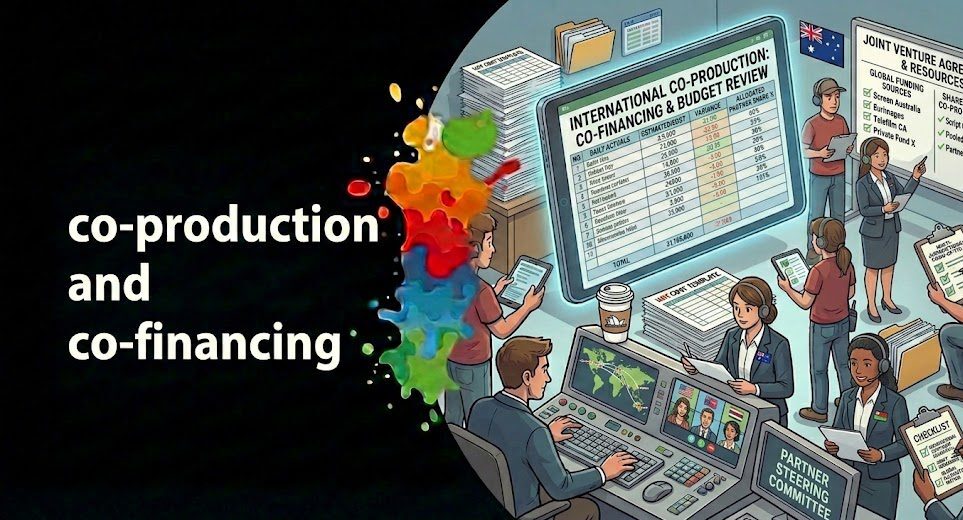
Two projects. Two international partners. Two completely different deal structures — but producers use the terms interchangeably every week. Co-production vs co-financing isn’t just a semantic distinction. It determines who owns the IP, who controls the creative, who gets the credits, and — critically — who has access to which incentives, tax credits, and film funds across multiple territories.
Get the structure wrong and you’ve either locked a passive capital partner into creative decisions they’ll never make, or handed a creative partner IP rights and profit positions you didn’t intend to share. Both mistakes are expensive. Both are common.
This guide breaks down exactly how co-production and co-financing differ, when each structure makes sense, and how the best producers deploy both — sometimes on the same project.
Find Co-Production Partners Across 140,000+ Companies
VIQI — Vitrina’s AI intelligence engine — maps active co-producers and financiers by territory, treaty eligibility, and genre. Teams at Netflix, Warner Bros, and Paramount use Vitrina to identify the right partners before markets open.
200 free credits. No credit card required.
The Core Distinction: Creative Partner vs Capital Partner
Here’s the clearest way to think about it. A co-production is a partnership between two or more producers who both contribute creatively and financially to a project. A co-financing arrangement is where one party contributes capital only — no creative input, no production credits, no IP ownership in the traditional sense.
That single distinction creates downstream differences across every dimension of a deal: who gets listed as producer, who sits in IP ownership, which country’s tax incentives your project qualifies for, and where each party lands in the recoupment waterfall. Let’s work through each one.
| Factor | Co-Production | Co-Financing |
|---|---|---|
| Creative involvement | Yes — shared decisions | No — capital only |
| IP ownership | Shared between partners | Typically with producer |
| Producer credits | Both parties credited | Exec producer credit (if any) |
| Incentive access | Multiple countries via treaty | Single-country incentives only |
| Revenue position | Proportional profit share | Waterfall equity position |
| Regulatory approval | Required (BFI, Telefilm, CNC) | Not required |
| Timeline to structure | Longer — compliance-driven | Faster — investment docs only |
Stop Guessing Who’s Financing. Get Targeted Outreach.
Stop searching and start getting funded. We identify the exact decision-makers currently backing projects like yours, turning raw data into risk-aligned capital partnerships.
Major Studios
Scouting early stage projects, IP, and Regional partners for global studio pipelines.
IP Owners & Leads
Connecting creative leads with qualified financiers and major streaming platforms.
Streamers
Securing high-value pre-buy content and discovering early-stage global IP for platforms.
Indie Producers
Bridging the gap for indie filmmakers to reach executive production partners and capital.
Global Financing Ecosystems
Mapping complex markets and pairing projects with disciplined, risk-aligned capital across global territories worldwide.
What Co-Production Actually Means (and What It Unlocks)
A co-production is a formal creative and financial partnership. Both parties bring producers, crew, talent, and capital — in proportions that must be roughly aligned. That’s not a preference. For official treaty co-productions, regulatory bodies in each country require that financial contribution and creative contribution track each other. If a UK producer puts in 30% of the budget, they need to control roughly 30% of the creative package: directors, writers, principal cast, key crew.
Why does that matter? Because the payoff is national film status in both countries. A UK-Canada official co-production qualifies simultaneously as a British film and a Canadian film. That means your project can access UK tax relief and Telefilm Canada and Canadian broadcaster pre-buys — all on the same project. For productions where the numbers need to work across multiple incentive regimes, that’s not a nice-to-have. It’s the mechanism that makes the capital stack viable.
Canada has the largest bilateral treaty network — 60+ countries, with over 60 official co-productions annually totalling approximately $500M CAD each year. France has 61 bilateral treaties. The UK maintains active treaties with Australia, Brazil, Canada, China, France, India, Israel, Morocco, New Zealand, and South Africa, among others. These aren’t obscure agreements — they’re operational financing tools that producers use at Cannes, AFM, and Toronto every cycle.
For a full breakdown of how these treaty frameworks operate in practice, see our guide to how co-productions work across global film and TV.
The Two Types: Official Treaty vs Unofficial
Not every co-production runs through a treaty. Unofficial co-productions — structured through Production Service Agreements — give you more flexibility on spend percentages and personnel requirements. The trade-off? You don’t get national status in both countries. You access one country’s incentives, and the other party’s contribution is treated more like a service arrangement. If you need the full incentive stack from both territories, the official treaty route is the only path.
And one important geographic note: the US has no official co-production treaties. American producers working internationally are structuring unofficial co-productions or co-financing arrangements — not official treaty partnerships. That shapes how the capital stack works for US-anchored projects and why European co-production expertise has become genuinely valuable for bridging North American projects into treaty-eligible structures.
What Co-Financing Means in Practice
Co-financing is simpler in structure, if not always in negotiation. A co-financier provides capital in exchange for a defined return — typically an equity position in the project’s revenue waterfall. No creative approval rights. No co-producer credits (unless negotiated separately as an executive producer credit). No IP ownership claim beyond their financial participation. They’re in the deal as an investor, not a creative partner.
The waterfall position for co-financing equity sits well down the priority stack. Distribution and sales agent fees come off the top — typically 20-35%. Then P&A costs recoup. Then senior debt. Then gap financing. Then, finally, equity — which is where your co-financier lands. Target returns for equity positions run 120-125% of principal, meaning a co-financier who puts in $2M expects to recoup $2.4-2.5M before profits start flowing to net participants. That’s the risk premium for sitting behind every debt instrument in the stack.
Andrea Scarso, Managing Partner at IPR VC — a Helsinki-founded equity financier with 12 years operating across European film and TV — describes the model clearly: the appeal of equity financing is that when you hit a successful IP, the upside exceeds the overall portfolio risk. But that calculus only works if the portfolio is structured correctly and if you’re working with the right creative partners from the start. IPR VC takes equity positions in projects — not companies — and builds what Scarso calls a library of assets that collectively generates long-tail revenue well beyond the initial release window.
Andrea Scarso explains IPR VC’s approach to equity co-financing in film and TV — and why the quality of investment structuring matters more than deal flow:
Andrea Scarso (Managing Partner, IPR VC) — “Equity Financing in Film & TV: IPR VC’s Strategic Partnership Model” | Vitrina LeaderSpeak Episode 70
For independent producers, co-financing unlocks capital without giving up creative control. That’s the core appeal. You keep the director’s chair, the creative brief, and the casting decisions. The co-financier gets financial exposure and upside. But — and this is where many producers get caught — co-financing agreements vary enormously in what rights and approvals they carve out for investors. Budget approval rights, distribution deal approval, and audit rights can all end up in a co-financing agreement if you don’t negotiate them out. Know what you’re signing.
Track Active Co-Financiers Across 400,000+ Projects
Vitrina maps institutional equity investors, family offices, and co-financing funds by geography and content type. See who’s actively deploying capital — and which projects they’ve backed — before you start outreach. Used by teams at Warner Bros, Paramount, and Google TV.
200 free credits. No credit card required.
7 Specific Differences That Change How You Structure the Deal
1. IP Ownership
In a co-production, IP is shared between the co-producing entities — typically in proportion to their financial and creative contribution. Both parties can exploit the IP in their respective territories. In a co-financing structure, IP ownership typically stays with the producer, and the co-financier holds only a financial claim against revenue. The distinction becomes critical for sequels, franchise rights, format sales, and long-term library value. If your project has franchise potential, think hard before splitting IP with a co-producer when what you actually need is a capital partner.
2. Incentive Stacking
This is where co-production’s financial advantage is most concrete. An official treaty co-production lets you stack incentives from two countries — accessing cash rebates, tax credits, and soft money from both simultaneously. A UK-Australia co-production can target the UK High-End TV tax relief alongside Screen Australia’s Producer Offset on the same budget. As a co-financing deal — where only one party has national status — you access one country’s incentives only. For productions where the soft money differential between single-country and dual-country regimes is significant, the administrative complexity of official co-production often pays for itself several times over.
3. Creative Control
Co-production means shared creative decisions — by definition and by regulatory requirement. Your co-producer has a voice on casting, locations, director choices, and script development because their national status depends on genuine creative contribution. That’s the trade-off for the incentive access. Co-financing doesn’t require this. Your capital partner may negotiate for budget approval or distribution deal approval — those are financial safeguards — but they’re not sitting in the writer’s room. If creative autonomy matters to your project, co-financing protects it; co-production may not.
4. Regulatory Requirements
Official treaty co-productions require approval from competent authorities in each country — the BFI in the UK, Telefilm Canada, CNC in France, Screen Australia, and so on. Applications are typically submitted at least 4 weeks before principal photography begins, with provisional approval first and final certification post-completion. The documentation requirements are real: financial contribution percentages, creative contribution breakdowns, chain-of-title, personnel lists. Co-financing doesn’t carry any of this regulatory overhead — it’s a commercial agreement between parties, not a national certification.
5. Contribution Proportionality Rules
Treaty co-productions operate within defined financial bands. For bilateral treaties, each party must contribute between 10-80% (with some treaties requiring 20% minimum). And that financial contribution must align proportionally with the creative contribution. A partner providing 40% of the budget can’t take 5% of the creative roles — the regulators will reject it. Co-financing has no such constraints. An investor can put in 15% of the budget and take a purely passive financial position, or 60% and still have no creative approval rights if the agreement is structured that way.
6. Revenue Waterfall Position
Co-producers share in revenue proportionally, in line with their ownership stake — but their actual recoupment position can vary depending on how the deal is structured and whether they’ve taken any senior debt position alongside equity. Co-financiers sit in the equity tier of the recoupment waterfall — after distribution fees, P&A costs, senior production loans, and gap financing. That’s the highest-risk, highest-potential-return position. Most institutional co-financiers price that risk into their return expectations: 120-125% of principal is the typical floor for equity co-financing positions in independent film.
7. Deal Timeline
Treaty co-productions take longer to structure — the regulatory approval process, creative negotiation, and compliance requirements add months to a development timeline. As Andrea Scarso of IPR VC notes, the financing conversation needs to happen from the moment a producer starts thinking about packaging, not after the script is locked. Co-financing moves faster: it’s an investment agreement, not a multinational certification. For productions on compressed timelines — or where treaty eligibility isn’t achievable — co-financing can close in weeks where co-production takes months.
Find the Financiers Backing Your Genre
Stop searching and start getting funded. We identify the exact decision-makers currently backing projects like yours, turning raw data into risk-aligned capital partnerships.
When to Use Each Structure — and When to Stack Both
The real dynamic is that experienced producers often use co-production and co-financing simultaneously on the same project. Here’s the logic: a treaty co-production between a UK and Canadian producer unlocks national film status and incentives in both territories. That changes the effective budget. Then a co-financing equity partner comes in to close the remaining gap — without creative rights, without production credits, without treaty complications.
The incentive stacking from the treaty co-production makes the project more attractive to equity co-financiers, because the net budget is lower relative to the soft money offset. And the co-financer’s capital allows you to uphold your treaty obligations without stretching the primary producer’s cash position. Strategic players understand that these two structures aren’t alternatives — they’re layers in the same capital stack.
When to choose co-production over co-financing alone:
- Your story spans two countries and both need authentic production presence
- The incentive differential between single-country and dual-country access is significant (15%+ of budget)
- Your co-producer brings genuine distribution access in their home territory
- You need crew and locations from both territories for creative reasons anyway
When co-financing is the cleaner choice:
- You want to protect creative control without sharing IP or production decisions
- Your US partner can’t access a treaty structure
- The project timeline doesn’t allow for regulatory approval
- You need a capital close faster than treaty compliance allows
As reported by Variety, the growing complexity of international production financing has pushed many independent producers toward hybrid structures — using treaty co-productions to build the incentive base, then bringing in co-financiers to complete the capital stack without complicating the creative structure. And per reporting from Screen International, European co-productions have grown substantially, with countries like Belgium now running 72% of their films as co-productions — a figure that reflects how deeply treaty structures have become embedded in European production financing.
The Fragmentation Paradox™ complicates both paths. With 600,000+ companies operating across the global supply chain in opaque silos, finding the right co-production partner — one with genuine treaty eligibility, the right creative track record, and active relationships in your target territory — takes real intelligence. The same goes for identifying institutional co-financiers who are actively deploying capital in your genre and budget range. For our full breakdown of how to navigate international co-productions, see the strategic imperative of international co-production.
Structure Your Financing Deal with Vitrina Concierge
Vitrina’s Concierge team works directly with producers to map treaty eligibility, identify qualified co-production and co-financing partners, and de-risk your capital stack before negotiations begin. Used by teams across 140,000+ global entertainment companies.
No commitment required to start the conversation.
The Bottom Line
Co-production and co-financing solve different problems. Co-production brings a creative and financial partner who changes your national film status, unlocks incentives in two countries, and shares both the IP and the creative decisions. Co-financing brings capital that sits passively in the equity waterfall — protecting your creative control and IP ownership in exchange for a defined return. Both are legitimate, and neither is universally better. The right structure depends on what your project actually needs to close.
What’s certain: confusing the two is expensive. A financier who wanders into creative territory they weren’t contracted to occupy, or a co-producer who doesn’t deliver the treaty-eligible creative contribution their incentive access requires — both create problems that don’t surface until it’s too late to restructure. Get the distinction clear at the term sheet stage, not the delivery stage.
Key takeaways:
- Co-production = creative + financial partnership: shared IP, shared decisions, shared credits, national film status in both countries via treaty
- Co-financing = capital partnership only: equity waterfall position, no creative rights, producer retains IP and creative control
- Treaty co-productions stack incentives across two jurisdictions — potentially adding 15-30% of effective budget through combined tax relief and soft money access
- Co-financing equity positions typically target 120-125% of principal and sit behind all debt in the recoupment waterfall
- Both structures can coexist on the same project — co-production builds the incentive base, co-financing closes the gap without complicating the creative structure
For how this plays out across a full capital stack, see our breakdown of the film financing capital stack.
Join 140,000+ Companies Navigating Global Content Partnerships
Vitrina is the intelligence platform for the global film and TV supply chain. Find treaty-eligible co-production partners, track institutional co-financiers, and connect with the right counterparties — by territory, genre, and deal type. Netflix, Paramount, and Google TV are already on the platform.
Start free. 200 credits. No credit card required.
Frequently Asked Questions
What is the difference between co-production and co-financing?
A co-production is a partnership where both parties contribute creatively and financially — sharing IP ownership, production credits, and creative decisions. A co-financing arrangement is purely financial: one party provides capital in exchange for a revenue waterfall position, with no creative input or IP ownership. Co-production can unlock national film status in multiple countries through bilateral treaties; co-financing does not affect national status.
Can a co-financing partner also be a co-producer?
Yes — but the two roles carry different obligations and rights, and conflating them in a single agreement creates problems. A party can be a co-producer (with creative rights and IP ownership) and also provide co-financing (as a capital partner). If treaty co-production status is sought, their financial and creative contribution must meet the proportionality requirements of the relevant treaty. Many sophisticated entertainment financiers — like IPR VC, which operates across European film and TV — take equity co-financing positions while providing executive producer-level strategic support, without claiming full co-production rights.
What are the financial contribution requirements for a treaty co-production?
For bilateral treaty co-productions, each party must typically contribute between 10-80% of the total budget, with some treaties setting a 20% minimum floor. Crucially, financial contribution must align proportionally with creative contribution — if you provide 40% of the budget, your party needs to control approximately 40% of the creative elements: directors, writers, principal cast, key crew. Multilateral treaties are slightly more flexible, with minimum contributions often as low as 5-10% per party.
How does co-financing fit into the recoupment waterfall?
Co-financing equity sits in the equity tier of the recoupment waterfall — after distribution fees (20-35%), P&A cost recoupment, senior production loans, and gap financing. Institutional co-financiers typically target returns of 120-125% of principal to compensate for their subordinate position. This is the highest-risk position in the stack, but it also carries the most upside if the project overperforms commercially.
Does the US have co-production treaties?
No. The United States has no official bilateral co-production treaties. American producers working internationally structure unofficial co-productions through Production Service Agreements, or pursue co-financing arrangements that give them the capital without the treaty-eligible national status. This is a significant structural limitation for US-anchored projects seeking to access European or APAC incentive regimes — it’s why US producers often look for European majority co-producers to lead official treaty applications.
Which countries have the strongest co-production treaty networks?
Canada has the largest bilateral treaty network with over 60 country partnerships, facilitating 60+ official co-productions annually worth approximately $500M CAD. France has 61 bilateral treaties and a strong co-production culture, with CNC administering the framework. The UK maintains active treaties with Australia, Brazil, Canada, China, France, India, Israel, Morocco, New Zealand, and South Africa, among others. Belgium operates the highest co-production rate by volume — 72% of its films are produced through co-production structures.
When should a producer choose co-financing over co-production?
Co-financing is the cleaner choice when you want to protect creative control without sharing IP or production decisions, when your partner is a US entity without treaty access, when the project timeline doesn’t allow for regulatory approval (typically 4+ weeks before principal photography), or when the incentive differential between single-country and dual-country access doesn’t justify the administrative complexity of treaty compliance. Many productions use both: a treaty co-production to build the incentive base, then co-financing equity to close the remaining capital gap.
How do you find the right co-production or co-financing partner?
The most efficient approach is intelligence-led outreach — identifying which producers in your target territory have current treaty eligibility, active slates in your genre, and distribution relationships your project needs. For co-financiers, the same applies: institutional equity funds, family offices, and film investment vehicles differ significantly in their deployment appetite by genre, budget range, and geography. Vitrina’s platform maps 140,000+ companies across the global film and TV supply chain, including treaty-eligible co-producers and active equity investors, with teams like Netflix UK identifying partners in under 48 hours through the platform.
Find Film+TV Projects, Partners, and Deals – Fast.
VIQI matches you with the right financiers, producers, streamers, and buyers – globally.
Producers Seeking Financing, Co-Pros, or Pre-Buys?
Vitrina Concierge helps producers reach the right financiers, commissioners, distributors, and co-production partners — with precision outreach, not cold pitching.
Join Industry Briefings Trusted by Leaders

Format Adaptations: Global Trends
Where formats are traveling, which adaptations are breaking out, and how streamers are backing remakes in 2025–2026.

Books, Novels & Comics Adaptations: Global Trends
Books, webtoons, and manga driving the next global screen hits. Discover how in this webinar.

Micro-Dramas & Mobile-First Storytelling
Micro-dramas are building real audiences and revenue. Understand the platforms, buyers, and economics behind the growth.

Navigating Global Content Licensing Trends
How global content licensing is shifting beyond flat fees to flexible, deal-driven models.