About Innovation Hub
 Global Content Pulse (Webinars)


 Global Production Financing
(Webinars)
Global Production Financing
(Webinars)  LeaderSpeak Podcast
  Global Entertainment Digest (Newsletter)
  About Vitrina
 About VIQI
 Our Story
 Our Solutions 🔥
 Film+TV Projects Tracker 🚀
 Case Studies
 Our Profile
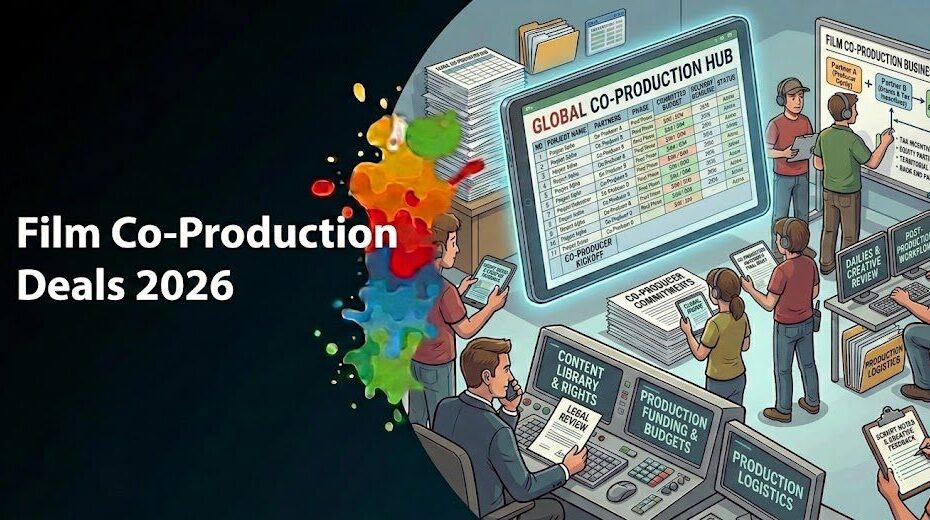
Film co-production deals have never been more structurally complex — or more financially necessary. In 2026, the independent production financing model that relied on a single country’s incentives and a handful of pre-sales is under serious pressure. Phil Hunt, Founder & CEO of Head Gear Films — which has financed 550+ films and operates at 35-40 pictures a year — put it plainly in his October 2025 Vitrina LeaderSpeak interview: “The whole industry has become much, much harder in terms of getting movies off the ground and getting movies sold.”
That’s the honest baseline. But here’s what insiders recognize: the producers closing deals in this environment aren’t the ones lamenting the crunch — they’re the ones who’ve learned to structure cross-border co-productions that stack incentives, access multiple national film funds, and spread risk across partners with genuine market-access value. The capital is out there. It’s just distributed differently than it was three years ago.
This guide maps the current landscape for film co-production deals in 2026 — treaty frameworks, financial stacking mechanics, Sovereign Hub opportunities, and where the smart money is actually moving.
Table of Contents
- Why Co-Production Deals Are Different in 2026
- Treaty Networks That Actually Move Production Finance
- The Financial Stacking Mechanics Explained
- Sovereign Content Hubs and the 2026 Co-Production Opportunity
- How to Select the Right Co-Production Partner
- Structuring the Deal: What Goes in a Co-Production Agreement
- The Traps That Kill Co-Production Deals
- FAQ
- Conclusion
Ask VIQI: Which Countries Have Active Co-Production Treaties With Your Territory?
VIQI is Vitrina’s AI assistant — trained on 1.6 million titles, 360,000 companies, and 5 million entertainment professionals. Ask it which treaty frameworks fit your project, who the right co-production partners are, and what incentive stacks are available for your budget.
✓ Included with 200 free credits | ✓ No credit card needed
Why Co-Production Deals Are Different in 2026
Co-productions aren’t new. Belgium co-produces 72% of its films internationally. France runs 61 bilateral treaties administered through the CNC. Canada manages the largest bilateral network in the world — 60+ country agreements channeling $500M CAD annually through Telefilm. These mechanisms have been operational for decades.
What’s changed in 2026 is the context. Post-COVID production excess created a financing bubble that’s now compressed. Streaming platforms cut commissioning budgets. Pre-sale markets weakened as international broadcasters consolidated. And the result — which Phil Hunt identified directly in his October 2025 interview — is a “big crunch” where independent producers can’t close the capital stack the way they could in 2021.
But here’s the real dynamic at play: the crunch is worse for producers who rely on a single-territory financing model. It’s considerably more manageable for those running genuine multi-territory co-productions. Why? Because a properly structured official treaty co-production grants national film status in each co-producing country — which means access to each country’s national film fund, each country’s broadcaster pre-buy requirements, and each country’s tax incentive at full qualifying rate. You’re not combining financing fragments. You’re unlocking entirely separate capital pools.
That structural advantage — access to multiple sovereign capital sources on a single project — is why international co-production has become a strategic imperative for independent producers serious about closing budgets above $5M in 2026.
📺 Phil Hunt (Head Gear Films) on Film Finance in 2025–2026: Why It’s Harder Than Ever
Phil Hunt — Founder & CEO of Head Gear Films, which has financed 550+ movies — discusses the post-COVID financing crunch, what lenders are looking for in 2026, and how structured co-production lending actually works in practice.

Treaty Networks That Actually Move Production Finance
Not all treaty networks carry equal financing weight. Understanding which frameworks are operationally active — not just legally in force — is where the real intelligence advantage sits. Here’s what the market looks like in 2026.
Canada’s network remains the most productive. With 60+ bilateral agreements covering the UK, France, Germany, Ireland, Australia, New Zealand, Italy, Spain, Brazil, China, and India, Telefilm Canada has infrastructure that simply doesn’t exist elsewhere. The framework is well-practiced, the competent authorities are experienced, and the tax credit stacking — federal CPTC at 25% plus provincial programs ranging from 21.5% in Ontario to 36-40% in Quebec — creates legitimate soft money positions that lenders will advance against.
The UK-Australia and UK-Canada corridors are particularly active, combining the UK’s Audio-Visual Expenditure Credit (AVEC) at 25% (with an enhanced 29.25% for VFX as of April 2025) with partner territory incentives to build capital stacks that approach 50-60% of budget in soft money before equity is even in the conversation.
The European Convention — covering 43 countries under a multilateral framework revised in 2018 — matters because it also feeds Eurimages, the Council of Europe’s co-production fund. For qualifying European projects, Eurimages adds another capital layer that’s frequently overlooked by non-European producers. The 2018 revision reduced the multilateral minimum contribution to 5% (down from 10%), which meaningfully expanded who can participate in multi-country structures.
France’s 61 bilateral treaties are backed by one of the world’s most robust national film fund systems. The CNC’s International Production Tax Rebate offers 30% (rising to 40% if French VFX spend exceeds €2M) — and France’s 2025 protection of film subsidies despite broader budget pressure signals structural commitment to co-production as policy. Italy maintains a €1M joint fund with France specifically for bilateral projects. These aren’t theoretical mechanisms; they’re operational capital.
The producers closing deals use this intelligence to structure partner selection around complementary incentive architectures — not just creative alignment. Your incentive stacking strategy across two jurisdictions should be mapped before the creative package is finalised, not after.

Your AI Assistant, Agent, and Analyst for the Business of Entertainment
VIQI AI helps you plan content acquisitions, raise production financing, and find and connect with the right partners worldwide.
- Find active co-producers and financiers for scripted projects
- Find equity and gap financing companies in North America
- Find top film financiers in Europe
- Find production houses that can co-produce or finance unscripted series
- I am looking for production partners for a YA drama set in Brazil
- I am looking for producers with proven track record in mid-budget features
- I am looking for Turkish distributors with successful international sales
- I am looking for OTT platforms actively acquiring finished series for the LATAM region
- I am seeking localization companies offer subtitling services in multiple Asian languages
- I am seeking partners in animation production for children's content
- I am seeking USA based post-production companies with sound facilities
- I am seeking VFX partners to composite background images and AI generated content
- Show me recent drama projects available for pre-buy
- Show me Japanese Anime Distributors
- Show me true-crime buyers from Asia
- Show me documentary pre-buyers
- List the top commissioners at the BBC
- List the post-production and VFX decision-makers at Netflix
- List the development leaders at Sony Pictures
- List the scripted programming heads at HBO
- Who is backing animation projects in Europe right now
- Who is Netflix’s top production partners for Sports Docs
- Who is Commissioning factual content in the NORDICS
- Who is acquiring unscripted formats for the North American market
The Financial Stacking Mechanics Explained
Here’s how the capital stack actually assembles in a well-structured bilateral co-production. We’ll use a concrete example: a UK-Canada production at £8M total budget.
- UK AVEC (25% of UK-qualifying spend): With 60% of budget spent in the UK, that’s roughly £1.2M in credits — bankable at 85-90% of face value, producing approximately £1M in advance.
- Canadian CPTC (25% of Canadian-qualifying labor): With 40% of budget in Canada and a labor-intensive content structure, this generates C$800K-$1M, again bankable.
- Ontario provincial credit (21.5-40% depending on type): If Toronto-based, adds another C$300-500K on provincial labor.
- BFI certification + Telefilm equity: Official co-production status unlocks potential Telefilm equity contribution for the Canadian partner — which counts toward the Canadian co-producer’s minimum 20% financial contribution.
- Pre-sales from both territories: UK broadcasters (BBC, ITV) and Canadian broadcasters (CBC, Bell) count as territory pre-sales from their respective markets — each bringing the sales agent into the territory and strengthening the gap position.
The result: before a single equity investor is approached, you’ve potentially assembled 35-45% of budget in soft money and bankable credits. That’s the structural argument for official co-production versus single-territory production. Gap financing, which sits between senior debt and equity in the recoupment waterfall, then covers a manageable portion rather than a structural gap in the capital stack.
One discipline that separates experienced co-production producers from first-timers: they model the all-in cost of the incentives, not the headline rates. Origination fees, interest on rebate loans (typically 80-90% of incentive face value advanced by lenders during production), legal costs across two jurisdictions, and audit requirements all compress the net benefit. According to Screen International, the all-in cost of incentive monetisation typically runs 3-5% of the credit value — material, but almost always worth the structural benefit.
Map Co-Production Partners by Territory, Budget, and Incentive Structure
Trusted by Netflix, Warner Bros, and Paramount. Join 140,000+ companies on Vitrina tracking global production deal flow, co-production partner capabilities, and territory incentive stacks.
✓ 200 free credits | ✓ No credit card required | ✓ Full platform access
Sovereign Content Hubs and the 2026 Co-Production Opportunity
The most structurally significant shift in global co-production in 2026 isn’t a treaty change. It’s the maturation of Sovereign Content Hubs™ — government-backed production ecosystems in MENA and APAC that are now offering co-production capital at incentive rates that exceed anything available in traditional Western markets.
Saudi Arabia is the clearest example. Vision 2030 has deployed $71.2B toward entertainment, with over $4B earmarked for film-specific infrastructure — 17 operational studios, Film AlUla, NEOM production facilities, and a 40% cash rebate that competes directly with the most generous programs globally. The Riviera Content Fund ($100M) and the broader Cultural Development Fund have made Saudi a genuine co-production partner, not just a service territory. The 2024 selection of “Norah” for Cannes — the first Saudi film to receive that distinction — signals that the creative infrastructure is now producing exportable content.
For co-production deal structuring, Saudi’s 40% rebate on qualifying in-country spend — combined with a 30% minimum local spend requirement — creates a meaningful financial case for productions with genuine story reasons to shoot there. The math: on a $10M film with $4M in Saudi-qualifying spend, the rebate returns $1.6M. Combine that with a European or Canadian co-producer’s domestic incentive and pre-sales from both territories, and the capital stack can genuinely reach 55-65% soft money.
South Korea operates at a different maturity level — a fully functioning Hallyu export machine with Netflix having committed $2.5B in Korean production. KOFIC administers robust co-production support, and Korean creative credibility (post-Parasite, post-Squid Game) means a Korean co-production partner brings international market value, not just local incentives. UK-Korea and Australia-Korea bilateral frameworks are active and increasingly used by English-language producers seeking Asian market access.
The UAE offers up to 50% incentives through Abu Dhabi and free zone tax benefits (0% corporate tax for 50 years) that make it structurally attractive for content businesses establishing regional operations. And producers working the MENA content market increasingly find that UAE co-production structures unlock access to the broader Arab-speaking audience that’s difficult to reach through any other mechanism.
How to Select the Right Co-Production Partner
This is where the Fragmentation Paradox™ hits co-production hardest. There are 140,000+ active film and TV companies globally — and finding a co-production partner who combines creative alignment, financial credibility, genuine territory access, and clean legal standing is not a task that traditional network relationships handle well at scale.
What’s actually happening — behind closed doors — is that many co-production partnerships are structured primarily around incentive access rather than genuine creative collaboration. That’s not inherently wrong, but it creates fragile structures: the “minority co-producer” whose primary contribution is their tax credit contribution, not their production expertise or distribution relationship. These arrangements frequently create problems during production (creative decisions without creative investment) and post-production (delayed deliverables as the minority partner’s obligations become clear).
The factors that actually predict a successful co-production partnership — beyond incentive compatibility — are these. Language and cultural proximity: Spain-Argentina, France-Quebec, and UK-Australia partnerships consistently outperform others because the creative and logistical friction is lower. Infrastructure complementarity: if your primary production territory lacks specialized VFX or post-production capability, a partner whose home infrastructure fills that gap creates genuine value, not just a financial structure. Distribution relationships that are real: a co-producer who genuinely has broadcaster access in their home territory — not just a theoretical network connection — compresses the pre-sale timeline and strengthens the overall capital stack.
Phil Hunt’s framing is useful here. Head Gear’s approach to partnership is deal-structured, not passion-driven: “What we’re really primarily looking for are projects that the market really wants.” Apply that same discipline to partner selection — what does this partner bring that the market actually values?
Structuring the Deal: What Goes in a Co-Production Agreement
Official treaty co-productions require a formal co-production agreement that satisfies both competent authorities — Telefilm Canada, the BFI Certification Unit, the CNC, the FFA, Screen Australia, and so on. Timing is strict: applications must be submitted to competent authorities at least 4 weeks before principal photography begins, with earlier consultation strongly recommended.
The agreement itself needs to address four structural areas without ambiguity. First, financial contributions: bilateral minimums sit at 10-20% per co-producer with maximums of 80-90% — and those contributions must be proportional to creative contribution. You can’t claim 70% of the creative and put in 15% of the money without triggering structural compliance problems. Second, creative and technical contribution: directors, key cast, and crew from each co-producing territory must reflect the financial stakes — this isn’t a guideline, it’s a treaty requirement enforced during final certification.
Third, profit waterfall and recoupment: each co-producer’s recoupment position, their share of sales agent commissions, their territory-specific distribution rights, and the handling of tax credit proceeds all need precise contractual treatment. Disputes over waterfall structure — after the film is complete and money is coming in — are a persistent source of co-production litigation. Don’t leave waterfall language to “we’ll sort it later.” Fourth, completion bond requirements: gap lenders and many equity investors require a completion guarantee. In a co-production, the completion guarantor needs to be comfortable across both jurisdictions — find one early.
On unofficial co-productions (Production Service Agreements rather than treaty structures): these offer more flexibility but materially fewer financial benefits. No national status, no automatic access to both countries’ film funds, and incentive access limited to whichever single territory’s spend qualifies. For US producers — the US has no official bilateral co-production treaties — PSAs are the only route, which is one structural reason why US producers increasingly structure projects through UK, Canadian, or Australian co-producers who carry treaty access. As Variety has reported, these co-production financing strategies have become a core independent film production route precisely because they open capital pools inaccessible to single-territory structures.
The Traps That Kill Co-Production Deals
Strategic players understand these failure modes — and build structures specifically designed to avoid them.
Currency exposure without a hedge. A UK-Canada deal has GBP, CAD, and potentially USD in the same capital stack. Currency movement between financing close and production start can materially erode the budget before cameras roll. Model the downside case. Some productions have lost 6-8% of effective budget to unfavorable currency moves that weren’t hedged — more than the gap financing cost.
Third-country shooting exceeding treaty limits. Most bilateral treaties allow 20-30% of shooting in a third country — not the co-producing territories. Exceeding that limit without prior approval from both competent authorities risks decertification, which means the loss of one territory’s entire incentive entitlement. If your project genuinely needs significant third-country production, structure for it early — not as a post-production disclosure.
Underestimating the accounting complexity. Two sets of production accountants, two sets of audit standards, two sets of cost reporting requirements — often in different currencies and with different qualifying cost definitions. Productions that don’t budget adequately for cross-border finance and accounting infrastructure routinely find their soft money eroded by compliance costs that weren’t modelled. Build this into your budget before you approach lenders.
Missing application timing. The 4-week minimum before principal photography is a hard deadline, not a suggested guideline. Applications submitted late don’t qualify for provisional approval, which means both competent authorities haven’t signed off before you’re shooting — creating legal and financial exposure that completion guarantors and lenders will not be comfortable with. Start the official process early, consult Telefilm or the BFI Certification Unit before you’re certain about the start date, not after.
Need a Co-Production Partner in a Specific Territory? We’ll Find One.
Vitrina Concierge is your Virtual Agent. We don’t give you a list — we make warm introductions directly to co-production partners and financiers actively seeking projects in your genre and budget range.
- LA producer → Netflix UK, Fifth Season, Fox Entertainment (48 hours)
- European producer → Saudi co-production partners via CDF-aligned companies (week one)
- Middle Eastern studio → Legendary Pictures (direct access)
Frequently Asked Questions: Film Co-Production Deals 2026
What is an official film co-production deal and how does it differ from an unofficial one?
An official treaty co-production is structured under a formal bilateral or multilateral agreement between countries, granting the project national film status in each co-producing territory. This unlocks each country’s tax incentives, national film fund access, and broadcaster pre-buy eligibility simultaneously. An unofficial co-production — structured as a Production Service Agreement — offers more structural flexibility but limits financial benefits to one territory’s incentives. For projects above $5M, official treaty structures typically deliver materially better capital stacks.
Which co-production treaty networks are most active in 2026?
Canada maintains the world’s largest bilateral network — 60+ country agreements generating $500M CAD annually through Telefilm. UK treaties covering Australia, Canada, France, and India are particularly active, combining AVEC credits with partner incentives. France’s 61 bilateral frameworks include joint funds with Italy and robust CNC support. The European Convention’s 43-country multilateral framework feeds Eurimages capital for qualifying projects. MENA co-productions via Saudi Arabia (40% rebate) and UAE (up to 50%) represent the fastest-growing opportunity for producers able to meet local spend requirements.
How much of a film budget can co-production incentives realistically cover?
In a well-structured bilateral co-production — UK-Canada, for example — soft money from incentives alone can cover 35-50% of budget before equity is approached, depending on spend location, project type, and how aggressively provincial programs are incorporated alongside federal credits. Add territory pre-sales from both co-producing countries and Eurimages (for qualifying European projects), and total non-equity capital can reach 60-70% on projects that fit the right profile. The remaining gap is where gap financing or equity completes the stack — but from a materially stronger position than single-territory production.
Can US producers access official co-production treaty benefits?
No — the US has no official bilateral co-production treaties with any country, which is a persistent structural disadvantage for US-based independent producers. The standard workaround is to structure the project through a UK, Canadian, or Australian producing entity (which carries full treaty access) while the US producer participates as an equity investor or executive producer. This approach is widespread and legal — but it requires ceding the “lead producer” position to a treaty-eligible partner. PSAs remain the alternative for US-led productions that need international co-production capital without formal treaty structures.
What are the minimum financial contribution requirements in a co-production deal?
In bilateral treaty structures, each co-producer typically must contribute a minimum of 10-20% and a maximum of 80-90% of total budget. Multilateral structures (under the European Convention) reduce the minimum to 5% to accommodate smaller-country co-producers who might otherwise be structurally excluded. Critically, financial contributions must be proportional to creative and technical contributions — you can’t put in 10% financially and claim 50% of the creative credits without creating a certification problem. Both competent authorities verify this alignment before granting final certification post-production.
What role do Sovereign Content Hubs play in co-production financing in 2026?
Sovereign Content Hubs™ — government-backed production ecosystems in MENA and APAC — have become significant co-production capital sources. Saudi Arabia’s 40% cash rebate and $71.2B entertainment sector investment make it competitive with the most generous Western programs. The UAE offers up to 50% in Abu Dhabi. South Korea combines KOFIC support with Netflix’s $2.5B local production commitment to create strong co-production demand for English-language producers seeking Asian market access. These aren’t service territories — they’re active co-production partners with genuine capital to deploy and market access to offer.
When should a film co-production application be submitted to competent authorities?
Applications must be submitted to both competent authorities (such as Telefilm Canada, the BFI Certification Unit, or the CNC) at least 4 weeks before principal photography begins. Earlier consultation is strongly recommended — most experienced co-producers engage competent authorities during script development, not after production financing is closed. Missing this window prevents provisional approval, which creates compliance and insurance exposure that completion guarantors won’t accept. Contact the relevant authorities early. The administrative timeline is non-negotiable once production commences.
How do currency fluctuations affect film co-production deal structures?
Currency exposure is one of the most frequently underestimated risks in cross-border co-production. A UK-Canada deal with GBP and CAD in the same capital stack can see 6-8% of effective budget eroded by unfavorable currency movements between financing close and production start — more than the cost of gap financing on many projects. Experienced producers model the downside currency scenario, hedge meaningful exposures where cost-effective, and structure milestone payment schedules to limit the window of exposure. For productions with MENA co-production elements, USD-denominated incentives reduce (but don’t eliminate) this risk.
Conclusion: In 2026, the Capital Stack Is Built Across Borders or It Isn’t Built at All
Phil Hunt’s observation from October 2025 — that the industry has become “much, much harder” — isn’t pessimism. It’s context. The producers responding to that context correctly aren’t waiting for the financing environment to revert. They’re structuring film co-production deals that stack soft money across jurisdictions, access multiple national film funds, and position projects with distribution relationships in more than one territory before equity is on the table. That’s not a workaround for the crunch. That’s just what serious international production finance looks like now.
Key Takeaways:
- Treaty networks drive capital access: Canada’s 60+ bilateral agreements, France’s 61 treaties, and the UK-Australia corridor are operationally active and funding 60+ official co-productions worth $500M CAD annually.
- Incentive stacking is the structural advantage: Well-structured bilateral co-productions can assemble 35-50% of budget in soft money before equity is approached — materially changing the gap financing requirement and investor proposition.
- Sovereign Content Hubs™ are real capital sources: Saudi Arabia’s 40% rebate and $71.2B entertainment commitment, UAE’s 50% incentive ceiling, and South Korea’s Netflix-backed production ecosystem represent genuine co-production partnerships — not service arrangements.
- Application timing is non-negotiable: Competent authorities require applications at least 4 weeks before principal photography — engage Telefilm, BFI, or CNC during development, not after financing closes.
- Partner selection determines deal survival: Creative alignment matters. But complementary infrastructure, genuine distribution relationships, and legally clean contribution structures determine whether the co-production agreement survives production and delivers on its financial promise.
The Fragmentation Paradox™ hits co-production particularly hard — 140,000+ companies globally means the information required to identify, verify, and connect with the right co-production partner is not accessible through traditional network relationships alone. The producers accelerating through the 2026 financing environment are the ones with real-time intelligence on who’s active, what they’ve actually financed, and where the capital is moving before it hits the trades.
Find Co-Production Partners Before the Right Ones Are Already Committed
Trusted by Netflix, Warner Bros, Paramount, and Google TV. Track 400,000+ projects. Access 3 million verified entertainment professionals. Ask VIQI which treaty frameworks fit your project and budget.
✓ 200 free credits | ✓ No credit card required | ✓ Cancel anytime
Need direct introductions to co-production partners or financiers? Explore Concierge Service →
Find Film+TV Projects, Partners, and Deals – Fast.
VIQI matches you with the right financiers, producers, streamers, and buyers – globally.
Producers Seeking Financing, Co-Pros, or Pre-Buys?
Vitrina Concierge helps producers reach the right financiers, commissioners, distributors, and co-production partners — with precision outreach, not cold pitching.
Join Industry Briefings Trusted by Leaders

Format Adaptations: Global Trends
Where formats are traveling, which adaptations are breaking out, and how streamers are backing remakes in 2025–2026.

Books, Novels & Comics Adaptations: Global Trends
Books, webtoons, and manga driving the next global screen hits. Discover how in this webinar.

Micro-Dramas & Mobile-First Storytelling
Micro-dramas are building real audiences and revenue. Understand the platforms, buyers, and economics behind the growth.

Navigating Global Content Licensing Trends
How global content licensing is shifting beyond flat fees to flexible, deal-driven models.