About Innovation Hub
 Global Content Pulse (Webinars)


 Global Production Financing
(Webinars)
Global Production Financing
(Webinars)  LeaderSpeak Podcast
  Global Entertainment Digest (Newsletter)
  About Vitrina
 About VIQI
 Our Story
 Our Solutions 🔥
 Film+TV Projects Tracker 🚀
 Case Studies
 Our Profile
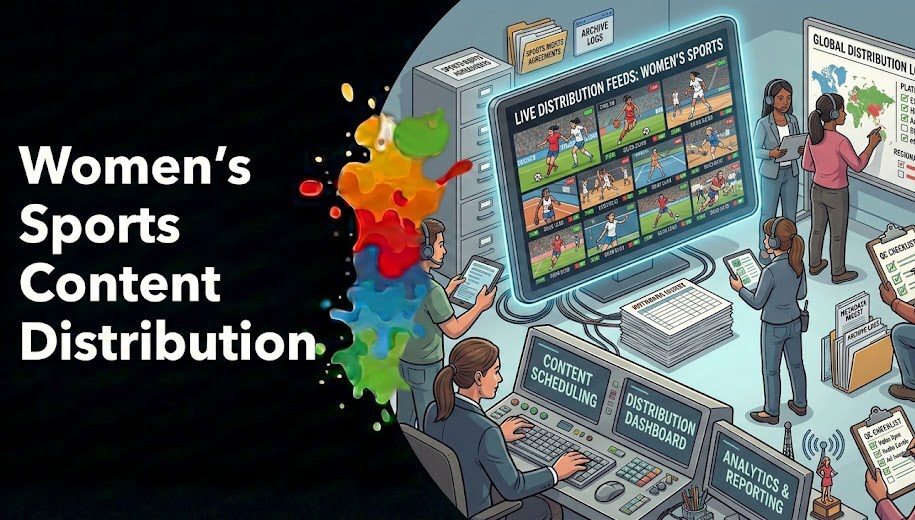
Here’s the thing nobody at your last market was saying out loud: women’s sports content distribution has quietly become one of the most competitive rights acquisition categories in global media—and if you’re still treating it as a niche add-on, you’re leaving serious money on the table.
The WNBA just signed an 11-year, $2.2 billion media rights deal split across Amazon Prime Video, NBC Sports, and Ion. The NWSL locked in a 10-year partnership with Apple TV+. And the FIFA Women’s World Cup 2023 drew over 2 billion viewers across platforms worldwide.
But none of that automatically helps you close your next deal. Because there’s a distribution fragmentation problem that almost nobody is talking about—and it’s costing producers and rights holders 15–20% in margin leakage before they even get to a negotiating table.
This guide gives you the strategic framework to fix that. You’ll learn which platforms are actively buying, how to structure deals for maximum recoupment, and where global demand is spiking fastest in 2026.
In This Guide
- Why Women’s Sports Content Distribution Is Booming Right Now
- The $2.2 Billion Signal Every Distributor Needs to Read
- Which Platforms Are Actually Buying Right Now
- The Fragmentation Problem Killing Your Distribution Deals
- How to Structure Deals for Maximum Recoupment
- Weaponized Distribution: The Multi-Window Revenue Strategy
- Regional Demand Hotspots in 2026
- How to Find the Right Distribution Partner Fast
- Key Takeaways
- Frequently Asked Questions
Find the Right Distribution Partner in 48 Hours—Not 6 Months
Ask VIQI, Vitrina’s AI intelligence layer, to map active buyers for your specific genre, territory, and budget range. Trusted by Netflix, Warner Bros, and 140,000+ companies globally.
No credit card required. Instant intelligence, zero commitment.
Why Women’s Sports Content Distribution Is Booming Right Now
Let’s be direct. For most of the past two decades, women’s sports content was treated as charity programming—undervalued by buyers, under-resourced by producers, and consistently under-distributed. That era is over. And the executives who still think otherwise are getting outflanked by competitors who read the room earlier.
The Paris 2024 Olympics drove record digital viewership specifically for women’s events. Streaming platforms that ignored this category two years ago are now running competitive acquisition processes for women’s sports rights packages. The brands chasing this audience are putting serious budget behind their media buys—in ways that fundamentally change the revenue model for rights holders at every level of the supply chain.
But here’s the uncomfortable truth: despite all that momentum, women’s sports still captures roughly 5% of total sports media coverage, according to research commissioned by Ally Financial and conducted by Nielsen. That gap—between audience appetite and media investment—is exactly where the opportunity lives for content distributors who move first. It’s not a problem. It’s a market inefficiency you can exploit.
The platforms buying women’s sports content today aren’t doing it out of goodwill. They’re doing it because the ROI case is finally undeniable. Engagement metrics on women’s sports content—particularly across social and digital platforms—consistently outperform equivalent men’s sports programming at a fraction of the rights acquisition cost. That’s a capital allocation decision, full stop. And smart operators are making it.
As we covered in our guide to top sports production companies, the production side of women’s sports is scaling rapidly to meet demand. Distribution is now the bottleneck—and it’s one you can solve with the right intelligence.

Your AI Assistant, Agent, and Analyst for the Business of Entertainment
VIQI AI helps you plan content acquisitions, raise production financing, and find and connect with the right partners worldwide.
- Find active co-producers and financiers for scripted projects
- Find equity and gap financing companies in North America
- Find top film financiers in Europe
- Find production houses that can co-produce or finance unscripted series
- I am looking for production partners for a YA drama set in Brazil
- I am looking for producers with proven track record in mid-budget features
- I am looking for Turkish distributors with successful international sales
- I am looking for OTT platforms actively acquiring finished series for the LATAM region
- I am seeking localization companies offer subtitling services in multiple Asian languages
- I am seeking partners in animation production for children's content
- I am seeking USA based post-production companies with sound facilities
- I am seeking VFX partners to composite background images and AI generated content
- Show me recent drama projects available for pre-buy
- Show me Japanese Anime Distributors
- Show me true-crime buyers from Asia
- Show me documentary pre-buyers
- List the top commissioners at the BBC
- List the post-production and VFX decision-makers at Netflix
- List the development leaders at Sony Pictures
- List the scripted programming heads at HBO
- Who is backing animation projects in Europe right now
- Who is Netflix’s top production partners for Sports Docs
- Who is Commissioning factual content in the NORDICS
- Who is acquiring unscripted formats for the North American market
The $2.2 Billion Signal Every Distributor Needs to Read
The WNBA’s 11-year, $2.2 billion media rights deal—split between Amazon Prime Video, NBC Sports, and Ion—isn’t just a milestone for basketball. It’s a signal about where the entire women’s sports content market is heading. As Deadline reported, this deal represented a rights valuation increase of more than 300% over the previous agreement cycle. That’s not incremental growth—that’s a full revaluation event for an entire content category.
And it didn’t happen in isolation. The NWSL’s partnership with Apple TV+—spanning 10 years and valued at approximately $240 million—established streaming-first as a legitimate go-to-market model for women’s sports leagues. Apple didn’t buy NWSL rights because they were cheap. They bought them because exclusive sports content drives subscription retention in ways that scripted programming simply doesn’t.
But what most distributors miss: these headline deals filter down. When a league signs a major streaming deal, it creates downstream demand for documentary content, behind-the-scenes programming, athlete narrative series, and archival rights packages. That’s where independent producers and smaller rights holders have real opportunity—if they know which doors to knock on and in what order.
Andrea Scarso, Managing Director at IPR VC, noted in his Vitrina LeaderSpeak interview that one of his firm’s key strategic partnerships—with Red Bull Studios—specifically focuses on “sports and sports adjacent stories in the documentary space.” That’s not a coincidence. Sports documentary content sits at the intersection of audience demand and manageable production budgets, making it an attractive entry point for distributors who can’t compete on live rights but can own the adjacent storytelling around them.
Variety has tracked consistent growth in international acquisition interest for women’s sports content, with European broadcasters, APAC streaming platforms, and MENA regional players all expanding their women’s sports content budgets through 2024 and into 2026. The money is moving. The question is whether your distribution strategy is positioned to capture it.
Which Platforms Are Actually Buying Women’s Sports Content Right Now
Not every platform with a sports strategy is buying women’s sports content—and knowing the difference before you pitch is what separates efficient deal flow from six-month wild goose chases. Here’s the honest breakdown of who’s actively in market and what they actually want.
Streaming-First Buyers
Amazon Prime Video is all-in. Their WNBA investment signals a broader women’s sports strategy, and their acquisition team is actively evaluating women’s sports documentary content that complements their live rights portfolio. But don’t mistake scale for slow-moving. Amazon moves fast—your window to get in front of the right decision-maker closes faster than you think.
Apple TV+ is selectively acquisitive. The NWSL deal shows their appetite, but Apple acquires based on prestige positioning—they want content that elevates the platform’s brand identity, not just fills programming hours. If your women’s sports content isn’t driving a compelling narrative arc, don’t waste a cold pitch. Come in with data on audience engagement and a clear editorial vision.
Netflix remains a calculated buyer. Their pattern is consistent: they greenlight women’s sports content when there’s a compelling athlete narrative attached—documentary series style, not straight highlights coverage. Their track record with tennis and motorsport programming shows exactly the storytelling format they want layered onto sports rights packages. Know their template before you walk in.
DAZN and Sports-Specialist Platforms
DAZN has built an international sports streaming footprint specifically designed around rights packages that don’t make economic sense for broadcast incumbents. Our analysis of DAZN’s content acquisition strategy shows their willingness to build programming around underserved sports audiences—and women’s athletics fits squarely in that mandate.
The tricky part? DAZN’s market presence varies dramatically by territory. What they’re buying in Germany looks very different from their strategy in Japan or Mexico. Territory-by-territory intelligence isn’t optional when planning a DAZN pitch—it’s the baseline you need before you even pick up the phone.
Broadcast and Regional Players
Traditional broadcasters—BBC, Sky Sports, NBC Sports—are still actively acquiring, but they’re increasingly pairing live rights with documentary and extended programming packages. If you’re approaching broadcast, bundle your content intelligently. A standalone documentary pitch rarely makes it past the initial filter; a programming bundle that solves a scheduling problem does.
Regional players are a different conversation entirely. Rolla Karam, Head of Programming at OSN (with a WBD content partnership), was candid in her Vitrina LeaderSpeak interview: sports content is “a beast by itself—it requires a massive, massive budget” and demands a coherent “big offering” to justify the distribution infrastructure. That’s an important signal for how mid-tier regional buyers are thinking. They want documentary and narrative entry points—not one-off rights packages they can’t build around.
Track 140,000+ Active Buyers — Get 200 Free Credits
Stop guessing which platforms are actively acquiring women’s sports content. Vitrina’s real-time intelligence maps verified buyers across 140,000+ companies globally—filtered by content type, territory, and budget. Join producers from Netflix, Warner Bros, and Paramount who’ve already made the switch from relationship-only deal-making.
Get 200 Free Credits — No Credit Card Required
Start tracking women’s sports buyers in minutes. Cancel anytime.
The Fragmentation Problem Killing Your Distribution Deals
Here’s what the trades won’t tell you directly: the biggest reason women’s sports content distribution deals fall apart—or never get off the ground—isn’t lack of buyer interest. It’s the Fragmentation Paradox.
Over 600,000 companies operate in the global film and TV ecosystem. More than 140,000 are actively producing or acquiring content right now. But most producers and distributors operate with verified knowledge of maybe 10–20 partners—built over years of festival circuits and market relationships. That’s an information deficit with a very real financial cost: 15–20% margin leakage on most deals, according to Vitrina’s supply chain intelligence data.
You’re paying inflated rates to intermediaries because you don’t have pricing benchmarks. You’re settling for suboptimal distribution partners because you don’t know who else is in market. And you’re losing 3–6 months on deals that should close in weeks—because your verification process runs on relationship networks rather than real-time intelligence. That’s not a minor inefficiency. At scale across a $10M production budget, it’s hundreds of thousands in direct margin erosion.
In women’s sports content distribution specifically, this fragmentation problem is amplified by the speed of market evolution. Platforms that weren’t buying six months ago are now competitive acquirers. New regional buyers are entering markets you’ve never pitched. Existing partners are shifting appetite from live-adjacent content to narrative-driven programming—and you might not know it until after you’ve spent six weeks on a pitch that was dead on arrival.
This is exactly the intelligence problem that Vitrina’s Smart Pairing infrastructure is built to solve—mapping real-time buyer appetite across verified company profiles so your distribution strategy is built on current data, not outdated relationships. Our deeper guide to streaming content acquisition strategies breaks down how data-driven distribution outperforms the relationship-only approach in both deal velocity and deal quality.
How to Structure Women’s Sports Distribution Deals for Maximum Recoupment
Deal structure in women’s sports content distribution isn’t one-size-fits-all. It never was. But the shift toward streaming has introduced new structural patterns that rights holders need to understand before they walk into any acquisition conversation—because the decisions made at signing determine your entire recoupment trajectory.
MG vs. Revenue Share: Know Which Fight to Pick
Streaming platforms default toward flat MG (minimum guarantee) structures—they pay a fixed license fee and retain all downstream revenue upside. For established women’s sports properties with proven audience data, you should be fighting hard for backend revenue participation. Especially on subscription platforms where your content drives subscriber acquisition, the downstream value gap between an MG-only deal and a hybrid structure can be enormous over a multi-year license window.
But that negotiation leverage only exists if you walk in with audience analytics. Engagement data from prior distribution windows—social metrics, digital viewership numbers, VOD performance—are your most powerful negotiating tools. CFOs at streaming platforms absolutely use them to model recoupment projections. Don’t discount them as “soft” data. They’re the hard currency of this negotiation.
Territory Carve-Outs: Don’t Sell Everything at Once
This is one of the most common—and most costly—mistakes in women’s sports content distribution. A global deal sounds clean. But selling worldwide rights to a single platform at this stage of the category’s growth means leaving regional upside on the table that you can never recapture.
The smarter approach: retain territory rights in markets where local demand is developing independently. MENA, APAC, and specific European markets are building women’s sports content appetite at different rates—and at price points that improve your overall deal economics when carved out and sold separately. The capital stack looks very different when you’re running a coordinated multi-territory rights campaign vs. a single global deal.
Windowing Strategy: Protect Your Recoupment Timeline
Live sports rights and documentary content have very different windowing economics. For women’s sports documentary and narrative programming, a properly sequenced strategy—festival or theatrical premium, SVOD, AVOD, free-to-air, and finally library licensing—accelerates recoupment while protecting asset value at each stage. Don’t collapse your windows under platform pressure. Especially when a platform is asking for exclusive rights without actually paying an exclusivity premium.
Get Your Distribution Strategy Reviewed by a Vitrina Concierge Expert
Our Vitrina Concierge team works directly with producers and rights holders to identify the right buyers, optimize deal structure, and protect your recoupment timeline. Netflix UK in 48 hours—that’s the kind of result we help create.
Book a Concierge Strategy Session
No commitment required. Discuss your content’s distribution potential with a specialist.
Weaponized Distribution: The Multi-Window Revenue Strategy
The most sophisticated distributors in women’s sports content aren’t selling their IP once and calling it done. They’re using weaponized distribution—strategically licensing the same content across competing platforms and sequential windows to maximize ROI and accelerate recoupment across the full capital stack.
Think about what Warner Bros Discovery demonstrated with their Netflix co-opetition model. They licensed premium HBO content to a direct competitor—using owned IP as a financial instrument rather than a platform-exclusive asset. The same logic applies to women’s sports content, particularly documentary and narrative IP that doesn’t depreciate after a single platform window.
Your women’s sports docuseries doesn’t have to live exclusively on one platform. It can open on a prestige SVOD with first-window rights—generating the credibility and award consideration that elevates its licensing value in secondary windows. Then move to a broader streaming platform. Then free-to-air. Then international territory deals in markets your primary distributor never covered. Each stage extracts incremental value from the same underlying IP investment.
But. Weaponized distribution only works if you’ve structured your rights agreements correctly from day one. Non-exclusive windows, territorial holdbacks, and clearly defined reversion clauses—these aren’t legal niceties. They’re the financial architecture that determines whether your content generates one revenue event or four. Get them right before you sign anything.
And this is where the Fragmentation Paradox gets acute again. If you don’t know who the secondary and tertiary buyers are—in each territory, by content type, with verified acquisition budgets—your weaponized distribution strategy is just a theory. It needs market intelligence to execute. Our analysis of sports documentary distribution strategy shows exactly how multi-window planning plays out across different content categories and budget levels.
Regional Demand Hotspots in 2026
Regional demand for women’s sports content isn’t uniform—and treating it as if it were is one of the fastest ways to under-monetize your IP. Here’s where the acquisition heat is concentrated right now, and what it means for your distribution sequencing.
North America: Still the Premium Market
The US and Canada remain the highest-value territory for women’s sports content distribution rights—driven by WNBA, NWSL, NCAA, and growing commercial brand investment behind women’s athletics. But rights in this market are getting more competitive and more expensive. If you’re entering as an independent rights holder, your best leverage is narrative content and documentary programming that complements existing live rights deals rather than competing with them directly.
Europe: Multi-Language, Multi-Buyer Complexity
The UK market—anchored by BBC, Sky Sports, and Amazon Prime Video UK—is actively acquiring women’s sports content across live rights, documentary, and short-form programming categories. Germany, France, and the Nordic markets are each developing independent acquisition programs with their own content preferences and budget cycles.
The complexity? Each European market has different language requirements, acquisition timelines, and regulatory factors affecting what gets commissioned vs. acquired. A territory-by-territory approach here isn’t optional—it’s the only strategy that captures the full regional value without leaving territory-specific upside on the table.
APAC: High Potential, Sovereign Hub Dynamics
Japan, South Korea, and Australia are all seeing meaningful growth in women’s sports viewership—driven partly by Olympic programming performance and partly by domestic league development. But APAC’s Sovereign Hub dynamics mean you need real-time intelligence on which platforms are commissioning vs. acquiring, and what content formats are actually driving subscription decisions in each market. One-size-fits-all pitches don’t make it past the first filter here.
MENA: An Emerging Market with Real Budget
The MENA region’s appetite for women’s sports content is more nuanced than it first appears. As Rolla Karam of OSN described directly, major regional buyers are making deliberate strategic choices about sports content investment—the budget requirements are significant, and they need content that fits a coherent platform narrative, not one-off acquisitions they can’t build audience around. Women’s sports documentary content—particularly international tournament coverage and athlete narrative series—is finding traction as a lower-infrastructure entry point into regional sports programming strategies. Watch this space closely through 2026.
How to Find the Right Distribution Partner Fast
You’ve got the content. You’ve got a distribution strategy. Now: how do you actually get in front of the right buyers—without burning six months and half your P&A budget on market trips that produce warm handshakes but no term sheets?
The traditional answer—go to MIP, Cannes, AFM, and work the room—still has value. Don’t throw it out. But it’s an incredibly inefficient way to identify acquisition-active buyers for a specific content category in a specific territory at a specific budget level. The intel you collect at a market is necessarily 6–12 weeks old by the time you act on it. And the buyers you don’t have prior relationships with? Getting a serious meeting without an introduction is harder than ever.
That’s the Insider Advantage that Vitrina is built to deliver at scale. Instead of 3 verified buyer contacts built over years of festival attendance, you’re working from a verified database of 140,000+ active companies—filtered by acquisition appetite, content category, territory focus, and current budget activity. Real-time deal flow intelligence. Not static company profiles updated once a year before a market.
The practical result: producers who’ve leveraged Vitrina’s Smart Pairing intelligence have connected with Netflix UK in under 48 hours for content that would have taken months of traditional outreach. That’s the compression of a historically inefficient process through verified real-time data—and it changes the economics of your entire distribution operation. De-risking your deal flow starts with knowing the market better than your competitors. Not just the 10 buyers you’ve met before. The entire active acquisition landscape.
Key Takeaways
Women’s sports content distribution is no longer a niche strategy—it’s one of the most compelling acquisition categories in global media right now. But capturing that value requires operational precision, not just strong content. Here’s what you need to act on immediately:
- The market signal is unambiguous: The WNBA’s $2.2B deal and NWSL’s Apple TV+ partnership prove that women’s sports content has fully crossed into premium territory. Buyer interest is real—and expanding globally across every distribution window.
- Know your buyers before you pitch: Amazon, Apple TV+, Netflix, and DAZN each have distinct acquisition criteria requiring tailored approaches. Generic pitches waste time and burn relationships you’ll need later.
- Fragmentation is costing you 15–20% margin: The information asymmetry problem is fixable. Real-time intelligence platforms close the gap between what you know and what’s actually happening in the market right now.
- Structure deals to protect recoupment: Territory carve-outs, windowing strategies, and MG vs. revenue share structures determine your total ROI—not just the headline deal number. Get these right before you sign anything.
- Weaponize your distribution across windows: Multi-platform, multi-window licensing—executed in the right sequence—generates 3–4× the revenue of a single-platform exclusive deal. But it requires smart rights architecture and real market intelligence to execute properly.
Frequently Asked Questions About Women’s Sports Content Distribution
Start Distributing Smarter—Today
Vitrina gives you verified intelligence on 140,000+ active buyers globally—so your women’s sports content reaches the right platform, in the right territory, at the right time. Trusted by teams at Netflix, Warner Bros, Paramount, and Google TV.
Get 200 Free Credits — Start Now
No credit card required. 200 free credits, cancel anytime.
Find Film+TV Projects, Partners, and Deals – Fast.
VIQI matches you with the right financiers, producers, streamers, and buyers – globally.
Producers Seeking Financing, Co-Pros, or Pre-Buys?
Vitrina Concierge helps producers reach the right financiers, commissioners, distributors, and co-production partners — with precision outreach, not cold pitching.
Join Industry Briefings Trusted by Leaders

Format Adaptations: Global Trends
Where formats are traveling, which adaptations are breaking out, and how streamers are backing remakes in 2025–2026.

Books, Novels & Comics Adaptations: Global Trends
Books, webtoons, and manga driving the next global screen hits. Discover how in this webinar.

Micro-Dramas & Mobile-First Storytelling
Micro-dramas are building real audiences and revenue. Understand the platforms, buyers, and economics behind the growth.

Navigating Global Content Licensing Trends
How global content licensing is shifting beyond flat fees to flexible, deal-driven models.