

 About Innovation Hub
 Global Content Pulse (Webinars)


 Global Production Financing
(Webinars)
Global Production Financing
(Webinars)  LeaderSpeak Podcast
  Global Entertainment Digest (Newsletter)
  About Vitrina
 About VIQI
 Our Story
 Our Solutions 🔥
 Film+TV Projects Tracker 🚀
 Case Studies
 Our Profile
The Academy Awards will leave linear television in 2029, moving to YouTube in a landmark shift that signals the end of broadcast dominance for premium live events.
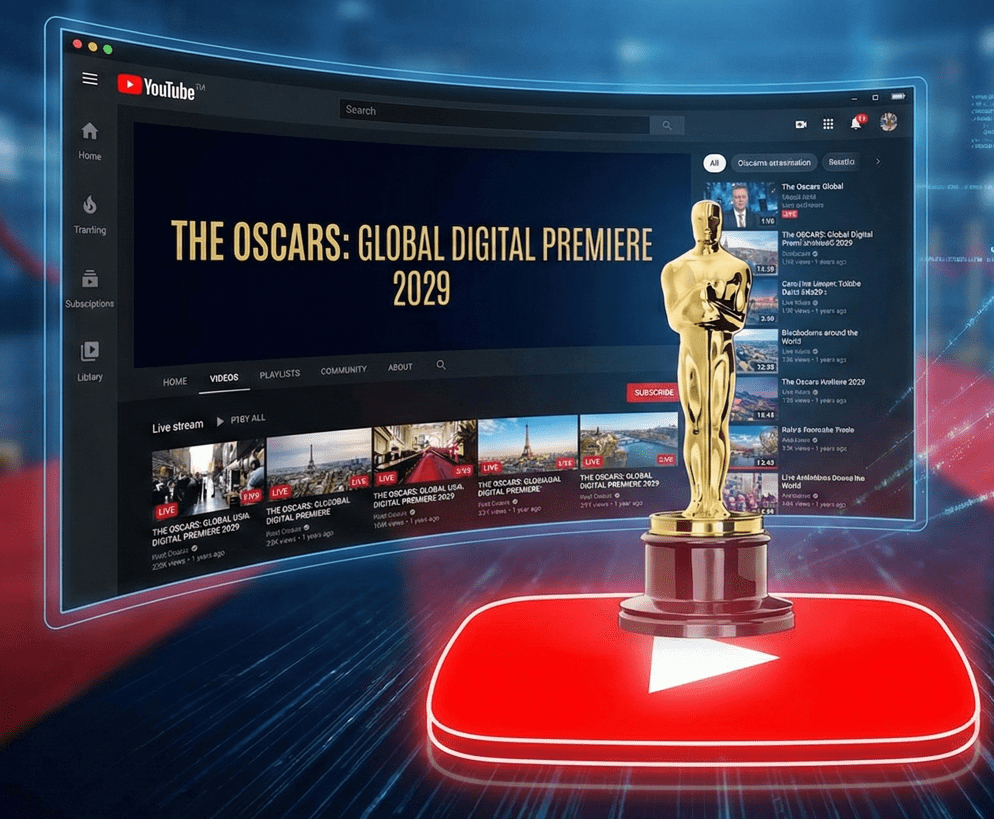
Deal Overview
The Academy of Motion Picture Arts and Sciences has orchestrated a paradigm shift for its flagship event: starting in 2029, the Oscars will bypass traditional fragmented broadcast networks to live on YouTube as a single, globally unified digital event. This five-year partnership (2029–2033) transforms the ceremony from a linear television broadcast into a “direct-to-planet” interactive experience. The deal consolidates global rights onto one platform, effectively turning the Oscars into the world’s largest simultaneous live stream, accessible to over 2 billion logged-in users.
Parties & Dealmakers
The Academy: CEO Bill Kramer and President Lynette Howell Taylor are leading the transition from a legacy broadcaster model to a tech-native future. YouTube (Alphabet): CEO Neal Mohan is positioning the platform not just as a distributor, but as an innovation partner. The deal integrates the broader Alphabet stack, bringing Google Arts & Culture into the fold to digitize and curate Academy archives for year-round engagement.
Concept Innovation
The “Borderless” Broadcast This partnership introduces a supply chain innovation: Real-Time Localization. Unlike the legacy model, where international feeds relied on local broadcasters for translation, YouTube will leverage its automated and AI-driven multi-language audio tracks. This allows a viewer in Tokyo, São Paulo, or Mumbai to experience the event simultaneously with customized audio, removing language as a barrier to entry. Furthermore, the deal integrates “Creator Mode” logic—moving away from a single directed feed to potentially allow for creator-led co-streams and alternative viewing angles, mirroring how Gen Z consumes live gaming and sports.
Supply-Chain Impact
The operational focus shifts from Regional Licensing to Centralized Cloud Distribution. By eliminating hundreds of local broadcast intermediaries, the Academy simplifies its delivery chain into a single, robust digital feed. This centralization allows for instant global ad deployment and data harvesting. It also opens the door for “click-to-purchase” integrations (merch, cinema tickets, or digital collectibles) directly within the video player—capability linear TV never possessed.
Vitrina Perspective
The innovation here isn’t the streaming itself; it is the Year-Round Ecosystem. The Academy is finally breaking the “one night a year” curse. By utilizing Google Arts & Culture to digitize 52 million archival items (costumes, scripts, photos), they are building a persistent digital museum that feeds the main event. This moves the Oscars from a television show to a content vertical, keeping the IP relevant 365 days a year through educational hubs, shorts, and archival deep dives.
Find Film+TV Projects, Partners, and Deals – Fast.
VIQI matches you with the right financiers, producers, streamers, and buyers – globally.
Join Industry Briefings Trusted by Leaders

The New Deal Room: A 2026 Playbook for Global Content Licensing
How global content licensing is shifting beyond flat fees to flexible, deal-driven models.
Film & TV Production Financing: 2026 Trends
Production financing conditions are changing quickly. Understanding where money is moving and what buyers are backing is key to getting projects approved and funded in 2026.
Unreleased Film+TV Projects: Opportunities & Showcase
A curated view of unreleased Film and TV projects open for financing and collaboration
The Mid-Budget Comeback: Why Mid-Budget Films Is the Smartest Bet in the Room
Mid-budget films are attracting new capital. See why this segment is becoming one of the strongest bets in Film today.
