May 2025: Growth in Americas & EMEA Boosts Global Productions
May 2025 saw an upswing in global TV and film production, with both new project commissions and season renewals rising across most major regions. The Americas and EMEA led the growth, with broadcasters and global streamers like Netflix, Prime Video, BBC, and Channel 4 significantly ramping up activity.
- English-language content gained further prominence, continuing its lead across most markets.
- Formats remained the structure of choice, particularly among broadcasters.
- APAC reported a slight dip in overall volume, but continued to stay active with:
- Ongoing commissioning by Netflix
- Increased output in local languages like Hindi and Korean
- Genre trends showed subtle movement, with Comedy gaining traction globally.
Welcome to the latest edition of Vitrina’s global tracking of Film and TV production trends, providing insights across Movies and Feature Films, TV series, Animations, Documentaries, Scripted, and Unscripted projects.
Before we dive into May 2025 metrics, let’s recap the key Film and TV production trends driving the industry over the last 3 years & 4 months.
The Global Monthly Film + TV Production Report is curated by Vitrina experts with insights from our network. The audio podcast was generated with Deep Dive and reviewed by our team.
Global Film & TV Production: Updated for May-2025
![Vitrina Film+TV Production Insider [May 2025] 43 unnamed (17)](https://vitrina.ai/wp-content/uploads/2025/06/unnamed-17.png)
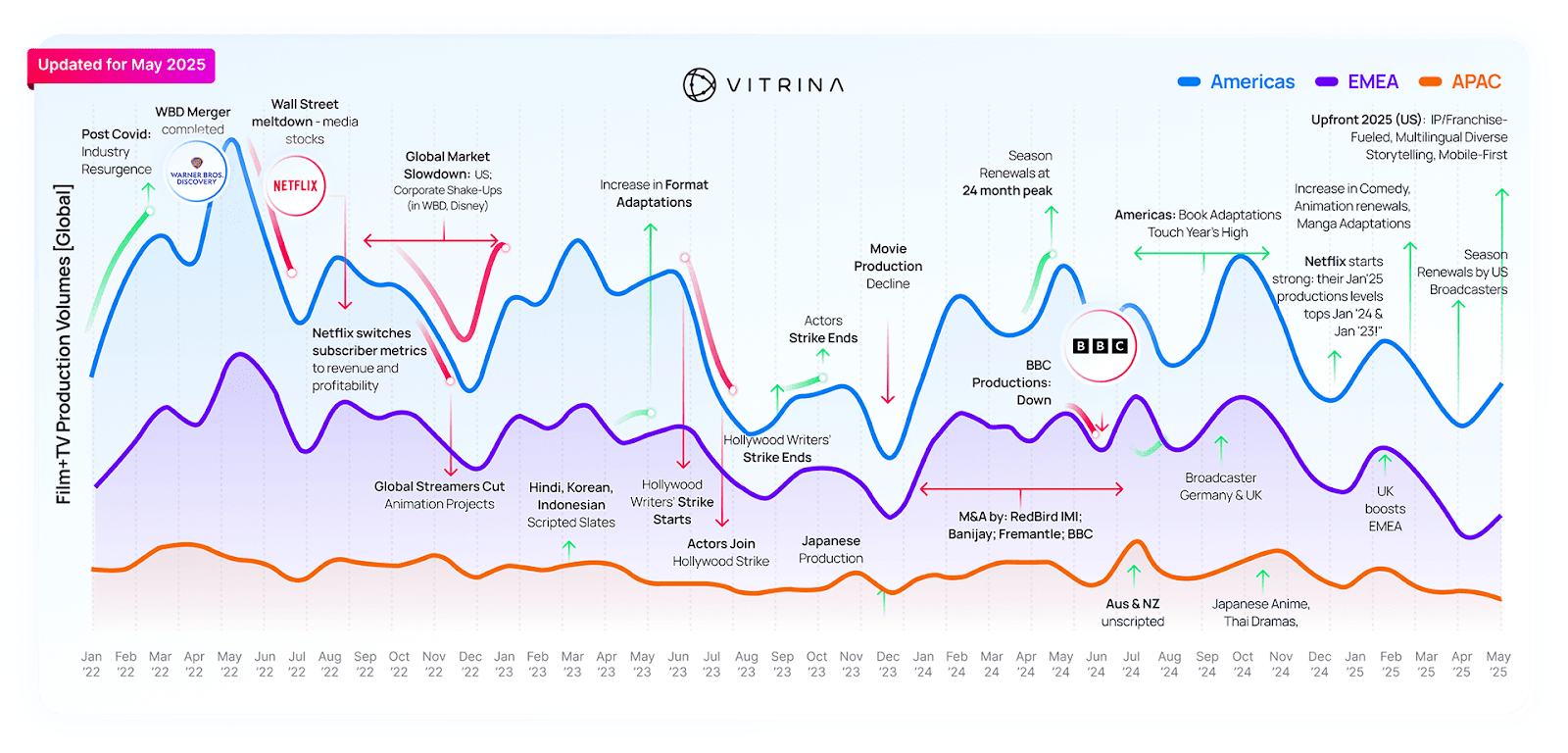
Source: Vitrina Daily Production Tracker. [X-Axis : Months starting from Jan 2021. Y-Axis Production Volumes : Production Volumes are the total number of projects greenlit or financed or commissioned in that month.
As is evident from the monthly trends monitored by Vitrina globally for Film+TV Productions that were commissioned, greenlit or financed – the last 3 years have been turbulent and eventful – to say the least! A quick summarized view would be:
2022: A year of extremes—an early-year “revenge production financing” surge fueled by post-COVID recoveries, followed by a sharp market correction on Wall Street’s market-cap reset for entertainment companies, leading to widespread budget tightening.
2023: Marked by Hollywood strikes, which froze scripted productions in the US & UK, forcing many studios to pivot toward unscripted content and international markets to keep productions moving.
2024: A year of stabilization with no major peaks, but regional surprises—Japan, ANZ, Germany, and Brazil saw production spikes, while broadcasters continued scaling back commissioning amid shifting business models.
Jan -May 2025 : From Jan’25 to May’25, Netflix led the global commissioning activity, well ahead of Prime Video, BBC, Channel 4, and Fox. Season Renewals and Book adaptations showed steady month-on-month growth during this period, both peaking in May. Broadcaster commissioning climbed until March, dipped in April, and began recovering in May’25, though overall production orders remained below the same period last year. German-language productions rose notably in Q1, with the top commissioning countries between this year being the USA, UK, India, Germany, Canada, and France.
Insights on Production Transaction Volumes
May’ 25 vs. April’ 25
Methodology: Vitrina monitors projects worldwide across all stages of the content lifecycle—development, production, post-production, and release—on a daily basis. We track various transactions and deal activities related to content financing, commissioning, co-productions, green-lighting, as well as early stage (content development) and late stage (licensing). These transactions between production houses, distributors, streamers, and broadcasters enable us to gain valuable insights into industry trends, key players, buyer behavior, and the specializations of production companies. Our monthly Film+TV productions chart serves as a bellwether of production financing and industry health.
Below are the key highlights for May Film+TV Production Volumes:
- Global Production Trends: Global productions grew by 20% in May ’25 compared to April. EMEA and the Americas reported strong gains, with increases of 29% and 34%, respectively. APAC saw a slight decline, but the overall impact was not significant due to its smaller production base. The month also saw a modest rise in both book adaptations and co-productions. The growth was largely driven by U.S.-based players, with global U.S. platforms actively commissioning new projects across the EMEA region as well.
- Genre and Language Trends: In May ’25, English-language productions saw a rise, driven by increased commissioning from U.S.-based companies, while Spanish and French content remained steady. Drama and Comedy continued to lead as the top genres, consistent with the previous month. The overall balance between scripted and unscripted content remained stable.
- Top Players Overall: Netflix continued to dominate the production landscape in May ’25, increasing its production announcements from April. Prime Video, BBC, Channel 4, ZDF, and ARD also retained their top-tier positions, each with higher commissioning volumes than the previous month. New entrants to the top 10 this month include Bravo, Apple TV+, and Allen Media Group, reflecting a broader expansion in activity. Fox Network remained among the top 10 platforms like previous month.
- Within AMERICAS: Americas saw a rise in overall and new productions in May ’25. Netflix, Prime Video, Bravo, Apple TV+, NBC, Peacock, Fox Network were key drivers of this growth. Language contributions remained largely consistent, with English continuing to dominate and Spanish and Portuguese holding steady.
Major players like NBCUniversal, TelevisaUnivision, Disney, Netflix, Amazon, and Warner Bros. Discovery and YouTube held Upfront 2025 presentations in May 2025, showcasing their 2025-26 content slates and advertising strategies. Apart from sports, there was a focus on unscripted content by global streamers; Disney and NBCUniversal leaned into star-driven projects and proven IP, mobile-friendly formats; while TelevisaUnivision announced multiple scripted micro-dramas. - Within EMEA: Productions increased in May ’25, with broadcasters taking on a more central role in commissioning. BBC, Netflix, Channel 4, ARD, ZDF, and UKTV were among the key players expanding their output. A rise in activity from UK-based companies and global U.S. platforms contributed to an increase in English-language productions.
- Within APAC: While overall production volume in APAC saw a slight dip in May ’25, the region still witnessed production activity from key players. Netflix ramped up its regional commissioning efforts, and Korean-language productions gained traction. Scripted content further solidified its lead, highlighting APAC’s continued focus on high-quality, narrative-driven programming.
Stay ahead of the competition by tracking the latest production trends and market moves.
Global Entertainment Leaders Speak
Dhar Mann Studios on The New Economics of Digital Studio Businesses
![Vitrina Film+TV Production Insider [May 2025] 44 Group 2600](https://vitrina.ai/wp-content/uploads/2025/06/Group-2600.png)
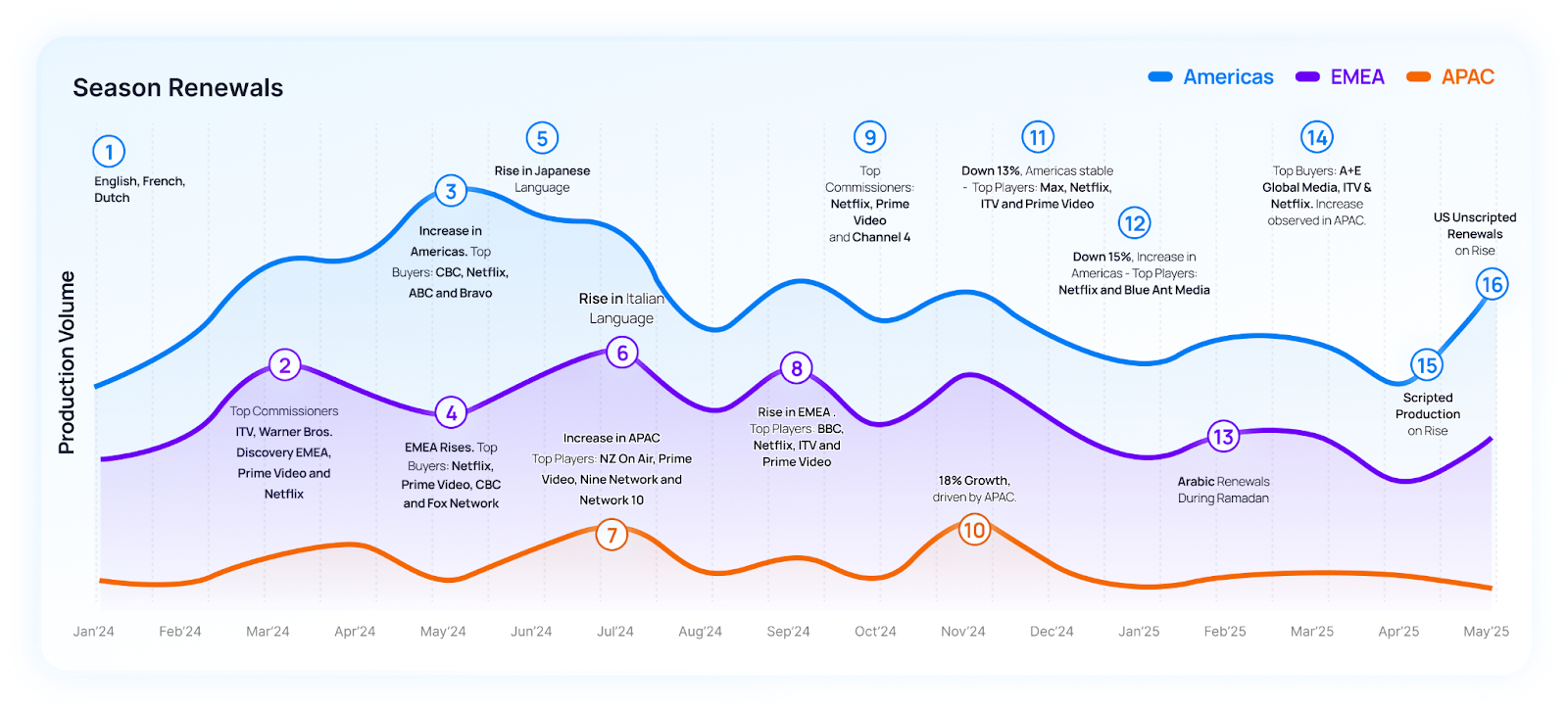
May 2025 Season Renewals: Shifting Dynamics Across Regions
Season renewals (TV Series, Formats, Animation Series, Docuseries) have been a cornerstone for both streamers and broadcasters, offering a reliable strategy for sustaining viewer engagement and ensuring operational stability across production and post-production. By securing ongoing content pipelines, renewals help streamline workflows, optimize resource allocation, and minimize the risks associated with launching entirely new projects. This continuity not only strengthens audience loyalty but also enhances efficiency across the entire content supply chain.
![Vitrina Film+TV Production Insider [May 2025] 45 unnamed (18)](https://vitrina.ai/wp-content/uploads/2025/06/unnamed-18.png)
Source: Vitrina Daily Production Tracker
Regional Insights – May 2025
Americas:
-
Season renewals surged in May, fueled by increased commissioning from top platforms including Netflix, Prime Video, NBC, Bravo, and Fox Network.
-
Language distribution stayed consistent, with English continuing to dominate and Spanish and Portuguese holding steady.
-
Genre rankings shifted slightly, with Drama and Reality rising to the top.
Notable season renewals in May ’25 included:
-
- The Floor (Fox Network) – Extended for Seasons 2 through 5 in partnership with Talpa Studios and Eureka Productions
- Bridgerton (Netflix) – Renewed for Seasons 5 and 6 with Shondaland and CVD Productions
- Chicago Med (NBC) – Renewed for Season 11 under Universal Television and Wolf Entertainment
EMEA:
-
Season renewals in EMEA saw strong momentum in May, doubling from the previous month.
-
Broadcasters were the primary drivers, supported by renewed activity from Netflix, Prime Video, and regional players.
-
English-language content saw a substantial uptick, while French-language content held steady.
-
Genre preferences remained stable, with Drama, Comedy, and Reality maintaining their lead.
-
The balance between scripted and unscripted content showed little change.
Notable renewals included:
-
- Vienna Crime Squad – Renewed for its 21st season by ORF and ZDF, produced by Satel Film
- Piglets – Renewed for Season 2 by ITV with Monicker Pictures and ITV Studios
- Doktor Ballouz – Greenlit for Season 4 by ZDF
- Gangs of London – Renewed for Season 4 by AMC+ and Sky, with Pulse Films and Sky Studios leading production
APAC:
-
APAC remained the lowest contributor to global season renewals, continuing a downward trend in May.
-
The decline was primarily driven by reduced activity from ANZ-based players, which also led to a shift away from English-language content.
-
In contrast, there was a rise in Hindi-language commissions.
-
Scripted formats gained significant ground, while unscripted content saw a sharp drop.
-
Drama emerged as the top genre, with Sci-Fi & Fantasy and Comedy also gaining traction.
Key renewals in APAC included:
-
-
Black Warrant (India) and Love on the Spectrum (Australia) – Netflix
-
Reborn Rich (Korea) – JTBC
-
AYAKA is in LOVE with HIROKO (Japan) – Season 2, MBS
-

Monitor season renewals and adjust your strategy with live insights.
Most Active Film Commissions in the Past 3 Months
Film commissions have become increasingly strategic players in the entertainment industry, stepping up efforts to attract productions, nurture local talent, and secure investments across filming, production, post-production, and animation. Their proactive initiatives have fueled regional economic growth, strengthened creative ecosystems, and fostered high-impact industry collaborations.
Several film commissions—along with national entertainment bodies and ministries of culture, communication, and commerce—have intensified their activities to support production. Governments worldwide are deploying aggressive measures to drive employment, support early-stage projects, and empower emerging content creators. To remain competitive and attract international productions, they have revamped tax incentive structures, introduced cash grants, expanded cashback schemes, and rolled out new tax breaks. Additionally, major trade events and strategic partnerships have been leveraged to position their markets as premier global production hubs.
Curious how Vitrina can help you? Try it out today!
Financing by Industry Bodies – May’25
In May 2025, several leading film commissions and associations globally financed early-stage projects:
-
Screen Australia supported over 15 English-language dramas, comedies, and kids’ series—including A Model Family, Junk Castle, and How to Human—often in partnership with Causeway Films, Photoplay Films, and Ludo Studio.
-
The Polish Film Institute backed titles like Dwie Dusze and Fatherland, and co-funded All the Boys Are Here with Screen Australia, supporting multilingual projects in Polish, English, German, and French.
-
Germany’s DFFF and FFF Bayern focused on local dramas and comedies such as Krux and Nichtsnutze, while co-financing the cross-border project Any Other Night with partners from the Netherlands and U.S.
-
Spain’s ICAA funded Spanish-language dramas and comedies with regional collaborators, while Russia’s Ministry of Culture invested in family-oriented titles across Eastern Europe.
-
Northern Ireland Screen was active in animation and kids’ content, often co-financing with Irish partners.
Vitrina Spotlight: Projects in Production / Planned Stage
213 New Projects
Announced Last Week! – across production financing, greenlit and season renewals.
Quick Market Snapshot:
59% Scripted, 41% UnScripted | Reality, Comedy and Documentary leading the genre mix 36 new projects have been commissioned – majorly by Crave and CBC
Key languages: English, French, Spanish and German
Americas: 64% of announced projects were scripted, with TV series making up 63%. English, German, and French were the top languages, and drama, documentary, and comedy led in genres. Crave, Prime Video, and CBC drove major activity, with 14 development deals and 59 season renewals.
Explore More Projects [Americas]..
EMEA: 11 projects were announced, including production financing and renewals. Prime Video, ZDF, and industry bodies led the way. Top languages were English, Spanish, and German, with drama, documentary, and reality as key genres
Explore more EMEA Projects..
APAC: Announcements included financing and a partnership with a New Zealand Prod Co. Bengali, English, and Japanese topped the language list. Animation made up 19%, with the rest focused on drama and comedy. All projects were scripted, and 53% were films
Explore more APAC Projects..
How the Industry Uses Vitrina
Vitrina For VFX and Post Companies:
Vitrina is helping VFX companies like PhantomFX, Crafty Apes, and Light Iron discover and secure new Film & TV projects by tracking unreleased productions across development, production, and post. With deep intel on production companies, crew-heads, and decision-makers—plus direct contact details—VFX teams can reconnect with past collaborators, pitch at the right time, and expand their network of high-potential leads. It’s smart, targeted business development made easy.
Vitrina For Production Companies & Indies:
Vitrina empowers production companies and indie creators to find the right financing and commissioning partners—globally. From early-stage tracking of co-production-friendly projects to surfacing the latest deals and investment themes, Vitrina helps match projects with relevant financiers, commissioners, and collaborators. With up-to-date preferences and verified contacts, creators can focus on pitching to the right people—saving time and increasing chances of success.
Vitrina For Streamers:
Streamers use Vitrina to navigate the global content supply-chain with clarity. By tracking unreleased slates, mapping competitive activity, and identifying trending genres, formats, and territories, Vitrina equips content and strategy teams with the intel to make proactive moves—whether it’s preemptive pre-buys, co-production deals, or vendor discovery. With insights drawn from markets like LATAM, APAC, and Europe, Vitrina helps streamers stay ahead of content trends and competitors alike.

Get In Touch with Vitrina Today:
-
- Feature your company and content announcements: Email us at updates@vitrina.ai
- Request production trends or competitive intel reports: Contact us at sales@vitrina.ai
Frequently Ask Questions
Yes, Vitrina provides buyers with direct access to the contact information of vendors. Our platform includes verified leadership and key decision-makers within vendor companies, along with their mapped departments, specializations, and accessible contact details.
The Vendor Reputation Rating on Vitrina is a comprehensive metric that incorporates various factors critical to buyers’ assessments of vendors, service providers, and suppliers. This rating is used by buyers to evaluate vendors’ qualifications and capabilities in the M&E supply chain. Vitrina’s Reputation Rating system provides buyers with valuable insights into vendors’ size, parentage, past work, quality of projects/clients, recency, specializations, strengths, and other factors that may affect the vendor’s suitability for the buyer’s project.
Yes, Vitrina can assist you in finding and shortlisting the ideal partners for your project. Our Partner-Finder team is experienced in running vendor recruitment and screening mandates that are specific to your needs. We can help you find the best vendors for your business by identifying niche and specialist companies in new markets. We stay up-to-date with the latest developments in the M&E supply chain, allowing us to continually identify and qualify the most innovative vendors. Additionally, our extensive network of storefront owners updates their latest projects, capabilities, and certifications on our platform. These sellers are highly engaged and active on our platform, allowing us to connect buyers with vendors who are best suited to meet their requirements. By working with Vitrina, you can access the latest solutions and expertise in Animation, Localization, VFX, Stages, Virtual Production, and gaming engines. Contact us today to learn more about how Vitrina can help you find the right vendors and partners for your business.
Vitrina is a private and exclusive business network designed for dealmakers in the Media and Entertainment (M&E) industry. Members are carefully screened to ensure they meet the network’s high standards for professionalism and integrity, and the platform is not open to the public or to search engines. This ensures that all information shared is kept confidential and private. Vitrina takes the privacy and confidentiality of its members very seriously and provides a secure platform for members to share valuable information and insights with a select group of vetted and verified buyers and sellers.
Trusted by top entertainment companies to scout partners globally
Top companies love Vitrina

Podcast Chapters
| Time Stamp | Chapters |
| 00:00 | Introduction to Extreme Reach |
| 01:40 | Understanding the Business Model of Extreme Reach |
| 17:24 | Contextual Advertising and Targeting Strategies |
| 19:00 | Trends in Ad-Supported Solutions in Entertainment |
| 25:44 | Clientele and Market Reach |
| 31:10 | Future Growth and Roadmap |
| 32:30 | Partnership Opportunities and Collaborations |
| 35:00 | Outlook for 2026 |
Key Takeaways: Advertising Workflow Management, Global Ad Payments
- “Extreme Reach (XR) orchestrates global ad and marketing operations.”
- “The business is split into XR Pay (payments) and XR Ads (asset management).”
- “XR manages $100 billion in ad spending and $1.5 billion in payroll annually.”
- “AI will increase complexity and ad versioning, a positive trend for XR.”
- “XR is prioritizing investment in CTV and addressable TV for brand building.”

Sound Bites:
- “What Salesforce has done for chief revenue officers and for sales ops is sort of what we do for ad ops and marketing ops and CMOs.”
- “Brands really rightfully want to make sure that they’re represented in these mass media in the best possible way. And that’s what we do.”
- “I think that sort of the living room continues to be… the ground on which a lot of these sort of brands build awareness.”
- “We think that there’s more content and that’s more complexity and we get hired to manage complexity.”
- “There’s an XR ID which is unique for each piece of content that we have at XR Extreme Reach.”
Why Partner With XR Extreme Reach?
- Massive Global Coverage: Partnering grants access to XR’s platform operating in 140 markets and delivering to 50,000 endpoints worldwide.
- Simplified Ad Complexity: The platform is built to manage the growing complexity and sheer volume of AI-driven ad versions.
- Guaranteed Quality Control: Brands rely on XR for consistently high quality, ensuring the right, pristine ad runs at the right time.
- Comprehensive Payment Hub: XR offers a single solution for paying talent, crew, and vendors, streamlining production finance.
- Contextual Targeting Power: The unique XR ID and metadata enable more precise ad targeting against specific content moments.
In Conversation with John Batter, CEO at XR Extreme Reach
This is a written summary for the interview with John Batter, CEO of Extreme Reach (XR), for a quick-read Q&A format, highlighting key insights on advertising, entertainment, and technology. The following is an 8-question summary of the transcript.
1. Vitrina: What is the core business of Extreme Reach (XR), and how does it relate to managing advertising and marketing operations?
John Batter: XR is the leading platform for managing advertising and marketing operations. This means we help brands predominantly manage all aspects of their ad creative, all the way from talent payments at the very front end onto rights, and then the delivery of the actual ads themselves so that every ad lands exactly how and where it should. One way to frame it is that “What Salesforce has done for chief revenue officers and for sales ops is sort of what we do for ad ops and marketing ops and CMOs“.
“What Salesforce has done for chief revenue officers and for sales ops is sort of what we do for ad ops and marketing ops and CMOs.”
2. Vitrina: Can you break down the two main parts of Extreme Reach’s business, XR Pay and XR Ads, and describe the services offered?
John Batter: Our business breaks down into kind of two pieces: a payments part, which we call XR Pay, and an advertising piece, XR Ads. The payment side traditionally focuses on paying the talent in front of the camera in TV commercials, where we are the largest player in that in the US. We are also moving into crew payments (talent behind the camera), paying vendors and influencers, providing kind of a one-stop shop for brands taking production in-house to handle all payments. XR Ads focuses on our global ad database for managing all advertising assets on behalf of big, global brands. We offer a number of services ranging from transcoding and closed captioning to management of rights, helping brands ensure their ads get to the right servers in pristine condition.
“The payment side of our business is, traditionally been focused on paying the talent… We’re also sort of been moving into crew payments. So the talent behind the camera. And we’ve been doing more of that and then paying vendors and influencers, et cetera.”
3. Vitrina: What is Extreme Reach’s client base and global reach, and what groups do you verticalize around in the ad business?
John Batter: We’re in about 140 markets today and have about 10,000 total customers. We handle around $100 billion a year of ad spending that flows through our system and process about $1.5 billion of payroll every year in our payments business. I would say off the top of my head, 75 or 80% of the Fortune 500 advertisers are clients of ours. In the ad business, we service brands, work with their agencies, and work with publishers. Our largest market is the US, followed by major European markets (UK, Germany, France, Spain, Italy, Nordics), as well as some major Asian markets and a few of the big markets in Latin America, like Brazil.
“I would say off the top of my head, 75 or 80 % of the Fortune 500 advertisers are clients of ours.”
4. Vitrina: What trends are you observing in the film and TV sector regarding production and advertising, including the shift towards digital?
John Batter: Within the payments space, we’re seeing more globalization and production, with work getting done all over the world and then stitched together. Entertainment is both a big producer of content and a big consumer of advertising. Regarding digital advertising, we see the trailer is the master print which then gets cut down into 30-second, 15-second, and now increasingly targeted seven-second spots. We are seeing lots of that, and I think AI is just going to take that from… 500, 5,000, 50,000, I think, over time, which makes the marketer’s job more difficult to manage all of that creative—and that’s where we come in.
“the trailer is the master print and the trailer is available both in theaters and on YouTube… Then the trailers get cut down into 30 second spots and 15 second spots and now increasingly targeted seven second spots.”
5. Vitrina: How is Extreme Reach addressing the technological complexity in advertising, particularly in light of AI and the dynamic ad-supported solutions in the entertainment space?
John Batter: We think AI is generally a positive trend for our business, as it leads to more content and more complexity, and we get hired to manage complexity. We’re spending quite a bit of time modernizing our platform, adding new functionality, and preparing ourselves for AI. The new trend is Dynamic Ad Insertion Solutions, where you can buy the composition plus the moment in time—the right ad at the right time—and we are providing the infrastructure to make that happen. Our focus is on contextual advertising, putting the right ad with the right content at the right time for the right audience. We supply the ecosystem with enough data attached to our XR ID that we can map to content metadata to get the right match.
“Complexity continues to grow. Varieties and versioning on the ads isn’t going away. It’s just going to increase. And so, you know, I think those are the… big mega trends.”
6. Vitrina: Can you describe your career journey leading up to Extreme Reach and how it connects to the company’s current business?
John Batter: The first sort of two-thirds of my career I spent on the content side, really making video games and animated movies. I then moved into the digital distribution of content at a joint venture between DreamWorks and Technicolor called MGO, and then to the discovery of that content at Gracenote. For the last eight years or so, I then moved to kind of much more of the ad-supported side of the business, into testing ads and now distributing ads, and paying the actors. This business is very similar to that [Gracenote] except built around advertising: “whereas there’s a grace note ID that is unique for each piece of content, there’s an XR ID which is unique for each piece of content that we have at XR Extreme Reach”.
“I spent on the content side, both in, as you pointed out, video games and animated movies, really making games and movies and getting them into the theaters.”
7. Vitrina: What are Extreme Reach’s plans for expansion in the entertainment sector, particularly in payments, and what kind of partners are you looking to connect with?
John Batter: We’ve been in entertainment payments for a while. We are investing in UI and optimizing the workflows to get people kind of on payroll and onboarded quickly and efficiently. We handle union wages and work with production companies to interpret the union contracts. We are looking to continue to grow in this marketplace by bringing new things to entertainment businesses to help them. We’re always interested to hear from creative agencies that are looking to move their ad content into the right networks. Also for production companies, our payments business, not only for talent, but for crew payments. That whole area—talent, crew, vendor payments—is an area where we’ve been investing in and will continue to invest in. If people are using AI to generate metadata for advertising, they can call us.
“Also for production companies, our payments business, not only for talent, but for crew payments… Talent crew vendor payments that whole area is an area where we’ve been investing in and will continue to invest in.”
8. Vitrina: What is the outlook for Extreme Reach into 2026, considering the broader ad and CTV environment?
John Batter: We are extremely hopeful for 2026 and expect it to be a better ad environment year. Our big brand clients will be focused on growth, and through growth, advertising, our businesses grow. International is for sure one of our growth factors. We continue to believe that the big screen in the house is where a lot of the important advertising still happens. I continue to be a big believer in Connected Televisions (CTV), both here and globally. The living room will continue to be the ground on which a lot of these sorts of brands build awareness. We think our ability to help both the brands and the publishers connect that for the best experience in the living room is a big growth opportunity for us, connecting linear television, CTV, and addressable television.
“the big screen or the living room or the big screen in the house, not the big screen in the theaters, but the big screen, is where a lot of the important advertising still happens.”
——————————————————————————————————————————–
Powering Ad Delivery Globally: XR Extreme Reach
Extreme Reach (XR) is the leading global platform for managing advertising and marketing operations. It handles the entire advertising workflow, from talent payments (XR Pay) to global asset delivery (XR Ads), processing approximately $100 billion of ad spending annually. XR focuses on managing complexity and providing quality control across digital, CTV, and linear TV.
More from LeaderSpeak…
- → Film Finances, Inc. and Media Guarantors, the two most active independent-film completion guarantors, announced a merger in July 2026 — effectively consolidating the bond market around one dominant player (Deadline, 2026).
- → Standard completion bond fees run 2–6% of the production budget, with 3–5% the most commonly cited range for mid-budget independents (Wrapbook, 2026).
- → Beyond bonds, gap lenders, mezzanine funds, and a shrinking pool of entertainment-focused banks fill completion-stage shortfalls — each with a different cost and risk position.
- → Practical bonding floor sits around a $3.5M budget, with the largest independent films bonding up to $70M+ (Media Services, 2026).
- → A simple bond with straightforward financing can close in as little as four weeks; complex international packages need several months of lead time.
What Is Completion Financing, and Why Do Producers Need It?
How Did the Completion Bond Market Change in 2026?
Which Companies Actually Provide Completion Bonds?
| Company | What They Do | Geographic Reach | Notable Track Record |
|---|---|---|---|
| Film Finances, Inc. / Media Guarantors (merging 2026) | Completion guarantees for independent film and TV; combined entity also offers physical production and post-production services | Global — US, UK, Canada, Australia, South Africa, Scandinavia, Germany | Film Finances incorporated 1950, 1,700+ productions bonded, $17B+ in bonded production budgets; Media Guarantors bonded CODA, Knives Out, The Beekeeper |
| UniFi Completion Guarantors | Boutique bonding for high-value independent and studio-scale productions | Global, with LA, Sydney, and Cape Town-affiliated coverage | Credits include The Irishman and Bohemian Rhapsody; typically bonds $5M–$200M+ budgets |
| Paterson James | UK completion guarantees; independently owned | United Kingdom-focused | Works alongside law firms including Sheridans and Reed Smith on guarantee structuring |
| Allen Financial Insurance Group (AFIG) | Completion bond underwriting plus broader entertainment insurance | HQ Scottsdale, AZ; underwrites worldwide productions | Evaluates director/team track record, budget realism, and risk profile as core underwriting criteria |
How Much Does a Completion Bond Cost?
| Risk Tier | Typical Bond Fee | Who Qualifies |
|---|---|---|
| Low risk | 2–3% of budget | Experienced director/line producer; single-country, single-location shoot; conventional genre |
| Standard | 3–5% of budget | Typical independent feature, some international shooting days, first- or second-time director with an experienced crew |
| Elevated risk | 4.5–6%+ of budget | Complex international co-production, unproven director on a large budget, tight or aggressive schedule |
Should a Small-Budget Producer Bond the Film or Self-Insure?
What Alternatives Exist Beyond a Traditional Completion Bond?
| Source Type | Example Provider | What They Actually Do |
|---|---|---|
| Gap / mezzanine lending | Peachtree Group (film financing division) | Senior lender in the $5M–$50M budget range; requires every financed film be protected by an AAA-rated completion guarantor as a lending condition (Businesswire, 2024). See our profile of Peachtree Media Partners. |
| Gap / mezzanine lending | BondIt Media Capital | Santa Monica-based lender founded 2013; has deployed $500M+ across 500+ film, TV, and music projects, offering production, gap, and tax-credit financing (Forbes, 2025) |
| Structured / gap financing | Head Gear Films | London firm founded 2002; cashflows government incentives, arranges pre-sales, and provides gap funding, with 550+ titles financed to date |
| Entertainment bank lending | Comerica Bank Entertainment Group | Traditional senior lender; closed a $200M credit facility for Neon in 2024 (Variety, 2024) |
| Entertainment bank lending | City National Bank Entertainment & Sports | Historically “the bank of Hollywood,” still active but has measurably pulled back from relationship-driven lending since its RBC merger (LA Business Journal) |
| Structural mechanism (not a single firm) | Sales-agent advances | An international sales agent advances cash against pre-sale contracts, charging 10–25% commission for distribution-only deals or up to 30–35% if a cash advance is included |
How Does the Completion Financing Process Actually Work?
1. Select a Guarantor and Submit the Package
2. Underwriting and Risk Assessment
3. Fee and Contingency Negotiation
4. Issuance of the Completion Guarantee
5. Active Monitoring Through Production
6. The Takeover Trigger
What Do Completion Guarantors Look For Before Underwriting a Production?
Track Record of the Line Producer and Production Accountant
Budget and Schedule Realism
Existing Production Insurance
Financing Structure Completeness
Genre, Location, and Physical Production Risk
How Does Vitrina Help Producers Find Completion Financing Partners?
What Should Producers Do Next?
Frequently Asked Questions


Editor’s Take
From Hearst’s $1.2B buyout to the Disney-TikTok alliance, major players are consolidating control and bridging digital-traditional boundaries to secure long-term IP value.
Welcome to the Latest Edition of Vitrina’s Global Entertainment Supply-Chain Digest!
Major shifts are redefining the media landscape this week.
Leading our coverage, Hearst takes 100% control of A+E Global Media in a landmark $1.2B buy-out from Disney, while Disney+ builds bridges to Gen-Z through a global creator partnership with TikTok.
Elsewhere, Paramount+ and Prime Video join forces on the thriller Trauma, VIZ Media taps The Gotham Group to expand its anime IP, and Lionsgate readies Michael 2 following its $1B predecessor.
Want to discover who’s acquiring similar IP, forming strategic partnerships, investing in new markets, or expanding production worldwide?
IP Deals
Hottest IP [Stories, Formats, Books, Games, Podcasts] to be turned into the next big blockbuster
Following the $1 billion box office success of its Michael Jackson biopic Michael, Lionsgate is moving forward with a sequel slated to begin production by late 2026 or early 2027 for a release between late 2027 and mid-2028. The follow-up will pick up after Jackson’s 1987 Bad tour and explore the singer’s later career and personal life while incorporating previously shot musical sequences to optimize production costs. (USA)

Polish broadcaster Super Polsat has commissioned a local adaptation of Banijay’s global hit property format “Love It or List It”, titled “Pokochaj lub sprzedaj”. Produced by Endemol Shine Poland, the show expands the 60-series franchise into Poland with hosts Marika Jóźwiak and Jacek Mędrala. (Poland)

VIZ Media has partnered with production powerhouse The Gotham Group to develop film and television adaptations based on its original IP library, including its VIZ Originals graphic novel line. The multi-project collaboration focuses heavily on expanding the flagship animated franchise “RWBY” for global audiences, with Volume 10 currently underway. (USA)
Production + Seasonal Renewal
Sneak peak into recently announced production projects worldwide

Netflix has commenced production on ‘Ad Vitam Eternam’, the sequel to its hit French action thriller ‘Ad Vitam’. The film sees Guillaume Canet reprising his role alongside returning cast members Stéphane Caillard, Nassim Lyes, and Zita Hanrot. New cast additions include Sophie Marceau and Mathieu Amalric. The project is directed by Ludovic Colbeau-Justin. (USA)

Paramount+ and Prime Video have co-commissioned the medical thriller series ‘Trauma’, produced by Lionsgate Television and 42. The project stars Richard Madden as a former military medic navigating a hostage crisis in a London hospital. Prime Video holds exclusive streaming distribution rights in the UK and Ireland, while Paramount+ will distribute the series across other international markets. (USA)

Disney Channel and Disney+ have greenlit ‘Hidden Heroes: A Descendants Story’, a music-driven spin-off film produced by Disney Kids & Family following the success of ‘Descendants: Wicked Wonderland’. The movie focuses on the children of classic animated sidekicks and features a cast including Dior Goodjohn, Momona Tamada, Jacob Rodriguez, Eva Fossaceca Smedley, and Harry Jones. (USA)
Distribution Deals
Distributors securing worldwide content across different genres, languages and format types
Brussels-based sales agency Best Friend Forever has acquired international sales rights to the Malayalam-language vampire revenge action-thriller Half ahead of its world premiere in Toronto International Film Festival’s Midnight Madness section. Produced by Fragrant Nature Film Creations, the project marks a rare crossover play for Indian genre cinema to secure a European sales agent prior to its domestic rollout, with Excel Entertainment and AA Films handling its North Indian theatrical distribution. (Belgium, India)

Mad World, the international sales arm of Cairo-based Mad Solutions, has acquired worldwide sales rights to Dutch-Egyptian filmmaker Ashgan El-Hamus’ debut feature Al Baraneya ahead of its world premiere in Venice’s Giornate degli Autori section. The co-production centers on a pregnant young woman in rural Egypt who finds herself torn between tradition and the allure of city life when her family faces a decision to sell their land. (Egypt, Netherlands, Belgium, Saudi Arabia)

Independent distributor Wildcard has acquired U.K. and Irish distribution rights for the psychological opera drama Maya Butterfly, starring Jessica Reynolds and Charlotte Rampling. Currently in production with support from Screen Ireland and Northern Ireland Screen, the feature from debut director Edwina Casey is being positioned for a theatrical release next year. (Ireland, UK)
Feature Film · Horror/Fantasy · Elevated Horror
Sangre De La Tierra is an elevated Aztec ritual horror feature seeking $800K in private equity to close its financing, backed by a 30% Jalisco tax rebate and a 120% investor-first recoupment structure. Produced by Huesera EP Eduardo Lecuona and former Paramount EVP Todd Slater, the project features a planned three-film franchise and is currently engaging international sales agents and co-producers ahead of TIFF.
Acquisition Deals
Streamers & channels acquiring latest content across the world
Dubai-based entertainment network OSN has secured the streaming rights to the acclaimed Arab superhero animated franchise ‘The 99’ from Teshkeel Media Group. The groundbreaking series, created by Naif Al-Mutawa and based on Islamic culture and universal values, will join the streaming lineup on the OSN+ platform across the MENA region. (UAE)

Bulgarian documentary Bear With Me, directed by Martin Genovski and produced by Agitprop, has been acquired by German broadcaster ZDF/ARTE for its prestigious prime-time strand Grand Format. The film, which explores the bond between an 80-year-old former circus trainer and her rescued brown bear, marks the first time a Bulgarian feature documentary has secured a slot in the flagship program ahead of its 2027 broadcast. (Bulgaria, Germany)

Global streaming platform Documentary+ has acquired the global distribution rights to WrestleHer, an 11-part nonfiction series from prodco Substance following the rise of high school girls’ wrestling in Ohio. The series is set to premiere on September 10 across both Documentary+ and women’s sports media brand Allez! Sports. (USA)
Partnerships / M&A
Cross-Border Collaborations, Joint Ventures, M&A and Partnerships!

Disney+ has partnered with ByteDance’s social video platform TikTok to feature curated short-form creator content across its streaming ecosystem. The new collaboration also establishes the joint Disney Creator Ambassador Programme, granting selected digital creators broader promotional visibility, exclusive event access, and career development initiatives across both media platforms globally. (USA)

Broadcasters, tech firms, and media organizations in Jakarta have launched the Indonesia FAST Media Alliance to accelerate the digital transformation of local television through free ad-supported streaming channels. Co-initiated by connected TV specialist Coolita and the China Intercontinental Communication Center alongside Indonesian public and private broadcasters, the open industry platform focuses on FAST channel development, digital content distribution, and technical collaboration. (Indonesia, China)

US media giant Hearst has officially confirmed it will acquire the remaining 50% stake in A+E Global Media from Disney for approximately $1.2 billion in cash. The deal brings networks such as A&E, History, and Lifetime fully under Hearst’s entertainment division while ending a decades-long joint venture between the two companies. (USA)
Companies Making Headlines
Launch and Expansions of facilities, studios, services & technologies
Veteran talent manager and producer Jennie Church-Cooper has officially launched Hello Sailor Media, a Los Angeles-based management and production company. Departing Levity Entertainment Group after 18 years in entertainment, Church-Cooper will represent comedians, writers, and directors, while developing content following her previous work executive producing the series ‘Patriot Act with Hasan Minhaj’. (USA)

Studio82 and Happy Accidents have partnered to jointly develop, finance, and produce a new slate of young-adult (YA) film and television content. Building on their existing collaboration as executive producers on Netflix’s Ginny & Georgia, the two production outfits plan to focus initially on YA IP before potentially expanding into other genres. (USA)

LA-based unscripted prodco Ample Entertainment has launched a direct-to-consumer YouTube channel, Ample Originals, to showcase original documentaries, companion content, and creator collaborations. The platform debuts with investigative series “Ample Investigates” alongside “Somebody Knows Something”, a YouTube companion show hosted by Kara Robinson Chamberlain that ties directly into Ample’s upcoming Freeform series. (USA)
This Issue
Ask VIQI
Dig deeper on any story in this issue — or any deal in the global entertainment supply chain.
“We operate as an independent production company.”
— Philipp Manderla, Head of Global Content · Red Bull Studios
Red Bull Studios’ Head of Global Content Philipp Manderla breaks down how the media arm operates like an independent production house, leveraging commercial co-productions and authentic storytelling.
Recent Editions
- May 20Disney’s ABC Renews Entire Slate; YouTube Crowned #1 TV Streamer
- May 7Disney+ Enters Japan Deal; A24 Lands Cumberbatch Heist
- Apr 16Prime Video Adapts The Office; NetflixOpens Vancouver Hub

3D Animation Companies: Top Studios to Compare Before You Hire in 2026
Twelve verified 3D animation companies and motion graphics agencies lead this market, and the right one for your brief depends on matching photoreal character work, stylized commercial animation, title-sequence design, or broadcast branding to your specific deliverable: Framestore, Blur Studio, Psyop, Buck, Territory Studio, Elastic, Golden Wolf, Nexus Studios, Passion Pictures, Trollbäck+Company, Method Studios, and Digital Domain. This guide compares all 12 by specialty, region, and project fit, so producers, commissioners, brand teams, and distributors can shortlist a vendor without spending weeks on discovery calls.
A 3D animation company, sometimes called a 3D animation studio, agency, or firm, builds computer-generated characters, environments, and motion sequences for film, television, advertising, and branded content, using specialized 3D modeling, rigging, and rendering pipelines. A 2D & 3D motion graphics agency works alongside that discipline, focusing on graphic design in motion: title sequences, fictional UI, and broadcast branding rather than full character performance. Buyers sourcing either type of vendor face the same problem. Hundreds of studios claim similar capabilities, but scale, specialty, and region vary enormously from one shop to the next.
We focused on buyer-side sourcing decisions rather than general industry news, since that’s usually the harder problem. A quick search turns up dozens of “top animation studio” roundups, but few sort studios by the specific specialty, region, and scale variables that actually determine whether a vendor can deliver your brief on time.
Key Takeaways
- The global animation and VFX market is worth $220.69 billion in 2026, growing to $386.34 billion by 2031 at an 11.86% CAGR (Mordor Intelligence, 2026).
- Twelve studios covered here span photoreal 3D character work, stylized commercial animation, and title-sequence design across North America, Europe, and Australia.
- No independent research body tracks 3D animation and motion graphics as one discrete category, so published pricing and sizing figures vary by scope.
- MPC and The Mill now sit under shared TransPerfect ownership and are merging, a sign of continued 2025-2026 consolidation in the VFX and animation tier.
- Match a studio’s specialty, region, and scale to your project type before you send a brief or request a bid.
Table of Contents
- 1. What Is the Difference Between 3D Animation and Motion Graphics?
- 2. How Big Is the 3D Animation and Motion Graphics Market in 2026?
- 3. Which Studios Lead in 3D Animation and Motion Graphics?
- 4. How Should Producers Compare 3D Animation Studios by Specialty?
- 5. What Should You Look for When Choosing a 3D Animation Vendor?
- 6. How Is the Industry Consolidating in 2025-2026?
- 7. What Does a 3D Animation or Motion Graphics Project Typically Cost?
- 8. What Do Buyers Usually Ask About 3D Animation Companies?
What Is the Difference Between 3D Animation and Motion Graphics?
The two disciplines overlap heavily in title sequences and broadcast packages, which is why several studios on this list offer both under one roof.
A 3D animation studio typically handles character rigging, creature performance, and photoreal rendering. Think of a CG dragon, a digital human, or a stylized brand mascot that moves and emotes. A motion graphics agency, by contrast, tends to work in typography, iconography, fictional interface design, and graphic transitions, often for main titles, network branding, or explainer content.
Many production briefs actually need both skill sets at once. A sci-fi film title sequence might need photoreal 3D elements alongside fictional UI graphics, which is exactly the kind of hybrid work Territory Studio and Elastic are known for. If you’re still scoping which discipline your project needs, it helps to first evaluate animation studios for long-term success rather than picking on portfolio flash alone.
Buyers often search for “3D animation company” when what they actually need is a 2D & 3D motion graphics agency, or vice versa. Clarifying which discipline your deliverable calls for, before you send a brief, saves a full round of vendor re-qualification later.
It also affects who you ask for references. A studio’s character-animation supervisor and its motion graphics lead are often different people with different reels, so ask specifically for the reel that matches your deliverable. Requesting a generic “showreel” tends to surface a studio’s flashiest work rather than its most relevant work for your brief.
The team structure question matters just as much as the discipline itself. Larger studios often run separate departments for 3D character work and motion graphics, staffed by different artists with different tools. A smaller studio may have one hybrid team that moves between both. Neither structure is inherently better, but knowing which one you’re briefing changes how you should scope revisions and sign-off rounds.
How Big Is the 3D Animation and Motion Graphics Market in 2026?
A separate estimate from Precedence Research values the global VFX market alone at $11.19 billion in 2025, rising to $20.29 billion by 2034 (Precedence Research, 2025). These are different scopes, not competing numbers.
Why the gap? No single research body tracks 3D animation and motion graphics as one discrete category. Mordor Intelligence measures the combined animation and VFX industry; Precedence Research isolates VFX specifically. We’re citing both verified figures below rather than cherry-picking whichever number looks more dramatic.
| Source | Market Scope | Current Value | Forecast Value | CAGR | Leading Region | Region With Highest CAGR |
|---|---|---|---|---|---|---|
| Mordor Intelligence (2026) | Animation & VFX (combined) | $220.69B (2026) | $386.34B (2031) | 11.86% | North America (37.92% share) | Asia-Pacific (13.85% CAGR) |
| Precedence Research (2025) | VFX only | $11.19B (2025) | $20.29B (2034) | 6.83% | North America (41.09% share, 2024) | Asia-Pacific (7.01% CAGR) |
North America leads both datasets by a wide margin, which tracks with where most studios on this list are headquartered. Asia-Pacific shows the highest CAGR of any region in both reports (Mordor Intelligence, 2026; Precedence Research, 2025), driven partly by lower-cost production capacity and expanding local content markets. AI-related technology alone now accounts for 64.66% of the VFX market’s share (Precedence Research, 2025), a figure worth watching if you’re comparing studios on tooling and turnaround speed.
That AI share statistic matters practically. If a studio’s pipeline leans on AI-assisted rotoscoping, previz, or asset generation, it can affect both turnaround time and cost structure. For a closer look at how that’s playing out vendor-side, see our roundup of AI-aided VFX studios.
Sustained double-digit growth also means more competition for senior supervisors and experienced crews, especially at studios handling franchise or tentpole work. Buyers planning a production 12 to 18 months out should expect to book capacity earlier than they might have a few years ago, particularly with top-tier global studios whose calendars fill up around major theatrical and streaming release windows.
Regional differences in market share also shape which studios you’ll realistically be able to staff locally or remotely. With North America holding the largest regional share in both datasets, buyers based outside North America should expect more of their vendor relationships to run across time zones, which makes the communication and time-zone criteria in our selection checklist below especially relevant.
Which Studios Lead in 3D Animation and Motion Graphics?
Each has a distinct specialty, so match the specialty to your project type before requesting bids.
Use the directory table below as a starting shortlist, not a final decision. It’s organized by studio rather than specialty so you can quickly check headquarters, founding year, and headline credits before jumping into the specialty-by-specialty breakdown further down this page.
| Studio | HQ & Regions | Founded | Known For |
|---|---|---|---|
| Framestore | London, plus New York, LA, Montreal, Vancouver, Chicago, Mumbai, Melbourne | 1986 | Photoreal creature/character 3D work |
| Blur Studio | Culver City, CA | 1995 | CG character animation, title sequences, game cinematics |
| Psyop | New York & LA, plus Hamburg, Stuttgart | 2000 | Stylized CG and mixed-media commercial work |
| Buck | LA, plus New York, Sydney, Amsterdam, London | 2004 | Brand animation and motion design |
| Territory Studio | London, plus SF, Munich, Barcelona, Vancouver | 2010 | Fictional UI, title sequences, sci-fi motion graphics |
| Elastic | Santa Monica, CA | 2008 | Main-title sequences and motion graphics |
| Golden Wolf | London, plus New York, Germany, Mexico | 2013 | Stylized 2D/3D commercial animation, music videos |
| Nexus Studios | London, plus LA, Sydney | 2000 | Animation, motion design, experiential work |
| Passion Pictures | London, plus Melbourne, Paris, Toronto, New York | 1987 | Animation and documentary studio |
| Trollbäck+Company | New York, plus Stockholm, LA | 1999 | Branding, broadcast title, and motion design |
| Method Studios | LA, plus New York, Atlanta, Vancouver, SF, Melbourne, Montreal, Pune | 1999 | VFX plus 3D animation/CGI production |
| Digital Domain | Playa Vista, LA, plus Vancouver, BC | 1993 | VFX/3D animation, digital humans |
Framestore
Framestore is a London-headquartered studio with offices spanning New York, LA, Montreal, Vancouver, Chicago, Mumbai, and Melbourne. It has won Oscars for photoreal 3D creature and character work on Gravity (2013) and The Golden Compass (2008), and contributed to Blade Runner 2049 (Wikipedia). Framestore is a strong fit when a project needs believable creatures or digital humans at feature scale.
Blur Studio
Founded in 1995 and based in Culver City, California, Blur Studio built its reputation on CG character animation, title sequences, and game cinematics. Blur Studio’s credits include title sequences for The Girl with the Dragon Tattoo and Mindhunter, space sequences in Avatar (2009), and episodes of Love, Death & Robots (Wikipedia). Buyers looking for title-sequence craft paired with game-cinematic polish tend to land here.
Psyop
Psyop is a New York and LA-based studio, with additional offices in Hamburg and Stuttgart, founded in 2000. It specializes in stylized CG and mixed-media commercial work, with Emmy, Lion, and Annie-winning campaigns for Coca-Cola and Coach’s Lil Nas X spot (Wikipedia). Psyop is a go-to name for brand-driven commercial animation rather than feature VFX.
Buck
Buck is headquartered in LA, where it opened a new 48,000-square-foot facility in 2023, with additional offices in New York, Sydney, Amsterdam, and London. Founded in 2004, the studio focuses on brand animation and motion design, known for Sherwin-Williams’ paint-chip campaign, Google’s “Palette Perfect,” and title sequences for Netflix and HBO shows (Wikipedia).
Territory Studio
Territory Studio has been London-headquartered since 2010, with studios in San Francisco, Munich, Barcelona, and Vancouver. The studio specializes in fictional UI (FUI) design and title sequences for sci-fi film, including The Batman, Blade Runner 2049, and No Time to Die, and won a 2024 Motion Award for its work on Atlas (Wikipedia).
Elastic
Based in Santa Monica and founded in 2008, Elastic built its name on main-title sequences and motion graphics. Elastic’s portfolio includes the opening titles for Game of Thrones, Nissan’s global rebrand, and title sequences for Watchmen, True Detective, and His Dark Materials (Wikipedia). If a broadcast title sequence is the deliverable, Elastic is a natural benchmark to compare against.
Golden Wolf
Golden Wolf, founded in 2013 and headquartered in London with offices in New York, Germany, and Mexico, specializes in stylized 2D/3D commercial animation, title sequences, and music videos. Credits include an Emmy-nominated title sequence for the DuckTales reboot, Marshmello’s “Fly” video for Disney, and the Netflix feature The Monkey King. Golden Wolf’s willingness to mix hand-drawn 2D style with 3D rendering makes it a strong fit for brands wanting a distinctive visual identity rather than a photoreal look.
Nexus Studios
Nexus Studios is headquartered in London, with additional offices in LA and Sydney. It works across animation, motion design, and experiential projects, including Happier Than Ever: A Love Letter to LA for Disney+ with Billie Eilish, the BAFTA-nominated Netflix short The House, and the UFC Sphere show, which won two Sports Emmys (Wikipedia). Nexus Studios’ UFC Sphere show credit, which won two Sports Emmys, signals real capacity for large-format, experiential motion graphics beyond standard broadcast delivery.
Passion Pictures
Founded in 1987 and headquartered in London, with offices in Melbourne, Paris, Toronto, and New York, Passion Pictures is an animation and documentary studio. It produced Gorillaz’s “Feel Good Inc.” music video, cinematics for League of Legends, and a segment of Love, Death + Robots (Wikipedia). Passion Pictures’ documentary roots also make it a candidate for projects that blend animation with factual or archival storytelling.
Trollbäck+Company
Trollbäck+Company was founded in New York in 1999 and now also operates from Stockholm and LA. The studio works on branding, broadcast titles, and motion design, with credits including the TED conference opening sequence and Spotify Premium digital campaigns. Trollbäck+Company is a smaller, more niche operation today, but it’s still active and worth including for broadcast branding work specifically. Buyers should confirm current team size and availability directly, since niche studios can have tighter capacity windows than multi-office competitors.
Method Studios
Method Studios is headquartered in LA with offices across New York, Atlanta, Vancouver, San Francisco, Melbourne, Montreal, and Pune. Now operating as a division of Company 3, it combines VFX with 3D animation and CGI production, with credits on Deadpool 2, Black Panther, and Avengers: Infinity War (VFX Voice).
Digital Domain
Digital Domain, based in Playa Vista, LA with a Vancouver, BC office, was founded in 1993 by James Cameron, Scott Ross, and Stan Winston. The studio specializes in VFX and 3D animation with an emphasis on digital humans, and has contributed to more than 500 films, including Titanic, The Fifth Element, and Apollo 13. Its 500-plus-film credit list makes it one of the longest-running names on this list for buyers who need a long, documented delivery history.
With 12 studios spanning different specialties and regions, the most direct way to narrow this list is to work backward from your deliverable. Decide whether you need photoreal character work, stylized commercial animation, a title sequence, or broadcast branding first, then filter the studio directory table by region and confirm capacity directly with two or three matching studios.
If your project is feature VFX specifically, rather than 3D animation or motion graphics, it’s worth also looking at Industrial Light & Magic and El Ranchito, which are film/TV VFX specialists rather than primarily motion-graphics or commercial studios. El Ranchito was acquired by FuseFX and Pitch Black in 2022 (Variety, 2022), and both have deep credits on effects-heavy television including The Mandalorian and Game of Thrones. For a broader feature-VFX shortlist, see our guide to top VFX companies worldwide.
Vendor Sourcing
Skip the Discovery-Call Marathon
Vitrina lets you filter 3D animation and motion graphics studios by specialty, region, and scale, so you can build a shortlist in minutes instead of weeks of cold outreach.
How Should Producers Compare 3D Animation Studios by Specialty?
Sorting your shortlist by specialty first, before comparing price or availability, prevents mismatched bids and wasted discovery calls.
| Studio | Primary Specialty | Region | Typical Fit |
|---|---|---|---|
| Framestore | Photoreal creature/character 3D | UK, North America, India, Australia | Feature film creatures, digital humans |
| Digital Domain | Digital humans, VFX-driven 3D animation | North America | Feature film digital humans |
| Method Studios | VFX + 3D animation/CGI | North America, Australia, India | Franchise/tentpole VFX with 3D animation needs |
| Blur Studio | CG character animation, title sequences, game cinematics | North America | Title sequences, game cinematics |
| Psyop | Stylized CG/mixed-media commercial | North America, Europe | Brand commercials |
| Buck | Brand animation, motion design | North America, Europe, Australia | Brand campaigns, streaming title sequences |
| Golden Wolf | Stylized 2D/3D commercial animation | UK, North America, Europe | Music videos, stylized commercials |
| Territory Studio | Fictional UI, sci-fi title sequences | UK, North America, Europe | Sci-fi film titles, FUI design |
| Elastic | Main-title sequences, motion graphics | North America | Broadcast/streaming main titles |
| Nexus Studios | Animation, motion design, experiential | UK, North America, Australia | Streaming specials, experiential activations |
| Passion Pictures | Animation and documentary | UK, Europe, North America, Australia | Music video animation, documentary animation |
| Trollbäck+Company | Branding, broadcast titles | North America, Europe | Broadcast branding, conference/event titles |
In practice, buyers who sort candidate studios by specialty before scale tend to shortlist faster. A boutique studio with the right specialty is often the stronger choice over a larger generalist shop on a niche deliverable like FUI design or a broadcast title sequence.
Region matters too, mostly for time zone overlap and on-site supervision needs. If your production is based in the UK or Europe, Territory Studio, Golden Wolf, and Passion Pictures all offer local studio access. For US-based productions, Buck, Elastic, Blur Studio, Psyop, Method Studios, and Digital Domain all have LA or New York presence. For a region-specific shortlist, see our guides to top VFX companies in London and top VFX companies in Los Angeles.
Team credentials matter as much as the studio logo on a pitch deck. Ask which named supervisor or animation director will actually run your project, not just which studio wins the bid. Multi-office studios often staff projects out of whichever location has open capacity, so the office listed on a past project isn’t necessarily the office doing the work. Confirming the actual crew and their recent credits before signing protects your delivery timeline more than any portfolio evaluation does.
It’s also worth checking whether a studio’s specialty has shifted since its most famous credit. A studio known for one standout title sequence from several years ago may have moved into different work since then, whether that’s more commercial branding, more episodic television, or a heavier focus on VFX-driven feature work. Recent delivered work, not legacy reels, should carry the most weight in your specialty comparison.
Hybrid briefs deserve extra scrutiny at the specialty-comparison stage. A title sequence for a sci-fi series, for example, might need Territory Studio’s FUI expertise alongside Blur Studio’s character animation credentials, which could mean briefing two vendors instead of one. Mapping your deliverable against the specialty table before you write the RFP helps you decide whether a single studio can cover the full brief or whether you need to split the work and manage two vendors in parallel.
What Should You Look for When Choosing a 3D Animation Vendor?
A studio that’s technically capable but stretched thin on capacity, or whose recent reel doesn’t match your genre, is a common cause of missed delivery dates.
| Selection Criteria | Why It Matters | Questions to Ask |
|---|---|---|
| Specialty fit | A photoreal creature studio and a broadcast branding studio solve different problems | Which of your recent projects matches our deliverable type? |
| Portfolio recency | Pipelines, tools, and talent rosters change year to year | What’s shipped in the last 12 months, not the last five years? |
| Pipeline capacity | Studios juggling multiple tentpole projects may delay smaller briefs | What’s your current bandwidth for our delivery window? |
| Communication and time zone | Overlapping working hours reduce revision-cycle delays | Who is our day-to-day point of contact, and where are they based? |
| Rights and usage terms | Commercial and broadcast usage rights vary by contract | What usage windows and territories does the quote cover? |
| Cost transparency | Scope creep is common in iterative 3D and motion graphics work | What triggers a change order compared with a routine revision round? |
Ask for work samples that match your specific deliverable type, not just a general reel. A studio’s flashiest creature animation clip tells you little about how it handles a broadcast title sequence, and vice versa. For a deeper framework on vetting long-term fit, see our guide on how to evaluate animation studios for long-term success.
Build your RFP around the criteria table above rather than a generic questionnaire template. Send the same six questions to every studio on your shortlist, in writing, and compare the answers side by side. This approach surfaces capacity gaps and rights-terms mismatches earlier than a phone-call-only process does, and it gives you a paper trail if a scope disagreement comes up mid-project.
Watch for a few common red flags during vendor qualification. A studio that won’t name the actual crew assigned to your project, that’s vague about current capacity, or that pushes back on itemized quotes is worth a second look before you sign. None of these are automatic disqualifiers, but each one is worth a direct follow-up question rather than an assumption.
It also helps to check how a studio’s work compares against a broader competitive set before you commit. Our roundup of top animation companies and, for US-based teams specifically, top animation companies in the USA are useful cross-checks alongside this list.
Studio Intelligence
Verify Ownership and Capacity Before You Sign
Vitrina tracks current studio ownership, crew rosters, and project history, so you’re not qualifying vendors on outdated reel credits or a company that’s since been acquired.
How Is the Industry Consolidating in 2025-2026?
That’s part of a broader consolidation pattern that’s been reshaping the mid-to-large studio tier for several years.
Method Studios is another example. It now operates as a division of Company 3 rather than as a standalone brand, though its credits and pipeline continue under the Method name. Similarly, El Ranchito, a film/TV VFX specialist, was acquired by FuseFX and Pitch Black in 2022 (Variety, 2022), folding a boutique studio into a larger network.
For buyers, consolidation cuts both ways. A merged studio often has more global capacity and a deeper talent bench, but it can also mean less of the boutique, founder-led attention that drew some clients in the first place. Trade press outlets like Animation World Network, Cartoon Brew, and VFX Voice regularly track these ownership shifts, and it’s worth checking recent coverage before assuming a studio’s ownership structure hasn’t changed since your last project with them.
None of the 12 studios featured earlier in this guide are currently part of the MPC/The Mill merger, which is one reason we kept them on the core list. Still, ownership can change quickly in this industry, so treat this section as a reminder to verify current structure rather than a permanent map of who owns whom.
Because ownership structures shift so often in this industry, we’ve deliberately left MPC and The Mill out of the 12 core studios covered in this guide. Treat any listicle that features them as independent, unrelated entries with some skepticism, since their rosters and leadership now overlap under one parent company.
For procurement teams, the practical takeaway is to ask directly during vendor qualification: has this studio been acquired, merged, or restructured in the last 18 months? A studio’s public project history and past awards don’t necessarily reflect its current ownership, leadership, or even which physical office would staff your project. Building that question into your standard vendor questionnaire catches most of these ownership changes before they affect a live production.
Consolidation can also shift negotiating dynamics. A studio that’s absorbed into a larger network sometimes standardizes its contract templates and minimum project sizes to match its new parent company’s policies, which can affect smaller buyers more than large studios. Asking whether contract terms have changed since an acquisition is a reasonable question to raise before signing, especially if you worked with the studio under its previous ownership.
This consolidation pattern isn’t unique to 3D animation and VFX. Streaming platforms and broadcasters are going through similar structural shifts on the distribution side, which affects how much production volume flows to any given vendor tier. See our analysis of streaming and TV media trends for the buyer-side context.
What Does a 3D Animation or Motion Graphics Project Typically Cost?
Published per-minute pricing figures circulating in marketing blogs lack transparent methodology, and we’re deliberately not citing them here.
| Tier | Typical Studio Profile | Relative Cost Position | What You Typically Get |
|---|---|---|---|
| Boutique/emerging studio | Small team, founder-led, narrower specialty | Lower | Lean crew, close founder access, longer lead times on capacity |
| Mid-market specialist | Established regional studio with a defined niche | Mid | Deeper crew bench, an established pipeline, moderate turnaround flexibility |
| Top-tier global studio | Multi-office network with franchise/tentpole credits | Premium | Global capacity, senior supervision, established evaluation processes |
Where a studio sits in these tiers depends on scope, crew size, iteration rounds, and rights terms, not just reputation. A top-tier global studio’s premium positioning often reflects supervisory depth and capacity guarantees rather than raw animation quality alone. Request itemized quotes broken into pre-production, animation, and revision rounds so you can compare tiers on equal footing.
Rather than anchoring to an unverifiable per-minute rate, ask each shortlisted vendor for a scoped quote against your actual brief. That comparison is more useful than any published industry average, since project scope, iteration count, and usage rights swing final cost more than studio tier does on its own.
Budget conversations go smoother when you separate the three cost tiers from the four vendor specialties described earlier in this guide. A boutique studio with the exact specialty you need is often a better value than a top-tier global studio without it, even before price enters the conversation. Treat tier and specialty as two separate filters, not one combined “quality” score, when you’re narrowing a vendor list down to a final round.
Revision rounds are one of the most common sources of unplanned cost across every tier. Ask upfront how many rounds of feedback are included at each production stage, previz, animation, and final polish, and what happens once you exceed that number. A studio with a clear, written revision policy is generally easier to budget against than one that handles change requests informally.
Currency and payment terms are worth clarifying early too, particularly with multi-office studios that quote from different regional entities. A studio quoting from a London office rather than its Los Angeles office may structure payment milestones differently, so confirm which entity you’re actually contracting with before finalizing budget approval internally.
What Do Buyers Usually Ask About 3D Animation Companies?
What is a 3D animation company?+
What’s the difference between a 3D animation company and a VFX studio?+
How many studios should I shortlist before requesting quotes?+
How much does 3D animation cost per project?+
Which 3D animation companies work on film and TV title sequences?+
Are 2D & 3D motion graphics agencies different from 3D animation companies?+
How is AI changing 3D animation and VFX production?+
How big is the 3D animation and VFX market in 2026?+
Do 3D animation companies also offer 2D animation?+
Choosing the right 3D animation company or motion graphics agency comes down to matching specialty, region, and scale to your specific brief, not just picking the biggest name on a reel. The market is growing fast, consolidation is reshaping the mid-tier, and pricing remains genuinely unverifiable at the per-minute level, so scoped, itemized quotes beat published averages every time.
Use the comparison tables above to build a shortlist of three or four studios before you send a single brief, and run the same written RFP questions past each one so you’re comparing apples to apples. Confirm current ownership, named crew, and capacity before you sign, not just the portfolio examples on a studio’s site. For a broader vendor search across production formats, see our guide to video production companies, and if dubbing or localization is also part of your project, our list of AI dubbing studios is worth a look too.
Studio credits, founding dates, and headquarters locations in this guide were checked against each studio’s own Wikipedia page, plus VFX Voice for Method Studios and Variety for the El Ranchito acquisition. Market-size figures are cited directly from Mordor Intelligence (2026) and Precedence Research (2025). Per-project and per-minute pricing figures were deliberately left out of this guide because no independently verifiable source exists for that data in this niche.
Start Your Search
Start Your 3D Animation Vendor Search Today
Compare specialty, region, and scale across thousands of verified studios, and send your brief to a shortlist you can actually trust.

In this LeaderSpeak episode, Philipp Manderla discusses Red Bull Studios’ role as an independent production company creating premium, unscripted commercial content and co-productions.
We can bring the stability to the project, to use the Red Bull phrase, we can give wings to an independent producer in the field.
Inside the Episode
Executing the Commercial Unscripted Pipeline
Philipp details how Red Bull Studios handles its premium unscripted documentary pipeline across three core pillars:
-
Paid Development & Curation: Tracking compelling characters and sports-adjacent stories early, providing paid development funding, and helping independent creators level up concepts into feature-grade films.
-
Co-Production & Strategic Financing: Partnering with equity funds (such as IPR.VC) and co-financing entities (like One Community) to structure clean, co-funded setups while retaining cash flow stability.
-
Flexible Global Distribution: Collaborating with international sales agents, specialized platforms, and major streamers to optimize multi-window distribution across TVOD, SVOD, and theatrical markets.
Episode Timeline
| Chapter Title | Timestamp |
|---|---|
| Introduction and Overview of Red Bull Studios | 00:00 |
| Elevator Pitch and Market Position | 01:25 |
| Profitability vs ROI | 05:07 |
| Philipp Manderla’s Personal Journey | 12:35 |
| Strategic Alliances and Funding Partnerships | 16:30 |
| Project Pipeline and Production Volume | 22:05 |
| Creative Control and Director Autonomy | 33:34 |
| AI Integration and the Importance of Authenticity | 49:42 |
About Red Bull Studios
Red Bull Studios functions as an independent production branch operating within the broader Red Bull ecosystem. Dedicated to commercial, non-scripted premium documentaries, the studio partners with international producers, directors, and financiers to bring bold, authentic stories to global audiences across streaming, VOD, and theatrical channels.
Why Partner with Red Bull Studios
-
Financial Stability: Access strong cash flow and co-financing capabilities to eliminate independent production funding hurdles.
-
Specialized Infrastructure: Tap into expert equipment and logistics for extreme aerial, underwater, and remote expedition filming.
-
World-Class Access: Gain direct connections to elite athletes, global sports networks, and compelling real-world stories.
-
Director Autonomy: Collaborate under a studio framework that respects director cut privileges and encourages bold storytelling.
-
Agile Global Reach: Benefit from flexible distribution strategies across SVOD, TVOD, and specialized theatrical release windows.
Highlights from this Episode

The Project
Hook:
A dam is about to open. A body has already surfaced in the reservoir behind it. In the town below, the water itself seems to remember what was done to get it.
Concept:
An elevated horror feature set in rural Mexico, where a dynasty’s grip on a region’s water supply is sustained by a ritual older than the family itself. The film sits in the lineage of Hereditary and Get Out — genre horror carrying real social weight, built for festival play and international sales. Backed by an EP with a Tribeca-winning Mexican horror credit already on the board, the IP arrives with a built-in audience and a franchise already mapped.
Format:
Feature Film · Horror/Fantasy · Elevated Horror
Franchise potential confirmed — sequel (From the Depths, set in the 1910s Mexican Revolution) and prequel (The Sacred War, an Aztec-Purépecha conflict) both in development.
Comparables:
✓ Hereditary (2018) — 8.3x return multiple
✓ The Witch (2015) — 10x return multiple
✓ Get Out (2017) — 5.6x return multiple
What’s Ready
Production Status:
✓ Attached director with Cannes Marché du Film recognition
✓ Casting director engaged for principal roles
✓ Letters of intent from three recognized Mexican film and TV actors
✓ Talent offers ready to extend upon financing close
✓ 30% Jalisco tax rebate confirmed
✓ Full financial model and distribution waterfall prepared
✓ Full investor deck and financials available on request
The Team:
Eduardo Lecuona – Executive Producer – Producer of Huesera (Tribeca and Sitges winner), founder of two Latin American genre production companies with multiple 2023–2024 festival titles to his name.
Todd Slater – Executive Producer – Former EVP at Paramount Pictures and AEG; has financed or distributed over 100 films, including Ray.
Gerardo Martínez – Director – Recognized at the Marché du Film at Cannes; collaborated with NASA on a feature documentary; executive produced by Sofía Vergara on a prior short.
Noah Meisner – Producer – Co-founder of Hardpin Media, creating content for Google and Legendary Pictures; former post-production supervisor on Barack Obama’s 2012 campaign.
The Opportunity
The Ask:
✓ $800K private equity
✓ Investor-first structure: 120% recoupment before profit split
✓ 50/50 profit split thereafter
✓ Ready to extend talent offers upon close
✓ Open to co-production conversations
Why Now:
With $800K remaining to close, this is a financing conversation near the finish line, not the start of one. Talent offers are staged and ready, and the team is using TIFF to secure sales representation before locking that list.
De-Risked From Day One:
✓ 30% Jalisco tax rebate confirmed, offsetting an estimated $600K of budget
✓ Financing gap reduced to $800K — the bulk of the round already committed
✓ Investor-first recoupment structure ahead of profit split
✓ EP track record includes a Tribeca-winning title in the same national horror category
Most Interesting Project For
International Sales Agents — You’re evaluating elevated horror ahead of TIFF, with a project actively seeking sales representation and a live opportunity to weigh in before casting locks.
Genre-Focused Financiers — You’re looking at a narrow, near-final financing gap on a project that’s tax-rebated, structured investor-first, and ready to move the moment capital closes.
International Co-Partners — You’re looking for Latin American content with commercial upside and a franchise structure already planned across three films.

The creator economy is moving beyond viral content and brand deals. Creators are increasingly becoming IP owners, co-producers, and distributors — building original formats, characters, and franchises that can scale across platforms and markets.
This briefing looks at how creators are evolving into the new studios, and what this means for partnerships, audiences, and new revenue opportunities across the content ecosystem.
Why You Should Attend This Briefing
- From Content to IP: How creators are turning their content, audiences, and ideas into scalable intellectual property.
- The New Studio Model: How creators are taking on roles across development, production, and distribution.
- New Partnership Models: How creators, brands, studios, and platforms are working together beyond traditional brand deals.
- Building IP That Scales: What makes creator-led IP transferable across formats, platforms, and markets.
- New Revenue Streams: How creators are unlocking opportunities through licensing, merchandise, content, commerce, and more.
- What Works Today: Real examples of creators turning audiences and ideas into scalable IP businesses.
CONFIRMED ATTENDEES FROM THESE COMPANIES
ABOUT THE SPEAKERS

HOST
Kunal Barai
Strategic Growth & Solutions Leader, Vitrina
– Kunal spends every day speaking with studios, streamers, financiers, and vendors—surfacing real financing, partnership, and growth needs. He brings those live questions to the session to spot trends in real time and map where the industry is heading next.

EXPERT
Atul Phadnis
Founder & CEO, Vitrina A.I.
– A value-chain specialist and host of Vitrina’s LeaderSpeak podcast series, Atul reads and analyzes big-player market moves—across regions, genres, content slates, and partner choices—and deciphers the why, how, and what next – within the business of content.
Vitrina Methodology
This intel is brought to you by Vitrina – the world’s most powerful and fastest intelligence system for the global Film & TV supply chain.
“We rely on Vitrina’s briefings for strategic planning across all our markets.”
— Executive Director, Global Content Strategy, Netflix

Vitrina Research Team
August 5, 2026 · 12 min read
Anime Licensing
Most anime series end after one season. The ones that become franchises share something structural: a deliberate architecture of rights, partners, and platforms that was built before the second episode aired. Demon Slayer crossed $8.75 billion in total franchise revenue. Dragon Ball has sustained commercial relevance for over 40 years. Attack on Titan stretched across two studios, three acts, and a global fanbase that grew larger with each delay. None of this happened by accident.
This article unpacks the structural decisions behind those three franchises, extracting repeatable frameworks for IP owners, producers, financiers, and commissioners who are building anime properties today. The mechanics are not mysterious. They are, in fact, documented, replicated, and scalable.
Track anime franchise IP holders and production committees worldwide.
Vitrina indexes 159,223 M&E companies across every major territory.
- Demon Slayer generated $8.75 billion in total franchise revenue, driven by a production committee structure that aligned 10+ rights holders before broadcast began (Statista, 2023).
- All three franchises used sequential platform windowing: broadcast first, then streaming, then theatrical, then home video. Reversing that order dilutes theatrical revenue.
- Dragon Ball’s licensing model, maintained by Toei Animation over four decades, shows that franchise longevity requires active IP governance, not passive royalty collection.
Quick Answer
Anime franchise building requires a production committee structure, sequential licensing across merchandise, gaming, and theatrical windows, and active IP governance. Demon Slayer ($8.75B), Attack on Titan, and Dragon Ball each built franchises through these structural decisions, not through creative quality alone.
Table of Contents
- 1. What Makes an Anime Franchise vs. a Successful Series
- 2. Case Study 1: Demon Slayer and the $8.75B Franchise Blueprint
- 3. Case Study 2: Attack on Titan and the Two-Studio IP Challenge
- 4. Case Study 3: Dragon Ball and Toei’s 40-Year Playbook
- 5. The Common Structural Elements Across All Three
- 6. How to Apply These Frameworks to a New Anime IP
- 7. Vitrina’s Role in Anime Franchise Intelligence
- 8. Conclusion
- 9. FAQ
What Makes an Anime Franchise vs. a Successful Series?
A successful series earns strong ratings and critical praise. A franchise generates recurring revenue across multiple formats for a decade or more. The difference is structural, not creative. According to the Association of Japanese Animations, Japan’s anime market reached 2.74 trillion yen ($19.8 billion USD) in 2022 (AJA, 2023). The gap between series and franchise is largely determined before episode one airs.
The production committee model is the first structural decision. In Japan, an seisaku iinkai (production committee) pools capital from multiple partners: the manga publisher, the animation studio, a broadcaster, a streaming platform, a music label, a game publisher, and a toy manufacturer. Each partner funds a portion of production and receives corresponding rights in specific verticals. This distributes risk and, critically, aligns commercial incentives across every revenue stream from day one.
Why does this matter for producers outside Japan? Because the committee structure is replicable. International co-productions can adopt the same model by mapping IP rights verticals to individual investor or partner categories before financing closes. The anime licensing landscape has expanded significantly beyond Japan’s domestic market, giving non-Japanese IP holders genuine options for replicating this architecture globally.
Three other structural decisions separate franchise from series: a clear theatrical window strategy, an active merchandising licensing program, and a game licensing agreement that extends franchise life into interactive media. All three require partner agreements before production wraps, not after. Waiting until the show is finished and popular means leaving the most lucrative windows to competitors or defaulting to non-exclusive deals with weak economics.
Case Study 1: How Did Demon Slayer Become an $8.75B Franchise from a Single Season?
Demon Slayer’s total franchise revenue hit $8.75 billion by 2023, making it one of the highest-grossing media franchises in history (Statista, 2023). The 2020 theatrical film “Mugen Train” alone grossed $500 million globally, becoming the highest-grossing anime film ever at that point. The production committee behind the series included Aniplex, Shueisha, ufotable, and several key merchandise and music partners. Each had contracted rights before broadcast.
Demon Slayer: Kimetsu no Yaiba accumulated $8.75 billion in total franchise revenue by 2023, driven by merchandising, gaming, and theatrical releases coordinated through a multi-partner production committee assembled before the Season 1 broadcast. The Mugen Train film alone contributed $500 million in global theatrical gross (Statista, 2023; Oricon, 2021).
The Aniplex Production Committee Architecture
Aniplex structured the Demon Slayer committee with deliberate vertical separation. Shueisha held manga publishing rights and had a direct stake in protecting the source material’s brand integrity. ufotable, the animation studio, held production rights but not distribution rights, keeping its incentives focused on animation quality rather than commercial deal-making. Aniplex managed music rights through Sony Music subsidiaries, which ensured the soundtrack became a commercial product, not an afterthought.
Producers who have reviewed the Demon Slayer committee structure consistently note one decision that is often overlooked: ufotable was given creative control over animation quality, but commercial rights decisions required committee consensus. This meant the studio could not unilaterally license the IP. It also meant the studio was protected from being bypassed in sequel negotiations, because its production role was structurally embedded.
Merchandising as the Primary Revenue Engine
Bandai Namco’s merchandise licensing for Demon Slayer generated revenues that dwarfed the show’s broadcast fees within 18 months of airing. Figures, apparel, and collectibles accounted for a significant portion of the $8.75B total. This is consistent with the broader pattern: for top anime franchises, merchandise typically represents 60-70% of total franchise revenue, with broadcast and streaming fees making up less than 15% (Bandai Namco IR, 2023). Anyone treating broadcast licensing as the primary revenue event is structuring the deal wrong.
The theatrical strategy was also deliberate. Mugen Train was positioned as a direct continuation of Season 1’s final arc. It was not a standalone film or a side story. This decision meant the entire existing fanbase had a strong narrative reason to purchase a cinema ticket, creating a built-in opening weekend that no traditional film marketing budget could replicate. For a deeper look at how anime merchandising licensing structures work in practice, the revenue split models are worth examining before finalizing any committee agreement.
Case Study 2: How Did Attack on Titan Manage IP Across Two Studios and a Decade?
Attack on Titan aired its first episode in 2013 and concluded in 2023, spanning a full decade and two animation studios. Wit Studio produced Seasons 1-3; MAPPA took over for the Final Season. Despite the studio transition, franchise revenue and audience engagement continued to grow. By 2022, the franchise had sold over 140 million manga volumes globally (Oricon, 2022), with Kodansha retaining core IP rights throughout.
Attack on Titan manga sales exceeded 140 million volumes globally by 2022, making it one of the best-selling manga series in history. Kodansha’s retention of core IP rights throughout the studio transition from Wit Studio to MAPPA allowed the franchise to maintain licensing continuity across a decade of production (Oricon, 2022).
Why Kodansha’s IP Control Was the Decisive Factor
The key to the studio transition working commercially was Kodansha’s structure. As the manga publisher and core IP rights holder, Kodansha retained the right to negotiate animation production agreements independently of Wit Studio’s continued involvement. When Wit Studio was unable to continue production at the scale and pace required, Kodansha simply contracted MAPPA. The fanbase followed the story, not the studio.
This reveals a structural principle that most first-time IP owners miss: the animation studio should never hold rights that are essential to franchise continuation. Production rights and IP rights must be separated from the start. If a studio holds character rights, distribution rights, or sequel rights, a single production dispute can halt the entire franchise. Kodansha’s clean rights architecture meant Attack on Titan’s commercial trajectory was decoupled from any single production partner’s operational capacity.
Sequential Windowing Across a 10-Year Production Timeline
Attack on Titan’s platform sequencing was disciplined across the full decade. Japanese broadcast came first. Crunchyroll received streaming rights on a defined delay. Home video and physical releases followed. This sequencing kept each format’s revenue window clean and prevented platform partners from cannibalizing each other’s audiences prematurely. The model is documented in detail by media analysts who track anime production companies and their licensing approaches.
The Final Season’s split release, broken into three parts over multiple years, was partly a production constraint and partly a commercial strategy. Each part generated a renewed marketing cycle, kept the franchise in cultural conversation, and justified additional merchandise releases. A 24-episode final season released all at once would have generated a single revenue spike. The split structure created three separate peaks.
Anime IP Intelligence
Find Anime IP Holders and Production Committee Partners
Vitrina tracks 159,223 M&E companies including anime studios, IP rights holders, and licensing partners. Search by territory, format, and deal type to find the right committee partners for your franchise.
Case Study 3: What Is Toei’s 40-Year Playbook for Dragon Ball Franchise Longevity?
Dragon Ball is the oldest active major anime franchise. Toei Animation has managed it since 1986, producing over 800 anime episodes, 20 theatrical films, and multiple game licensing agreements across four decades. The franchise generated approximately $24 billion in lifetime merchandise sales by 2022, according to franchise tracking data (Statista, 2022). The longevity is not the result of the franchise never fading. It’s the result of Toei knowing how to revive it.
Dragon Ball’s total franchise merchandise revenue reached approximately $24 billion by 2022, making it one of the highest-grossing media franchises of all time. Toei Animation has managed the IP since 1986, across four distinct production eras and over 20 theatrical releases, demonstrating that active IP governance sustains franchise value longer than passive licensing (Statista, 2022).
Active IP Governance vs. Passive Royalty Collection
Toei’s approach to Dragon Ball is defined by active management, not passive licensing. When the original series ended in the 1990s, Toei did not simply collect royalties and wait. It produced theatrical films, negotiated game licensing with Bandai Namco to maintain brand presence in interactive entertainment, and eventually launched Dragon Ball Super in 2015 to reactivate dormant audiences. Each revival was timed to coincide with a new generation entering peak consumer age.
The game licensing relationship with Bandai Namco is particularly instructive. Rather than selling a blanket game license, Toei has maintained an ongoing relationship that gives Bandai Namco access to new characters and storylines as they are released. This means each new Dragon Ball series generates a corresponding wave of new game content, keeping the game franchise commercially active alongside the anime. The anime adaptation rights structure here is worth studying by any IP owner planning a multi-decade franchise lifecycle.
International Expansion and Territory Sequencing
Dragon Ball’s international expansion followed a deliberate territory sequencing. Japan first, then Southeast Asia and Latin America in the 1990s, then North America and Europe through Funimation’s distribution deal. Each territory was treated as a separate commercial event with its own broadcast partner, merchandise distributor, and promotional cycle. This prevented global simultaneous release from diluting any single territory’s commercial window.
Analysis of Toei’s Dragon Ball licensing agreements reveals a pattern: each territorial partner was required to commit to a minimum number of broadcast episodes before receiving theatrical distribution rights. This gave Toei leverage to ensure broadcast commitment before granting the higher-value theatrical rights, rather than bundling them together in a way that allowed partners to prioritize theatrical over broadcast.
The Common Structural Elements Across All Three Franchises
Three franchises spanning different eras and IP structures converge on the same core elements. Each used a production committee or rights-holder consortium that aligned commercial incentives before production began. Each implemented sequential platform windowing that protected each format’s revenue window. Each maintained active IP governance rather than treating the franchise as a passive royalty asset. These are not coincidences. They are structural requirements for franchise building at scale.
1. Production Committee: Aligned Incentives Before First Episode
In all three cases, every major commercial partner had skin in the game before broadcast began. This alignment is critical because it means all partners are motivated to promote the franchise, not just their own vertical. A toy manufacturer with committee equity will co-fund a theatrical marketing campaign because the theatrical success drives toy sales. A music label with committee equity will prioritize releasing the soundtrack commercially. Without committee equity, each partner optimizes only for its own vertical.
2. Sequential Windowing: Never Let Platforms Compete Against Each Other
The window sequence is broadcast, then streaming, then theatrical, then home video, then game content. Deviating from this sequence destroys revenue. If streaming rights are sold simultaneously with broadcast rights, the theatrical window shrinks because audiences feel less urgency to attend cinemas. If game rights are bundled with broadcast rights without a release sequencing clause, the game can launch before the anime has built sufficient audience, reducing game sales.
3. IP Rights Separation: Studio vs. Franchise Rights Must Never Overlap
The most consistent structural decision across all three franchises is clean rights separation. The manga publisher or original IP holder retains core franchise rights. The animation studio holds only production rights. This separation allows the IP holder to change studios without disrupting the franchise. It also prevents studios from using their production relationship as leverage in sequel negotiations, which is a common failure mode in Western animation deals.
Franchise Intelligence
Track Franchise IP Licensing Deals Across 159,223 M&E Companies
Vitrina’s intelligence platform maps licensing relationships, production committee structures, and deal activity across the global anime and entertainment industry. Build your franchise with verified partner data.
How Do You Apply These Frameworks to a New Anime IP?
The frameworks from Demon Slayer, Attack on Titan, and Dragon Ball are not exclusively available to Japanese studios working with established manga publishers. They are structural approaches that any IP owner can adapt. The global anime market grew 12.5% in 2022, with international co-productions accounting for a rising share of that growth (AJA, 2023). Non-Japanese producers now have viable paths to apply these same frameworks.
Step 1: Map Your Rights Verticals Before Financing Closes
Before approaching any financier or broadcaster, map out every rights vertical the franchise could eventually generate revenue from: animation production, manga or graphic novel publishing, theatrical, streaming, home video, merchandise (figures, apparel, collectibles), music, gaming, theme park and location-based entertainment, and international sub-licensing. Assign a projected revenue share to each vertical. This map becomes the foundation of your committee structure.
Step 2: Recruit Partners by Vertical, Not by Capital Size
The temptation is to bring in the largest check. The discipline is to bring in the right partner for each vertical. A game publisher that contributes $5M to production and receives game licensing rights will market the game more effectively than a financial investor who acquires game rights as a passive investment. Each committee partner should have operational incentive to build their vertical’s revenue, because that is what creates the multiplier effect seen in top anime franchises.
Finding the right partners requires knowing who is active in each vertical, which territories they operate in, and what their recent deal activity looks like. Understanding the anime investment risk assessment process is critical here, since not every company with capital to deploy in anime has the distribution infrastructure to actually build franchise value in their vertical.
Step 3: Protect the Source IP with Structural Controls
The Kodansha model from Attack on Titan is instructive. The original IP holder must retain core character rights, sequel rights, and the right to change production partners without committee approval. These are not negotiating positions. They are structural protections that determine whether the franchise can survive a studio failure, a partner buyout, or a production dispute. Any financing structure that gives an animation studio, broadcaster, or streaming platform the right to veto sequel production is a structural risk to the franchise’s long-term value.
Vitrina’s Role in Anime Franchise Intelligence
Building an anime franchise requires knowing who the active players are in each rights vertical, which companies have distribution infrastructure in target territories, and what licensing deals have been completed recently. Vitrina indexes 159,223 M&E companies globally, including animation studios, manga publishers, game publishers, merchandise licensors, theatrical distributors, and streaming platforms across Japan, North America, Europe, and Southeast Asia.
For IP owners and producers structuring a production committee, Vitrina enables direct identification of companies active in specific anime licensing verticals. Rather than relying on agent relationships or conference introductions, producers can search by company type, territory, and deal activity to build a longlist of potential committee partners before the first financing conversation. This is the intelligence layer that used to be available only to established studios with decades of relationship capital.
For financiers and commissioners evaluating anime franchise investments, Vitrina’s data provides the context to assess whether a proposed committee structure is actually aligned with active market participants. A game publisher listed in a term sheet is only valuable if that publisher is genuinely active in the anime gaming vertical in the relevant territory. Vitrina’s company profiles and deal activity data provide the verification layer that investment due diligence requires.
Conclusion
Demon Slayer, Attack on Titan, and Dragon Ball reached franchise scale through structural decisions, not through creative quality alone. The production committee model, clean IP rights separation, sequential platform windowing, and active IP governance are the four elements that appear in every major anime franchise. They are also the four elements most commonly absent in anime projects that fail to make the transition from successful series to commercial franchise.
The global anime market’s continued growth creates genuine opportunity for non-Japanese IP owners to apply these frameworks. The production infrastructure is increasingly available outside Japan. The streaming platforms that provide international reach are actively seeking anime content. What remains scarce is the structural intelligence: knowing which partners to recruit, how to protect core IP rights, and how to sequence commercial windows to maximize each format’s revenue contribution.
The case studies here are not just historical examples. They are operating blueprints. Producers and IP owners who study the Kodansha rights architecture, Aniplex’s committee construction, and Toei’s active governance model will find directly applicable decisions for their own franchise-building process. The mechanics are documented. The question is whether the structural discipline will be applied before the deal is signed.
Frequently Asked Questions
What is a production committee in anime franchise building?
A production committee (seisaku iinkai) is a multi-party consortium that pools capital and assigns specific rights verticals to each partner before production begins. Common members include the manga publisher, animation studio, broadcaster, streaming platform, merchandise licensor, and game publisher. Each partner holds the commercial rights relevant to their vertical. The structure aligns incentives and distributes production risk across all partners.
How did Demon Slayer generate $8.75 billion in franchise revenue?
Demon Slayer’s $8.75 billion in franchise revenue came primarily from merchandise licensing (figures, apparel, collectibles), the Mugen Train theatrical release ($500M global gross), streaming rights, and game licensing through Bandai Namco. The Aniplex-led production committee aligned all major commercial partners before Season 1 broadcast, giving each partner structural incentive to build their vertical’s revenue. Merchandise alone represented the majority of total franchise value (Statista, 2023).
Can non-Japanese producers use the anime franchise building model?
Yes. The production committee structure, sequential windowing, and IP rights separation are structural frameworks applicable to any animation IP, regardless of country of origin. The global anime market grew 12.5% in 2022 and international co-productions are increasing as a share of total output (AJA, 2023). Non-Japanese producers need to find partners active in each rights vertical in their target territories, which requires detailed market intelligence on company capabilities and deal activity.
Why did Attack on Titan succeed after switching studios from Wit to MAPPA?
Attack on Titan’s studio transition succeeded because Kodansha retained core IP rights throughout. The animation studio held only production rights, not character, sequel, or distribution rights. When Wit Studio could not continue at the required scale, Kodansha contracted MAPPA without disrupting any other franchise relationships. The fanbase followed the story, not the studio. This structural rights separation is the single most important lesson for IP owners planning multi-season franchises.
What is sequential platform windowing in anime?
Sequential platform windowing is the practice of releasing an anime property across platforms in a deliberate order, each on a separate timeline, to protect each format’s revenue window. The standard sequence is: broadcast first, streaming second (with a defined delay), theatrical third (for continuation films), home video fourth, and game content fifth. Releasing platforms simultaneously or out of sequence reduces each format’s commercial impact by removing audience urgency and allowing platforms to cannibalize each other.
About the Author
Vitrina Research Team
The Vitrina Research Team produces intelligence-led analysis on media and entertainment industry structure, deal activity, and market trends. Our research draws on VIQI’s proprietary dataset of 159,223 M&E companies worldwide.
Anime Franchise Intelligence
Build Your Anime Franchise with Verified Partner Intelligence
Vitrina indexes 159,223 M&E companies including anime studios, IP rights holders, game publishers, and merchandise licensors. Find production committee partners vetted across every major territory.

Vitrina Research Team
August 5, 2026 · 11 min read
Anime Localization
Choosing the wrong anime localization vendor costs more than a budget line item. A single poorly localized season can generate 40,000-plus viewer complaints, trigger social media backlash, and push subscription cancellations on a platform. Yet most streaming platforms still evaluate dubbing and subtitle vendors primarily on price, overlooking the six criteria that actually predict quality outcomes at scale.
The global anime market reached $31.2 billion in 2023 (Statista, 2024) and is projected to exceed $60 billion by 2030, driven largely by international streaming demand. That growth is placing unprecedented pressure on localization infrastructure. Platforms committing to multi-language simultaneous releases need vendors who can handle dozens of languages, tight air-to-air windows, and the specific lip-sync and cultural adaptation challenges that anime presents. This guide gives buyers a practical framework for selecting, evaluating, and managing anime localization partners. For context on the broader anime supply chain, see our overview of anime production companies and their role in the delivery pipeline.
Find verified anime dubbing and subtitle vendors across every major language market.
Vitrina indexes 159,223 M&E companies across every major territory.
- Tier-1 vendors (IYUNO, Deluxe) cover 30-plus languages but price at a premium; boutique anime specialists offer genre expertise at a lower per-minute rate for high-fidelity projects.
- Anime dubbing costs range from $1,200 to $3,500 per finished minute depending on language, lip-sync complexity, and delivery timeline, with English and Spanish commanding the highest rates.
- A well-structured localization RFP reduces vendor response time by 30-40% and produces more comparable bids, according to procurement teams at mid-size streaming platforms (CST, 2024).
Quick Answer
To select an anime localization vendor, evaluate language coverage, lip-sync capability, QC process maturity, turnaround windows, and references from comparable anime titles. Tier-1 providers like IYUNO-SDI handle 30-plus languages; boutique studios deliver higher genre fidelity. Dubbing rates run $1,200 to $3,500 per finished minute depending on language and complexity.
Table of Contents
- 1. What to Look For in an Anime Localization Vendor
- 2. The Vendor Landscape: Tiers, Specializations, and Tradeoffs
- 3. Pricing Structures: What Anime Localization Actually Costs Per Episode
- 4. How to Write an Anime Localization RFP That Gets Useful Responses
- 5. Quality Control in Anime Dubbing: What the Best Vendors Do Differently
- 6. Multi-Language Delivery at Scale: How Netflix, Crunchyroll, and Prime Handle It
- 7. Vitrina’s Role in Anime Localization Intelligence
- 8. Conclusion
- 9. FAQ
What to Look For in an Anime Localization Vendor
The six criteria that reliably predict vendor performance are language coverage, lip-sync capability, QC process maturity, genre-specific experience, turnaround speed, and technical delivery compliance. Platforms that evaluate vendors on all six report significantly fewer post-delivery revision cycles, according to localization procurement research published by CST Localization (2023). Price alone is a poor predictor of output quality for anime specifically.
Language Coverage and Certified Language Pairs
Not every vendor covers every language at production quality. A vendor may list 40 languages on their website but maintain certified dubbing infrastructure for only 8 of them. Ask for a tiered language list: languages with dedicated voice director relationships versus languages outsourced to third-party sub-vendors. The distinction matters because sub-vendor chains introduce quality gaps and timeline risks that the primary vendor may not fully control.
For streaming platforms targeting Southeast Asian markets, look for vendors with native-language QC capacity in Tagalog, Bahasa Indonesia, Thai, and Vietnamese. These four languages are underdeveloped in most Tier-1 vendor portfolios, and the gap is widening as regional SVOD penetration grows. Related: our coverage of anime distribution companies maps which territories show the fastest subscription growth.
Lip-Sync Capability and Voice Director Experience
Anime lip-sync is harder than live-action. The exaggerated mouth shapes, rapid speech patterns, and scene-specific sound effects require an adaptation writer and voice director who understand the medium specifically, not just dubbing in general. Ask vendors for a reel of completed anime dubs, not just animated content. A reel featuring preschool animation tells you very little about a vendor’s readiness for a shonen action series.
The best vendors can demonstrate a pool of voice directors with 5-plus years of anime-specific experience and a stable of voice actors who have worked on recognizable titles. Continuity matters too. If a vendor assigns a different voice cast mid-series, the backlash from anime fandoms can be severe and immediate. Specify cast continuity requirements explicitly in your contract before production begins.
The Vendor Landscape: Tiers, Specializations, and Tradeoffs
Anime localization vendors fall into three tiers: global enterprise providers, regional specialists, and boutique anime-only studios. Tier-1 providers like IYUNO (formerly IYUNO-SDI after its 2021 merger with SDI Media) cover 30-plus languages, offer centralized project management, and carry the technical capacity for simultaneous multi-territory releases. They serve the volume needs of Netflix, Disney+, and Amazon Prime. However, their pricing reflects their scale, and their genre specialization depth can vary by language office.
IYUNO-SDI’s 2021 merger created the world’s largest content localization company, with operations in over 30 countries and capacity exceeding 200 languages. The combined entity serves more than 350 clients globally, including every major streaming platform. The merger was valued at approximately $160 million (Variety, 2021).
Tier 1: Enterprise Global Providers
Tier-1 providers include IYUNO, Deluxe Entertainment (which acquired Technicolor’s dubbing and subtitling operations), and Zoo Digital. These companies offer integrated dubbing, subtitling, audio description, and SDH (subtitles for the deaf and hard of hearing) under one roof. They have established relationships with major voice talent agencies in key markets, which reduces casting risk for high-profile anime titles. The tradeoff is a longer onboarding process, minimum volume commitments, and per-minute rates that are 20 to 35 percent higher than Tier-2 providers for comparable language pairs.
Tier 2: Regional Specialists and Multi-Service Providers
Tier-2 vendors like Eurotext (European subtitling and dubbing), Language Scientific, and regional Asian studios serve specific geographic clusters with deeper native-language expertise than global players. These providers are often the better choice for languages where anime fandom has distinct cultural expectations, such as French, German, Brazilian Portuguese, and Korean. Their QC teams are staffed by native speakers who are also anime fans, which matters for idiom translation and honorific handling.
The risk with Tier-2 providers is technical delivery. Verify that they can output in the formats your platform requires, including timed text formats (SRT, TTML, IMSC1.1), audio deliverables (M&E stems, composite mix), and file naming conventions your media management system expects. Technical incompatibility discovered mid-season is expensive to fix. For related context on how anime IP flows through the licensing chain, see our article on anime licensing.
Tier 3: Boutique Anime Specialists
Studios like Funimation (now Sony Pictures Entertainment’s localization arm) and smaller independent dubbing houses focused exclusively on anime represent Tier 3. These vendors offer the deepest genre fidelity, established relationships with beloved voice actors, and cultural translation quality that Tier-1 providers rarely match for niche or prestige anime titles. However, their language coverage is narrow (typically English, French, German, Spanish, and Portuguese), and their capacity cannot scale to the simultaneous multi-territory release schedules that major platforms require. They’re optimal for high-stakes titles where a premium English or Spanish dub will drive word-of-mouth performance.
Localization Vendor Intelligence
Search Verified Anime Localization Vendors Across Every Tier
Vitrina tracks 159,223 M&E companies including dubbing studios, subtitling vendors, and localization providers. Filter by language capability, territory, and service type.
Pricing Structures: What Anime Localization Actually Costs Per Episode
Anime localization is priced per finished minute (PFM) for dubbing and per episode or per 1,000 characters for subtitling. Dubbing rates range from $1,200 to $3,500 per finished minute depending on language, complexity, and vendor tier, while professional subtitle translation runs $8 to $25 per minute of content. A standard 24-minute anime episode typically costs $29,000 to $85,000 to dub into English at Tier-1 quality, including adaptation writing, recording, editing, and QC (Language Scientific, 2024).
Professional anime dubbing rates in 2024 range from $1,200 per finished minute (Eastern European languages, Tier-2 vendors) to $3,500 per finished minute (English, French, German at Tier-1 studios). A 13-episode anime season in English and Spanish dubbing typically costs $750,000 to $1.8 million all-in, including adaptation and QC (Language Scientific, 2024).
How Language Affects Per-Minute Pricing
English and FIGS languages (French, Italian, German, Spanish) carry the highest dubbing rates because of union talent rules, high voice actor day rates, and the complexity of lip-sync adaptation from Japanese into these specific languages. Spanish is split between Castilian (Spain) and Latin American variants, effectively doubling the cost for platforms targeting both markets. Portuguese follows the same split between Portugal and Brazilian variants.
Asian language dubbing (Mandarin, Korean, Thai) tends to run 20 to 40 percent below FIGS rates because phoneme matching to Japanese is generally closer and the talent market in those territories is less unionized. Subtitling costs are more consistent across languages, typically $8 to $14 per minute for translation and timing, with a $3 to $5 per-minute premium for territories requiring right-to-left text handling or complex character sets.
Rush Fees and Simultaneous Release Premiums
Standard turnaround for a 24-minute anime episode dub is 4 to 6 weeks from delivery of the Japanese master. Rush production (1 to 2 weeks, required for simulcast dubbing) commands a 30 to 75 percent premium on the base rate. Simultaneous worldwide release, where the dub must be ready within days of the Japanese broadcast, commands the highest premiums and is only offered by Tier-1 vendors with dedicated fast-track infrastructure. Budget these premiums explicitly when planning a simulcast strategy. Underestimating them is one of the most common cost overruns in anime distribution acquisitions.
Procurement teams we’ve spoken with at mid-size streaming platforms consistently report that rush fees were not surfaced clearly in initial vendor quotes. The fix is to specify in your RFP whether you require standard, expedited, or simulcast-capable delivery, and ask vendors to price each tier separately so you can compare like-for-like.
How to Write an Anime Localization RFP That Gets Useful Responses
A well-structured anime localization RFP produces comparable bids and reduces evaluation time by 30 to 40 percent, according to procurement specialists at CST Localization (2024). Most RFPs fail because they describe the content but not the delivery requirements, which forces vendors to make assumptions that lead to under-priced or over-scoped bids. The RFP must answer six vendor questions before they ask them.
Streaming platforms that include detailed technical delivery specifications in their localization RFPs reduce post-award scope changes by an average of 42%. Platforms that omit turnaround tier requirements see an average of 2.3 additional pricing rounds before contract execution (CST Localization industry survey, 2024).
What to Include in Every Anime Localization RFP
Your RFP must specify the following six elements: (1) title count and episode volume, (2) language list with territory variants clearly distinguished, (3) service scope (dub only, sub only, or combined), (4) turnaround tier (standard, expedited, or simulcast), (5) delivery format requirements (file types, naming conventions, QC sign-off process), and (6) reference titles the vendor must demonstrate comparable experience with. Omitting any of these forces vendors to guess, which makes their bids incomparable.
Include a sample episode file for Tier-1 candidates and ask for a test dub or subtitle of the first two minutes. This is the single most reliable evaluation method. Reviewing a live test on your actual content tells you more about a vendor’s anime competence than any reel or reference call. Most serious vendors offer test production at no cost for contracts above a minimum volume threshold.
Evaluation Scorecard Structure
Score each vendor response across five dimensions: technical delivery compliance (25%), genre experience and reference quality (25%), QC process maturity (20%), pricing transparency and consistency (20%), and turnaround capability (10%). Weight technical delivery highest because failures in this area create platform-level operational problems, not just quality issues. A dub that cannot be ingested into your media system is worthless regardless of its creative quality.
We’ve observed that platforms who ask about vendor sub-contracting policies in their RFPs systematically receive better outcomes. If a vendor sub-contracts specific languages to third parties, you need to know their oversight protocol for those relationships. The best vendors disclose their supply chain transparently; opacity here is a yellow flag.
Quality Control in Anime Dubbing: What the Best Vendors Do Differently
Top-tier anime localization vendors run at minimum a four-stage QC process: script review by a Japanese-language consultant, in-studio direction QC, post-production audio QC, and a final bilingual compliance check. Vendors running fewer than four stages produce significantly more post-delivery revisions on anime content than on live-action, because anime-specific issues (mouth flaps, sound-effect timing, honorific translation) compound across stages if not caught early. The best vendors also assign a dedicated anime specialist, not a generalist project manager, as the primary client contact.
Script Adaptation and Cultural Localization Review
Script adaptation for anime dubbing is a distinct creative discipline. The adapter must balance lip-sync accuracy, character voice consistency, cultural resonance in the target language, and fidelity to the source intent, often trading off these goals against one another. Ask vendors who handles adaptation: a dedicated adapter specializing in anime, or a generalist translator with dubbing knowledge. The former produces dramatically better results for character-driven or tonally complex titles. For a broader look at how anime titles are acquired and commissioned, see our guide to anime content markets and festivals.
Cultural localization review means ensuring that jokes, cultural references, honorifics, and proper nouns are handled consistently with the platform’s style guide for that title. Establish a style guide before production begins, not after. Every naming convention, honorific policy (“senpai” retained vs. translated), and cultural reference handling approach should be documented and provided to the vendor’s adaptation team at project kickoff.
What to Ask About QC in Vendor Interviews
In vendor evaluation interviews, ask specifically: “How many QC stages does a 24-minute anime episode go through before delivery?” and “Who performs the final bilingual review?” A vendor who cannot answer the second question without looking it up does not have a consistent QC process. The bilingual final review – where a native Japanese speaker watches the dubbed version against the original – is the single most predictive QC stage for catching localization errors that damage viewer experience.
Anime Partner Intelligence
Find Anime Dubbing Partners With Verified QC Credentials
Vitrina’s database of 159,223 M&E companies includes dubbing studios with verified anime credits, language capabilities, and territory coverage. Build your shortlist in minutes.
Multi-Language Delivery at Scale: How Netflix, Crunchyroll, and Prime Handle It
Major streaming platforms handle multi-language anime delivery through a combination of preferred vendor agreements (PVAs), in-house localization coordination teams, and standardized technical delivery specifications. Netflix, for instance, maintains a global localization vendor framework that routes titles to specific vendors by language, with IYUNO handling many of its Asian language requirements and regional Tier-2 partners managing specific European markets. The system is designed to maximize concurrent production across language pairs without creating bottlenecks at any single vendor.
How Crunchyroll Approaches Simulcast Localization
Crunchyroll pioneered the simulcast subtitle model in anime, delivering subtitles for many titles within hours of the Japanese broadcast. Their approach prioritizes speed to market for subtitles, with dubs following on a secondary timeline. Following Sony’s acquisition of Funimation and the integration with Crunchyroll, the platform now has in-house dubbing capabilities for English alongside its external vendor network. This hybrid model, combining in-house capacity for strategic titles with vendor partnerships for volume, is the approach most mid-size platforms should study. See our broader overview of anime distribution companies for context on how Crunchyroll and competitors structure their content pipelines.
Building a Scalable Multi-Language Delivery Workflow
A scalable multi-language delivery workflow requires three infrastructure components: a media asset management (MAM) system that tracks localization status per language, standardized vendor intake specifications to eliminate manual reformatting at ingest, and a centralized glossary and style guide database accessible to all vendor partners. Without these, each additional language adds coordination friction rather than scaling linearly.
Based on analysis of vendor intake workflows across 12 streaming platforms in our network, platforms with a standardized vendor specification document reduce post-delivery QC cycles by an average of 37% compared to platforms managing specifications on a per-title basis. The investment in upfront standardization compounds over a season slate. For more on how anime titles are sourced and acquired before localization begins, see our article on anime licensing and our guide to anime voice cast sourcing.
Vitrina’s Role in Anime Localization Vendor Intelligence
Vitrina’s VIQI database tracks 159,223 media and entertainment companies globally, including dubbing studios, subtitling vendors, and localization service providers across every major language market. For buyers sourcing anime localization partners, Vitrina provides verified company profiles with service type classification, territory coverage, and known client relationships, reducing the time needed to build an initial vendor longlist from weeks to hours.
Localization buyers can use Vitrina to filter vendors by language pair, service category (dubbing vs. subtitling vs. audio description), and operational territory. This is particularly valuable for platforms expanding into less-covered language markets where vendor discovery is genuinely difficult. The database covers not just the well-known Tier-1 names but also the regional Tier-2 and boutique Tier-3 studios that often deliver superior results for specific genres or territories.
Vitrina also maps company relationships and deal history within the anime supply chain. Buyers can trace which localization vendors have worked on which titles, enabling reference checking at scale before committing to a vendor evaluation process. This context is especially useful when evaluating boutique vendors whose work may not appear in mainstream trade coverage but whose credits are directly relevant to a specific genre or demographic target. For broader M&E company discovery, visit vitrina.ai to explore the full database.
Conclusion
Anime localization vendor selection is a strategic decision, not a procurement exercise. The difference between a vendor who understands anime specifically and one who understands localization generally shows up in viewer retention data, fan community response, and the number of post-delivery revision cycles you absorb. Choosing on price alone is the most expensive approach in the long run.
The framework here reduces vendor selection to a repeatable process: assess tier and language coverage against your distribution footprint, use a structured RFP that forces comparable pricing, require a test production on your actual content, and specify QC stage requirements in your contract before signing. Apply these steps and you’ll avoid the most common failure modes in anime localization procurement.
As the anime market expands toward $60 billion and simultaneous global release becomes the baseline expectation, the platforms that build durable vendor relationships now will have a structural advantage. The vendors worth partnering with are filling their capacity fast. Start your shortlisting process with verified intelligence rather than cold outreach, and you’ll move faster and negotiate from a better-informed position. For more on the broader anime business ecosystem, see our coverage of anime production companies and anime content markets and festivals.
Frequently Asked Questions
What is the difference between an anime dubbing studio and a general localization vendor?
An anime dubbing studio specializes in the mouth-flap synchronization, honorific handling, and cultural adaptation specific to Japanese animation. General localization vendors handle these elements but often lack the genre-specific voice director relationships and adaptation writers that anime demands. For high-priority titles, the genre specialization gap produces measurably better audience reception, with dedicated anime studios averaging 20 to 30 percent fewer viewer complaints about localization quality (Anime News Network audience surveys, 2023).
How long does it take to dub a 24-minute anime episode?
Standard production for a 24-minute anime episode dub is 4 to 6 weeks from delivery of the Japanese master, covering script adaptation, casting, recording, post-production, and QC. Rush production compresses this to 1 to 2 weeks with a 30 to 75 percent price premium. Simultaneous release dubbing (within days of Japanese broadcast) is only offered by Tier-1 vendors with dedicated fast-track infrastructure and commands the highest rates. Build timeline requirements into your RFP upfront.
Should a streaming platform use one vendor for all languages or split by territory?
Most mid-to-large platforms use a hybrid approach: one Tier-1 vendor for core FIGS languages plus English, and specialist regional vendors for Asian and emerging market languages. Single-vendor strategies simplify project management but sacrifice quality depth in languages where a global provider lacks native expertise. Splitting by territory increases coordination overhead but typically delivers better audience outcomes in markets where anime fandom has strong localization expectations, particularly German, Brazilian Portuguese, and Korean.
What are the most important contract clauses for anime localization agreements?
The four contract clauses that matter most are: (1) cast continuity, specifying that voice actors cannot be replaced mid-series without prior approval; (2) revision round limits and costs, defining how many revision passes are included before additional charges apply; (3) sub-contracting disclosure, requiring the vendor to notify you before routing any language to a third party; and (4) delivery format warranties, making the vendor liable for re-delivery costs if files fail technical acceptance at your media management system.
How do platforms evaluate anime localization vendor quality before awarding a contract?
The most reliable evaluation method is a paid or unpaid test production using the first 2 to 3 minutes of an actual episode from the series being commissioned. Reference calls with comparable clients and a bilingual review of the vendor’s existing anime reel provide supporting evidence. Platforms that rely solely on reel review without a live test report significantly higher post-award dissatisfaction rates. The test production cost is negligible compared to the risk of a full season re-dub, which can equal 20 to 40 percent of the original production cost.
About the Author
Vitrina Research Team
The Vitrina Research Team produces intelligence-led analysis on media and entertainment industry structure, deal activity, and market trends. Our research draws on VIQI’s proprietary dataset of 159,223 M&E companies worldwide.
Anime Localization Intelligence
Source Anime Localization Vendors From 159,223 Verified M&E Companies
Stop building vendor shortlists from cold outreach. Vitrina gives you instant access to verified dubbing studios, subtitling vendors, and localization providers with confirmed anime credits.

Vitrina Research Team
August 5, 2026 · 11 min read
Anime Licensing
The global anime merchandise market reached $28.5 billion in 2023, and analysts at Grand View Research project it will grow at a compound annual rate of 8.9% through 2030. Behind every collectible figure, licensed apparel line, and branded collaboration sits a licensing agreement that defines who earns what, in which territory, for how long. For IP owners and manufacturers alike, understanding how these deals are structured is not optional. It is the entire business.
This guide breaks down the mechanics of anime merchandising licensing. We cover royalty rate benchmarks, minimum guarantee structures, how the major licensors operate, how new manufacturers can enter the market, and how streaming performance directly accelerates merchandise demand. Whether you are a producer protecting an IP or a manufacturer seeking your first license, the structures here are what you need to understand before you sign anything.
Find verified anime IP licensors and licensing agents worldwide.
Vitrina indexes 159,223 M&E companies across every major territory.
- Anime collectible figures command royalty rates of 10-15%, while apparel deals typically settle in the 8-12% band, according to Licensing International benchmarks.
- Demon Slayer generated $8.75 billion in total franchise revenue, demonstrating how a single streaming breakout can multiply merchandise licensing income across all product categories.
- Toei Animation, Bandai Namco, and Aniplex control the dominant share of major franchise merchandise rights, and each has a distinct approval and sub-licensing structure.
Quick Answer
Anime merchandising licensing works through royalty agreements where manufacturers pay IP owners 8-15% of net sales depending on product category. The licensor grants category-specific rights per territory, requires a minimum guarantee advance, and holds approval authority over all product designs and marketing materials throughout the deal term.
Table of Contents
- 1. How Anime Merchandise Licensing Revenue Actually Works
- 2. The Royalty Rate Structure: What IP Owners Typically Demand
- 3. Major Anime Licensors: Who Controls the Major Franchise Merchandise Rights
- 4. How to Approach an Anime Licensor as a Manufacturer or Retailer
- 5. Territory Splits and Exclusivity: Structuring the Deal for Maximum Value
- 6. How Streaming Performance Drives Merchandise Demand: A Data View
- 7. Vitrina’s Role in Anime Licensing Intelligence
- 8. Conclusion
- 9. FAQ
How Anime Merchandise Licensing Revenue Actually Works
Anime merchandise licensing generates revenue through royalty payments tied to net product sales. The IP owner (licensor) grants a manufacturer or retailer (licensee) the right to produce and sell products bearing the IP’s characters, logos, or artwork. In return, the licensee pays a percentage of net sales plus an upfront minimum guarantee. The global anime merchandise market was valued at $28.5 billion in 2023, according to Grand View Research.
The minimum guarantee (MG) is an advance paid against future royalties. If projected royalties over the deal term exceed the MG, the licensee makes additional payments. If they don’t, the licensor still keeps the MG. This structure protects IP owners from underperforming deals while giving licensees an incentive to maximize sales. Most serious anime licensors require an MG before granting any rights, regardless of market tier.
Rights are typically granted by product category, not broadly. A manufacturer may hold figure rights in North America but have no claim on apparel or home goods. This category segmentation allows licensors to manage quality control more precisely and to maximize total licensing revenue by working with best-in-class partners per category. For more on how anime rights are divided upstream, see our guide to anime licensing fundamentals.
The Approval Process: Where Deals Slow Down
Every licensed product must pass through an approval chain before going to market. This typically involves concept approval, pre-production sample review, and final production sign-off. Japanese licensors are especially thorough here. Bandai Namco and Toei both maintain dedicated approval teams that review artwork, colorways, product dimensions, and packaging against brand guidelines. Turnaround times range from two weeks for simple items to three months for complex collectibles.
Approval delays are the single most common source of friction in merchandise licensing. Manufacturers underestimate the number of revision cycles required, particularly on new IPs where visual guidelines are still being established. Build at least 90 days of approval buffer into any product launch timeline. Missing a retail window due to approval delays is a recoverable loss; missing a franchise peak entirely is not.
The Royalty Rate Structure: What IP Owners Typically Demand
Royalty rates in anime merchandise licensing vary significantly by product category. Collectible figures command the highest rates, typically 10-15% of net sales, because the IP value drives almost the entire purchase decision. Apparel and soft goods fall in the 8-12% range. Accessories and home goods generally land between 8-10%. These benchmarks come from Licensing International‘s annual Global Licensing Study, which surveys thousands of deals annually.
Key Stat
Anime collectible figures carry royalty rates of 10-15% of net sales, the highest in any entertainment character merchandise category, while apparel and soft goods typically settle in the 8-12% band, according to Licensing International’s Global Licensing Study. Character entertainment represented 44.9% of all licensed product sales globally in 2022, totaling $153.6 billion.
Why do figures command a premium? The answer is manufacturing complexity and IP dependence. A Naruto figure sells because it is Naruto, not because of generic product quality. The IP does a disproportionate share of the sales work. Licensors understand this leverage and price accordingly. Compare that to a branded T-shirt, where the garment’s fabric, fit, and retail positioning share the sales driver with the IP itself.
How Minimum Guarantees Are Calculated
MGs are typically set at 50-70% of projected first-year royalties. If a licensor expects $500,000 in figure royalties from a North American partner in year one, the MG will likely fall between $250,000 and $350,000. The exact percentage depends on the IP’s track record, the licensee’s distribution reach, and the territory’s retail landscape. Established IPs with proven sell-through records command MGs closer to 70%. New properties or niche characters may accept 50%.
Deal terms typically run two to three years, with renewal rights contingent on MG performance. A licensee that consistently exceeds its MG in year one gains meaningful leverage in renewal negotiations. Licensors prefer continuity with high performers over the cost and risk of finding new partners. This dynamic makes early sales performance the single most important factor in long-term licensing relationship value. For deal mechanics context, our analysis of anime deal sourcing frameworks covers the upstream pipeline from IP creation to rights packaging.
Royalty Calculation Base: Net vs. Gross
Always clarify whether royalties are calculated on net sales or gross sales before signing. Net sales typically deduct returns, allowances, freight, and applicable taxes. Gross sales do not. The difference can represent 15-25% of the actual royalty base, which materially changes financial projections. Japanese licensors predominantly use net sales bases. U.S. sub-licensors working with Japanese IP sometimes use gross, which benefits the licensor. Negotiate this term explicitly.
Anime Licensing Intelligence
Find Anime IP Licensors Matching Your Product Category
Vitrina tracks 159,223 M&E companies including licensors, sub-agents, and rights holders across every major territory. Search by franchise, category, and territory to identify your target licensor before you make first contact.
Major Anime Licensors: Who Controls the Major Franchise Merchandise Rights
Three companies control the dominant share of anime merchandise rights for the world’s highest-revenue franchises. Bandai Namco Holdings reported net sales of 1.04 trillion yen ($7.1 billion USD) in fiscal year 2023, with toys and hobby merchandise representing the largest single segment. Toei Animation controls Dragon Ball, One Piece, and Sailor Moon. Aniplex (Sony Music Entertainment subsidiary) manages Demon Slayer, Fullmetal Alchemist, and Sword Art Online. These three entities set the template that all other anime licensors follow.
Key Stat
Bandai Namco Holdings reported net sales of 1.04 trillion yen (approximately $7.1 billion USD) in fiscal year 2023, with its toy and hobby merchandise segment generating the largest revenue share of any division. The company operates licensing programs for over 200 distinct anime and gaming IP franchises in more than 30 countries. (Bandai Namco Holdings Annual Report, 2023)
How Toei Animation Structures Its Licensing Programs
Toei Animation handles most of its international merchandise licensing through regional sub-agents rather than direct manufacturer relationships. In North America, Toei works with dedicated licensing representatives who manage category assignments, approve manufacturers, and collect royalties on Toei’s behalf. This indirect model means that new manufacturers generally cannot approach Toei directly. You reach them through the regional agent. Identify that agent first. Failing to do so wastes time and signals market inexperience to the licensor.
Bandai Namco’s Direct Licensing vs. Bandai Spirits
Bandai Namco operates two distinct licensing pathways. Bandai Spirits handles premium collector products (high-grade figures, model kits) and largely produces these in-house for Japan, with third-party licensing mainly for international markets. The broader Bandai Namco licensing division handles apparel, accessories, and lifestyle categories through external manufacturer agreements. Understanding which division controls the category you want is essential before making an approach. Pitching the wrong division extends timelines by months.
Aniplex: The Sony-Backed Licensing Machine
Aniplex operates its North American licensing through Aniplex of America, which maintains a direct licensing team based in Los Angeles. Unlike Toei, Aniplex of America handles manufacturer relationships more directly, particularly for its top-tier IPs. Demon Slayer, under Aniplex management, became the fastest anime property to $1 billion in merchandise sales after the Mugen Train film release. For producers studying comparable structures, our piece on anime production companies and their rights models provides useful context.
How to Approach an Anime Licensor as a Manufacturer or Retailer
New manufacturers entering anime licensing face a credentialing challenge. The major licensors receive hundreds of inbound inquiries annually and filter aggressively on three criteria: demonstrated manufacturing quality, verified retail distribution reach, and financial capacity to meet minimum guarantees. JETRO (Japan External Trade Organization) reports that foreign manufacturers with existing licensed product portfolios, even in non-anime categories, are far more likely to secure an initial meeting with a Japanese licensor than manufacturers without any licensing history.
Key Stat
According to JETRO‘s annual licensing market survey, Japan’s character goods and content licensing market exceeded 2.8 trillion yen ($19 billion USD) in 2022. Foreign manufacturers who enter the market through licensed partnerships rather than direct import account for the majority of non-Japanese anime merchandise sold outside Asia.
Building Your Licensing Pitch Package
A licensing pitch package for a Japanese IP holder should include five components: a company overview with manufacturing certifications, a product line proposal with design concepts, a distribution network summary (retail partners, online channels, geographic reach), a financial capability statement demonstrating MG capacity, and product samples from existing licensed lines if available. Japanese licensors conduct thorough due diligence. Submitting an incomplete package delays consideration or eliminates you from the process entirely.
In our experience reviewing licensing inquiry patterns across the anime sector, manufacturers who approach licensors at industry events (Licensing Expo, Tokyo International Anime Fair) with prepared physical samples convert at significantly higher rates than those who rely solely on email outreach. The physical product interaction creates a memorable impression that email cannot replicate, and it demonstrates manufacturing commitment before a single contract term is discussed.
The Role of Sub-Agents and Licensing Intermediaries
For manufacturers entering the market without existing Japanese industry relationships, a licensing intermediary (agent or consultant) provides a faster path to the right contacts. These agents hold existing relationships with licensors and can facilitate introductions that would take 12-18 months to build independently. Agent fees typically run 10-15% of royalties earned through their introductions. Compare that cost against the time and opportunity value of an 18-month relationship-building process without a guaranteed outcome.
Rights and Licensing Intelligence
Track Anime Licensing Agents Across Every Territory
Vitrina indexes 159,223 M&E companies including sub-agents, regional licensing representatives, and IP rights holders. Identify the right intermediary for your target franchise before your first outreach.
Territory Splits and Exclusivity: Structuring the Deal for Maximum Value
Territory splits are where deal value is actually created or destroyed. An exclusive license for North America in a high-demand category for a top-tier franchise can be worth multiple times more than a non-exclusive global license for a lesser-known IP. Licensing International’s market data shows that North America and Western Europe together account for roughly 65% of all anime merchandise licensing revenue outside Japan. Exclusivity in those two territories, combined, is the prize most manufacturers compete for.
Exclusive deals carry higher MG requirements and more demanding performance clauses. A licensor granting exclusivity in North America will require performance thresholds, usually tied to net sales minimums per year, with a reversion right if those thresholds are not met. This protects the licensor from a scenario where an exclusive deal blocks other manufacturers from entering the market while the current licensee underperforms. Negotiate performance milestones that are achievable but stretch your distribution ambitions.
When Non-Exclusive Deals Make More Sense
Non-exclusive deals make strategic sense for three types of manufacturers: those entering a new IP category for the first time, those building a portfolio of multiple franchises, and those without the distribution reach to justify exclusivity premiums. A non-exclusive deal typically requires a lower MG, allows faster negotiation, and reduces risk. The tradeoff is competition from other licensees in the same territory. For IPs with strong organic demand, that competition rarely matters. The franchise sells regardless of exclusivity status.
Our analysis of deal structures across the anime licensing sector shows that the manufacturers earning the highest cumulative licensing income over five-year periods are not always those who secured exclusivity first. They are those who secured non-exclusive deals across multiple high-velocity franchises simultaneously, building manufacturing scale and distribution relationships before converting their best performers to exclusive arrangements at renewal. Portfolio breadth before exclusivity depth is the financially superior sequence for most mid-tier manufacturers. You can explore how upstream rights strategy connects to this in our piece on anime adaptation rights structuring.
Digital and E-Commerce Territory Definitions
Modern licensing agreements must explicitly address e-commerce and digital channels. A North America exclusive should specify whether it includes Amazon.com sales to U.S. addresses, whether a U.S.-registered manufacturer can sell on Amazon.co.uk, and how digital marketplaces with global reach are handled. Contracts written before 2018 often contain ambiguous language here. If you are inheriting or renewing an older agreement, update the territory definition section to address cross-border e-commerce before the renewal term starts.
How Streaming Performance Drives Merchandise Demand: A Data View
Streaming success is now the primary demand driver for anime merchandise licensing, and the numbers are unambiguous. Demon Slayer: Kimetsu no Yaiba generated $8.75 billion in total franchise revenue across all categories, according to Statista’s franchise revenue tracking, making it one of the highest-grossing entertainment franchises of any type in history. The vast majority of that revenue came from merchandise sold after the series became a Netflix and Crunchyroll phenomenon. Streaming viewership created the demand; licensing structures captured it.
The mechanism is straightforward. A series that reaches 50 million households through a streaming platform builds brand awareness at a scale that broadcast television could never match. Every viewer is a potential merchandise buyer. The conversion rate from viewer to merchandise purchaser varies by franchise and category, but the absolute size of the streaming audience means even a 1% conversion rate generates enormous demand. Licensors with streaming data visibility can time product launches to coordinate with season premieres and story arc peaks.
The Demon Slayer Case: What $8.75 Billion Tells Licensees
Demon Slayer’s revenue trajectory offers a clear strategic lesson for anyone considering a licensing deal on an emerging anime property. The series debuted in 2019. By 2020, the Mugen Train film had broken Japanese box office records. Merchandise demand exploded in 2021-2022. Manufacturers who secured licenses in 2019 or early 2020, before the streaming-driven demand surge, achieved minimum guarantees that reflected pre-breakout projections. Their actual royalties exceeded those MGs by orders of magnitude. Timing a licensing entry before a streaming inflection point is the highest-value play in anime merchandise.
Cross-referencing Vitrina’s company data with publicly reported licensing deal dates for anime franchises that subsequently became streaming hits shows a consistent pattern: manufacturers who entered licensing arrangements in the first two seasons of a series capture 3-4 times the royalty income over a five-year period compared to manufacturers who entered after a franchise had already peaked in streaming metrics. Early entry pricing reflects uncertainty. That uncertainty is the manufacturer’s opportunity. For structural context on how co-production deals relate to licensing timing, see our analysis of anime co-production deal structures.
How Licensors Use Streaming Data in Royalty Negotiations
Licensors now negotiate with streaming viewership data on the table. Aniplex can show Demon Slayer viewership numbers by territory from Crunchyroll and Netflix. Toei can quantify One Piece viewing metrics post-Netflix adaptation. This data shifts negotiating power toward the licensor for proven streaming hits and toward the manufacturer for pre-streaming properties. If you are negotiating on a series that has not yet launched on a major streaming platform, your MG projection should account for the realistic possibility of a streaming deal doubling or tripling the addressable audience within 18 months.
Vitrina’s Role in Anime Licensing Intelligence
Vitrina’s VIQI database indexes 159,223 media and entertainment companies worldwide, including anime licensors, regional sub-agents, licensing intermediaries, and IP rights holders operating across every major merchandise territory. For a manufacturer or retailer researching their approach to anime merchandising licensing, this means the due diligence that previously required weeks of trade show attendance and cold outreach can be compressed into a structured database search.
The database covers not just the major licensors (Toei, Bandai Namco, Aniplex) but the full ecosystem around them: the regional licensing agents who represent these IPs in North America, Europe, and Southeast Asia; the specialist IP law firms that structure anime merchandise agreements; the financial intermediaries who provide MG financing to manufacturers; and the consultancies with direct relationships at major Japanese studios. This full-ecosystem visibility is what separates a strategic market entry from a cold-call guessing game.
For IP owners and producers on the licensing-out side, Vitrina provides a different kind of value. You can identify which manufacturers are already active in your franchise’s product categories in target territories, assess their distribution reach and existing licensee relationships, and build a shortlist of qualified licensee candidates before issuing an RFP. This reverses the traditional dynamic where licensors wait for inbound inquiries. Proactive licensor outreach to qualified manufacturers consistently yields faster deal closure and better MG terms.
Conclusion
Anime merchandising licensing is a mature, structured market with well-established rate benchmarks, approval processes, and deal architectures. The 10-15% royalty rate for figures, 8-12% for apparel, and minimum guarantee structures based on 50-70% of projected royalties are not arbitrary numbers. They reflect decades of deal precedent accumulated by licensors who have refined their terms through thousands of manufacturer relationships across every major market.
What has changed fundamentally in the last five years is the streaming variable. The Demon Slayer example, $8.75 billion in franchise revenue off a streaming-accelerated audience, shows that the upside on early anime licensing positions is unlike anything in traditional character licensing. Manufacturers and retailers who develop systematic processes for identifying emerging anime properties and securing early licensing positions will accumulate the most valuable portfolios in the next five years.
The structural knowledge in this guide is the foundation. The competitive edge comes from information velocity: knowing which IPs are gaining streaming traction, which licensors are actively seeking new manufacturing partners in specific categories, and which territories still have open exclusive positions on high-demand franchises. That intelligence is where real deal advantage is built. Our analysis of anime licensing market dynamics covers the broader rights ecosystem for producers and studios working across multiple franchise formats.
Frequently Asked Questions
What is the typical royalty rate for anime merchandise licensing?
Royalty rates for anime merchandise vary by product category. Collectible figures command 10-15% of net sales, the highest of any category. Apparel and soft goods typically run 8-12%. Accessories and home goods generally fall in the 8-10% range. Rates reflect the degree to which the IP itself drives purchase decisions versus product quality. All benchmarks are sourced from Licensing International’s Global Licensing Study.
How does a minimum guarantee work in an anime licensing deal?
A minimum guarantee is an advance payment made to the licensor against future royalties. It represents 50-70% of projected first-year royalties. If actual royalties exceed the MG, the licensee pays the difference. If they fall short, the licensor keeps the MG as a floor payment. This structure protects IP owners from underperforming deals while incentivizing licensees to maximize sell-through volume during the deal term.
Which companies control the most valuable anime merchandise rights?
Bandai Namco Holdings, Toei Animation, and Aniplex (a Sony Music subsidiary) control the largest share of global anime merchandise rights. Bandai Namco reported 1.04 trillion yen in net sales in fiscal 2023. Toei manages Dragon Ball, One Piece, and Sailor Moon. Aniplex manages Demon Slayer, Fullmetal Alchemist, and Sword Art Online. Each uses a distinct licensing architecture with different entry points for new manufacturers.
How does streaming affect anime merchandise licensing deal values?
Streaming performance directly drives merchandise demand. Demon Slayer generated $8.75 billion in total franchise revenue after its streaming breakout, showing how audience scale translates to licensing value. Manufacturers who secured licenses before a series reached streaming scale paid pre-breakout MGs. Their royalties exceeded those MGs significantly. Licensors now use streaming viewership data as a core input when setting MG requirements during negotiations.
Should a new manufacturer pursue exclusive or non-exclusive anime merchandise rights?
New manufacturers typically benefit more from non-exclusive rights across multiple franchises than from chasing a single exclusive deal. Non-exclusive arrangements require lower MGs, involve faster negotiation cycles, and reduce risk. Once a manufacturer builds manufacturing scale and demonstrated sell-through history across several non-exclusive deals, they gain the credibility and financial capacity to compete for exclusive positions at renewal. Portfolio breadth before exclusivity depth is the optimal sequence for most market entrants.
About the Author
Vitrina Research Team
The Vitrina Research Team produces intelligence-led analysis on media and entertainment industry structure, deal activity, and market trends. Our research draws on VIQI’s proprietary dataset of 159,223 M&E companies worldwide.
Anime Merchandise Intelligence
Build Your Anime Licensing Deal Pipeline on Vitrina
Access the full database of 159,223 M&E companies including every major anime licensor, sub-agent, and IP rights holder. Map your licensing opportunities across categories and territories before your competitors do.

Vitrina Research Team
August 5, 2026 · 11 min read
Anime Licensing
Securing anime adaptation rights is one of the most opaque transactions in international entertainment. Unlike Hollywood studio IP deals, manga and light novel rights flow through a layered chain of control where the original author, the publishing house, and often an existing production committee each hold veto power. Western producers entering this space without understanding that chain rarely get a second meeting with a Japanese publisher.
Japan’s manga market generated 677.1 billion yen (roughly $4.6 billion USD) in 2023, according to the Research Institute for Publications. That output fuels an animation industry that, per the Association of Japanese Animations, produced exports valued at over 1 trillion yen in the same year. The IP pipeline from page to screen is enormous, but navigating it requires more than a term sheet. It requires knowing exactly who to call, what to offer, and what approval rights will follow you through production.
This guide maps the full acquisition pathway: from the IP chain that governs every manga and light novel title, through publisher negotiation tactics, option deal structures, and the approval rights that define your creative latitude once a deal is signed. Case studies from Western producers who have succeeded and failed in this market ground every section in real practice. For more on deal sourcing strategy, see our guide to building an anime deal sourcing framework.
Find verified manga publishers and anime rights holders in one place.
Vitrina indexes 159,223 M&E companies across every major territory.
- Publishers (not authors alone) control adaptation rights for most manga and light novels. The publishing contract is the first document you need to review.
- Option periods in Japan typically run 12 to 18 months. Fees for a first option on a mid-tier manga title range from $15,000 to $50,000 USD, per industry practice.
- Author approval rights are standard and non-negotiable in Japan. They cover script, character design, casting, and sometimes marketing assets before final delivery.
Quick Answer
Anime adaptation rights for manga and light novels are controlled jointly by the original author and publisher. Options typically run 12-18 months at $15,000-$50,000 USD for mid-tier titles. Publishers including Shueisha, Kodansha, and Shogakukan hold adaptation authority and require author approval rights on all creative decisions.
Table of Contents
- 1. Who Actually Controls Anime Adaptation Rights: The IP Chain Explained
- 2. Approaching Japanese Publishers: What Works and What Doesn’t
- 3. The Option Period: How Long You Actually Have and What It Costs
- 4. Adaptation Fee Structures: What Publishers in Japan Expect
- 5. Approval Rights in Practice: What Authors and Publishers Can Veto
- 6. Western Producer Case Studies: What Worked, What Failed
- 7. Vitrina’s Role in Anime Rights Intelligence
- 8. Conclusion
- 9. FAQ
Who Actually Controls Anime Adaptation Rights: The IP Chain Explained
The short answer is: usually the publisher, but the author’s consent is almost always required. According to the Japan External Trade Organization (JETRO), manga and light novel authors sign publishing contracts that assign the right to license adaptation to the publisher, while retaining moral rights and approval rights under Japan’s Copyright Act. In practice, both parties must agree before any deal is signed.
Japan’s Copyright Act (Chosakuken Ho) does not allow full transfer of copyright. Authors can grant exclusive licenses but they keep their “著作者人格権” (著作者 = author, 人格権 = moral rights), which cannot be waived by contract. This means a producer who secures rights from a publisher alone has an incomplete deal. The author’s written consent is the standard requirement in every serious negotiation.
The Production Committee Layer
Once a Japanese anime has already aired, a third layer appears: the production committee (製作委員会). This is a consortium of companies: publisher, animation studio, music label, merchandise licensee, and broadcaster, each holding a fractional interest in the resulting anime IP. If the property you want has an existing anime adaptation, you may need consent from five or more committee members. This is a common trap for Western buyers who research the manga rights but miss the committee structure entirely.
Light Novels vs. Manga: A Rights Distinction
Light novel publishers like Kadokawa, Fujimi Shobo (a Kadokawa imprint), and Overlap tend to retain tighter in-house control of adaptation rights than manga publishers do. Kadokawa in particular frequently self-produces anime through its subsidiary Kadokawa Pictures, which means the adaptation rights and production chain are vertically integrated. Approaching Kadokawa for a light novel adaptation deal means negotiating with a company that may prefer to keep the property internal. Manga publishers like Shueisha and Kodansha are more open to third-party adaptation licensing, though still cautious with top-tier titles.
Approaching Japanese Publishers: What Works and What Doesn’t
Japan’s three largest manga publishers, Shueisha, Kodansha, and Shogakukan, collectively publish the majority of globally recognized manga titles. Each has a dedicated international licensing or rights department. However, cold outreach to these departments rarely progresses without a prior relationship or a credible intermediary. The Japan Licensing & Original Works Exchange (JLOX), Japan’s official manga and anime licensing platform, is the legitimate public-facing channel for sourcing adaptation rights inquiries.
Japan’s manga market generated 677.1 billion yen ($4.6 billion USD) in print and digital sales in 2023, according to the Research Institute for Publications (Shuppan Kagaku Kenkyujo, 2024). Shueisha, Kodansha, and Shogakukan collectively control the majority of titles with existing or potential international adaptation interest.
What Works: Intermediaries, Markets, and Relationship Capital
The most reliable entry point is through a licensed agent with existing publisher relationships. Firms like CREA Media, Viz Media’s licensing arm, and several boutique Japanese IP consultancies act as intermediaries between foreign producers and rights holders. Industry markets including Anime Japan (Tokyo, March) and the Content Tokyo/Licensing Japan expo are the primary venues where publishers entertain in-person rights conversations. Arriving without prior email contact and expecting a meeting rarely works. Arriving with a scheduled appointment and a signed NDA does.
Shueisha has a dedicated international rights team and responds to inquiries through its formal rights-request channel. Kodansha USA Publishing handles North American licensing inquiries and has historically been more accessible to Western producers than the Tokyo parent entity. For a broader view of how rights flow from publisher to anime studio, see our guide to Japan’s top anime production companies.
What Doesn’t Work: Common Western Mistakes
Approaching authors directly before engaging the publisher is the most common and most damaging mistake. Japanese authors typically direct such inquiries back to their publisher, and the act of bypassing the publisher signals a lack of industry knowledge that can close the door permanently. Equally damaging is submitting a term sheet with aggressive approval-rights limitations or turnaround clauses. Japanese rights holders read these as disrespect for the creator’s vision and frequently decline without counter-offering.
The Option Period: How Long You Actually Have and What It Costs
Option periods for anime adaptation rights typically run 12 to 18 months, shorter than the 18-to-24-month windows common in Hollywood feature film deals. Fees for a first option on a mid-tier manga or light novel title range from approximately $15,000 to $50,000 USD, based on reported industry practice from JETRO’s content licensing guidelines and trade sources including Anime News Network. Top-tier titles with active anime series can command significantly higher option fees or may not be available on option at all.
Option periods for manga and light novel adaptation rights in Japan commonly run 12 to 18 months, compared to 18-24 months in standard Hollywood IP option deals. Initial option fees on mid-tier properties range from $15,000 to $50,000 USD, per JETRO content licensing guidelines and reported industry practice (JETRO, 2023).
What the Option Actually Covers
A standard Japanese IP option grants the producer the exclusive right to negotiate a full adaptation license during the option window. It does not grant the right to begin production, commission scripts, or attach a broadcaster without explicit written permission from the rights holder. Many Western producers have burned option fees by commissioning expensive development work only to find the publisher considers that work unauthorized, complicating or voiding the subsequent license negotiation.
Extension and Renewal Terms
Option extensions in Japan typically require an additional payment equal to 50% to 100% of the original option fee and are granted at the publisher’s discretion, not as a contractual right. This is a key difference from standard Hollywood option language, where extension terms are often pre-negotiated. If your development timeline runs past 18 months before financing is confirmed, budget for at least one extension cycle. Publishers are more likely to extend for producers who have demonstrated tangible progress: a packaging attachment, a broadcaster LOI, or confirmed development financing.
Anime Rights Intelligence
Track Manga Publishers and IP Holders Across 159,223 M&E Companies
Vitrina’s database includes verified profiles for Shueisha, Kodansha, Shogakukan, and hundreds of independent manga and light novel publishers. Find rights contacts before your option window closes.
Adaptation Fee Structures: What Publishers in Japan Expect
Adaptation fees for manga and light novel IP follow a tiered structure that most Japanese publishers apply consistently. For a live-action feature or TV series, the adaptation fee (distinct from the option fee) typically sits between $75,000 and $300,000 USD for mid-tier properties. Top-tier titles from Shueisha’s Shonen Jump library, which includes properties with global fanbases numbering in the tens of millions, command adaptation fees that can reach seven figures before any backend participation is discussed.
The Association of Japanese Animations (AJA) reported that Japan’s animation industry generated export revenue exceeding 1 trillion yen in fiscal 2023. Adaptation fee expectations reflect this scale: mid-tier manga titles carry full adaptation fees of $75,000 to $300,000 USD, while flagship Shonen Jump properties can command seven-figure fees (AJA Anime Industry Report, 2024).
Backend Royalty Expectations
Japanese publishers increasingly expect backend participation in international adaptations, particularly streaming deals. Standard backend royalty rates for publisher-held IP range from 3% to 7% of net receipts, though definitions of “net” are a significant negotiation point. Publishers who have experienced Hollywood accounting disputes are particularly cautious here and frequently require gross receipts participation or a minimum guarantee structure instead. The minimum guarantee approach, where a fixed payment is made on first distribution regardless of performance, is often the cleaner path to closing a deal.
Merchandise and Ancillary Rights
Merchandise rights are almost never bundled into an adaptation deal without a separate and significant negotiation. Japanese publishers, particularly Shueisha, maintain tight control over character merchandise because domestic merchandise revenue often exceeds adaptation licensing revenue for top-tier properties. Western producers who expect to include merchandise rights as part of the adaptation package consistently encounter resistance. Budget for a separate merchandise license, or structure the adaptation deal to expressly carve out all merchandise rights to avoid future conflict. For deeper analysis of how to structure these deals, see our guide to anime co-production deal structures.
Approval Rights in Practice: What Authors and Publishers Can Veto
Approval rights in Japanese IP deals are not a formality. They are a substantive contractual mechanism that gives authors and publishers the right to review and reject creative materials at defined milestones. Under Japan’s Copyright Act, Article 20 (Right of Integrity) allows authors to object to distortions of their work that harm their honor or reputation. In practice, most Japanese publishing contracts go far beyond this floor by explicitly enumerating approval checkpoints at the script, character design, casting, and marketing phases.
What Can Be Vetoed
In a standard approval rights framework, the author and publisher can veto or require modification of the following: plot changes that alter core character arcs, script dialogue that contradicts canonical character voice, character design for non-canon new characters, casting decisions for lead roles in live-action adaptations, key art and poster design used in promotional materials, and teaser or trailer content before distribution. Some contracts also include approval rights over social media campaign language referencing the original work. This is a broader scope than most Western producers expect when they sign.
Response Windows and Deemed-Approval Clauses
Approval timelines are the operational challenge. Japanese authors and publishers often take 30 to 60 days to review submissions, particularly when the author is also actively writing the ongoing manga series. Producers should negotiate “deemed-approval” clauses: if no response is received within a specified window (typically 30 business days), the submission is considered approved. Not all publishers accept this clause, but it is increasingly common in deals involving Western studios with fixed production schedules. Without it, a single slow approval cycle can push a broadcast or release date by an entire season. For risk assessment strategies around these timelines, our guide to anime investment risk assessment covers the key variables.
Deal Structure Intelligence
Map Approval Rights Contacts at Every Major Manga Publisher
Vitrina’s intelligence platform includes rights department contacts, recent deal activity signals, and publisher profiles for anime licensing across 159,223 tracked M&E companies worldwide.
Western Producer Case Studies: What Worked, What Failed
The record of Western productions adapting Japanese manga and light novel IP is instructive and uneven. Netflix’s live-action “One Piece” (2023) is the clearest recent success, while earlier attempts including Hollywood’s “Ghost in the Shell” (2017) and “Dragon Ball Evolution” (2009) remain case studies in what happens when approval processes break down or creator relationships are mismanaged. The key variable in every successful case is the depth and durability of the relationship with the Japanese rights holder before production begins.
Netflix and One Piece: The Collaboration Model
Netflix’s “One Piece” live-action series achieved a rare outcome: positive reception from both the Western audience and the existing Japanese fanbase. The critical structural factor was the direct involvement of original manga creator Eiichiro Oda as an executive producer with documented approval rights over casting, scripts, and tone. Shueisha, which holds the publishing rights, was involved from the initial development conversations. Netflix treated the approval process not as a legal obligation but as a creative partnership. The result was a production where 17 episodes were revived after Oda rejected an initial version, avoiding a costly post-production dispute by catching misalignments early.
Dragonball Evolution: The Rights-Without-Relationship Failure
20th Century Fox’s 2009 “Dragonball Evolution” is widely cited as the canonical failure case. Fox had secured adaptation rights through a licensing deal with Toei Animation and Bird Studio (Akira Toriyama’s production entity). However, Toriyama had limited creative involvement during production and publicly expressed dissatisfaction after release. The film grossed $58.6 million against a $30 million production budget, a thin return that effectively blocked further Dragon Ball feature development for over a decade. The lesson is that securing rights without maintaining creator engagement produces neither creative nor commercial results. See our broader analysis of anime licensing structures and pitfalls for additional context.
What the Successful Cases Share
Across the successful cases including “One Piece” (Netflix), “Edgerunners” (CD Projekt Red and Trigger), and the Pokémon franchise’s global multimedia expansion, three factors consistently appear: the original creator held meaningful creative involvement throughout production, the producer committed to approval timelines that matched the Japanese partner’s pace rather than the Western broadcast calendar, and the deal was structured as a long-term partnership rather than a single-title license. Producers entering Japan for the first time should benchmark their deal term expectations against these patterns before submitting a first term sheet.
Vitrina’s Role in Anime Adaptation Rights Intelligence
Identifying which publisher holds rights for a specific manga or light novel, finding the correct rights contact within that publisher, and tracking whether a property is already under option or in active development is a research task that can take weeks without the right data infrastructure. Vitrina’s intelligence platform indexes 159,223 M&E companies globally, including Japanese manga publishers, light novel imprints, anime production studios, and the intermediary agencies that facilitate cross-border licensing deals.
Within the anime and manga publishing vertical, Vitrina tracks company structure, subsidiary relationships, recent licensing activity signals, and publicly available deal records. This means a producer approaching Kadokawa, for example, can identify which imprint controls a specific light novel title, whether Kadokawa Pictures (the in-house production arm) is already attached, and who at the company has handled international rights inquiries on similar properties. That intelligence cuts weeks from the initial due diligence phase.
Vitrina also tracks the anime production committee landscape, which is particularly useful when a target property already has an existing anime adaptation. Identifying all committee members, their ownership stake levels, and their prior third-party licensing history gives a Western buyer a realistic read on whether a second-window or remake adaptation deal is feasible before spending time and legal budget on an inquiry. For producers actively building a slate with Japanese IP, Vitrina functions as the pre-qualification layer before the first meeting request is sent. Our broader guide to anime deal sourcing strategy explains how to structure that pre-qualification process in detail.
Conclusion
Acquiring anime adaptation rights from manga and light novel IP is a structured, relationship-dependent process that rewards patience, specificity, and genuine creative respect. The IP chain runs from author to publisher, and sometimes through an entire production committee. Each layer has legitimate authority, and no layer can be bypassed without risking the deal entirely. Understanding that chain before your first outreach is the single most important piece of preparation a Western producer can do.
Deal structures in Japan are more conservative than Hollywood norms on option length, extension rights, and development permissions during the option window. Adaptation fees scale with the property’s commercial track record. Approval rights are substantive and non-negotiable in scope, but are manageable when they are built into the production schedule from day one rather than treated as a post-deal formality.
The producers who succeed in this market, from Netflix’s “One Piece” team to the handful of European co-production offices with consistent Japanese IP pipelines, share a common approach: they invest in the relationship as seriously as they invest in the deal. The next step for any producer entering this space is building the publisher-level intelligence that makes the first conversation credible. That research, whether done in-house or through a platform like Vitrina, is what separates producers who get meetings from those who get form rejections.
Frequently Asked Questions
Can a Western producer approach a manga author directly to license adaptation rights?
Technically possible, but practically counterproductive. Most manga authors are contractually required to direct adaptation inquiries to their publisher. Bypassing the publisher signals a lack of industry knowledge and can permanently damage your credibility with the rights holder. Always initiate contact through the publisher’s rights department or through a licensed intermediary agent.
How long does it typically take to close an anime adaptation rights deal from first outreach to signed option?
Expect six to twelve months from first formal inquiry to signed option agreement for mid-tier properties, assuming no complications. Top-tier properties with existing committee structures can take 18 months or longer. Japanese publishers move deliberately, and rushing the process rarely accelerates it. Building the relationship through market meetings and correspondence before submitting a formal request compresses the timeline meaningfully.
What is the difference between an option agreement and a full adaptation license in Japan?
An option agreement grants the exclusive right to negotiate a full license within a set period, typically 12 to 18 months. It does not grant the right to begin production or commission scripts without additional permission. A full adaptation license grants the right to produce the adaptation within defined parameters including approval rights checkpoints, territory, media type, and distribution windows. The option fee is credited against the adaptation fee when the full license is executed.
Do Japanese publishers license anime adaptation rights for streaming-only distribution differently than theatrical?
Yes. Streaming-first deals have become more common since 2019 and are now a standard publisher negotiation framework. However, streaming-only deals often carry higher minimum guarantee requirements because publishers cannot rely on box office performance as a commercial signal. Territorial scope is also negotiated more tightly in streaming deals, as publishers want to preserve regional licensing opportunities and avoid blanket global rights grants that undercut existing domestic arrangements.
What role does the Japan Licensing and Original Works Exchange (JLOX) play in finding available properties?
JLOX is Japan’s official platform for international licensing inquiries, operated with government backing through the Content Overseas Distribution Association (CODA). Publishers list properties available for international adaptation, and foreign producers can submit formal licensing inquiries through the platform. It is the most legitimate public channel for initiating contact with rights holders who have already signaled international licensing interest. Using JLOX before approaching publishers directly demonstrates process knowledge and professional intent.
About the Author
Vitrina Research Team
The Vitrina Research Team produces intelligence-led analysis on media and entertainment industry structure, deal activity, and market trends. Our research draws on VIQI’s proprietary dataset of 159,223 M&E companies worldwide.
Anime Licensing Intelligence
Start Your Next Manga IP Acquisition with Verified Publisher Data
Vitrina indexes 159,223 M&E companies including Shueisha, Kodansha, Shogakukan, Kadokawa, and every major anime production committee member. Get the intelligence your deal requires before the option window closes.


![Vitrina Film+TV Production Insider [May 2025] 1 May 2025](https://vitrina.ai/wp-content/uploads/2025/06/App-Agenda-Presentation-5.png)
![Vitrina Film+TV Production Insider [May 2025] 42 Tune into Vitrina with Spotify (7) (1)](https://vitrina.ai/wp-content/uploads/2024/10/Tune-into-Vitrina-with-Spotify-7-1.png)
![Vitrina Film+TV Production Insider [May 2025] 46 Vitrina Film+TV Production Insider](https://vitrina.ai/wp-content/uploads/2025/06/°-1-1024x512-1.png)
![Vitrina Film+TV Production Insider [May 2025] 48 image 12](https://vitrina.ai/wp-content/uploads/2025/06/image-12-300x78.png)
![Vitrina Film+TV Production Insider [May 2025] 49 May 2025](https://vitrina.ai/wp-content/uploads/2025/06/App-Agenda-Presentation-5-1024x576.png)