

 Companies
  Content
 Global Content Pulse (Webinars)

 Global Production Financing (Webinars)
  LeaderSpeak Podcast
  Latest Projects
 Global Trends
 About Projects Tracker
 About Vitrina
 Our Story
 Our Solutions 🔥
 Case Studies
 Our Profile

The impact of password sharing on content financing is the direct correlation between lost Average Revenue Per User (ARPU) and the reduction of available capital for high-end production slates.
This involves transitioning from “Walled Garden” subscription models to diversified revenue streams, including ad-supported tiers and “Weaponized Distribution” strategies to recoup investment.
According to Vitrina AI intelligence, the industry’s metamorphosis toward a data-powered framework is now essential, as executives face a critical “data deficit” when trying to track actual reach versus paid subscribers.
In this strategic analysis, you will learn how supply chain intelligence is being used to recover lost revenue and why the $72 billion Netflix-Warner deal signals a new era of revenue integrity.
Legacy financing models relied on stable subscription growth, but the reality of 100 million+ unmonetized viewers has forced a structural shift in how development is funded.
This guide addresses these gaps by examining how real-time project tracking and vertical AI can identify more efficient production partners and distribution windows.
Table of Contents
Key Takeaways for CXOs
-
Revenue Integrity: Recovering ARPU from password sharing allows streamers to maintain annual content spends exceeding $17 billion without diluting quality.
-
Monetization Shifts: The shift toward “Weaponized Distribution” compensates for lost subscription revenue by licensing high-value assets to rivals after initial exclusivity windows.
-
Data-Driven Due Diligence: Accessing verified profiles of 140,000+ companies ensures that new financing partners are vetted against verifiable deal histories.
The Magnitude of Financial Leakage in Streaming
Password sharing represents an estimated $9.1 billion in annual revenue leakage for the streaming industry. For senior executives, this isn’t just a loss of profit; it is a structural deficiency that limits the ability to greenlight expensive, high-risk projects.
When 1 in 3 viewers is unmonetized, the ROI for a $200 million blockbuster like “Red Notice” becomes significantly harder to justify, leading to a “data trust deficit” between financiers and platforms.
Analyze competitor content acquisition trends:
How Crackdowns Reshape Content ROI and Greenlighting
The crackdown on password sharing serves as a “reset” for content greenlighting. As platforms recapture these viewers—either through paid sharing fees or conversion to ad-supported tiers—the ROI math shifts back toward premium originals.
This transition allows executives to leverage vast amounts of viewing data to personalize content acquisition, ensuring that new investments like “Stranger Things” or “Bridgerton” act as competitive moats against subscriber churn.
Industry Expert Perspective: AVOD, FAST, and Beyond: Streaming Solutions
Carol Hanley, CEO of Whip Media, discusses how streaming analytics, revenue tracking, and audience insights are helping platforms recover ROI across FAST, SVOD, and AVOD models.
Key Insights
Carol reveals how Whip Media’s technology identifes audience response and aesthetic visuals, allowing platforms to package content more effectively across tiers. This level of metadata enrichment is critical for recouping revenue from previously unmonetized “sharing” households.
Weaponized Distribution: Compensating for ARPU Loss
Consolidation and “Weaponized Distribution” are the industry’s response to stagnant ARPU growth caused by password sharing. The $72 billion Netflix-Warner deal signals the dawn of an era where content is licensed to rivals to maximize cash flow.
By rotating high-value assets like Harry Potter across platforms post-release, companies recoup production costs on “sunk” assets, effectively bypasssing the revenue ceiling created by shared accounts.
Identify co-production and financing partners:
Using Supply Chain Intelligence to Recover Revenue
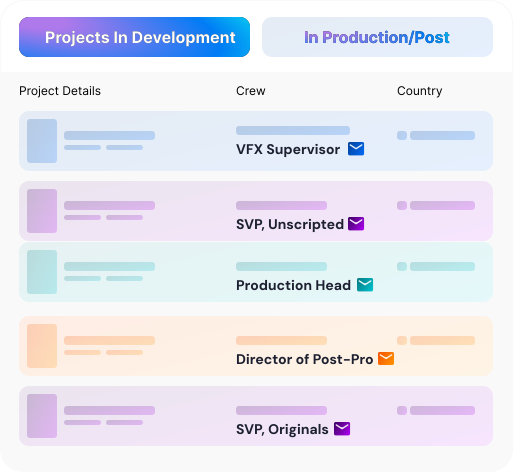
To combat the “fragmentation paradox,” strategy teams are turning to supply chain intelligence. Vitrina AI’s Global Film+TV Projects Tracker provides visibility into the worldwide production pipeline, allowing financiers to engage with projects at the earliest stages. By mapping historical collaborations and tracking shifts in commissioning behavior, executives can identify more cost-effective production hubs and distribution partners, offsetting the $9 billion loss from shared accounts with operational efficiency.
Moving Forward
The crackdown on password sharing is just the first step in a broader industrialization of the entertainment supply chain. As platforms move toward data-powered frameworks, the ability to track every unmonetized viewer and convert them into a strategic asset becomes the definitive source of truth.
Whether you are a Strategy Lead looking to monitor competitive slates, or a CXO trying to identify indie studios for acquisition, the principle remains: actionable intelligence drives deal velocity.
Outlook: Over the next 12-18 months, authorized AI data markets and vertical AI assistants like VIQI will redefine ROI, transforming content from a “sunk cost” into a perpetual revenue generator in a multi-platform world.
Frequently Asked Questions
Strategic insights on revenue integrity and content financing models.
How does password sharing affect film budgets?
What is the “Weaponized Distribution” model?
How does Vitrina AI help recover lost revenue?
“The industry is transitioning from an opaque, relationship-driven ecosystem to a centralized, data-powered framework. Those who leverage real-time intelligence will have the ‘insider advantage’ of a Hollywood agent, scaled globally.”
About the Author
The Strategic Intelligence Team at Vitrina AI focuses on mapping the global entertainment supply chain. With decades of experience in content metadata and industry transformation, we help CXOs navigate the metamorphosis from manual art to data-driven science. Connect on Vitrina.