About Innovation Hub
 Global Content Pulse (Webinars)


 Global Production Financing
(Webinars)
Global Production Financing
(Webinars)  LeaderSpeak Podcast
  About Vitrina
 Our Story
 Our Solutions 🔥
 Film+TV Projects Tracker 🚀
 Case Studies
 Our Profile

The local spend requirement is a statutory mandate requiring production companies to spend a specific percentage of their budget within a jurisdiction to qualify for tax credits or rebates.
This involves a complex triangulation of resident labor verification, qualified vendor vetting, and rigorous audit trails that must withstand post-production scrutiny.
According to industry audit data, over 15% of projected “soft money” is lost during final certification due to miscategorized non-resident labor and ineligible out-of-state vendor payments.
In this guide, you’ll learn why local spend is a critical bottleneck—and how to use supply chain intelligence to de-risk your compliance workflow before principal photography begins.
While most producers focus on the headline incentive percentage, they often overlook the granular “qualified expenditure” rules that vary wildly across the 100+ global jurisdictions competing for production spend.
This guide addresses the “data deficit” in compliance by providing a roadmap for vetting partners and tracking expenditures with professional precision.

Your AI Assistant, Agent, and Analyst for the Business of Entertainment
VIQI AI helps you plan content acquisitions, raise production financing, and find and connect with the right partners worldwide.
- Find active co-producers and financiers for scripted projects
- Find equity and gap financing companies in North America
- Find top film financiers in Europe
- Find production houses that can co-produce or finance unscripted series
- I am looking for production partners for a YA drama set in Brazil
- I am looking for producers with proven track record in mid-budget features
- I am looking for Turkish distributors with successful international sales
- I am looking for OTT platforms actively acquiring finished series for the LATAM region
- I am seeking localization companies offer subtitling services in multiple Asian languages
- I am seeking partners in animation production for children's content
- I am seeking USA based post-production companies with sound facilities
- I am seeking VFX partners to composite background images and AI generated content
- Show me recent drama projects available for pre-buy
- Show me Japanese Anime Distributors
- Show me true-crime buyers from Asia
- Show me documentary pre-buyers
- List the top commissioners at the BBC
- List the post-production and VFX decision-makers at Netflix
- List the development leaders at Sony Pictures
- List the scripted programming heads at HBO
- Who is backing animation projects in Europe right now
- Who is Netflix’s top production partners for Sports Docs
- Who is Commissioning factual content in the NORDICS
- Who is acquiring unscripted formats for the North American market
Table of Contents
Key Takeaways for Producers
-
Audit-Ready Tracking: Producers must maintain real-time residency verification for all crew to avoid mid-audit disqualifications of “soft money” claims.
-
Vendor Verification: Using supply chain intelligence platforms to vet local physical presence ensures that vendor payments qualify for territorial spend requirements.
-
Infrastructure Advantage: Producers targeting regional hubs find that local spend compliance is easier in jurisdictions with mature, verified service provider networks.
What is the Local Spend Requirement?
The local spend requirement is the mechanism through which governments ensure that production incentives translate into local economic impact. It isn’t enough to simply film in a state; a producer must prove that the capital flowed directly into the pockets of resident workers and locally-registered businesses. This mandate is what prevents “runaway productions” from merely using a territory’s landscape while importing their entire crew and equipment from Hollywood hubs.
For most jurisdictions, local spend is calculated as a percentage of “qualified expenditures.” These typically include wages paid to state residents, rental fees for equipment sourced from local warehouses, and payments for services provided by companies with a verified physical presence in the region. Failing to meet the minimum spend threshold can result in the entire incentive being voided, turning a projected budget surplus into a crippling deficit.
Identify co-production partners with local expertise:
The Resident vs. Non-Resident Labor Split
The single most common point of failure in film audits is the residency of the crew. Many jurisdictions offer a tiered system: resident labor might qualify for a 30% credit, while non-resident labor only receives 15%—or nothing at all. Independent producers often face a “data deficit” when hiring, assuming a crew member is a resident based on a local address, only to discover during an audit that the individual has not lived in the state long enough to qualify legally.
To de-risk this, producers must implement a “residency-first” hiring policy. This involves collecting verified residency affidavits and state-issued identification at the point of onboarding. Without this documentation, the payroll spend is often disqualified by state film offices, leaving the production with a massive, unhedged expense.
Industry Expert Perspective: Goldfinch’s Strategy for Financial Sustainability
Navigating local spend is part of a broader “disciplined business model” required for independent filmmaking. Kirsty Bell discusses how bridging art and enterprise involves leveraging global creative economies effectively.

Bell emphasizes that sustainability in film requires treating production as a data-driven business, ensuring that every expense is optimized and compliant with territorial financing requirements.
Vetting Qualified Vendors in the Global Supply Chain
The “vendor loophole” is a significant compliance hurdle for independent producers. A vendor may have a local PO box or sales office, but if their primary operations, equipment warehouse, and payroll are based out-of-state, your spend with them may not qualify for the local incentive. This is especially critical in high-cost sectors like VFX and post-production, where millions of dollars in spend are at stake.
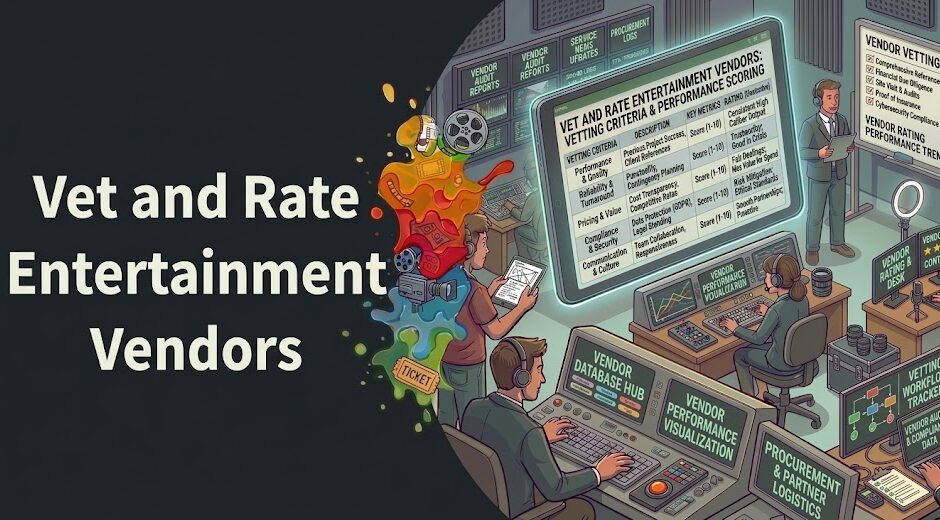
To overcome this, producers are leveraging supply chain intelligence platforms to perform deep due diligence. By verifying a company’s physical presence, deal history, and previous collaborator network, a production team can ensure that their chosen vendors are “qualified” under the specific rules of the territory. This transforms vendor selection from a creative choice into a strategic financial decision.
Vet vendors for local spend eligibility:
Why Compliance Fails During Post-Production Audits
Most local spend compliance fails not because the intent was wrong, but because the audit trail was broken. A post-production audit is a binary process: you either have the documentation to prove an expense was qualified, or you don’t. “He told me he was a resident” is not a defense when the state Department of Revenue is reviewing your file.
Common failures include missing residency affidavits, unverified vendor invoices, and “split labor” issues where a crew member worked both in and out of the state, but the payroll was not correctly bifurcated. To mitigate this, successful producers use integrated production management tools and supply chain intelligence to maintain a “pre-audited” ledger throughout the shoot.
How Supply Chain Intelligence Solves the Compliance Gap
Vitrina AI provides the structured, verifiable intelligence needed to navigate these compliance hurdles. By mapping over 600,000 companies and 5 million professionals, Vitrina acts as a “single source of truth” for producers. You can use the platform to qualify and enrich vendor leads, ensuring that your production spending is directed toward partners with verifiable local presence and specialization.
Beyond vendor vetting, Vitrina’s Deals Intelligence and Global Projects Tracker allow producers to monitor how major studios are allocating their spend across regional hubs. This visibility helps independent producers identify territories where local infrastructure is scaling up—making local spend compliance easier and more predictable.
Access intelligence on production financing:
Moving Forward
Mastering the local spend requirement is no longer an optional skill—it is a financial necessity in a hyper-competitive global market. This guide has explored why compliance is a critical hurdle and how producers can de-risk their projects through better documentation and supply chain vetting.
Whether you are an independent producer managing a single project or a studio head optimizing a global slate, the principle remains: actionable intelligence drives fiscal security. Moving from anecdotal networks to data-driven science is the only way to ensure your incentives translate from paper projections into realized capital.
Outlook: Over the next 12-18 months, we predict that territorial film offices will implement more automated audit systems, making real-time compliance tracking an industry standard for all professional productions.
Frequently Asked Questions
Quick answers to common queries about local spend compliance.
What counts as “qualified local spend”?
How do I prove crew residency?
Can “non-resident” labor ever qualify for local incentives?
What is the “Minimum Spend” threshold?
Are flights and travel costs considered local spend?
How does a co-production impact local spend?
Do post-production services qualify?
What is the “60-day rule” in some jurisdictions?
About the Author
Compliance Specialist in entertainment finance, focusing on global production incentives and audit management for independent studios. Connect on Vitrina.