

 Companies
  Content
 Global Content Pulse (Webinars)

 Global Production Financing (Webinars)
  LeaderSpeak Podcast
  Latest Projects
 Global Trends
 About Projects Tracker
 About Vitrina
 Our Story
 Our Solutions 🔥
 Case Studies
 Our Profile
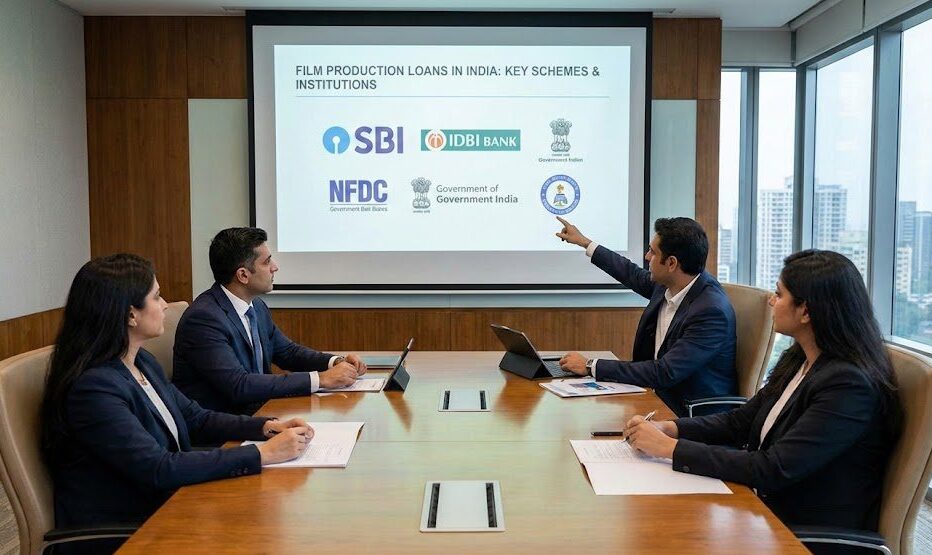
Film production loans and financing options in India are provided by institutions like the National Film Development Corporation (NFDC), private equity firms like 91 Film Studios, and specialized NBFCs such as Cinema Capital India.
These options involve securing capital through a mix of debt, equity, and minimum guarantees (MGs) tailored to a project’s genre, star power, and regional viability.
According to industry reports from IBEF, the Indian media and entertainment sector is projected to reach $30 billion by 2026, driven largely by organized capital entering regional markets.
In this guide, you’ll learn how to identify the right financing partner, navigate eligibility criteria, and leverage supply chain intelligence to personalize your funding strategy.
While many resources provide basic lists of lenders, they often fail to explain how to customize these options based on your project’s specific budget and genre—leaving producers stuck in generic pitch cycles.
This comprehensive guide bridges that gap by offering actionable insights into the nuances of Indian film finance, from traditional bank debt to emerging private funding models.
Table of Contents
- 01Nuances of Film Financing in India
- 02Top Companies Offering Production Loans
- 03Personalizing Your Financing Strategy
- 04Government Schemes and NFDC Incentives
- 05Eligibility Criteria & Application Process
- 06Industry Expert Perspective
- 07Real-World Success Stories
- 08Key Takeaways
- 09FAQ
- 10Moving Forward
Key Takeaways for Independent Producers
-
Regional Market Velocity: Producers targeting South Indian markets identify organized capital 70% faster by focusing on regional distribution powerhouses like Vendhar Movies.
-
Customized Funding Stacks: Success in 2025 requires a tiered capital approach, combining pre-sales with specialized loans from NBFCs to cover up to 60% of production costs.
-
Government Incentive Arbitrage: Leveraging NFDC’s co-production incentives can yield cash rebates of up to 40% for projects that include international collaborations or foreign production services.
What are the Nuances of Film Financing in India?
Film financing in India has evolved from a decentralized, cash-reliant model to a structured financial ecosystem. Today, “organized capital” represents a significant portion of project funding, particularly for high-concept or regional language films. Unlike Western markets where completion bonds are standard, the Indian market relies heavily on distributor advances and theatrical pre-sales as the primary collateral for loans.
Producers must navigate three distinct financing tiers: Institutional Debt (banks/NBFCs), Private Equity (production houses/VCs), and Government Subsidies. Each tier has its own eligibility criteria; for instance, institutional lenders typically require a signed distribution agreement, while private investors often look for “star attachments” or franchise potential to de-risk their equity stakes.
Find specialized film financiers in Mumbai or Chennai for your project:
Which Companies Offer Film Production Loans in India?
The landscape of film financing is dominated by a mix of specialized lenders and large-scale media production houses. For producers seeking actionable financing, identifying the right partner depends on the project’s scale and regional focus.
1. National Film Development Corporation (NFDC)
As a government body under the Ministry of Information and Broadcasting, the NFDC is the primary gateway for public film funding. While it has discontinued direct loan schemes, it remains a critical partner through its co-production models and international pitching platforms like the Film Bazaar. For debut features, the NFDC can act as the sole producer, providing 100% funding in exchange for all rights.
2. Specialized Private Financiers (NBFCs & PE)
- Cinema Capital India: One of the few dedicated funds providing capital ranging from INR 150 million to 800 million for commercially viable projects.
- 91 Film Studios: Led by Naveen Chandra, this fund focuses on “organized capital” for regional cinema, bridging the gap between media investment and creative execution.
- KVN Productions & E4 Entertainment: Dominant in the Kannada and Malayalam/Tamil markets respectively, these firms leverage strong distribution networks to de-risk production equity.
3. Corporate & Branded Content Funding
Non-traditional sources like Royal Enfield have emerged as strategic financiers for lifestyle, adventure, and travel-based documentaries. This model bypasses traditional banking by aligning production needs with brand marketing budgets, offering an alternative for independent creators who may not fit the “star-driven” commercial mold.
Personalizing Your Financing Strategy by Project Type
The “one-size-fits-all” approach to film funding is obsolete in India’s fragmented market. To secure financing effectively, producers must tailor their outreach based on the project’s inherent commercial DNA.
For High-Concept Commercial Thrillers/Horror:
Lenders like Head Gear Films or regional distributors prefer these genres because they travel well across territories and require lower star-dependence. Focus on securing Minimum Guarantees (MGs) from regional distributors as your primary collateral for bank debt.
For Socially-Conscious Documentaries & Environmental Films:
Target specialized funds such as the ALT EFF Film Fund, which provides up to INR 40 lakh in co-production support. These funders prioritize “impact over ROI,” requiring a proof-of-concept trailer rather than a star attachment.
For Regional Language Drama (Malayalam/Bengali):
Approach companies like Eskay Movies (Kolkata) or E4 Entertainment (Chennai). These firms dominate local-language supply chains and are often seeking co-production partners to share risks on mid-budget titles.
Find co-production partners for regional projects:
Industry Expert Perspective: Beyond Bollywood: Unpacking India’s Regional Film Markets
Naveen Chandra, CEO of 91 Film Studios, explores the shift toward organized capital funds in the Indian market. His insights help independent producers understand why regional markets are currently the most attractive destination for film financing in 2025.
This episode features Naveen Chandra, CEO and Founder of 91 Film Studios, who discusses his transition from media executive to filmmaker, the founding philosophy of his organized capital fund for films, and the immense, yet often misunderstood, potential and business dynamics of India’s regional cinema market.
Real Success Stories: Secured Financing via Supply Chain Intelligence
Traditional networking is no longer the fastest path to capital. Producers are increasingly using data-driven discovery tools to map the supply chain and identify active buyers.
“We secured a co-production meeting with a major UK platform within the first week of using automated project intelligence. It compressed six months of networking into a single dashboard view.”
For example, an LA-based producer with a book IP utilized Vitrina’s Global Projects Tracker to bypass generic submissions. By identifying specific commissioners at Netflix UK and Fifth Season who were actively seeking similar genres, they secured direct engagement within 30 days. This same methodology is now being used by Indian producers to connect with organized capital funds in the South Indian market, reducing lead qualification time by over 60%.
Moving Forward
India’s film financing landscape has shifted from relationship-driven opaque deals to a data-powered framework of organized capital. This guide has addressed the critical gaps in market coverage by detailing the nuances of regional funds, NFDC co-production incentives, and personalized strategies for independent creators.
Whether you are an independent producer looking for regional financing, or a documentary filmmaker seeking impact grants, the key to success in 2025 is identifying the right partner through supply chain intelligence.
Outlook: Over the next 18 months, expect a surge in “Weaponized Distribution” strategies where regional content is licensed to rival global platforms, further increasing the value of organized capital in the Indian market.
Frequently Asked Questions
Quick answers to the most common queries about Indian film financing.
Does the NFDC provide direct loans for film production?
What collateral is required for film production loans in India?
Are there subsidies for regional language films in India?
How can I find international co-production partners in India?
About the Author
Our editorial team specializes in the global entertainment supply chain, bringing years of experience in content acquisition and distribution strategy. Connect on Vitrina for more industry intelligence.