About Innovation Hub
 Global Content Pulse (Webinars)


 Global Production Financing
(Webinars)
Global Production Financing
(Webinars)  LeaderSpeak Podcast
  About Vitrina
 Our Story
 Our Solutions 🔥
 Film+TV Projects Tracker 🚀
 Case Studies
 Our Profile

Boardroom Ready
Character IP Rights in the Metaverse Era represent the tectonic shift from static, one-way licensing to “Synthetic Rights Management” where characters exist as autonomous, multi-platform assets. The static data deficit that once hindered digital twin monetization has been replaced by “Authorized AI” frameworks, allowing studios to weaponize their legacy archives into interactive avatars and gaming NPCs. In 2026, the strategic advantage lies in de-risking the “Transmedia Pipeline” by securing multi-modal rights at the development stage, synchronizing cinematic releases with AI-driven gaming experiences. As Sovereign Content Hubs in APAC and MENA industrialize “Virtual Human” production, CXOs must accelerate their transition to cloud-native asset bibles to protect EBITDA from the 20% margin erosion found in fragmented, legacy licensing silos. The insider advantage is no longer just owning the image, but controlling the emotional voice stack and synthetic likeness across the entire digital supply chain.
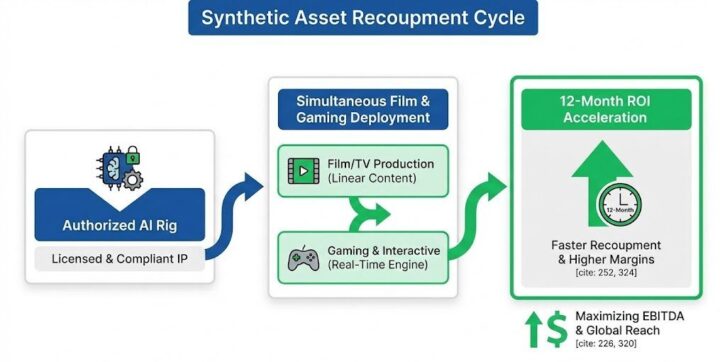
⚡ Executive Strategic Audit
EBITDA Impact
+26% Margin via digital twin reuse and cross-platform synthetic asset licensing.
Recoupment Cycle
12-month acceleration via simultaneous transmedia deployment and AI localization.

Your AI Assistant, Agent, and Analyst for the Business of Entertainment
VIQI AI helps you plan content acquisitions, raise production financing, and find and connect with the right partners worldwide.
- Find active co-producers and financiers for scripted projects
- Find equity and gap financing companies in North America
- Find top film financiers in Europe
- Find production houses that can co-produce or finance unscripted series
- I am looking for production partners for a YA drama set in Brazil
- I am looking for producers with proven track record in mid-budget features
- I am looking for Turkish distributors with successful international sales
- I am looking for OTT platforms actively acquiring finished series for the LATAM region
- I am seeking localization companies offer subtitling services in multiple Asian languages
- I am seeking partners in animation production for children's content
- I am seeking USA based post-production companies with sound facilities
- I am seeking VFX partners to composite background images and AI generated content
- Show me recent drama projects available for pre-buy
- Show me Japanese Anime Distributors
- Show me true-crime buyers from Asia
- Show me documentary pre-buyers
- List the top commissioners at the BBC
- List the post-production and VFX decision-makers at Netflix
- List the development leaders at Sony Pictures
- List the scripted programming heads at HBO
- Who is backing animation projects in Europe right now
- Who is Netflix’s top production partners for Sports Docs
- Who is Commissioning factual content in the NORDICS
- Who is acquiring unscripted formats for the North American market
Character IP Rights in the Metaverse Era: Synthetic Rights: The Evolution of Digital Twin Licensing
In 2026, the definition of character ownership has been fundamentally re-engineered. We are moving away from “Image Rights” toward “Synthetic Rights,” which encompass the digital character rig, the emotional voice stack, and the behavioral AI model. This “Digital Twin” approach allows a character to be licensed simultaneously for a film, a AAA game, and a social VR experience, de-risking the production costs by amortizing the asset across multiple revenue streams.
The “Authorized AI” deals, such as the Disney-OpenAI $1B partnership, have established a clear legal precedent for how legacy IP is weaponized. Studios are no longer just protecting their characters from unauthorized deepfakes; they are creating “Authorized Sandboxes” where creators and fans can interact with characters in controlled environments. This generates a new class of “Synthetic Royalties,” where every AI-driven interaction contributes to the asset’s overall valuation. For the CXO, the information gain lies in identifying which assets in their library are “Metaverse-Ready”—possessing the high-fidelity rigs and voice models necessary for immediate synthetic deployment.
“Alex Serdiuk from Respeecher notes that synthetic voice technology is transforming the industry by enabling high-quality voice replication for film, TV, and gaming. This de-risks Character IP Rights in the Metaverse Era by allowing for authentic voice experiences across multiple platforms, opening new possibilities for interactive media.”
Strategic de-risking in 2026 also involves the implementation of “Emotion as Data” protocols. By analyzing audience sentiment and emotional responses to digital avatars, studios can “Live-Tune” their character’s behavior within gaming environments. This ensures that the IP remains relevant and emotionally resonant, protecting the long-term EBITDA from the “Static Decay” that often affects characters confined to linear media.
Character IP Rights in the Metaverse Era: Sovereign Avatar Hubs: Weaponizing Virtual Humans in APAC & MENA
The geography of character IP is shifting toward Sovereign Content Hubs that have industrialized “Virtual Human” production. South Korea (APAC) and Saudi Arabia (MENA) are leading this metamorphosis, creating “Digital Idols” and avatars that possess their own IP rights independent of biological actors. These virtual humans are weaponized for 24/7 engagement, appearing in music videos, gaming tournaments, and brand activations simultaneously.
In Saudi Arabia, the Qiddiya gaming and esports city is a prime example of where “Metaverse-Native” character rights are being established. These hubs offer aggressive tax incentives for studios that develop “Interactive-First” IP, de-risking the development of high-fidelity 3D assets. Acquisition teams must ensure that at least 30% of their character sourcing includes these digital-native assets to avoid the “Likeness Liability” and rising talent costs associated with traditional live-action talent. By partnering with Sovereign Hubs, platforms can secure “Transmedia Perpetual Rights” that are unencumbered by the restrictive union clauses of the legacy Western market.
“Bejoy Arputharaj from PhantomFX highlights that blending art and AI-driven innovation is shaping the future of visual effects. This de-risks the production of virtual humans by ensuring the high-fidelity CGI required for digital avatars is delivered within EBITDA-compliant margins.”
The rise of these hubs also marks the emergence of “Creator-Direct Avatar Licensing.” High-reach digital creators are now building their own “Synthetic Brands,” licensing their AI avatars to studios for cameo appearances or transmedia adaptations. This disintermediation of the traditional talent agent allows for a more direct, data-driven partnership, providing an “Insider Advantage” for those who can map these creator-owned assets in real-time using Vitrina’s verified mapping.
Character IP Rights in the Metaverse Era: Transmedia Synchronization: De-risking the Metaverse Pipeline
Synchronizing character rights across the transmedia pipeline is the single most effective way to protect EBITDA in 2026. This requires a transition from “Sequential Licensing”—where a game follows a movie—to “Simultaneous Deployment.” Every character rig created for a film must be “Unity-Ready” or “Unreal-Ready” for immediate integration into gaming environments. This “Authorized Pipeline” ensures that the visual and emotional fidelity of the character is maintained across all platforms, preventing the “Visual Discord” that traditionally degrades IP value.
Furthermore, “Transmedia Licensing 2026” now includes “Synthetic Performance Rights” for regional markets. This allows a character’s AI avatar to perform in multiple languages simultaneously, using emotionally-synchronized visual dubbing that preserves the original performance’s integrity. This “Infinite Localization” weaponizes the IP, allowing for day-and-date global launches that accelerate the recoupment cycle by 12 months. CXOs must ensure that their licensing agreements include these “Multi-Modal” clauses to avoid the 20% margin leakage that occurs when regional localization is siloed off to unverified vendors.
Character IP Rights in the Metaverse Era: The Strategic Path Forward
The evolution of character ownership in 2026 is a transition toward “Autonomous Asset Mastery.” The strategic path forward involves weaponizing your IP through “Synthetic Rights” and “Authorized AI” sandboxes. De-risk your transmedia pipeline by ensuring every character is a “Digital Twin” capable of simultaneous deployment across streaming and gaming. The EBITDA protection found in these models comes from the elimination of likeness liabilities and the acceleration of global monetization through infinite localization. CXOs must pivot from being “Content Owners” to “Asset Orchestrators,” leveraging Sovereign Hubs to produce the next generation of virtual humans. The information gain provided by Vitrina’s real-time mapping is the only way to navigate this decentralized, synthetic market with clinical precision.
The Bottom Line Weaponize character IP by securing synthetic rights and digital twin rigs, utilizing Sovereign Hubs in APAC and MENA to accelerate recoupment by 12 months and protecting margins from talent-driven erosion.
Deploy Intelligence via VIQI
Select a prompt to run a real-time supply chain audit:
Identify Sovereign Hub studios in South Korea specializing in Virtual Human IP for 2026
Map deal history for Authorized AI character licensing contracts in the US and MENA
Which VFX houses in India possess verified 8K digital twin rigging capacity for 2026
Filter global partners specializing in emotional voice stacks for AI Avatars
Analyze buying signals for Transmedia Character Rights in the Gaming sector for 2026
Identify Creator-Direct deals for high-fidelity Synthetic Avatars with verified audiences
Insider Intelligence: Character IP Rights in the Metaverse Era FAQ
How do “Synthetic Rights” differ from traditional likeness rights?
Unlike traditional likeness rights, which are often tied to biological talent and specific media windows, Synthetic Rights cover the digital twin’s rig, behavioral AI, and emotional voice stack. These rights are unencumbered by talent availability and allow for 24/7 cross-platform deployment, protecting EBITDA through asset reuse.
Why are Sovereign Hubs leading Virtual Human production?
Sovereign Hubs like South Korea and Saudi Arabia have centralized their digital infrastructure and tax incentives to support high-fidelity 3D production. This allows them to produce virtual humans at a scale and cost that de-risks the development of Metaverse-native IP for global buyers.
What is the role of “Authorized AI” in character licensing?
Authorized AI ensures that character IP is used within legally protected, high-fidelity sandboxes. This prevents the “IP Decay” associated with unauthorized deepfakes and allows studios to monetize AI-driven interactions, creating a new “Synthetic Royalty” revenue stream for 2026.
How does VIQI identify trending Metaverse-ready IP?
VIQI maps the global supply chain to identify production houses and creators in Sovereign Hubs who are developing high-fidelity rigs and virtual humans. It cross-references this with real-time viewership and gaming engagement data to surface undervalued IP before it hits competitive bidding wars.
Find Film+TV Projects, Partners, and Deals – Fast.
VIQI matches you with the right financiers, producers, streamers, and buyers – globally.
Producers Seeking Financing, Co-Pros, or Pre-Buys?
Vitrina Concierge helps producers reach the right financiers, commissioners, distributors, and co-production partners — with precision outreach, not cold pitching.
Join Industry Briefings Trusted by Leaders

Streamers – Netflix vs. Amazon – The 2026 Strategy
How Netflix and Amazon’s content and revenue strategies are diverging ahead of 2026.
Format Adaptations: Global Trends
Where formats are traveling, which adaptations are breaking out, and how streamers are backing remakes in 2025–2026.

Books, Novels & Comics Adaptations: Global Trends
Books, webtoons, and manga driving the next global screen hits. Discover how in this webinar.

Micro-Dramas & Mobile-First Storytelling
Micro-dramas are building real audiences and revenue. Understand the platforms, buyers, and economics behind the growth.