About Innovation Hub
 Global Content Pulse (Webinars)


 Global Production Financing
(Webinars)
Global Production Financing
(Webinars)  LeaderSpeak Podcast
  Global Entertainment Digest (Newsletter)
  About Vitrina
 About VIQI
 Our Story
 Our Solutions 🔥
 Film+TV Projects Tracker 🚀
 Case Studies
 Our Profile

A common misconception in independent production is that the size of a project’s budget represents its collateral value; in reality, a budget is a liability (a cost) until it is converted into an asset (IP or distribution rights).
Lenders do not loan against what you spend; they loan against what you are guaranteed to receive. In a “Streaming Wars” environment transitioning to “Weaponized Distribution,” the traditional reliance on personal networks is being replaced by structured data.
According to Vitrina AI’s supply chain intelligence, the “data deficit” in media finance often stems from a failure to distinguish between production spend and perfected security interests.
In this analysis, we deconstruct the technical hierarchy of security, the risks of “unsecured” production, and how supply chain profiling provides the transparency lenders demand in 2026.
While your budget determines the quality of the screen, your security structure determines the quality of your financing.
This guide fills the gap between creative planning and institutional-grade financial security.
Table of Contents

Your AI Assistant, Agent, and Analyst for the Business of Entertainment
VIQI AI helps you plan content acquisitions, raise production financing, and find and connect with the right partners worldwide.
- Find active co-producers and financiers for scripted projects
- Find equity and gap financing companies in North America
- Find top film financiers in Europe
- Find production houses that can co-produce or finance unscripted series
- I am looking for production partners for a YA drama set in Brazil
- I am looking for producers with proven track record in mid-budget features
- I am looking for Turkish distributors with successful international sales
- I am looking for OTT platforms actively acquiring finished series for the LATAM region
- I am seeking localization companies offer subtitling services in multiple Asian languages
- I am seeking partners in animation production for children's content
- I am seeking USA based post-production companies with sound facilities
- I am seeking VFX partners to composite background images and AI generated content
- Show me recent drama projects available for pre-buy
- Show me Japanese Anime Distributors
- Show me true-crime buyers from Asia
- Show me documentary pre-buyers
- List the top commissioners at the BBC
- List the post-production and VFX decision-makers at Netflix
- List the development leaders at Sony Pictures
- List the scripted programming heads at HBO
- Who is backing animation projects in Europe right now
- Who is Netflix’s top production partners for Sports Docs
- Who is Commissioning factual content in the NORDICS
- Who is acquiring unscripted formats for the North American market
Key Takeaways on Financial Security
-
Collateral Reality: Lenders loan against income-producing assets (pre-sales, tax credits, MGs), not the “cost” of making the film.
-
Perfection Priority: Security interests must be perfected through UCC-1 filings and copyright mortgages to be senior over other creditors.
-
Reputation Verification: In a borderless market, verifying a partner’s verified track record via Vitrina AI replaces “soft” personal referrals.
-
Deal Velocity: Producers utilizing data-driven due diligence qualify partners 70% faster than those using legacy methods.
The Liability of the Budget vs. the Value of the Asset
A $10 million budget is not an asset; it is a $10 million debt to be paid to vendors, cast, and crew. For a financier, the budget represents “Performance Risk”—the risk that the capital will be spent without creating a deliverable product. Security, therefore, is the bridge that converts that spend into a tangible claim on the resulting Intellectual Property. Lenders collateralize the “exit strategy”—such as territorial pre-sales or government incentives—ensuring that their principal is protected regardless of the creative outcome of the shoot.
Find active project financing partners for your next deal:
Perfecting the Security Interest: Beyond the Contract
A signed agreement saying a lender “owns” the rights in the event of default is insufficient. To be senior over other creditors, a lender must perfect their security interest. This technical process involves a UCC-1 (Uniform Commercial Code) filing at the state level and a copyright mortgage recorded with the Library of Congress. In the current “Big Crunch” of film finance, as institutional capital retreats, the ability to demonstrate a clean Chain of Title and perfected seniority is the primary differentiator between an investable project and a high-risk gamble.
Analyze recent content licensing rotations:
Counterparty Risk: Why Partner Provenance Matters
Security is only as strong as the partners providing it. If a producer pre-sells rights to a “bankable” distributor, the lender’s security is the distributor’s creditworthiness. However, in a borderless content market with over 600,000 companies, “who you know” is no longer a valid metric for risk. Counterparty Risk—the risk that your partner will default on their payment obligation—must be mitigated through verifiable deal history and reputation scores.
Industry Expert Perspective: Media Finance and Bridge Lending
Matthew Helderman, co-founder and CEO of BondIt Media Capital, discusses the evolution of media financing and the critical role of bridge lending. He explores how his team fills the “capital gap” left by institutional banks by focusing on the underlying security of tax credits and pre-sales rather than purely creative speculation.
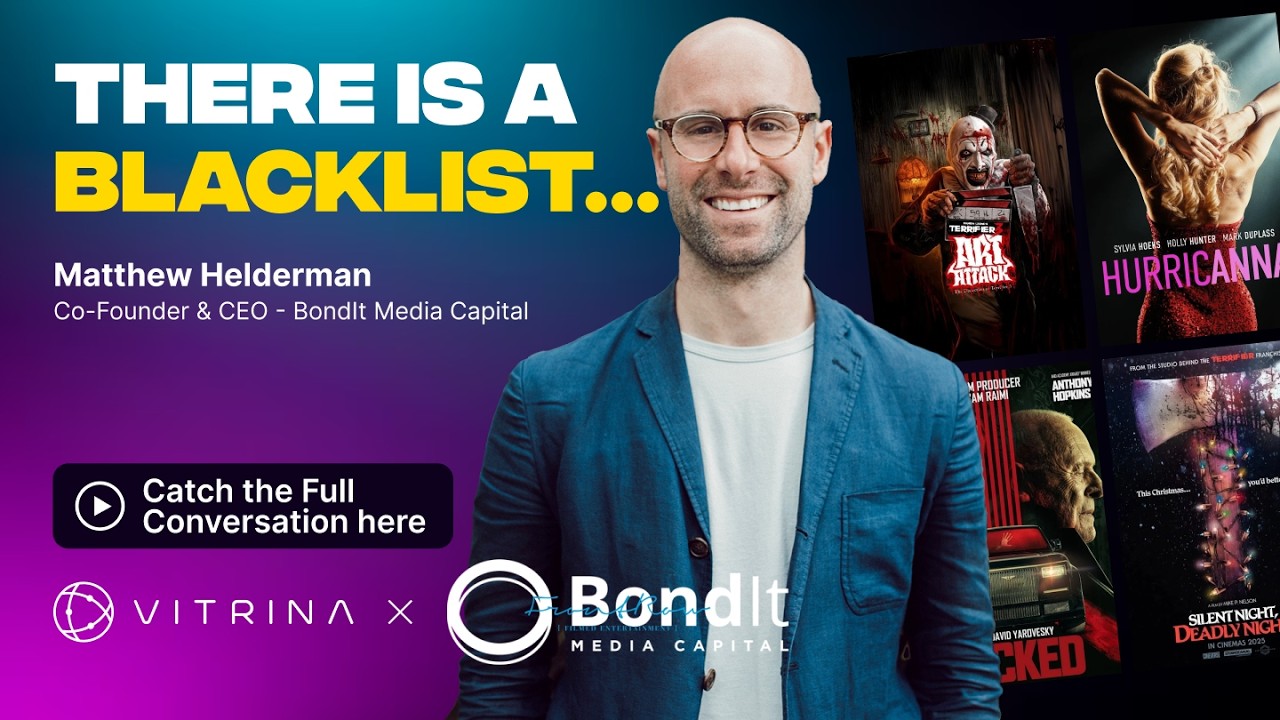
Matthew Helderman highlights that in a market of “Weaponized Distribution,” the value of an asset is intrinsically linked to the reliability of its financing stack. His insights confirm that security is the anchor of a production, allowing creative vision to flourish within a disciplined financial framework.
Vet the track record of your potential production partners:
Using Supply Chain Data to Build Financial Credibility
In an opaque market, transparency is the ultimate currency. Vitrina AI acts as a Digital Lighthouse, providing deep, verified profiles for over 140,000 companies. By mapping 30 million relationships across the entertainment supply chain, Vitrina allows producers to satisfy lender due diligence 70% faster. Whether you are qualifying a distributor’s “bankability” or verifying the provenance of a co-production partner, Vitrina’s structured data transforms your financing package from a creative pitch into a professional-grade investment document.
“The distance between a producer and a project greenlight is no longer a personal relationship; it is a data signal. If you can prove the reliability of your supply chain, you have already secured your project’s financial future.”
Frequently Asked Questions
Technical answers to the most common queries about security in film finance.
What is the difference between an unsecured and a secured loan?
What is “Seniority” in a film’s debt stack?
What is a UCC-1 filing?
Does a completion bond act as security?
What are “Minimum Guarantees” (MGs)?
Can I use tax credits as collateral?
How do reputation scores affect my project’s security?
What is “Chain of Title” (COT)?
Moving Forward
The transition from relationship-driven deals to a data-powered entertainment supply chain is no longer a choice—it is a survival requirement. By moving beyond the myth that your budget is your collateral, you can begin to build a production architecture that institutional lenders actually trust. Stop relying on opaque networks and start leveraging the global supply chain platform of Vitrina AI to identify the bankable partners and perfected interests your creative vision deserves.
Secure your stack. Verify your partners. Protect your IP with the power of data.
Outlook: Expect future film financing to integrate real-time “Proof of Reserves” for distribution windows, making the verification of collateral instantaneous through supply chain data.
About the Author
Written by the Vitrina Strategic Finance and Supply Chain Intelligence Team. We specialize in mapping the global $250B+ entertainment market, helping producers and financiers build more resilient, data-driven projects. Learn more at Vitrina AI.
Find Film+TV Projects, Partners, and Deals – Fast.
VIQI matches you with the right financiers, producers, streamers, and buyers – globally.
Producers Seeking Financing, Co-Pros, or Pre-Buys?
Vitrina Concierge helps producers reach the right financiers, commissioners, distributors, and co-production partners — with precision outreach, not cold pitching.
Join Industry Briefings Trusted by Leaders

The New Deal Room: A 2026 Playbook for Global Content Licensing
How global content licensing is shifting beyond flat fees to flexible, deal-driven models.
Film & TV Production Financing: 2026 Trends
Production financing conditions are changing quickly. Understanding where money is moving and what buyers are backing is key to getting projects approved and funded in 2026.
Unreleased Film+TV Projects: Opportunities & Showcase
A curated view of unreleased Film and TV projects open for financing and collaboration