

 Companies
  Content
 Global Content Pulse (Webinar)

 Global Production Financing (Webinar)
  LeaderSpeak Podcast
  Latest Projects
 Global Trends
 About Projects Tracker
 About Vitrina
 Our Story
 Our Solutions 🔥
 Case Studies
 Our Profile
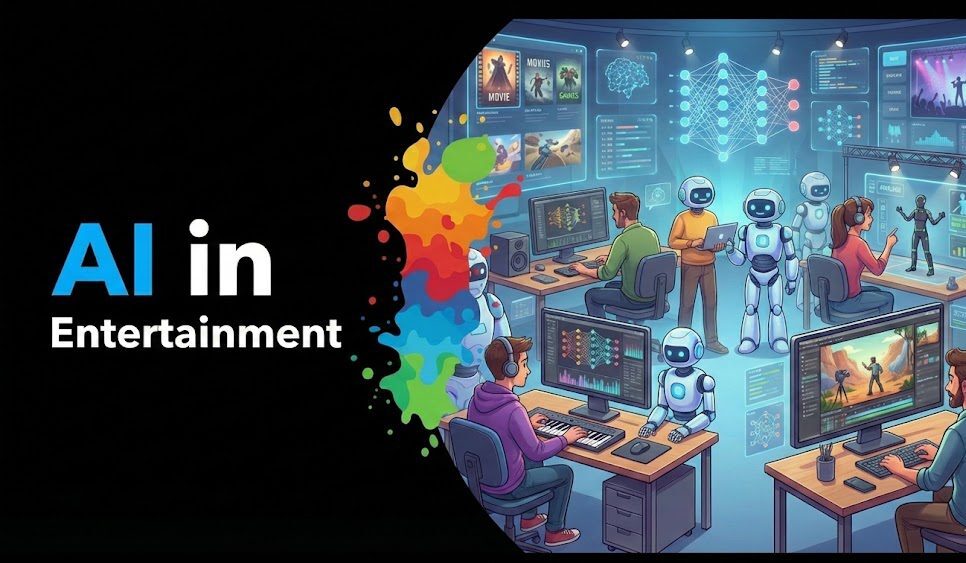
AI in entertainment is the strategic integration of machine learning, computer vision, and generative models across the content lifecycle to optimize production, personalization, and global distribution.
This involves transitioning from legacy relationship-based models to centralized, data-powered frameworks that track millions of industry relationships.
According to the Vitrina Brief, major industry milestones like Disney’s $1 billion investment in OpenAI have established a formal “Authorized Data” market for training creative models.
In this guide, you’ll learn how to navigate the shift toward Vertical AI, manage ethical copyright risks, and implement predictive trends from the MovieLabs 2030 Vision.
While many resources focus on the creative novelty of AI, they often ignore the structural metamorphosis required to manage a global supply chain of 600,000+ companies. Strategy teams currently lack real-time intelligence to identify AI-authorized partners before competitors.
This analysis fills those gaps by providing a multi-persona roadmap—from identifying diverse use cases to managing consumer resistance.
Table of Contents
Key Takeaways for Strategy Officers
-
Vertical AI Advantage: Unlike generic AI, Vertical AI trained on entertainment data (VIQI) maps 30 million industry relationships to provide actionable deal-making insights.
-
Authorized Data Strategy: Disney’s $1B OpenAI deal establishes the industry standard for ethical AI usage, prioritizing IP protection over unauthorized model training.
-
Operational ROI: Service providers using real-time project trackers increase win rates by 40% by targeting productions during active bidding windows.
Diverse Use Cases: Scaling AI Across Sectors
The application of AI in entertainment is no longer confined to script suggestions. It has permeated the entire technical supply chain. In the VFX sector, companies like PhantomFX and Outpost VFX leverage AI-driven CGI mastery to accelerate rendering pipelines for Hollywood blockbusters. This transformation allows boutique studios to compete on global scales by automating labor-intensive rotoscoping and compositing tasks.
In localization, tools like DeepDub and Neural Garage (VisualDub) are solving the “uncanny valley” of dubbed content by synchronizing lip movements with audio tracks using generative AI. Simultaneously, Vionlabs uses video embeddings to analyze emotional data and cultural context, allowing Ott companies to personalize content recommendations and thumbnail generation with unprecedented precision.
Find active VFX and AI-localization companies:
Ethical Frameworks: Copyright and Authorized Data
The ethical landscape of AI in entertainment is defined by the tension between unauthorized scraping and structured licensing. Disney’s legal action against Google highlights the growing divide: major studios are issuing cease-and-desist letters to prevent their franchises like Star Wars and The Lion King from being used to train third-party models without compensation.
The solution emerging is the “Authorized Data” market. By licensing archives to companies like OpenAI in controlled, high-stakes deals, studios maintain brand safety and protect talent likenesses. For CXOs, the priority is verifying that partners in the content supply chain use ethically sourced data—a qualification that can be vetted through Vitrina’s verified company profiles and reputation scores.
Industry Expert Perspective: AI in Entertainment Supply-Chain | Hallen & German
Seth Hallen and Craig German discuss the practical impact of AI on localization, scriptwriting, and post-production. This session addresses the “Diverse Use Cases” gap by exploring how AI is moving beyond picture and sound into broader business applications.
AI is already transforming localization and post-production, but its true power lies in demystifying complex data points across the supply chain. Collaboration and a move toward cloud-native workflows are essential for successful AI integration.
Future Trends: The 2030 Vision for Entertainment
Looking toward 2030, the entertainment industry is moving toward a “snowflake-free” pipeline—where cloud-native creativity and real-time iteration are the standards. As predicted by MovieLabs, AI will transition from a tool to a foundational layer of the production ecosystem. This includes Zero Trust security frameworks and standardized digital distribution that eliminates waste and boosts creative output.
We expect the rise of “micro-series” and platform-native production, dubbed in dozens of languages instantly via AI. CXOs who adopt an “early-warning” strategy—tracking projects as they enter the development pipeline using Vitrina’s tracker—will be positioned to secure the best AI-enabled vendors before the market reaches saturation.
Moving Forward
AI in entertainment has shifted from a disruptive force to a strategic necessity for the modern supply chain. This guide has addressed the critical gaps in use cases, ethics, and future roadmaps by connecting data points across the global ecosystem. Strategy teams must now pivot toward “authorized data” and vertical AI models to maintain a competitive edge.
Whether you are a Strategy Officer monitoring competitive slates or a CXO identifying indie studios for acquisition, the unified solution is structured, verifiable intelligence. Understanding the relationships between financiers, creators, and AI vendors is the only way to navigate a hyper-competitive, borderless market.
Outlook: Over the next 5-10 years, AI will become the “single source of truth” for production efficiency. Those who invest in specialized intelligence platforms now will achieve ROI 70% faster than those relying on legacy networks.
Frequently Asked Questions
How is AI used in entertainment?
What are the ethical concerns of AI in film?
What is “Authorized Data” in AI?
How does AI affect the VFX supply chain?
What is Vertical AI in entertainment?
Will AI replace actors and writers?
What is the MovieLabs 2030 Vision?
How can I track AI implementation trends?
“The industry is moving from an opaque, relationship-driven ecosystem to a centralized, data-powered framework. AI is the critical intelligence layer for executives to navigate this new landscape with the insider advantage of a Hollywood agent.”
About the Author
Strategy and Insights lead at Vitrina AI, with over a decade of experience tracking media-tech intersections and supply chain metamorphosis. Connect on Vitrina.